Two ingredient pancakes
Direct answer for two ingredient pancakes
At Pancakes World, the clearest two-ingredient pancake is made from one large ripe banana and two large eggs. Blend or whisk them until smooth, then cook the batter as small, silver-dollar pancakes in a nonstick pan over medium-low heat. Use roughly one tablespoon of batter per pancake and turn each one only after the underside is set and the top is beginning to lose its wet shine. These are soft banana-and-egg pancakes, not a flour-based substitute for a tall diner stack. That distinction matters: two ingredients can make a useful pancake, but they cannot reproduce every job performed by flour, milk, fat, sugar, salt, and leavening in a conventional batter.
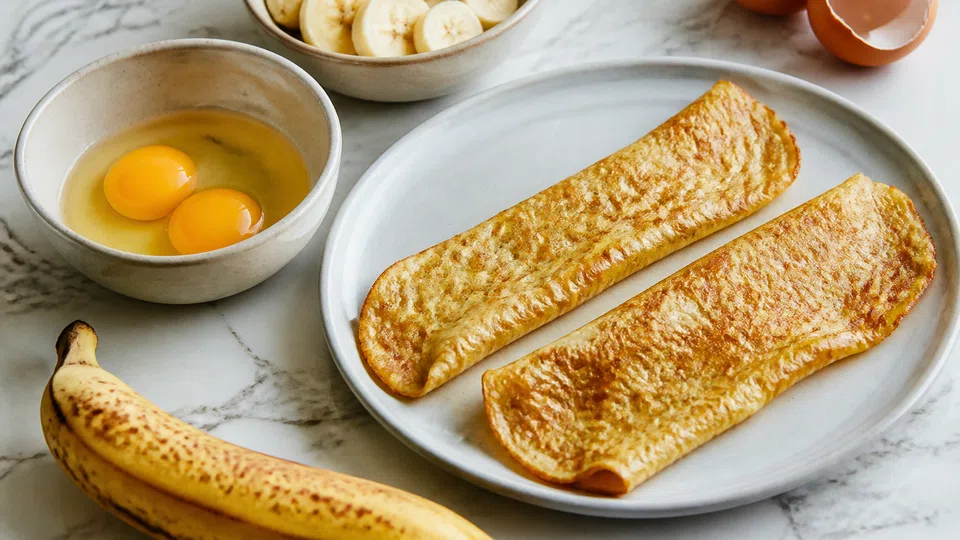
This formula and the small-pancake method follow a published Food Network Kitchen recipe. Pancake World has not represented it as a proprietary kitchen test. The practical guidance below explains what the two ingredients do, how to handle the loose batter, when another two-ingredient approach makes more sense, and where the two-ingredient promise stops being honest.
What “two ingredient pancakes” means
The phrase sounds self-explanatory, yet recipes count ingredients in inconsistent ways. A two-ingredient batter may still need oil or butter on the pan. A “just add water” mix contains many ingredients inside the packaged mix even though the cook adds only water. A banana-and-egg batter really does contain two foods, but optional cinnamon, syrup, cooking spray, or toppings take the finished plate beyond two. None of those conventions is automatically wrong; the useful move is to say which convention is being used.
On this page, two ingredient means two ingredients in the batter. Pan fat and toppings are disclosed separately rather than hidden. The main version uses banana and egg because a recognized culinary source supplies a complete ratio and method. It is naturally different from the three ingredient pancakes guide, which explains how flour, egg, and milk make a more conventional thin pancake. It is also different from flour and water pancakes, where the goal is an unleavened flour-and-liquid griddle cake rather than a sweet banana-and-egg cake.
That boundary prevents a common disappointment. Banana and eggs can set into small tender rounds, but there is no flour network to give them the chew and body of an American pancake, no chemical leavener to create a high rise, and no separate liquid to thin a batter that becomes overly thick. Their flavor is plainly banana and egg. Treating them as their own style makes the result easier to judge on its actual merits.
The ingredient count is not a nutrition or allergy claim. Eggs remain eggs; packaged mixes retain every ingredient and allergen named on their labels; pan fats and toppings still count for the person eating them even when they are excluded from a recipe headline. Anyone cooking for an allergy, intolerance, or medically restricted diet should use the actual package labels and qualified advice, not the number in a recipe title.
For the broader mechanics behind ratios, heat, and structure, see the Pancake Ingredients and Substitutions. This article owns the narrower question: how to choose and cook a credible pancake when the batter is limited to two named ingredients.
The reliable starting formula: banana and eggs
Food Network Kitchen publishes a version using one large banana and two large eggs. Its method blends the batter smooth, portions it by the tablespoon, and cooks the small pancakes for about one to two minutes per side over medium-low heat. The source also notes that butter may be needed when the pan is not nonstick. Those details are more important than the attractive “two ingredient” label: a loose, egg-rich batter is easier to manage in small portions and on moderate heat.
Ingredients for the batter
- 1 large ripe banana
- 2 large eggs
For the pan, use a sound nonstick skillet or griddle, or use the cooking fat appropriate to your regular pan. Pan fat is not silently counted as part of the two-ingredient batter. A wide, thin spatula is more useful than a heavy or blunt turner because these pancakes are delicate.
This article does not attach Recipe schema or claim an independent Pancake World test. The quantities and timed method are traceable to the culinary source listed at the end. The visual and sensory checkpoints are editorial cooking guidance for using that published method without pretending that every banana, egg, pan, and hob behaves identically.
Step-by-step method
- Prepare the pan before mixing. Place a nonstick skillet or griddle over medium-low heat. Starting moderately avoids the situation in which the first side colors while the egg-rich center is still fluid.
- Make a uniform batter. Peel the banana and combine it with the eggs. A blender gives the smooth method specified by Food Network Kitchen. If using a bowl, mash the banana very thoroughly before whisking in the eggs; expect small banana pieces and a less uniform pour.
- Cook one trial pancake. Drop about one tablespoon of batter onto the pan. Do not begin with a large ladleful. The first pancake checks the real pan temperature and shows how quickly this particular batter sets.
- Watch the whole pancake, not only a timer. The lower surface must be firm enough to release, the edge should look set, and the upper surface should be less liquid before the turn. If the bottom darkens while the top remains very wet, reduce the heat.
- Turn with full support. Slide a thin spatula well under the pancake and flip in one controlled motion. Trying to turn only from the edge can fold or tear the soft round.
- Cook the second side fully. The source method gives approximately one to two minutes per side, but use that as a range alongside the visible result. FDA guidance says foods containing eggs should be cooked thoroughly. Do not serve a center that is still wet with raw batter.
- Adjust only one variable. If the trial spreads too far, make the next portion smaller. If it colors too fast, lower the heat. If it sticks, address the pan surface or disclosed pan fat. Changing size, heat, and batter at once makes the trial uninformative.
- Serve promptly. Move finished pancakes to a clean plate that has not held raw egg or batter. Continue with small batches and avoid overcrowding the pan.
The finished pancake should be tender and easy to cut, with a banana-led taste and an egg-set structure. It will not have the dry, breadlike crumb of a flour pancake. A compact size is a method choice rather than decoration: it shortens the distance that the spatula must support and lets the center set before the underside becomes excessively dark.
A decision table for choosing the right pair
| What you actually want | Two batter ingredients | Expected result | Main constraint | Better route when the constraint is unacceptable |
|---|---|---|---|---|
| Small, soft, banana-forward pancakes | Ripe banana + eggs | Tender, moist rounds with clear banana and egg character | Delicate batter; not fluffy or breadlike | Flourless oat pancakes for more grain structure |
| A plain unleavened griddle cake | Flour + water | Chewy or firm flat cake, depending on hydration and thickness | No sweetness, fat, salt, or leavening in the batter | Three ingredient pancakes for a more conventional flour-egg-milk base |
| Fast preparation from a commercial product | Complete pancake mix + water, only when the package instructs it | Product-specific pancake | The mix contains more than one ingredient and instructions differ by product | Follow the exact label; do not transplant a generic ratio |
| A classic tall breakfast stack | No honest universal pair | Two ingredients cannot reliably cover flour structure, liquid, seasoning, fat, and leavening at once | The desired style conflicts with the ingredient limit | Use a full classic buttermilk pancake formula when available |
The table is a choice aid, not a ranking. The banana-and-egg formula answers the usual recipe intent directly. Flour and water answer a different food task. Complete mix and water answer a convenience task, but calling the package a single “ingredient” can obscure what is actually in it. A tall American stack is a sign that the two-ingredient limit may be the wrong priority.
Why banana and egg behave differently from ordinary pancake batter
In a conventional pancake, flour supplies most of the batter’s starch and structure. Liquid hydrates the flour. Eggs can contribute binding, fat and liquid; leavening can expand gas; sugar and salt can alter flavor; added fat can affect tenderness and the pan interface. Removing all but banana and eggs does not merely shorten a shopping list. It changes the physical system.
The banana thickens the mixture and supplies its dominant flavor. Ripeness changes softness and sweetness, so “one large banana” is still not a laboratory-standard quantity. The eggs provide the component that firms during cooking. Without flour, the batter has less of the support that makes a broad pancake easy to turn. That is why a tablespoon portion and a supported flip are sensible parts of the published method.
The eggs also explain the food-safety boundary. The batter should not be tasted raw, utensils and surfaces that touched raw egg should be washed, and the pancakes should be cooked through. The FDA advises keeping eggs refrigerated, washing hands and equipment after contact with raw egg, and cooking egg-containing foods thoroughly. This page does not replace local food-safety guidance, and appearance alone cannot provide a universal guarantee, but a plainly wet center is not a finished result.
Air introduced by blending may make the batter look foamy, but it does not turn this into a chemically leavened American pancake. Any foam can settle while the batter waits. Making the batter immediately before cooking and working in compact batches is therefore more coherent than blending it far ahead and expecting unchanged behavior.
Practical scenarios
Scenario 1: breakfast for one, with one pan
Use the published one-banana, two-egg batch and cook one tablespoon as a trial. If it releases cleanly and turns without folding, place several similarly sized portions in the pan while leaving room for the spatula. This is the most direct use case: a short ingredient list, immediate service, and no need to hold a large batch.
Do not pour the whole mixture as one pancake to save time. A pan-size banana omelet is much harder to turn and does not preserve the method that makes this batter manageable. Batch size and pancake size are separate decisions.
Scenario 2: the banana is very large or the batter spreads rapidly
The source ratio names ingredient units rather than gram weights, so normal produce variation remains. Start with a tablespoon portion. If it races outward into a thin irregular sheet, keep the next portion smaller and make sure the pan is already at moderate cooking heat. Do not “repair” the batter with unrecorded flour and continue calling it the same two-ingredient formula.
If you decide that structure matters more than the two-ingredient limit, make that change openly. The flourless oat pancakes route explains a grain-based option; it should not be smuggled into this recipe as a casual invisible fix.
Scenario 3: using a regular skillet rather than nonstick
Food Network Kitchen explicitly notes that butter may be needed with a regular skillet or griddle. That makes the plate a two-ingredient batter cooked with additional pan fat, not a literally two-item process. Disclose that distinction. Use enough appropriate fat to create the intended pan interface, and manage the heat so milk solids in butter do not darken before the batter sets.
If a “two foods only” restriction includes cooking fat, use suitable nonstick equipment in sound condition. Do not infer that every nonstick surface should be used without checking its manufacturer’s instructions.
Scenario 4: cooking for several people
The ratio can be multiplied arithmetically, but a larger bowl does not solve the service problem. These pancakes are small and cook in batches. Before scaling, count usable pan positions, estimate how many batches the published portion size creates, and decide whether people will eat in waves or whether finished pancakes will be held.
For a group breakfast, a more conventional batter or a make-ahead dish may be more practical. Ingredient minimalism is not automatically labor minimalism. If holding becomes necessary, follow current food-safety guidance rather than inventing a countertop window.
Scenario 5: a child, older adult, pregnant person, or immunocompromised guest
Do not use a soft or wet center as a stylistic choice. FDA identifies some groups as being at higher risk from foodborne illness and advises thorough cooking of foods containing eggs. Keep raw batter away from ready-to-eat foods, use clean utensils for serving, and consult qualified guidance for an individual’s needs. This is a handling boundary, not a promise that a recipe title makes a food appropriate for every person.
Common mistakes and precise recoveries
Expecting a fluffy flour pancake
The banana-and-egg pair does not contain flour or baking powder. It should be evaluated as a soft, egg-set banana pancake. If height and breadlike crumb are requirements, choose a recipe designed for that result instead of adding claims to this one.
Making the pancakes too large
Large circles magnify the weak point of a delicate batter: turning. Return to tablespoon portions. The goal is not a perfect geometric circle but a size that releases and can be supported by the spatula.
Using heat that is too high
An egg-rich, banana-containing batter can color before its center sets. Reduce the heat and allow the pan to settle before adding the next portion. Wiping out badly darkened residue may be necessary before continuing. Do not compensate by flipping a raw pancake repeatedly.
Flipping because the clock says so
The source offers a time range, not a guarantee for every pan. Combine elapsed time with release, set edges, and a top that is no longer freely liquid. If the pancake refuses to release, forcing it usually tears the base; give it a little more cooking time unless it is already darkening too fast, in which case lower the heat.
Leaving coarse banana lumps
Large pieces interrupt an already delicate structure and can make the batter portion unevenly. The source uses a blender. A fork-mashed version is possible as a household technique, but mash thoroughly and understand that it is not identical to the source method.
Hiding a third ingredient
Oil, butter, spice, syrup, and toppings are easy to omit from the headline and then slip into the method. Name them as optional additions or pan requirements. The article can preserve a two-ingredient batter without pretending the entire meal contains only two components.
Treating “two ingredients” as a dietary certification
Short is not the same as suitable. Eggs exclude an egg-free result; cooking fat and toppings can introduce other allergens; complete mixes can contain wheat, milk, egg, soy, or other ingredients according to the product. Read the actual labels every time. For an egg-free task, use the dedicated homemade pancakes without eggs guide rather than replacing egg here and claiming the same method still applies.
Scaling before proving the pan setup
The ratio may multiply, but the first pancake is still the cheapest diagnostic. Confirm heat, portion, release, and turn before filling the pan. When something fails, change one controlled variable. That practice is more useful than describing every first pancake as sacrificial without learning from it.
Actionable two-ingredient checklist
Before cooking:
- Decide whether you want banana-and-egg pancakes, an unleavened flour-and-water cake, or a product-specific complete-mix result.
- Confirm that two ingredients refers to the batter and list any pan fat or toppings separately.
- Read ingredient and allergen labels relevant to the people eating.
- Use refrigerated, uncracked eggs and a banana that can be blended or mashed smoothly.
- Set out a nonstick pan or disclose the appropriate cooking fat for another pan.
- Choose a thin spatula and a clean serving plate.
- Plan tablespoon portions rather than one large pancake.
During cooking:
- Heat the pan over medium-low heat before the first pour.
- Blend one large ripe banana with two large eggs until smooth for the source-based method.
- Cook one trial pancake first.
- Look for set edges, a firmer underside, and a top losing its wet shine.
- Reduce heat if the underside colors before the center sets.
- Support the whole pancake during the turn.
- Cook foods containing eggs thoroughly; do not taste raw batter.
- Keep raw-egg tools away from the clean serving plate.
After the trial:
- Change only portion size, heat, or pan management at one time.
- Keep later portions consistent with the successful trial.
- Serve the batch promptly or use current official holding and storage guidance.
- Record any deliberate third ingredient instead of preserving the headline through omission.
- Choose another route when the desired crumb, height, or dietary need conflicts with this pair.
Variations and their honest ingredient counts
Cinnamon or vanilla
Either changes a two-ingredient batter into a three-ingredient batter. That may be a worthwhile flavor choice, but it is a variation, not the same count. Food Network’s version lists pumpkin pie spice as optional, demonstrating the same transparent convention.
Oil or butter in the pan
These do not need to be counted as batter ingredients, but they must be disclosed in the method and considered by the person eating. A headline should not be allowed to erase a relevant food from the plate.
Baking powder
Adding baking powder changes both count and method. It does not guarantee a classic flour-pancake structure because flour is still absent. If the goal is a reliably different texture, use a formula developed for it rather than guessing a quantity here.
Complete pancake mix and water
This can be a two-item preparation, not a two-ingredient food. Use only a mix whose current package explicitly gives a water-only method, and follow its ratio, rest, heat, and allergen directions. Manufacturers can change formulations and instructions. A ratio from one brand should not be presented as universal.
Flour and water
Flour and water can form a cookable batter, but the result belongs to the plain, unleavened griddle-cake family covered on the dedicated route. Raw flour is not ready to eat, and its batter must be cooked rather than tasted. It does not become equivalent to banana-and-egg pancakes merely because both lists contain two items.
Banana and an egg substitute
That is not a one-for-one variation this article can validate. Egg products and household substitutes differ in composition and setting behavior. Use a tested formula built for the named product, and follow its label. Do not infer egg-free performance from the egg-based source.
Market and size differences
The source is written for large eggs and a large banana in a US culinary context. Egg size labels and the size of produce can differ by market. Because the published formula uses units rather than weights, the safest editorial approach is not to invent gram conversions. Keep the first portion small, observe the batter, and use a locally tested formula if exact reproducibility is essential.
Serving and storage notes
These pancakes make most sense as an immediate small-batch food. Their soft texture does not benefit from long uncovered holding, and the egg-containing dish needs responsible temperature control. Serve finished pancakes from a clean plate and keep raw batter, its bowl, and its utensils separate from cooked food.
If leftovers are refrigerated, the FDA’s consumer egg-safety page says cooked egg dishes should be refrigerated and used within three to four days. It also advises reheating refrigerated cooked egg dishes thoroughly to 165°F before serving. Follow that official guidance together with local rules and the actual condition of the food; this article does not offer a longer custom storage window.
Cool and refrigerate leftovers promptly rather than leaving them out for an open-ended brunch. The FDA advises not leaving cooked eggs or egg dishes out of refrigeration for more than two hours, or more than one hour when temperatures are above 90°F. Those are outer safety limits, not a recommendation to keep a delicate pancake on the table until the limit is reached.
For advance planning, prepare the tools and measure the workflow rather than blending raw egg batter far ahead. The source recipe is quick to blend, and immediate cooking avoids making an unsupported promise about how the banana-and-egg mixture will change during storage. For a planned buffet or a large group, choose a dish with a verified make-ahead and holding method.
The shortest useful conclusion
For an honest two-ingredient pancake, start with one large ripe banana and two large eggs, cook tablespoon-size portions over medium-low heat, and expect soft banana-and-egg rounds rather than a fluffy flour stack. Disclose any pan fat and toppings, cook the egg-containing batter thoroughly, and use the first small pancake to set heat and portion size. If you need breadlike crumb, major height, egg-free cooking, or a large make-ahead batch, the ingredient limit is no longer serving the task.
Explore more tightly bounded ingredient guides on Pancakes World, including soy milk pancakes when the actual question is a milk substitution rather than extreme ingredient reduction.
Sources and editorial references
- Food Network Kitchen, “Two-Ingredient Easy Banana Pancakes.” Formula, portion size, heat level, approximate cooking range, and regular-pan note checked 2026-08-16.
https://www.foodnetwork.com/recipes/food-network-kitchen/two-ingredient-easy-banana-pancakes-3363581 - U.S. Food and Drug Administration, “What You Need to Know About Egg Safety.” Egg purchasing, refrigeration, preparation, thorough cooking, serving, leftovers, and reheating guidance checked 2026-08-16.
https://www.fda.gov/food/buy-store-serve-safe-food/what-you-need-know-about-egg-safety
Editorial boundary: this is an evidence-checked informational guide using a published culinary formula; it is not presented as an independently tested Pancake World recipe, a nutrition plan, or medical advice. Article schema is the appropriate release target. Publication, media clearance, and schema implementation remain outside this draft.