Quinoa flour pancakes
Direct answer for quinoa flour pancakes
At Pancakes World, quinoa flour can make good pancakes, but it should not be treated as a neutral one-for-one replacement for wheat flour. For the most predictable first batch, use a source-tested pancake formula that was designed for quinoa flour, or replace only the portion a tested recipe specifically allows. Expect a more pronounced, earthy flavour and a more delicate structure than an ordinary wheat pancake. Mix only until the dry flour disappears, give the batter a short rest, cook one small pancake over moderate heat, and adjust from its spread, flavour, and ability to turn. Do not taste raw batter: flour is a raw food and must be cooked.
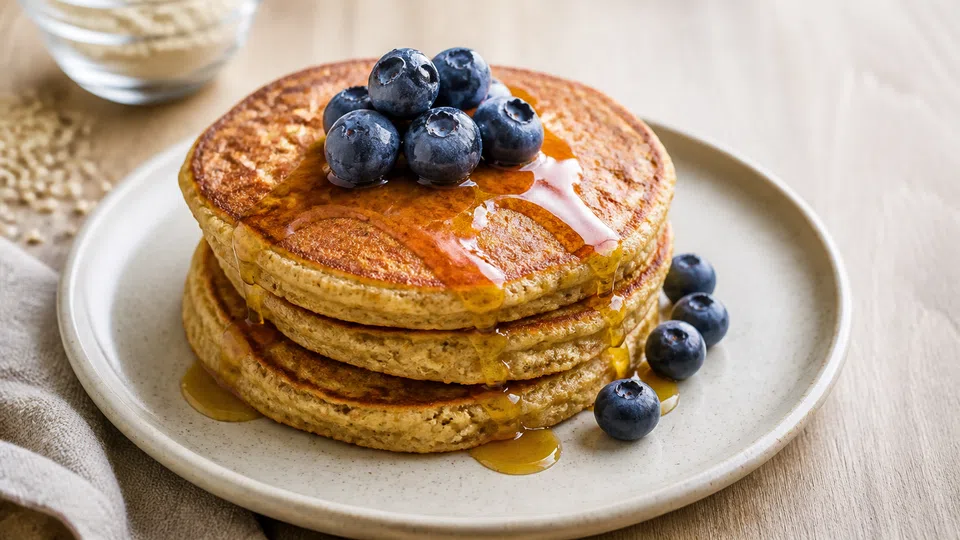
This guide answers the broad cooking question: how to choose, mix, cook, and troubleshoot quinoa flour pancakes. It does not claim that one unpublished ratio has been tested in every flour system. If you want a narrower diagnostic about bitterness and structure, see how to control quinoa flour flavour and fragility. For the underlying roles of flour, liquid, egg, leavener, and pan heat, use the Pancake Ingredients and Substitutions.
What quinoa flour pancakes are
Quinoa flour is finely milled quinoa. FAO's AGROVOC vocabulary identifies it as flour made from ground whole quinoa seed. In a pancake, it supplies the bulk of the dry mixture when used alone, or part of that bulk when it is blended with another flour. The label “quinoa flour pancakes” therefore covers several genuinely different batters:
- pancakes in which quinoa flour replaces only part of wheat flour;
- gluten-free pancakes in which quinoa flour is one member of a multi-flour blend;
- pancakes in which quinoa flour is the main or only flour, supported by eggs or another binder;
- recipes made with cooked quinoa as well as flour, which have a different texture and should not be confused with flour-only pancakes.
That distinction matters more than the title of the recipe. A partial substitution inherits much of its structure from wheat flour. A gluten-free blend divides the work among several flours and starches. A full-quinoa batter asks quinoa flour, liquid, binder, and heat to create the whole cake. Moving a quantity from one system into another without the rest of the formula is not a controlled substitution.
King Arthur Baking's quinoa pancake recipe illustrates this point. Its main formula uses cooked quinoa with a flour base, while a baker's note offers a specific quinoa-flour substitution within that tested system. The source supports that particular option; it does not establish a universal conversion for every pancake recipe.
Choose the kind of pancake before choosing a ratio
The useful first decision is not “How much quinoa flour is ideal?” It is “What should the finished pancake do?” Three practical routes answer different needs.
1. A familiar American-style stack with some quinoa flavour
Choose a partial substitution or a tested blend when you want a pancake that still behaves much like a conventional stack. A wheat-based partner can provide an elastic network; a gluten-free partner blend may provide body, starch, and binder in other ways. Quinoa contributes flavour and changes the way the batter absorbs liquid, but it is not required to carry every structural job.
This is the least disruptive route for a first experiment. Keep the original recipe's liquid, egg, leavener, salt, fat, and serving size stable. Change only the flour component in the amount authorized by the source recipe. If the source does not authorize a quinoa substitution, use a recipe written for it rather than inventing a conversion.
2. A quinoa-led, gluten-free pancake
Choose a tested gluten-free formula when avoiding gluten is part of the task. Quinoa itself does not contain gluten, but that fact alone does not make a finished meal suitable for a person who must avoid it. Every packaged ingredient, shared utensil, cooking surface, topping, and storage container remains part of the cross-contact question. Read current labels and follow the needs of the person eating; this article is not medical or allergen advice.
A quinoa-led batter may be intentionally tender and more fragile. Smaller pancakes are easier to turn because the spatula supports more of their area. A short rest can reveal whether the batter will thicken before the first full-size portion reaches the pan. Neither cue proves doneness, but both help the cook manage the batter without making several changes at once.
3. A savoury quinoa pancake
Choose a savoury direction when quinoa's earthy taste is an advantage rather than something to hide. Keep the base batter simple during the first test. Strong, wet, or heavy additions can change spread and make turning harder. It is often easier to cook a structurally sound pancake first and serve it with mushrooms, greens, yoghurt, eggs, beans, or a vegetable topping than to load all of those ingredients into an unproven batter.
If you do add vegetables to the batter, cook or drain them as the relevant recipe directs and add a measured amount. The aim is not to promise that every inclusion works; it is to keep moisture and weight visible so a failed turn can be diagnosed.
A decision table for the first batch
| Your priority | Sensible starting point | What to keep constant | First thing to observe |
|---|---|---|---|
| Familiar texture | A source-tested partial substitution | Original liquid, binder, leavener, and pancake size | Whether the batter spreads like the source describes |
| Strong quinoa identity | A tested quinoa-led formula | Flour brand, weighing method, rest, and heat | Plain flavour and edge stability |
| Gluten avoidance | A verified gluten-free recipe and labelled ingredients | Clean equipment and the exact specified blend | Whether the cooked pancake holds before toppings |
| Thin or foldable pancakes | A formula written for a thinner style | Portion and pan diameter | Whether the sheet bends after briefly cooling |
| Savoury serving | A plain base with toppings served separately | Base batter during the first test | Whether the earthy flavour suits the topping |
The table is a route selector, not evidence that all listed outcomes are guaranteed. Brands, milling, storage, binders, and equipment can change how a particular batter behaves. A recipe written and tested as a system remains a stronger starting point than a generic ratio detached from its other ingredients.
How the ingredients divide the work
Understanding ingredient roles makes troubleshooting more precise.
Quinoa flour supplies dry matter and its characteristic flavour. It does not build wheat gluten. Its behaviour may vary with brand and storage, so note the exact package used.
A partner flour or starch may add body, tenderness, flexibility, or crispness depending on what it is. “Gluten-free flour” is not one standardized ingredient; use the blend named by the source recipe.
If the blend contains tapioca, keep its role distinct from quinoa's: the tapioca flour pancake guide explains why a supporting starch cannot automatically replace the body flour. If rice flour supplies that body, use the separate rice flour pancake diagnostics rather than transferring quinoa corrections to it.
Eggs or another binder help the cooked pancake hold together within a particular formula. Egg substitutes are not interchangeable merely because they share a label such as “binder.” A flax gel, commercial replacer, banana, and additional starch bring different amounts of liquid, flavour, and solids.
Liquid hydrates the flours and determines how readily batter can spread. The volume needed is tied to the rest of the formula. Additions should be small after the recipe's stated rest rather than a large correction made before the flour has hydrated.
Leavening can create gas, but gas is useful only if the surrounding batter can hold it long enough to set. Adding more baking powder does not repair a batter that is too thin, structurally weak, or poorly cooked.
Fat and sweetener influence flavour, tenderness, release, and browning within a recipe. They are not simply optional decoration. If you change them while also changing flour, the first pancake cannot tell you which alteration caused the result.
Salt and flavourings help balance a strong flour. Vanilla, cinnamon, fruit, or savoury seasonings may complement quinoa, but they should not be used to disguise flour that smells rancid or otherwise abnormal.
A source-led method that does not invent a recipe
Use these steps with a tested quinoa-flour formula. Follow its ingredient amounts and any stated temperature or timing; the steps below explain how to observe the process rather than replacing the recipe.
- Read the whole formula. Confirm whether it uses quinoa flour, cooked quinoa, or both. Identify the required partner flour or blend and the named binder. Do not combine quantities from separate recipes.
- Check the package. Note whether the ingredient is quinoa flour rather than flakes or whole quinoa. Check date and storage condition. Reject flour with an abnormal or stale odour instead of trying to cover it with sugar.
- Weigh where possible. A gram value from the source recipe removes variation caused by packing a measuring cup. If the source gives only volume, use its stated measuring method.
- Prepare the pan and tools. Choose a flat cooking surface and a turner broad enough for the planned diameter. Set out a rack or plate so finished pancakes are not left in the pan while the next portion is measured.
- Mix dry ingredients evenly. Break up visible pockets of leavener or salt before liquid is added. This is especially helpful in a small batch where one concentrated pocket affects a large share of a pancake.
- Combine wet ingredients separately if the recipe directs it. This distributes egg, fat, and flavouring before they meet the flour.
- Mix only to the source's endpoint. Scrape dry flour from the bottom and sides, but do not continue beating merely because the batter looks different from wheat batter.
- Honor the stated rest. If the recipe specifies one, use it. If it does not, do not invent a long rest; instead proceed and observe the first small pancake.
- Cook a small diagnostic pancake. Use the same measured portion, pan area, and heat setting you can repeat. Small does not mean raw or underdone; cook it fully according to the formula and safety guidance.
- Evaluate after a brief cooling moment. Check spread, release, center, edge, flexibility, and plain flavour. Record one change only for the next portion.
This sequence gives the cook practical control without claiming Pancake World independently tested a new formula. It is compatible with the R10 evidence boundary: retain sourced facts, describe observable cues as diagnostics, and remove unsupported guarantees.
How to read the batter
Quinoa batter does not need to imitate the appearance of every wheat batter. The useful question is whether its movement matches the intended pancake style.
For a thick American-style pancake, the portion should generally settle rather than remain as a rigid mound. If it races outward into a thin irregular sheet, compare the measurement and ingredients with the recipe before adding more flour. If it will not spread at all, check whether flour was over-measured, whether the correct liquid was used, and whether the batter stood longer than the source intended.
For a thin pancake, free movement is expected, but the batter still needs to form a continuous layer. Holes that open before the structure sets may indicate the pan or batter is not behaving as the recipe requires. Do not diagnose from a single cue. Confirm portion size, pan temperature, and ingredient accuracy before changing the formula.
Lumps also need context. A few small soft lumps may disappear during cooking in some pancake formulas, while dry pockets of quinoa flour signal incomplete incorporation. Scrape the bowl once, fold enough to remove dry seams, and stop. There is no benefit in chasing a perfectly polished batter if the source recipe does not require it.
Cook one pancake as a diagnostic
The first pancake should answer six questions:
- Does the measured portion spread to the expected diameter?
- Does the edge begin to look set before the underside becomes too dark?
- Can the turner slide beneath the pancake without pushing raw batter?
- Does the pancake turn as one piece?
- Is the center cooked rather than wet or gummy?
- Does the plain pancake taste balanced before syrup or a strongly flavoured topping is added?
Use moderate, repeatable heat rather than chasing a clock. Pan material, burner power, and portion size affect timing. Bubbles can be useful in some formulas, but bubbles alone are not a universal doneness test. Look for several cues: a surface losing its wet shine, edges gaining structure, and an underside that releases when checked gently. Follow the source recipe for final cooking.
Do not taste raw batter as part of the evaluation. FDA guidance says flour is a raw food and advises against eating raw dough or batter. Keep flour and raw egg away from ready-to-eat toppings, and clean hands, bowls, utensils, and work surfaces after raw contact.
Troubleshooting quinoa flour pancakes
The pancake breaks during the turn
First ask whether it was turned too early or made too large. Wait for the recipe's set cues and use a broad turner. Make the next pancake smaller while keeping the batter unchanged. If it still breaks after proper cooking, verify the binder, flour blend, and liquid measurements. Only then consider a formula adjustment supported by the recipe developer.
The center is gummy
A dark surface and wet center often point to a mismatch among thickness, heat, and cooking time. Try a smaller portion at a slightly lower, stable heat so the center has time to set. Confirm that the batter was not thinned beyond the formula. Let the cooked test rest briefly before cutting, because trapped steam can make a just-stacked pancake seem wetter. If the problem persists, return to the tested formula rather than adding random dry ingredients.
The pancake is dry or crumbly
Check measurement before assuming quinoa flour itself is the only cause. Packed flour, an omitted fat, too little liquid, a very small portion cooked for the full listed time, or prolonged low heat can all dry a pancake. Correct the documented discrepancy first. If measurements are accurate, compare a shorter cook or the recipe's allowed liquid adjustment one change at a time.
The flavour is too strong
Taste the cooked pancake plain. If the flour tastes earthy but fresh, choose between three controlled responses: use the recipe's partial-substitution route, pair it with a complementary topping, or select a different tested formula. If the flour smells stale or the bitterness is harsh and abnormal, replace it. Sweetener should balance a sound ingredient, not conceal spoilage.
Some culinary sources discuss gently toasting quinoa flour to alter its flavour. Treat that as a separate method requiring its own source directions. Never taste raw flour to judge the result, and do not assume home heating turns flour into a ready-to-eat ingredient; FDA specifically warns that home heat treatment may not reliably make flour safe to eat raw.
The underside burns before the top sets
Reduce pan heat and/or make a smaller pancake. Wipe away pools of fat that fry isolated patches. Allow the pan to stabilize before the next measured portion. Do not thin the entire bowl solely to fix an overheated cooking surface.
The pancake stays pale and toughens
Check whether the pan was fully preheated and whether the source formula's fat and sweetener were included. A pancake left over low heat for a long time may lose moisture before it gains the intended color. Raise heat modestly only after verifying the pan and portion; color is a quality cue, not proof of safety on its own.
Early and late pancakes differ
Record how long the batter has stood. Later portions may behave differently if the flour continues hydrating, the leavener changes over time, or repeated additions of fat alter the pan surface. Do not keep thinning the bowl after every pancake. Compare an early and late portion, then use a source formula with a batch size you can cook at a consistent pace.
Three route-specific serving plans
A simple fruit breakfast
Use a tested plain quinoa pancake as the anchor. Serve fruit separately or add it only in the way the source recipe supports. This preserves the batter as the variable under observation and keeps juicy toppings from being mistaken for an undercooked center. Yoghurt, nut or seed butter, and syrup can be offered at the table according to dietary needs and labels.
A savoury lunch plate
Keep sweetener and flavouring within a savoury-tested formula, then pair the cooked pancakes with a warm vegetable topping or a soft egg prepared safely. A smaller pancake is easier to support under toppings. Keep wet sauces off the stack until serving so texture can be judged and leftovers can be stored by component.
A batch for mixed preferences
Cook one neutral base only if the selected source recipe is designed that way. Set out sweet and savoury toppings separately instead of dividing an untested batter and altering each half. This reduces simultaneous changes and makes allergen labels easier to keep with the correct component. It also lets the cook identify whether the base pancake succeeds before toppings are credited or blamed.
Storage and reheating boundaries
Follow the storage guidance attached to the actual tested recipe and the ingredients used. A broad pancake guide cannot assign one safe room-temperature or refrigerator life to every batter and topping. Cool leftovers promptly under applicable official guidance, use clean containers, and separate highly moist toppings from pancakes if texture matters.
For quality, avoid sealing a visibly steaming stack in a deep container; condensation can soften the surfaces. For safety, visual appearance and smell do not extend an official storage limit. When the history of a perishable topping or egg-containing dish is uncertain, choose the conservative action rather than guessing.
Reheat only the portion needed. A toaster may suit a thin, firm pancake; a covered skillet may warm a more delicate one; a microwave may soften the surface. These are quality options, not universal safety instructions. Use the method and endpoint appropriate to the validated recipe and accompanying food-safety guidance.
Common mistakes to avoid
- Treating quinoa flour, cooked quinoa, and quinoa flakes as interchangeable.
- Replacing all wheat flour when the source authorizes only a partial substitution.
- Combining the flour quantity from one recipe with the liquid and binder from another.
- Calling a pancake gluten-free without checking every ingredient and cross-contact point.
- Tasting raw batter to decide whether it needs more seasoning.
- Changing flour, liquid, binder, heat, and pancake size after one poor result.
- Hiding abnormal flour flavour under sugar or syrup.
- Using a dark underside as proof that a thick center is cooked.
- Scaling a first attempt before one small pancake has been evaluated.
- Claiming nutrition values without a verified formula and calculation.
Final checklist
Before mixing:
- choose a tested quinoa-flour formula that matches the intended style;
- confirm whether it uses flour, cooked quinoa, or both;
- verify labels and dietary requirements;
- record the flour brand and measure as directed;
- set out a repeatable portion tool and suitably broad turner.
During cooking:
- do not eat raw batter;
- keep the first pancake small;
- hold pan heat and portion size steady;
- look for surface set, release, and a cooked center;
- alter one documented variable at a time.
After cooking:
- taste one cooked pancake plain;
- record spread, tenderness, strength, and flavour;
- keep toppings from obscuring the diagnosis;
- cool and store leftovers under the relevant official and recipe guidance;
- scale only after the chosen formula works in the actual pan and batch sequence.
Questions cooks ask about quinoa flour pancakes
Can quinoa flour replace all-purpose flour one for one?
Not as a general rule. A specific tested recipe may authorize a specific substitution, but quinoa flour does not build the same structure as wheat flour. A one-for-one claim detached from the recipe's liquid, binder, leavener, and intended size is too broad. Use the conversion stated by the developer of the full formula, or choose a recipe created around quinoa flour from the beginning.
Are quinoa flour pancakes automatically gluten-free?
No finished pancake is automatically suitable simply because quinoa flour itself is identified as gluten-free. A recipe may include wheat flour, and packaged ingredients or shared equipment can introduce cross-contact. If gluten avoidance is medically important, verify every current label and preparation condition with the person concerned and appropriate professional guidance.
Should quinoa flour be toasted first?
Only when you are following a reliable method that calls for it. Toasting is a separate flavour treatment, not a universal prerequisite and not a substitute for cooking the finished batter. Keep the toasted and untoasted tests otherwise identical if you want to compare flavour. FDA guidance also warns consumers not to rely on home heat treatment to make raw flour safe to eat.
Why did a recipe made with cooked quinoa behave differently?
Cooked quinoa brings absorbed water and intact cooked grains; quinoa flour is a fine dry ingredient that hydrates inside the batter. They are different inputs. A recipe may provide a tested substitution between them, as King Arthur does in a baker's note, but that substitution belongs to that formula and should not be generalized to unrelated recipes.
Can the batter be made the night before?
Do so only when the selected recipe specifically supports overnight preparation. A long rest can change hydration and leavening, while raw egg or other perishable ingredients add storage requirements. A safer planning option for an unsupported formula is to measure dry ingredients ahead, refrigerate perishable ingredients correctly, and mix at the time the tested recipe directs.
How can I make the pancakes less bitter without adding lots of sugar?
First establish whether the flour is fresh and the cooked pancake tastes earthy or actually unpleasant. If it is sound but assertive, choose a partial-substitution formula, use a tested toasting method, or pair the cooked pancake with fruit, spice, yoghurt, or a savoury topping. Change one approach at a time. If the flour smells stale or abnormal, replacement is more appropriate than camouflage.
For more route-specific cooking help, Pancakes World connects ingredient choices to observable batter and pan decisions without turning one successful formula into a universal promise.
Sources and editorial references
- U.S. Food and Drug Administration — “Handling Flour Safely: What You Need to Know” —
https://www.fda.gov/food/buy-store-serve-safe-food/handling-flour-safely-what-you-need-know - King Arthur Baking — “Quinoa Pancakes” —
https://www.kingarthurbaking.com/recipes/quinoa-pancakes-recipe - Food and Agriculture Organization AGROVOC — “quinoa flour” —
https://agrovoc.fao.org/browse/agrovoc/en/page/c_c5b7a0b9 - King Arthur Baking — “Baking with ancient grains: a guide” —
https://www.kingarthurbaking.com/blog/2024/11/01/baking-with-ancient-grains-a-guide