Milkless pancakes
Direct answer for milkless pancakes
At Pancakes World, you can make American-style pancakes without milk by using 250ml lukewarm water in a batter of 300g plain flour, 3 teaspoons baking powder, 2 tablespoons sugar, 2 eggs, 2 teaspoons vanilla, 50g melted butter, and 1 teaspoon fine salt. Good Food publishes this water-based formula and cooks 3-tablespoon portions over low-medium heat. Use its remaining butter plus vegetable oil for the pan, or the stated dairy-free butter alternative when the whole plate must avoid dairy. Milkless does not automatically mean dairy-free: ordinary butter and some toppings still contain milk, and the eggs mean this version is not vegan.
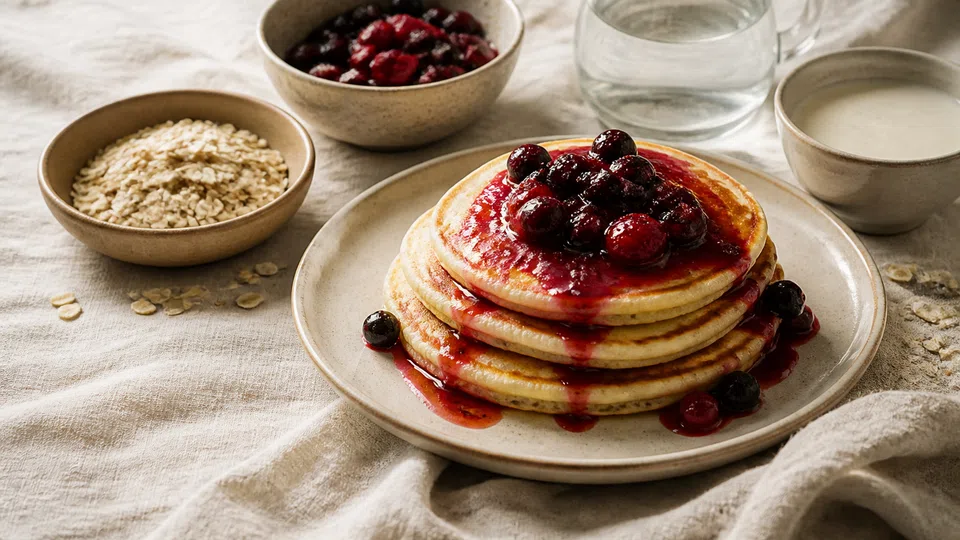
That distinction is the key to a useful milkless-pancake guide. One reader has simply run out of liquid milk; another must avoid every milk-derived ingredient. The recipe, pan fat, toppings, labels, and cross-contact plan need to match the actual task.
What “milkless pancakes” means
Milkless pancakes contain no milk as the batter liquid. They may use water, juice plus water, or a plant-based beverage in a formula written for it. The word does not tell you whether the batter contains butter, yogurt, cream, whey, casein, or another milk-derived ingredient. It also says nothing by itself about eggs, wheat, soy, nuts, nutrition, or suitability for an individual diet.
This page leads with a water-based recipe because it solves the most literal pantry problem: flour, eggs, leavening, fat, and water are available, but liquid milk is not. It is different from soy milk pancakes, which owns the exact soy-beverage substitution task, and from homemade pancakes without eggs, where egg removal is the central constraint.
Good Food’s milk-free recipe supports the water route directly. It uses 250ml lukewarm water and offers either butter or a dairy-free alternative. Food Network Kitchen publishes another no-milk pancake with 3/4 cup water plus 1/4 cup orange juice, melted butter, separated eggs, and leaveners; its cook’s note permits water instead of the juice. These are two complete formulas, not pieces to mix casually. The first is a straightforward thick batter. The second uses whipped egg whites and an acidic juice option. Choose one method and keep its ratios together.
For someone who merely ran out of milk, ordinary butter may remain acceptable. For someone avoiding milk because of an allergy or another strict requirement, the butter, pan fat, mix-ins, and toppings must be checked too. The FDA identifies milk as a major food allergen under US labeling rules and advises reading the complete ingredient information. “Non-dairy” wording, a recipe title, or a water-based batter cannot replace that check.
The parent Pancake Ingredients and Substitutions covers general hydration and heat. This route stays focused on selecting and executing a formula that omits milk without pretending all liquid swaps are equivalent.
Primary water-based formula
The following quantities are traceable to Good Food’s Milk Free Pancakes. Pancake World did not independently test them and does not claim a proprietary recipe. The source says the batch makes 12 to 14 pancakes and serves three to four people.
Batter ingredients
- 300g plain flour
- 3 teaspoons baking powder
- 2 tablespoons golden caster sugar
- 1 teaspoon fine salt
- 2 eggs
- 2 teaspoons vanilla extract
- 250ml lukewarm water
- 50g butter, melted and cooled slightly, or the source’s dairy-free alternative
For the pan
- 2 tablespoons vegetable oil, used as needed
- the remaining 20g from the source’s total 70g butter, or a verified dairy-free alternative
Separating batter fat from pan fat makes the dairy decision visible. If ordinary butter is used, the pancakes are made without liquid milk but are not dairy-free. If a dairy-free result is required, verify the replacement and every other packaged ingredient. Do not assume a generic “butter alternative” is suitable for every allergy or preference.
Source-based method with checkpoints
- Combine the dry ingredients. Whisk the flour, baking powder, sugar, and salt in a large bowl. Distributing the small ingredients before hydration reduces the need for heavy mixing later.
- Combine water, eggs, and vanilla. Mix the eggs, vanilla, and 250ml lukewarm water in a jug until uniform.
- Melt the batter fat. Melt 50g butter or the chosen verified alternative gently and let it cool slightly, as the source directs.
- Form the batter. Make a well in the dry mixture. Pour in the water mixture and melted fat gradually, whisking until the source’s thick, smooth consistency is reached. Do not add an unmeasured splash of water because the word “thick” seems surprising.
- Prepare the pan. Heat a nonstick frying pan over low-medium heat with 1 teaspoon oil and a small amount of the remaining butter or alternative.
- Cook one trial pancake. Spoon in 3 tablespoons batter to form roughly an 8cm pancake. This source-specific size helps the center cook while the edges set.
- Read the first side. The source gives one to two minutes, looking for set edges, bubbles in the center, and rise. Turn only when the pancake can be supported cleanly.
- Finish the second side. Cook about one further minute. Check that the center is cooked, then transfer to a clean plate or rack.
- Repeat in controlled batches. Renew pan fat as needed and preserve space between pancakes because the batter spreads.
Times describe the source method, not a guarantee across every hob and pan. Use the edge, bubble, release, color, and center checkpoints together. If the underside darkens before the top sets, lower the heat. If the first pancake spreads much wider than the source size, confirm the portion and the 250ml water measurement before changing the batter.
Choosing the right milkless route
| Your actual situation | Liquid route | Formula to follow | Important boundary |
|---|---|---|---|
| No milk in the refrigerator, dairy is otherwise acceptable | 250ml lukewarm water | Good Food water-based pancakes | Ordinary butter can remain; “milkless” is a pantry description |
| All milk-derived ingredients must be avoided | 250ml water plus verified dairy-free fat | Good Food option with label-checked alternative | Check pan fat, toppings, flour blend, and cross-contact information |
| Orange juice is available and a whipped-egg-white method is welcome | 1/4 cup orange juice plus 3/4 cup water | Food Network no-milk pancakes | Keep its two-cup flour formula and separated-egg method intact |
| No orange juice | Water in the Food Network formula as its cook’s note permits | Food Network formula only | Do not transplant the water quantity into the Good Food batch |
| Plant beverage is preferred | Use a recipe tested for that exact beverage | Beverage-specific formula | Product sugar, flavor, allergens, and solids vary |
| Eggs must also be removed | Use an eggless or vegan formula | Dedicated tested recipe | Do not remove both milk and eggs from this primary formula by guesswork |
| Only a boxed mix is available | Follow the current package | Product instructions | A water-only direction does not prove the mix contains no milk |
The table separates “liquid choice” from “dietary status.” The first question is what is missing. The second is what must be excluded. A cook who answers those in reverse order can accidentally make a water batter with butter and call it dairy-free.
Practical scenarios
Scenario 1: milk ran out midway through breakfast preparation
If no one needs dairy avoidance, use the Good Food formula exactly, including ordinary butter if available. Measure 250ml lukewarm water rather than replacing the missing milk cup for cup in an unrelated recipe. The water formula has its own flour, eggs, fat, sugar, salt, and leavening proportions.
Make one 3-tablespoon pancake before filling the pan. If it cooks through at the source size and low-medium heat, continue. This approach is more reliable than keeping an ordinary milk recipe and guessing how much extra fat or flavoring water needs.
Scenario 2: the breakfast must be free from milk ingredients
Use the same water route only after checking every ingredient. Select the source-permitted dairy-free butter alternative for both batter and pan, or use another complete tested dairy-free formula. Read labels for the replacement, flour, toppings, chocolate, cooking spray, and any packaged mix-in. Keep the relevant packages available while serving.
Milk allergy management is outside a recipe article’s authority. The FDA says milk is a major allergen and that consumers should read the entire ingredient list; advisory statements and cross-contact circumstances need individual attention. When unsure, use qualified guidance rather than interpreting “milkless” as a safety certification.
Scenario 3: water pancakes taste too plain for the planned plate
The primary formula already includes sugar, vanilla, salt, eggs, and fat. Cook the source batch before deciding it lacks flavor. Toppings can be chosen at service without changing hydration or leavening. If adding zest or spice to the batter, record it as a variation and verify that it meets any dietary constraint.
Do not solve a flavor concern by replacing water with an arbitrary volume of concentrated juice. Food Network’s orange-juice option is balanced inside a different formula containing baking soda and whipped egg whites. Use that full route if the flavor and method appeal.
Scenario 4: cooking the Food Network no-milk version
Keep its formula intact: 1/4 cup orange juice, 3/4 cup room-temperature water, 4 tablespoons melted butter, vanilla, two separated eggs, 2 cups all-purpose flour, 1/4 cup sugar, baking powder, salt, and baking soda. Whip the whites to stiff peaks and fold gently. Cook heaping 1/4-cup portions over medium heat.
This is not the primary article formula, so its eight-pancake yield and timing belong only to that batch. If orange juice is unavailable, the source says water can replace it. Ordinary butter still means the recipe is not dairy-free.
Scenario 5: serving a mixed-restriction group
Create a short ingredient matrix before cooking: milk, egg, wheat, soy, nuts, and any other relevant concerns. A water-based batter can still contain egg and wheat. A plant beverage may introduce soy or tree nuts. A topping can reverse the exclusion achieved in the batter.
Use separate, clean tools and a clearly identified serving plate when a cross-contact plan is required. Do not depend on memory after packages have been put away. If the kitchen cannot meet a person’s safety needs, say so rather than treating a recipe title as evidence.
Scenario 6: making more than one batch
Prove one batch on the actual pan before multiplying. Scaling ingredients does not increase pan capacity. Count how many 8cm portions fit without crowding, estimate the number of rounds, and decide whether people will eat as pancakes are made or whether a source-supported warm hold is practical.
Food Network uses a 200°F oven for its own batch, while Good Food directs serving warm without publishing a specific long hold. Do not transfer an unlimited holding window from one recipe to another. For a large event, select a menu designed for batch service.
Why water works here without pretending it is milk
Water supplies hydration. It does not bring the same dissolved sugars, proteins, fat, flavor, or color contribution as dairy milk. The Good Food recipe accounts for its chosen liquid with eggs, added fat, vanilla, sugar, salt, and baking powder. That complete balance—not the statement “water always replaces milk”—is the evidence.
This is why the article does not offer a universal 1:1 substitution. A thin crêpe formula, a buttermilk pancake, a complete mix, and a thick American pancake have different ingredient systems. The three ingredient pancakes page owns a thin flour-egg-milk baseline, while the flour and water pancakes page owns the much plainer two-component griddle-cake task. Milkless American-style pancakes keep more ingredients because water alone is not expected to perform every role.
Food Network’s second source also shows that “no milk” can be designed in more than one way. Orange juice and water enter a batter with baking soda, while separated and whipped eggs add a specific preparation step. The source notes that water can replace the orange juice, but that does not erase the rest of its formula. The evidence supports multiple coherent routes, not an open invitation to combine them.
What each remaining ingredient is doing in the practical workflow
The flour and water are not the whole recipe. Plain flour is the bulk dry ingredient, while water hydrates it. The eggs and melted fat remain part of the wet system. Baking powder is deliberately measured into the dry mix. Sugar, vanilla, and salt establish the formula’s flavor rather than asking water to imitate milk. The pan fat manages the cooking surface separately from the 50g fat mixed into the batter.
This role map is useful for troubleshooting because it stops one missing ingredient from being treated as six missing functions. If the pancake sticks, inspect the pan surface, heat, and pan fat before adding more batter fat. If it spreads too far, recheck the three-tablespoon portion and 250ml water measure before adding flour. If it colors too fast, lower the heat rather than removing sugar from a source formula that has not yet been cooked correctly. If it tastes different from a milk pancake, remember that difference is expected; the goal is a coherent water-based pancake, not a claim that water is sensorially identical to milk.
The same discipline keeps the Food Network version coherent. Its egg whites are whipped separately, its wet mixture includes both water and juice in the primary option, and its dry mixture contains baking powder plus baking soda. Substituting water for juice is expressly permitted by that source, but skipping the egg-white step or borrowing the Good Food flour quantity would be an additional unverified change.
A small-batch diagnostic before serving others
Cook the first pancake alone and write down five observations: how far the measured portion spreads, how long the edge takes to set, whether bubbles appear in the center, whether the underside releases without tearing, and whether the center is cooked after the second side. These observations are not a Pancake World performance claim; they are a transparent way to operate the published method on real equipment.
Change only the pan heat or spacing before the second pancake unless a clear measuring error is found. If an ingredient was omitted or doubled, restarting the batch is more defensible than a chain of guessed corrections. If the result is technically cooked but does not fit the intended plate, choose another complete route for the next batch rather than rewriting the evidence after the fact.
Common mistakes and precise recoveries
Replacing milk with water in any recipe without checking
Return to a complete water-based formula. The primary recipe was written with 250ml water; the secondary recipe uses 3/4 cup water plus 1/4 cup juice and allows all water. Neither proves a universal conversion for an unknown batter.
Calling a butter-containing pancake dairy-free
Name it accurately: milkless as a liquid choice, but made with butter. If full dairy avoidance is required, use the source’s dairy-free alternative and verify the pan fat and toppings. Never hide the distinction in a footnote after serving.
Removing eggs at the same time
The primary formula uses two eggs. Removing them changes structure and liquid simultaneously. Move to the dedicated eggless guide rather than inventing a replacement here.
Adding extra flour because the batter looks unfamiliar
Good Food describes a thick, smooth batter. Confirm that flour and water were weighed or measured correctly, all wet ingredients were incorporated, and the batter was not compared to a thin crêpe. Cook the source portion before changing the ratio.
Adding extra water before the first pancake
The recipe’s 250ml is evidence; an unmeasured splash is not. If the cooked trial is too thick for the intended result, decide whether you are willing to run a documented household adjustment. Do not present that adjustment as the source formula.
Overheating the pan
The primary method uses low-medium heat. If pan fat smokes or the underside darkens while the center is raw, stop adding batter, lower the heat, and let the pan stabilize. Replace scorched residue before continuing.
Flipping too early
Wait for set edges, central bubbles, rise, and clean release. Slide the turner beneath most of the pancake. A broken first pancake is a signal to inspect heat and set, not to whip more flour into the bowl immediately.
Tasting raw batter
FDA states that flour is raw and advises never eating or tasting raw dough or batter. The batter may also contain raw egg. Evaluate the fully cooked trial, and clean hands, utensils, bowls, and surfaces after raw-flour and raw-egg contact.
Assuming water makes the recipe allergen-free or lower in something
The batter still has wheat and egg, and ordinary butter adds milk. No calorie, fat, protein, sugar, or health conclusion follows from the absence of liquid milk alone. Use actual labels and qualified dietary guidance.
Actionable checklist
Before choosing a recipe:
- Decide whether milk is merely unavailable or every milk-derived ingredient must be excluded.
- Check whether eggs, wheat, soy, nuts, or other constraints also apply.
- Choose the Good Food water formula, the complete Food Network juice-and-water formula, or a tested plant-beverage formula; do not combine them.
- Read all packaged-ingredient and topping labels.
- Select ordinary butter only when dairy is acceptable; otherwise verify the stated alternative.
For the primary water batch:
- Weigh 300g plain flour.
- Measure 3 teaspoons baking powder, 2 tablespoons sugar, and 1 teaspoon fine salt.
- Mix two eggs, 2 teaspoons vanilla, and 250ml lukewarm water.
- Melt 50g butter or verified alternative and cool it slightly.
- Combine wet and dry ingredients into a thick, smooth batter.
- Heat a nonstick pan over low-medium with measured pan fat.
- Cook one 3-tablespoon, roughly 8cm test pancake.
- Turn after set edges, central bubbles, rise, and release.
- Finish the second side and confirm the center is cooked.
- Continue without crowding the pan.
For serving and cleanup:
- Transfer pancakes to a clean plate or rack.
- Keep raw batter utensils away from finished food.
- Never taste raw flour batter.
- Identify milk, egg, wheat, and other relevant allergens accurately.
- Keep labels available when serving someone with restrictions.
- Refrigerate or discard per current authoritative guidance rather than inventing a room-temperature window.
Variations by ingredient and market
Dairy-free butter alternative
Good Food explicitly permits one, but does not make every product interchangeable for every guest. Use a product suitable for the intended recipe and restriction, follow its label, and watch the pan because water and fat content can differ. Record the exact product in any real test note.
Plant-based beverage instead of water
That becomes a plant-milk formula. Use a source that gives the beverage and ratio. The soy route on this site uses an exact test-kitchen 1:1 permission within a different vegan recipe; it should not be pasted into this egg-and-water batter automatically.
Orange juice and water
Use Food Network’s complete formula. Its 1/4 cup orange juice sits beside 3/4 cup water and baking soda. The source permits water instead of juice, but this variation remains attached to the two-cup-flour, separated-egg recipe.
Thin pancakes rather than American-style rounds
The primary formula is portioned as thick 8cm pancakes. If the desired result is a thin crêpe, select a thin-pancake formula written without milk. Adding water until this batter pours across the pan would abandon the supported ratio.
US cups and metric weights
The Good Food source supplies grams and milliliters; Food Network supplies US cups and spoons. Keep each source’s units and formula together. This article does not invent conversions for the Good Food flour because volume measurement technique would add uncertainty.
Boxed pancake mix with water
Some mixes have water-only directions, but the mix is a composite product. Follow its current package for quantity, rest, heat, and portion. Check whether milk, whey, casein, egg, wheat, soy, or other allergens are already inside. “Just add water” describes preparation, not ingredient absence.
Storage and planning notes
Both cited recipes are designed for cooking and serving as a batch. Good Food says to serve the pancakes warm; Food Network transfers its pancakes to a baking sheet in a 200°F oven while completing the batch. Neither source establishes an all-day buffet window.
For make-ahead needs, use a recipe with explicit cooling, refrigerated storage, and reheating instructions. Do not store raw batter overnight merely because water replaced milk: it still contains raw egg and flour, and its leavening system was written for immediate cooking. Prepare equipment and dry ingredients ahead only if separation and labeling are handled safely.
When saving finished pancakes, cool and refrigerate them promptly under current food-safety guidance, use a clean container, and record what the batch contains. This article deliberately supplies no custom multi-day shelf life because the two source pages do not provide one for these finished formulas.
The most efficient group plan may be to choose a different breakfast format. A 12-to-14-pancake recipe still needs multiple pan rounds. Ingredient availability and service capacity are separate questions; solving the missing-milk problem does not solve timing automatically.
Practical conclusion
For a direct milkless result, the verified starting point is Good Food’s 300g-flour batter with 250ml lukewarm water, two eggs, baking powder, sugar, vanilla, salt, and added fat. Keep the 3-tablespoon portion and low-medium pan method. If dairy is acceptable, ordinary butter can remain; if all milk ingredients must be avoided, use a verified alternative and check every label. Choose the separate Food Network formula when its juice-and-water and whipped-egg-white method is the actual goal.
Continue exploring exact substitution boundaries on Pancakes World, including two ingredient pancakes when the controlling priority is an extremely short batter list rather than replacing milk.
Sources and editorial references
- Good Food, “Milk free pancakes.” Water-based formula, 12-to-14 yield, butter-or-dairy-free-alternative option, 3-tablespoon portion, 8cm size, low-medium heat, and cooking cues checked 2026-08-16.
https://www.bbcgoodfood.com/recipes/milk-free-pancakes - Food Network Kitchen, “No Milk Pancakes.” Separate orange-juice-and-water formula, water-only cook’s note, whipped-egg-white method, eight-pancake yield, portion, heat, and timing checked 2026-08-16.
https://www.foodnetwork.com/recipes/food-network-kitchen/no-milk-pancakes-7216999 - U.S. Food and Drug Administration, “Have Food Allergies? Read the Label.” Milk, egg, wheat, soy, and other major-allergen label guidance checked 2026-08-16.
https://www.fda.gov/consumers/consumer-updates/have-food-allergies-read-label - U.S. Food and Drug Administration, “Handling Flour Safely: What You Need to Know.” Raw-flour, no-raw-batter, separation, and cleanup guidance checked 2026-08-16.
https://www.fda.gov/food/buy-store-serve-safe-food/handling-flour-safely-what-you-need-know
Editorial boundary: this Article-schema guide compares two complete published milkless formulas. Pancake World has not claimed an independent test, a universal milk-to-water substitution, a nutrition outcome, medical suitability, or guaranteed allergen safety. Publication and media clearance remain outside this draft.