Flour and water pancakes
Direct answer for flour and water pancakes
At Pancakes World, yes, pancakes can be made with flour and water as the main batter ingredients, but flour and water alone produce a plain, minimally structured griddle cake rather than a fluffy American pancake. For a dependable result, use a source-tested water-based recipe that also specifies leavening, salt, fat, and any sweetener or binder it needs. Mix to a thick, pourable batter, cook one small pancake on a fully preheated lightly greased pan, and adjust only after checking spread and centre set. Water replaces liquid volume, not all of milk's flavour and solids, so the finished pancake will usually taste plainer. Do not taste the raw batter; flour must be cooked.
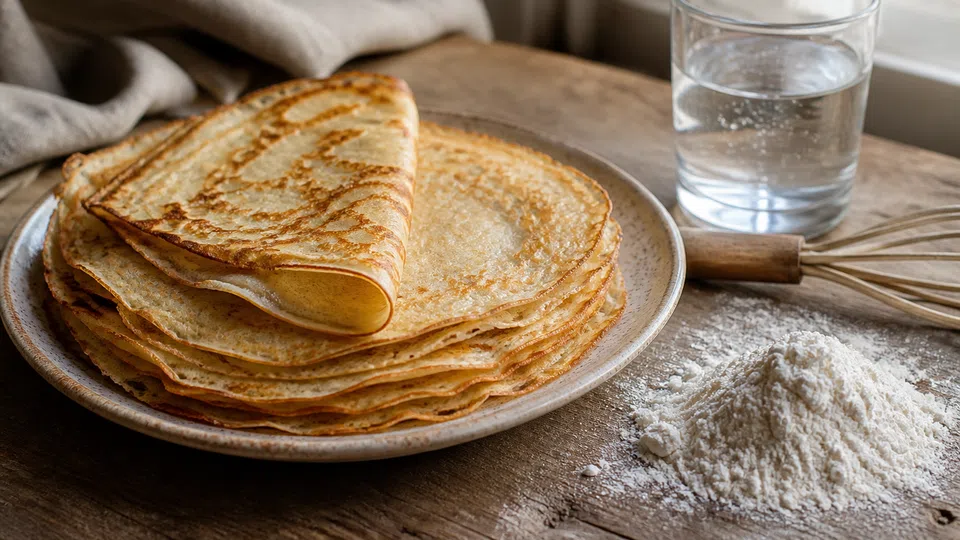
Utah State University Extension publishes a water-based pancake recipe in its food and family curriculum, demonstrating that water can work inside a complete pancake formula. That evidence does not mean every milk-based recipe accepts an equal water swap or that flour and water alone will become fluffy. This guide separates the bare two-ingredient idea from practical pantry pancakes. For other liquid substitutions, see pancakes without milk and the Pancake Ingredients and Substitutions.
What counts as a flour and water pancake?
The phrase covers three different jobs:
- A true two-ingredient griddle cake: flour and water are mixed, spread thinly, and cooked. It is closer to a plain flatbread or wrapper than a sweet breakfast stack.
- A water-based pantry pancake: flour and water are the central ingredients, while leavener, salt, oil, and perhaps sugar create a more recognizable pancake.
- A normal pancake recipe with water substituted for milk: this is safe to try only when the recipe developer authorizes it or the cook accepts an experimental result.
Those versions should not be merged. A two-ingredient batter has no added leavener, fat, egg, dairy solids, or seasoning. A pantry recipe may be egg-free or dairy-free yet still include several functional ingredients. A substitution starts from a formula designed around milk and changes one part of it.
The user's intent usually is practical: “I have flour and water; can I make breakfast?” The honest answer is yes, provided expectations match the ingredients. If you also have baking powder, salt, and a little oil, choose a tested water-based pancake recipe. If you literally have only flour and water, make a thin, fully cooked griddle cake and treat it as its own simple food rather than promising a fluffy stack.
Choose the result before mixing
Thin and flexible
Use a thin batter and a modest portion when the goal is a wrapper or crisp-edged cake. Spread it across the pan and turn only when the first side has formed a continuous sheet. This style does not need to imitate the height of an American pancake.
The practical risks are sticking, tearing, and a raw flour centre. Preheat the surface, grease lightly if the pan requires it, and keep the first cake small. A very thick flour-and-water layer can brown outside while remaining pasty inside.
Soft pantry pancake
Use a tested formula with leavener, salt, and fat when the goal is a softer breakfast pancake. These supporting ingredients are not decorative. Leavener creates gas; salt prevents a flat taste; fat changes tenderness and release. The recipe may include sugar for flavour and browning or a binder for structure.
Follow the complete formula. Do not remove egg and milk from a conventional recipe, then assume water alone replaces both. Milk is a liquid ingredient; egg has separate setting and emulsifying roles within the recipe.
Crisp-edged savoury cake
Use a thinner tested batter, a controlled film of oil, and savoury toppings served after cooking. The edge can become crisp while the centre remains flexible. Keep wet vegetables or heavy cheese out of the first diagnostic pancake so their moisture does not obscure the base batter.
Ingredient-role table
| Ingredient | What it contributes in a complete formula | What happens when it is absent |
|---|---|---|
| Flour | Dry bulk and, for wheat flour, gluten-forming proteins | No pancake body |
| Water | Hydration and batter flow | Dry ingredients cannot combine |
| Leavener | Gas for lift in formulas designed to retain it | A flatter result |
| Salt | Flavour balance | A noticeably plain taste |
| Fat | Tenderness, flavour, and pan release within the recipe | Leaner texture and possible sticking |
| Egg or other binder | Set and cohesion in recipes that use it | A different, often more fragile structure |
| Sweetener | Sweetness and some browning in the formula | Less sweet and potentially paler, not automatically failed |
The table describes roles, not mandatory ingredients. A true flour-and-water cake intentionally omits most of them. A source-tested pantry pancake includes the combination its developer found workable.
Why water does not behave exactly like milk
Water hydrates flour without bringing milk's fat, protein, lactose, or flavour. Replacing milk with water therefore changes more than thickness. The batter may look similar yet brown differently, taste plainer, and feel less rich. The size of that difference depends on the rest of the recipe.
This does not make water a bad ingredient. It means the formula should be designed or adjusted for it. Utah State University Extension's published water-based pancake demonstrates the correct evidence pattern: water appears together with specified dry ingredients and method. It is not offered as proof that any unrelated recipe accepts water unchanged.
King Arthur Baking's all-purpose baking-mix pancake recipe provides a narrower example: its main liquid is milk or almond milk, while its baker's note allows a measured amount of additional milk or water to thin the batter. That source supports water as a thickness adjustment inside that product-specific recipe. It does not support replacing the full milk amount with water.
The flour choice changes the answer
“Flour” is not one interchangeable input. A water amount that makes a pourable batter with all-purpose wheat flour may produce a different result with self-rising flour, bread flour, whole-wheat flour, or a gluten-free blend.
All-purpose wheat flour
This is the most common starting point for a plain pantry pancake. It can form enough structure for a thin cake and for fuller recipes containing leavener and fat. Mix only until incorporated. If the batter is worked aggressively, the cooked cake may become tougher, especially when there is little fat or sugar in the formula.
Self-rising flour
Self-rising flour already includes leavening and salt according to its product specification. Do not add the full leavener and salt from an all-purpose-flour recipe without checking the formula. Use a recipe written for self-rising flour or convert only with a reliable source.
Bread flour
Bread flour is designed for stronger gluten development than a typical tender pancake needs. A flour-and-water cake made from it may feel chewier, particularly after extended mixing. That does not make the ingredient unsafe or unusable, but it changes the expected style. Choose a thin savoury cake or a source formula that accounts for the flour rather than promising tenderness.
Whole-wheat flour
Whole-wheat flour includes more of the grain and can hydrate differently from refined all-purpose flour. Give it only the rest stated by the selected recipe, then adjust within the recipe's allowed range. Do not assume the same cup of water produces the same spread.
Gluten-free flour blends
Commercial blends vary. Some contain rice flour and several starches; some include a gum; others require a binder to be added separately. Use the exact blend the recipe names. Water alone cannot correct a missing structural component, and the presence of a gluten-free label does not establish that all preparation surfaces or toppings meet a diner's needs.
| Flour on hand | Better first move | Avoid |
|---|---|---|
| All-purpose | Choose a water-based pantry pancake formula | Treating a volume measure as exact after packing the cup |
| Self-rising | Use a self-rising-flour recipe | Duplicating leavener and salt automatically |
| Bread flour | Aim for a deliberate chewy or thin style | Promising a tender cake from an untested swap |
| Whole-wheat | Use a formula designed for its hydration | Copying an all-purpose water ratio without checking |
| Gluten-free blend | Match the named product and binder system | Assuming every blend is identical |
Build flavour without hiding the base
A water-based pancake can be enjoyable without pretending water supplies milk's flavour. Fix texture first, then choose one flavour direction.
For a sweet breakfast, use the salt, sweetener, and spice amounts from the selected recipe. Add fruit on top during the first batch so juice does not alter the diagnostic pancake. Once the base works, use only recipe-supported inclusions. Cinnamon, vanilla, cooked fruit compote, yoghurt, or nut and seed butters can make a plain cake feel complete, subject to labels and dietary needs.
For a savoury meal, reduce or omit sweetener only when the formula permits it. Serve the cooked cake with beans, cooked vegetables, eggs prepared safely, cheese, or a labelled plant-based topping. Wet ingredients are easier to control on top than inside an untested batter.
For a crisp snack, spread a thin layer and serve it soon after cooking. A cooled flour-and-water cake tends to firm, so match the serving time to the style. If the cake will wrap a filling, keep the filling light and avoid letting sauce soak the sheet before it reaches the table.
Do not use toppings to avoid examining a raw or pasty centre. The pancake must be fully cooked before flavour is the next question.
A source-led pantry method
Select a complete water-based recipe first. Use its exact amounts. The following method explains how to keep the process observable without inventing a Pancake World formula.
- Read the ingredient list. Confirm it is a water-based pancake, not a milk recipe with an assumed substitution.
- Identify the flour. All-purpose wheat flour, self-rising flour, and gluten-free blends are not interchangeable. Use the named ingredient.
- Measure accurately. Prefer gram weights when supplied. If measuring by volume, do not pack flour into the cup.
- Distribute leavener and salt. Mix dry ingredients before adding water so concentrated pockets are less likely.
- Add water as directed. Reserve only the adjustment explicitly allowed by the source. Do not pour in extra water before checking the initial consistency.
- Add oil or other wet ingredients. Keep them in the formula if specified; they are part of the tested system.
- Mix to the recipe's endpoint. Scrape dry flour from the bottom, then stop. Aggressive beating can make a wheat batter tougher.
- Use the stated rest. If none is stated, do not invent an overnight rest. Move to the first small pancake.
- Preheat the pan. Use moderate heat and a thin film of fat appropriate to the recipe.
- Cook one small test. A small portion is easier to turn and lets the centre set before the outside overcooks.
- Evaluate after brief cooling. Check the centre for raw paste, then taste the cooked pancake plain.
- Change one thing. Adjust water only in a measured increment; adjust heat without simultaneously altering batter.
The FDA identifies flour as a raw food and advises consumers not to eat uncooked flour, dough, or batter. Keep raw flour away from ready-to-eat toppings and clean hands, bowls, utensils, and surfaces after raw contact.
Batter consistency without milk
Consistency should match the chosen style, not a universal picture.
Thick pantry pancake batter
A measured scoop should fall and settle rather than remain a dry mound. If it runs like water, check whether too much liquid was added or the wrong flour was used. If it barely moves, verify flour measurement and add only a source-approved amount of water.
Water-based batter can expose overmixing because there may be less fat or dairy to soften the texture. Stop once dry flour has been incorporated. A few small soft lumps may be acceptable when the source recipe says so; dry streaks at the bottom are not.
Thin griddle-cake batter
The batter should spread into a continuous layer. If holes open immediately, it may be too thin for the flour or the pan may be too hot. If it sets before it can spread, reduce heat or adjust consistency within the chosen method.
Do not correct a thin batter by shaking unmeasured flour directly into the full bowl. Mix a small smooth slurry or new mini-batch only if the source method permits it; otherwise start again with recorded amounts.
Cook the first pancake as a diagnostic
Record six observations:
| Cue | Question |
|---|---|
| Spread | Does the measured portion reach the intended diameter? |
| Edge | Does it form a stable outline before the underside burns? |
| Surface | Is the wet shine receding according to the recipe's cues? |
| Release | Can the turner slide underneath without pushing paste? |
| Centre | Is it fully cooked rather than wet or gluey? |
| Taste | Does the cooked pancake need salt, richness, or a topping? |
No single cue proves everything. Bubbles can accompany setting in a leavened batter, but a non-leavened thin cake may use different cues. Brown colour shows a surface reaction, not necessarily a cooked thick centre. Cut or tear the first fully cooked test after a brief rest.
Hold portion size steady across the next two pancakes. If the first is pale and the second burns, the pan may still have been heating. Adjust the surface before changing the bowl.
Troubleshooting flour and water pancakes
The pancake is tough
Check whether the batter was beaten for a long time, the pancake was cooked too slowly, or the formula is literally only flour and water. A bare two-ingredient cake is expected to be lean and chewy compared with a formula containing fat and leavener. For a softer result, choose a tested pantry recipe rather than adding random ingredients to a finished bowl.
The centre is raw or pasty
Make the next pancake smaller or thinner and use moderate heat. A dark outside with a wet centre means the surface is cooking faster than the interior. Confirm that the batter is not excessively thick and that the first side was allowed to set before turning.
Never taste raw centre paste as a test. Continue cooking according to a validated method, or discard the failed test and correct the process.
The batter spreads too far
Verify water and flour measurements. Check whether self-rising flour, all-purpose flour, or a blend was required. Let the batter stand only for the recipe's stated rest, then reassess. If adjustment is authorized, add it in a measured mini-batch rather than dumping flour into the whole bowl.
The batter will not spread
Packed flour is a common measurement problem. Check the cup method or scale. If the recipe allows water adjustment, add a small measured amount and stir gently. Also check whether the batter sat much longer than intended.
The pancake sticks
Confirm the pan is preheated and suitable, then use the amount of fat the recipe directs. Wait until the underside has formed before forcing the turner. If batter sticks only where oil is absent, improve the film; if it sticks everywhere, check heat and surface condition.
The pancake is pale
Water brings no milk sugar, so a water-based formula may brown differently from the milk version a cook remembers. Confirm pan heat, fat, and any recipe sweetener. Do not keep cooking until dry merely to chase a darker colour.
The pancake tastes bland
First check whether salt was omitted. Then decide whether the result needs flavour in the batter or at the table. Cinnamon, vanilla, herbs, fruit, yoghurt, eggs, or a savoury topping can add character according to the selected recipe and dietary needs. Do not make several simultaneous changes before the base texture works.
The pancake tears
Wait longer before turning, make it smaller, and use a broad turner. If the recipe is egg-free, accept that its structure may differ and follow its tested binder system. Adding an egg changes the route from a flour-and-water pantry formula to another recipe; that may be useful, but it should be intentional.
Three practical pantry scenarios
Only flour and water are available
Mix a small amount to a spreadable consistency, season only if something else is available, and cook a thin cake fully on both sides. Expect a plain, chewy result. Make one at a time and use it as a wrap or base rather than promising breakfast-pancake height.
This is practical emergency cooking, not a tested signature recipe. Exact hydration varies with flour, so add water gradually and keep the cake thin enough to cook through.
Flour, water, baking powder, salt, and oil are available
Choose a validated pantry-pancake recipe using those ingredients. This combination can produce a more familiar soft pancake because the formula includes lift, seasoning, and fat. Do not infer quantities from this list; use the extension or culinary source.
A milk-based recipe is open, but there is no milk
Check the developer's substitution notes. If water is not authorized, choose a water-based recipe instead of silently rewriting the liquid system. If a non-dairy drink is available, use it only when the recipe supports that substitution and labels meet the eater's needs.
For a broader comparison of alternatives, see milkless pancakes and non-dairy pancake batter.
Controlled comparison: water amount
When a tested recipe offers an adjustment range, divide a small batter before changing it. Keep flour, portion, pan heat, and cooking time constant. Add a measured amount of water only to the second portion. Record spread, turn, centre, and tenderness.
Do not publish a single comparison as a universal ratio. Flour protein, brand, humidity, measuring method, and rest can alter the result. The useful record is local: exact flour, exact water, pan, portion, and observed difference.
| Observation | Baseline | Adjusted mini-batch |
|---|---|---|
| Scoop weight or volume | Record | Same |
| Diameter after spreading | Record | Record |
| Turn cue | Record | Record |
| Centre after brief rest | Record | Record |
| Plain taste and tenderness | Record | Record |
The table is a test worksheet, not fabricated testing by Pancake World.
Storage and serving
Serve bare flour-and-water cakes promptly because they can firm as they cool. A complete recipe may store differently depending on egg, dairy, fat, and toppings. Follow its instructions and current official guidance rather than applying one duration to every version.
Cool leftovers without trapping heavy steam, then store in clean containers as appropriate. Keep wet toppings separate when texture matters. Reheat only the portion needed by a method suited to the style: a skillet can restore a dry surface, while a microwave tends to soften it. These are quality options, not safety guarantees.
If a perishable topping or egg-containing pancake has an uncertain time history, appearance cannot prove it is safe. Use the applicable official rule.
Common mistakes
- Expecting flour and water alone to equal a rich leavened pancake.
- Removing milk and egg while calling both changes one substitution.
- Using a thinning note as permission to replace all milk with water.
- Packing flour into a cup, then correcting with unmeasured water.
- Making thick cakes that brown before the centre cooks.
- Tasting raw batter to judge seasoning.
- Adding leavener, oil, sugar, and binder after one failed test without measuring.
- Calling every water-based batter dairy-free without checking all ingredients and the pan.
- Hiding a process problem under heavy toppings.
- Claiming a pantry experiment was tested when no project test record exists.
Questions about flour and water pancakes
Can flour and water alone make a pancake?
They can make a cooked griddle cake, especially when spread thin. It will be plain and relatively lean because it lacks the ingredients that provide lift, tenderness, richness, and seasoning in a conventional pancake.
Can I replace milk with the same amount of water?
Only when the recipe developer says so or when you accept an experiment. Water hydrates flour but does not bring milk's solids, fat, or flavour. A purpose-built water recipe is the safer starting point.
Do I need an egg?
Not every water-based pancake recipe uses egg, but egg cannot simply be removed from a recipe that depends on it. Choose an egg-free formula designed around other structural choices. See the eggless pancake guide for that separate job.
Why is my two-ingredient pancake chewy?
Flour and water create a lean dough or batter with no added fat or leavener. Mixing and slow cooking can increase toughness. Use a thin layer, mix only as needed, and set expectations for a flat cake—or choose a tested fuller formula.
Can I add sugar or baking powder?
Yes, by selecting a recipe that specifies them. Once they are added, it is no longer a two-ingredient pancake, which is fine. The important point is to use quantities that belong to a complete formula.
Final checklist
- Decide between a true two-ingredient cake and a water-based pancake.
- Use a source-tested formula for a soft or fluffy result.
- Keep milk and egg substitutions separate.
- Measure flour without packing it.
- Add water gradually only where the source allows adjustment.
- Mix until no dry flour remains, then stop.
- Preheat the pan and cook one small test.
- Check the centre, not only the colour.
- Never taste raw batter.
- Record one change at a time.
Keep the first written record simple: flour name, measured water, rest, scoop, pan setting, spread, turn cue, and cooked centre. Those details are enough to repeat a useful batch without turning a pantry improvisation into an unsupported universal recipe.
Pancakes World gives pantry substitutions honest boundaries: a simpler ingredient list can still be useful when the expected result is stated clearly.
Sources and editorial references
- Utah State University Extension — “Mama Panya's Pancakes recipe take home” —
https://extension.usu.edu/fscreate/files/2023-26-staff/FFRCA-GG-Recipe-2.pdf - King Arthur Baking — “Quick-and-Easy Pancakes made with All-Purpose Baking Mix” —
https://www.kingarthurbaking.com/recipes/quick-and-easy-pancakes-made-with-all-purpose-baking-mix-recipe - U.S. Food and Drug Administration — “Flour Is a Raw Food and Other Safety Facts” —
https://www.fda.gov/consumers/consumer-updates/flour-raw-food-and-other-safety-facts