
Quick answer
No-milk pancake batter should usually pour in a broad, slow ribbon and spread into a round without racing to the edge of the pan. The better test is the first pancake: its edge should set before the centre dries, bubbles should rise through the top, and the cooked middle should be moist but not gummy. Correct a stiff batter with liquid by the tablespoon. Correct a very loose batter with a smooth flour-and-batter paste, also in small amounts.
“Without milk” describes an omission, not one fixed recipe. Water, oat beverage, soy beverage, almond beverage, diluted yogurt alternatives, and fruit-based liquids bring different solids, sugars, fat, and acidity. Begin with the formula written for your chosen liquid when possible. If you are adapting a familiar batter, use consistency and tester-cake evidence rather than assuming every beverage behaves like dairy milk.
What consistency means in this context
Consistency is the way batter flows, spreads, and holds suspended bubbles. It is not simply “thick” or “thin.” A mixture can look thick because the flour has not hydrated yet, because a plant beverage contains gums, or because the flour amount was high. It can look thin while still producing a set pancake if the egg and flour balance is sound.
Three observations are more useful than a single visual comparison: how the batter leaves a spoon, what it does in the first ten seconds on the pan, and how the tester looks when cut. Together they separate a real proportion problem from pan heat or turning time.
The ribbon test
Lift a spoonful about 10 centimetres above the bowl. A workable quick-pancake batter falls in a continuous band, briefly leaves a line on the surface, and then merges back in. It should not drop as a rigid clump or pour as a clear, fast stream.
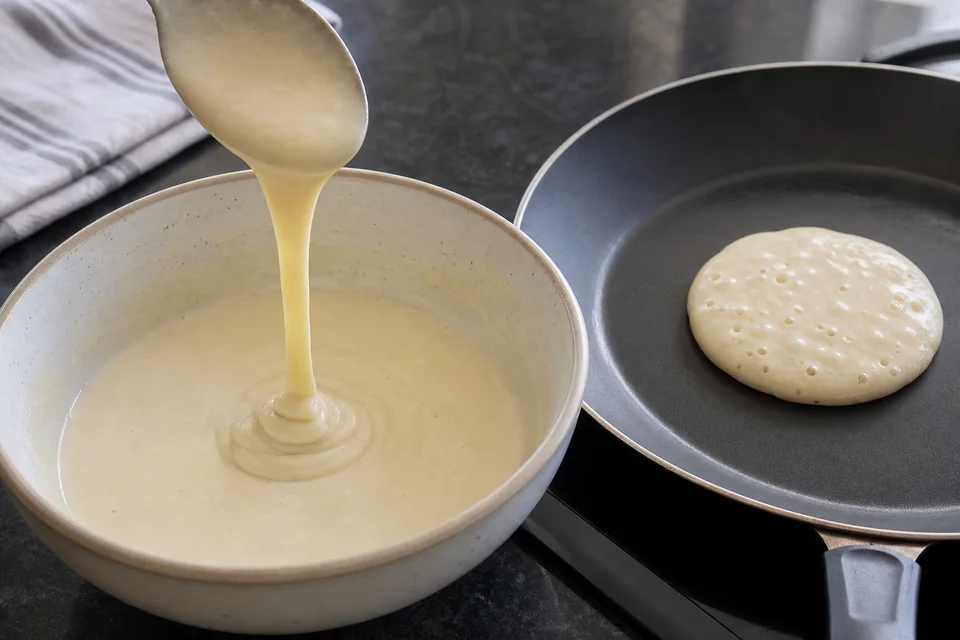
Use the ribbon only after the dry ingredients have been fully moistened and the batter has rested for five minutes. Flour keeps taking up liquid during that interval. A mixture that seemed slightly loose immediately after stirring may settle into a useful flow without any correction.
Small lumps do not make the test invalid. They often disappear as hydration continues. Scrape the bowl to ensure no dry pocket remains, but do not beat the mixture until it resembles a drink; excessive mixing can change texture without solving a proportion error.
The pan-spread test
Pour a small, measured portion onto a moderately heated, lightly greased skillet. A useful batter spreads somewhat under its own weight and then slows, leaving enough depth for a tender centre. If it remains in a steep mound, it is probably too stiff for that portion and heat. If it immediately forms a thin puddle, it is probably too loose or the pan is insufficiently hot.
Heat can imitate a consistency problem. On a cool surface, even a balanced batter continues spreading before its edge sets. On an overheated surface, the bottom fixes instantly and traps a thick centre. Let the pan preheat gradually and use the same small portion before rewriting the batter.
Wait for a defined edge and bubbles that begin to leave open holes. Those are more informative turning signals than a fixed number of seconds. The full cue sequence is covered in when to flip pancakes.
The cut-crumb test
After turning and cooking the tester, cut through its thickest point. A correct batter-and-heat combination produces a set, even crumb with no shiny paste. A narrow damp line can mean the cake was too large, turned early, or cooked over heat that coloured the exterior too quickly.
A tight, bread-like centre can come from a stiff batter, too much flour, or extended mixing. It is not proof that more baking powder is required. A wide, fragile cake with sparse bubbles can reflect excess liquid, weak leavener, or a pan too cool to set the structure.
When density is the main symptom, compare the possibilities in why pancakes turn dense. When the batter never develops or holds lift, use the separate diagnosis for why pancakes turn flat.
How different no-milk liquids affect the bowl
Water is the simplest substitution because it adds hydration without the fat, protein, or sugar found in many milk products. It can produce a clean-tasting pancake, though the flavour may be leaner and browning may be lighter. Fat already present in the formula becomes more noticeable.
Unsweetened soy beverage often brings more protein than many other plant beverages and may make a familiar batter feel relatively substantial. Oat beverages vary: some are thin, while barista-style products may contain added oil or stabilisers and flow more slowly. Almond and rice beverages can be comparatively light, but labels and brands differ.
Sweetened or flavoured drinks affect more than sweetness. Added sugar can darken the surface faster, so a medium-brown pancake may appear before its centre is ready. Lower the heat instead of thinning the batter merely because colour develops quickly.
Acidified plant beverages can work in formulas designed around acidity, but baking soda needs the correct acid balance. Do not add soda to a neutral recipe just because the dairy milk is absent. Baking powder and baking soda are not one-for-one substitutes.
A measured correction sequence
First, wait five minutes. Second, confirm the pan is properly preheated. Third, cook a small tester. Only then change the bowl. This order prevents a cool-pan problem from becoming a runny-batter problem after an unnecessary splash.
For batter that barely leaves the spoon, add one tablespoon of the same liquid used in the recipe. Fold it through gently, wait a minute, and repeat the ribbon check. Large additions are difficult to reverse and can dilute salt, sugar, and leavener as well as flour.
For batter that flows like cream and spreads too far on a proven hot pan, place one tablespoon flour in a cup. Stir in a spoonful of batter until smooth, then fold the paste into the bowl. This avoids hard flour beads. Rest again before deciding whether a second tablespoon is needed.
If the tester is thin but structurally sound, a smaller portion may be the best correction. If it is thick outside and raw within, reduce portion size and heat together only when the surface is also browning too fast. Otherwise change one variable so the next result remains interpretable.
Avoiding hidden measurement errors
Flour measured by volume is easily compressed. Scooping directly with the cup can add enough flour to make a no-milk batter look as though the substitute failed. Weigh the flour when possible. Otherwise loosen, spoon, and level it consistently.
Liquid markings also need a level surface and eye-level reading. A tablespoon intended as 15 millilitres is not a casual pour. Consistent tools are especially important when you are making corrections in small increments.
Check that the cup used for plant beverage is not carrying settled sediment or a thick layer left in the carton. Shake the package as directed before measuring. When trying a new product, note whether it is sweetened and whether the ingredient list includes added oils or stabilisers.
Mixing and resting without dairy milk
Whisk the dry ingredients thoroughly before adding liquid so leavener and salt are evenly distributed. Whisk egg, liquid, and fat separately, then combine. Stop once no dry flour remains. The absence of dairy milk does not make prolonged beating helpful.
A short rest can make the ribbon thicker as flour hydrates. Ten minutes is generally enough for a quick batter; this is not an instruction to hold an egg batter at room temperature for hours. If breakfast must be staged in advance, measure dry and wet components separately and combine near cooking time.
Fat may behave differently in a cold plant beverage. Melted butter can firm into small flakes, while neutral oil stays fluid. Butter flakes are not automatically harmful, but bringing the liquid closer to room temperature makes the mixture easier to combine.
Troubleshooting by symptom
If the batter is thick and the tester is dense, confirm the flour amount before adding more leavener. Use small liquid additions and mix minimally. If the batter looks normal but the tester is dense, consider overmixing, weak leavener, or heat that is too low.
If batter is loose and pancakes tear, verify pan heat and wait for a stronger edge before turning. Then reduce the portion. Only thicken the bowl when the tester still spreads excessively on a known-ready surface.
If pancakes are flat but tender, the style may simply be thinner than expected. If they are flat and gummy, check the leavener, measurement, and cooking sequence. Avoid doubling baking powder as a universal rescue; excess can harm flavour and structure.
If the first cake is dark and wet, the mixture may be fine. Lower the heat and make a smaller tester. Surface colour is influenced by sweeteners and the pan’s retained heat, so it cannot diagnose hydration on its own.
Food safety and dietary boundaries
Do not taste uncooked batter. Flour is a raw agricultural product, and batter made with egg also requires careful handling. Wash the spoon used for the ribbon test before it touches cooked food, clean splashes, and cook each centre until set.
A plant beverage does not automatically make a pancake vegan, allergen-free, or suitable for a specific medical diet. Egg, butter, shared equipment, and the beverage itself all matter. Read every label and make a separate recipe choice when dietary exclusion is important.
Frequently asked questions
Can I use water instead of milk?
Yes, in many simple formulas, but expect less richness and possibly lighter browning. Keep the recipe’s egg and fat unless you are following a tested formula that changes them, then judge the first cake before adjusting hydration.
Should oat-beverage batter be thicker?
Not by rule. Oat products vary considerably. Judge the ribbon, pan spread, and cooked centre rather than targeting a brand-independent thickness.
Why did the batter thicken while resting?
Flour continued to absorb liquid, and some beverages contain components that also increase viscosity. If the rested mixture will not spread on a ready pan, add the same beverage one tablespoon at a time.
What if the clues conflict?
Keep the bowl unchanged, cook a smaller tester over corrected heat, and compare. If the result still conflicts, use Pancake Troubleshooting to separate batter, pan, and timing causes.
Sources and editorial references
- Colorado State University Extension, “Ingredient Substitutions” —
https://extension.colostate.edu/topic-areas/nutrition-food-safety-health/ingredient-substitutions-9-329/ - Ohio State University Extension, “Favorite Pancakes” —
https://extension.oregonstate.edu/food/recipes/favorite-pancakes - King Arthur Baking, “Dairy-Free Pancakes” —
https://www.kingarthurbaking.com/recipes/dairy-free-pancakes-recipe - U.S. Food and Drug Administration, “Handling Flour Safely: What You Need to Know” —
https://www.fda.gov/consumers/consumer-updates/handling-flour-safely-what-you-need-know - U.S. Department of Agriculture Food Safety and Inspection Service, “Shell Eggs from Farm to Table” —
https://www.fsis.usda.gov/food-safety/safe-food-handling-and-preparation/eggs/shell-eggs-farm-table
For more practical food and breakfast guides, visit Pancakes World.
For the wider topic, start with Guides/pancake Ingredients.
For a closely related guide, see Yogurt in Pancake Batter: Control Acidity, Moisture and Spread.
A useful next comparison is Pancake Batter vs Crêpe Batter: What Changes?.
You can also continue with Classic Buttermilk Pancakes.
