Pancake Batter vs Crêpe Batter: What Changes?
Pancake and crepe batters can share flour, milk, eggs, and fat, yet they are designed to behave differently: pancake batter holds a thicker layer and often traps leavening gas, while crepe batter spreads into a thin film. Pancake World Home Page. The useful comparison is not a single ratio; it is the chain from fluidity and mixing through heat, setting, and the texture you want on the plate.

Pancake Ingredients and Substitutions
The short answer: depth changes the job of the batter
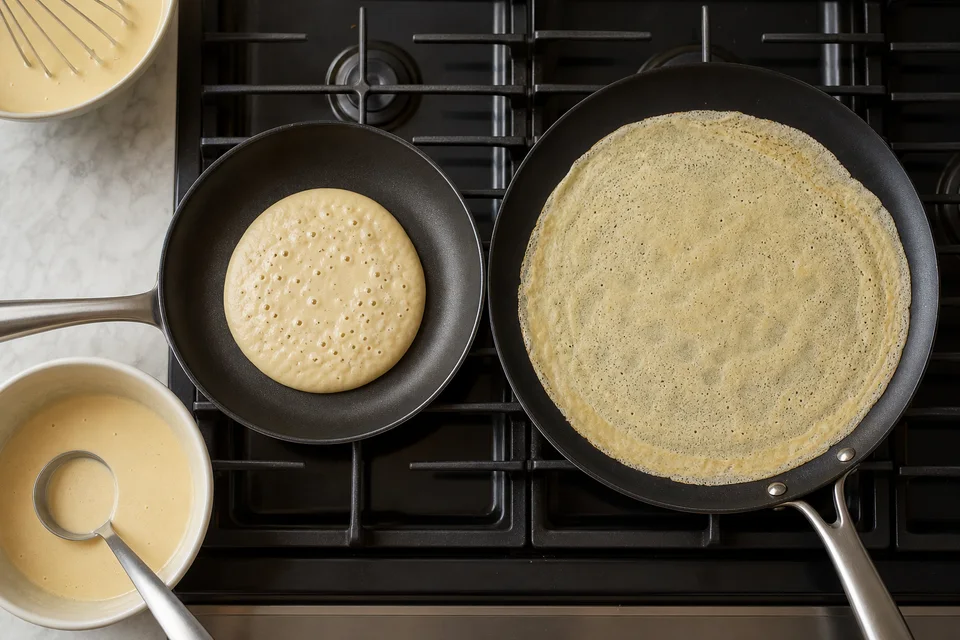
A conventional pancake batter is usually meant to stay in a small, deep pool after it reaches the pan. That gives it time to set around bubbles and produce a tender, thicker interior. A crepe batter is meant to move quickly across a broad surface, leaving a thin coating that cooks before it can rise very far. The essential variable is flow before the structure sets: a batter that spreads freely supports a thin crepe; one that spreads slowly supports a thicker pancake.
That is why a recipe cannot be converted reliably by merely adding liquid. Flour type, egg amount, fat, resting, pan size, and leavening all change how water is held and how the cooked sheet or cake sets. The comparison below describes tendencies rather than a universal formula, because each recipe and pan creates its own working range.
What changes with the amount of liquid
| Batter condition | What it does before setting | Likely cooked result |
|---|---|---|
| Relatively fluid, pourable crepe batter | Runs across the pan when the pan is tilted; gravity and the pan motion determine thickness. | A thin, flexible layer with little room for a tall crumb. |
| Thicker pancake batter | Spreads more slowly and stays deeper where it is poured. | A thicker piece that can retain gas cells as heat sets the structure. |
| Extra liquid added to either formula | Changes flow, but also changes the balance between water, starch, proteins, and fat. | May make spreading easier, but does not by itself guarantee tenderness, strength, or a successful flip. |
Flour and hydration: why the same ingredient list can behave differently
When flour meets liquid, starch and proteins take up water. The resulting suspension has a practical viscosity: it either travels across the pan or resists movement. Research on pancakes made from different wheat flours found that flour protein quantity and quality, along with pasting properties, were associated with batter flow, pancake diameter, and cooked texture. That supports a careful kitchen conclusion: flour is an active structural variable, not inert bulk. A change of flour can change spreading even when the measured liquid stays the same.
For a crepe, the objective is usually even coverage. A fluid batter can be swirled into a thin layer, but it still needs enough cohesion to lift after cooking. For a pancake, some resistance to flow is useful because a very thin pool has little height to preserve. If you are choosing wheat flour for a pancake-style batter, the guide to all-purpose, cake and bread flour in pancakes gives a related way to think about flour strength without treating one flour as best for every style.
Resting can alter how a particular batter looks and pours because ingredients continue to hydrate, but it is not a universal rescue. A crepe formula may be deliberately thin from the start; a pancake formula may be deliberately thicker and chemically leavened. Use the recipe's intended consistency as the reference, then make only one small change at a time if you are adapting it.
Eggs and fat help a thin batter become a handleable cooked layer
Eggs
Egg proteins change under heat and contribute to the set of a cooked batter. In a thin crepe, that set helps create a sheet that can be turned or folded; in a pancake, it contributes alongside flour and starch to the interior structure. Eggs also bring water and yolk components, so replacing or increasing them changes more than one variable. See why pancake recipes include eggs for a focused explanation of those roles.
Fat
Melted butter or another fat can change lubrication and mouthfeel, but temperature and mixing matter. If very warm fat is combined carelessly with a cool egg-rich mixture, the mixture may become uneven before it reaches the pan. The guide to why pancake batter separates while it rests helps distinguish ordinary settling or fat redistribution from a reason to redesign a formula.
The boundary
Neither eggs nor fat create the defining difference alone. A crepe can be egg-rich and still fail to spread if it is too thick; a pancake can contain eggs and still be flat if it has no depth or usable leavening. The mechanism is the combined system: composition controls flow, and heat fixes the shape that flow produced.

Leavening explains height, not every texture difference
Many pancake formulas use baking powder, baking soda with an acidic ingredient, or both. These chemical leaveners generate carbon dioxide in a wet batter; when the batter is deep enough and begins to set, gas cells can contribute to a lighter, thicker interior. A classic crepe is commonly made without this goal, because a large rise would work against an even, thin sheet. Leavening is therefore a design choice tied to thickness, not a rule that every pancake must follow or every crepe must reject.
Do not assume a spoon-for-spoon swap between baking soda and baking powder. Soda needs an appropriate acid; baking powder contains its own acid components, and products differ. If you want a low-profile pancake rather than a tall one, start with a formula designed for that target instead of removing an ingredient from a thick pancake recipe and expecting the same result. The guide to deliberately thin, tender pancakes is a useful comparison when the desired result is thin but not necessarily a classic crepe.
This explanation has a limit: bubbles do not prove that a batch will be airy, nor does the absence of visible bubbles prove a crepe is wrong. Pan heat, batter depth, mixing, and the formula's intended style also affect the final surface and texture.
Pan geometry completes the difference
A crepe pan or broad skillet makes the thin-batter goal visible: immediately after pouring, the cook tilts or uses a spreader to distribute the batter. The thin film heats quickly because it has a short distance from surface to center. A pancake is usually portioned and left to find its own diameter, so its depth persists while the first side cooks. The pan is part of the formula's mechanism because it determines how much surface is available and how the batter can be moved.
If you want to make thin pancakes on a crepe maker, do not judge the result by the height of a diner-style pancake. The guide to deliberately thin, tender pancakes gives a useful adjacent comparison: a thin pancake can be intentional, but it still has a different target from a crepe's even, foldable sheet.
A useful hypothetical comparison is to pour the same small amount of a thin batter into two cold, identical pans, then spread only one. The spread batter will cover more area and form a thinner cooked layer; that shows geometry, not a claim that one method is universally better. For ordinary cooking, use a preheated pan and follow the formula's visual cues rather than copying a fixed timing claim from another recipe.
If you are adapting a batter, change the target—not just an ingredient
| Your target | Primary adjustment to consider | What to watch |
|---|---|---|
| A thinner, crepe-like layer | Use a formula intended to spread, then work with its stated liquid and pan method. | Whether it covers the pan evenly and releases as a flexible sheet. |
| A thicker, pancake-like piece | Use a formula intended to hold depth, including its specified leavening if it has any. | Whether the portion spreads too far before the first side begins to set. |
| A flour change | Treat it as a new trial: flour affects water demand and structure. | Flow first, then the cooked texture; do not assume a one-to-one liquid correction. |
| A no-egg or specialty-flour version | Choose a tested formula for that ingredient system rather than subtracting from a conventional one. | Binding, spread, and tenderness may all move together. |
Troubleshoot the target texture before changing the formula
A crepe batter will not cover the pan
First separate a flow problem from a handling problem. If a batter remains in a thick pool after a prompt tilt, it may be outside the formula's intended flow range; if it flowed but set in ridges, the pan motion or timing may be the more useful variable. Do not solve either observation by adding several ingredients at once. Compare one small test portion with the written formula, then decide whether the next batch needs a recipe-specific adjustment or a different spreading motion.
A pancake batter spreads as if it were crepe batter
Check portion depth and the formula's target before declaring the batter wrong. A deliberately thin pancake can be successful, while an intended thick pancake that runs wide may have too little resistance to flow or may be meeting a pan condition that changes its first moments of cooking. The useful next step is to return to one controlled variable—formula, portion, or pan handling—rather than trying to create height with an arbitrary extra spoonful of flour or leavener.
The practical distinction
Choose pancake batter when you want depth
A pancake batter is organized around controlled spread, a thicker portion, and often leavening that can be retained while the interior sets. Its goal is not merely to be thicker; it is to make a tender cooked piece with height and a soft middle.
Choose crepe batter when you want coverage
A crepe batter is organized around fluidity, rapid distribution, and a thin set layer that can be folded or filled. Its success is evenness and flexibility, not loft. Keeping that goal clear prevents unhelpful fixes such as adding leavening to a thin-batter problem or adding liquid to solve a pan-handling problem.
Sources and editorial references
Original editorial explanation based on the cited food-science sources. It describes recipe design tendencies and observable results, not universal ratios, nutritional claims, safety advice, or personal kitchen tests.
- Influence of physicochemical characteristics of flour on pancake quality attributes: https://pmc.ncbi.nlm.nih.gov/articles/PMC6423256/
- The Difference Between Baking Soda and Baking Powder: https://news.ncsu.edu/2014/05/baking-soda-powder/
- Nutritional Aspects of Eggs for a Healthy and Sustainable Consumption: A Narrative Review: https://pmc.ncbi.nlm.nih.gov/articles/PMC12411868/