
Quick answer
Pancake recipes include eggs because a whole egg can help the cooked pancake hold together while also contributing liquid, yolk richness, and ingredients that help fat and water mix. Egg proteins change as the batter cooks and can become part of the pancake’s set structure. Components in the yolk can support emulsification, which means helping ingredients that do not naturally stay mixed form a more stable mixture.
That does not make eggs a universal requirement or a guarantee of fluffy pancakes. Some formulas are designed without them, and flour, starch, dairy, leavening, fat, mixing, portion depth, and cooking all affect the result. The useful question is therefore not simply “What does egg do?” but “What job is the egg doing in this particular recipe?”
If you change the egg, keep the rest of the formula and method stable for the first test. Compare the cooked structure, tenderness, moisture, flavor, color, and ease of flipping. Those observations are more reliable than assuming that every batter needs the same egg ratio.
How egg proteins help pancakes set
Egg whites and yolks both contain proteins. As heat reaches the batter, those proteins unfold and join into a firmer network, a process commonly described as coagulation. In a pancake, that network can contribute to the structure that remains after the batter changes from fluid to cooked. This is one reason an egg-containing pancake may be easier to lift or turn than the same untested formula with the egg simply removed.
Egg is not the only structural ingredient. Hydrated flour and starch also contribute to the cooked body, and the amount of each ingredient changes their relative importance. A recipe deliberately developed without egg may use a different balance and work well. Conversely, adding an extra egg to a proven egg-free formula is not automatically an improvement.
Judge structure after the pancake has had time to set according to its recipe. If it tears during the turn, first distinguish a formula change from handling: a crowded pan, an awkward tool, or moving the pancake before its underside supports it can produce a similar symptom. The focused guide to pancakes that fall apart provides a broader diagnostic path.
What the yolk contributes
The yolk contains ingredients that can act as emulsifiers. An emulsifier helps water and fat remain dispersed instead of separating quickly. In a pancake formula containing both watery and fatty ingredients, that function can support a more even batter. The American Egg Board is an industry source for this technical function, so this article uses it only for the bounded explanation of emulsification, not for a claim that yolk guarantees one pancake texture.
Yolk also brings its own fat, solids, color, and characteristic flavor. How noticeable those contributions become depends on the rest of the formula. A strongly flavored batter or a recipe with another substantial fat source may make the change less obvious; a simple batter may make it easier to notice. Color is especially dependent on ingredients and cooking, so a yellow crumb or browned surface should not be treated as proof of a particular egg quantity.
If you are testing yolk separately, use a formula written for that test or change one variable in a small portion. Do not assume that one yolk replaces one whole egg: removing the white also removes water and protein, while adding yolk changes the balance in a different direction.
Moisture, color, and flavor
A whole egg contributes both water-rich white and yolk solids. Removing it without adjusting anything else changes more than one property at once. The batter may become thicker or looser depending on what replaces the egg, and the cooked pancake may seem drier, more fragile, softer, firmer, richer, or less rich depending on the complete formula. These are possible observations, not universal outcomes.
Surface color is also a poor single-variable test. Pan temperature, sugar, milk solids, fat, contact time, and the condition of the cooking surface all influence browning. If a pancake is pale or dark, do not diagnose the egg quantity from color alone. Compare it with a control pancake from the unchanged recipe and record the conditions.
Flavor works the same way. Egg can be noticeable in a simple batter, but a stronger egg aroma may also reflect recipe proportions or cooking conditions. Avoid trying to hide an unwanted result by changing several seasonings at once. A controlled next batch will tell you more.
Whole egg versus white versus yolk
The three options are related but not interchangeable:
- Whole egg supplies white and yolk together, combining their water, proteins, yolk fat, solids, and emulsifying contribution in the ratio naturally present in that egg.
- Egg white emphasizes water and proteins while leaving out the yolk’s fat and emulsifying contribution. Whipping may introduce air, but whether that air survives mixing and cooking depends on a specific method.
- Egg yolk adds yolk proteins, fat, solids, flavor, color, and emulsifying ingredients without the white’s full water and protein contribution.
For a dedicated discussion of removing the yolk, use the egg-white pancake guide. Keeping that question separate prevents advice for whipped whites or yolk-free batter from being misapplied to an ordinary whole-egg recipe.
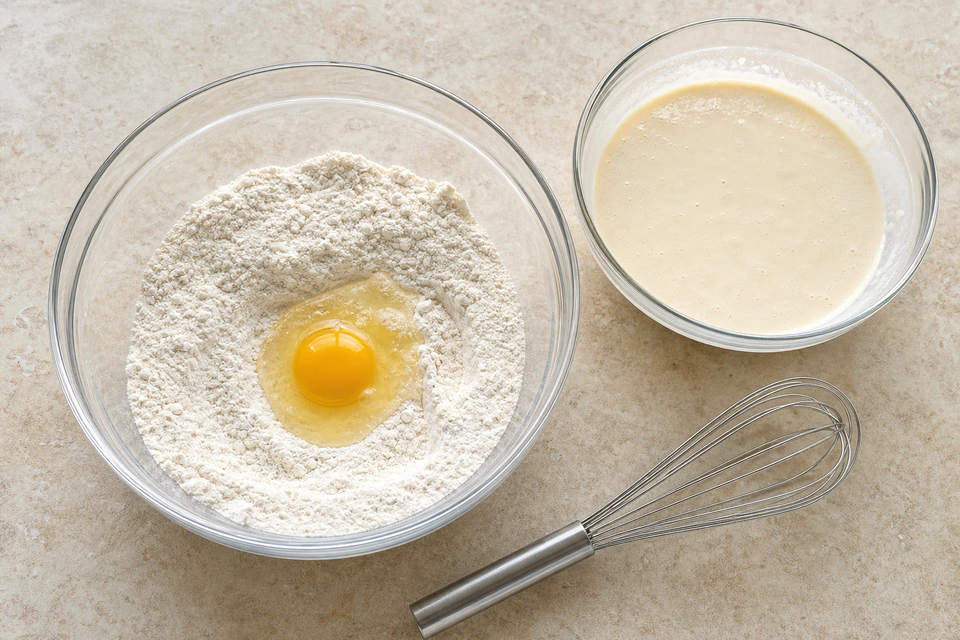
What happens if you omit or substitute the egg
If you omit an egg from a recipe that was formulated with one, the result may lose some structure, liquid, emulsification, richness, color, or flavor. Which change matters most cannot be known from the ingredient list alone. A formula with a large egg contribution is not the same experiment as a formula in which egg is a small part of the batter.
There is no approved universal substitute ratio in this guide. Commercial replacers, starch mixtures, fruit purees, seeds, dairy ingredients, and other substitutions change different properties and can bring their own flavors or allergens. Follow a tested egg-free recipe or the instructions for the specific substitute instead of treating every replacement as a one-for-one functional match.
For a useful test, make a control from the original recipe and one adjusted small batch. Keep flour, liquid, leavening, fat, mixing, rest, portion, and pan conditions as consistent as practical. Note whether the adjusted pancake spreads differently, releases cleanly, bends or breaks when lifted, and feels dry, moist, tender, or firm once cooked. That record supports the next decision without turning one kitchen result into a rule for all pancakes.
What changing egg quantity may do
Adding more egg changes the recipe’s total liquid and solids as well as its protein and yolk contribution. Reducing egg changes the same balance in the opposite direction. Either change can affect batter flow, set, flavor, and texture, but “more egg means better binding” is too simple: an altered formula may become unlike the pancake the recipe was designed to make.
When scaling a recipe, scale all ingredients together using the recipe’s method. Do not round the egg component casually in a small batch. If the scale produces an awkward partial egg, weigh a thoroughly mixed egg only when the recipe developer permits that method, or choose a batch size that uses whole units. This is portioning advice, not a universal egg-to-flour rule.
Make the first changed portion modest and observe it. If it spreads much more than the control, compare batter quantity and total liquid. If it is unusually firm or egg-forward, return to the original formula before changing another variable. If it is fragile, do not automatically add another egg; confirm that it was cooked and handled according to the recipe first.
Troubleshooting structure problems
Start with the dominant symptom rather than the ingredient you suspect:
| What you observe | First question | Focused guide |
|---|---|---|
| The pancake tears during lifting or turning | Did it have enough support, and was handling consistent? | Why pancakes fall apart |
| The pancake is heavy or compact | Is density the main texture problem rather than breakage? | Why pancakes are dense |
| The pancake has little height but a normal cooked center | Is this primarily a rise question? | Why pancakes are flat |
| The adjusted batter behaves differently from the control | What was the single measured change? | Return to the original recipe and repeat one controlled test |
For a current mixed batch, avoid chasing the result with repeated additions. Record the formula and cook a small test pancake. For the next batch, measure the egg and other ingredients consistently, use the original mixing sequence, and compare one change at a time. That approach preserves diagnostic value and reduces waste.
Egg and raw-batter safety
Raw and undercooked shell eggs can carry foodborne illness risk. Keep eggs refrigerated, prevent raw egg from contaminating ready-to-eat food and surfaces, wash hands and utensils after contact, and cook egg-containing food appropriately. Follow the recipe and current official food-safety guidance rather than using taste, color, bubbles, height, or a browned edge as proof of safety.
Do not taste raw pancake batter. If an egg is cracked, dirty, leaking, or has an uncertain handling history, do not rely on appearance or smell to restore that missing history. People at greater risk from foodborne illness should follow the stricter advice provided by their local health authority. This article explains ingredient function; it does not provide medical or allergy-safety assurance.
Frequently asked questions
Are eggs necessary in every pancake recipe?
No. Eggs perform useful functions in many formulas, but tested egg-free pancakes exist. Use a recipe designed for the ingredients you intend to use rather than deleting egg from an unrelated formula and expecting the same result.
Do eggs make pancakes fluffy?
Eggs can contribute structure, and whipped egg methods may use incorporated air, but fluffiness is not guaranteed by egg alone. Leavening, flour, liquid, mixing, portion depth, and cooking also matter. If low height is the main symptom, use the flat-pancake guide.
Is the white or yolk more important?
They do different jobs. White contributes water and proteins; yolk contributes proteins, fat, solids, flavor, color, and emulsifying ingredients. Their importance depends on the recipe, so neither is universally “the important part.”
Can I add an extra egg to stop pancakes falling apart?
Not as a universal fix. First check the original formula, measurement, cooking stage, and handling. An extra egg changes liquid and solids as well as protein, so it can create a different result.
Can I replace an egg with the same amount of any wet ingredient?
No. Equal volume does not mean equal function. A replacement may supply moisture without the same proteins, fat, or emulsification. Use tested replacement instructions or an egg-free recipe.
Why does my pancake taste strongly of egg?
The egg proportion, other flavor ingredients, and cooking can all matter. Confirm that the recipe was scaled correctly and compare it with the unchanged formula before reducing egg or adding masking flavors.
Related Pancake World guides
Start with the American Pancakes guide for a relevant complete-pancake reference. Read using only egg whites in pancakes for the yolk-free focus. For visible symptoms, choose pancakes that fall apart, dense pancakes, or flat pancakes rather than applying an egg change to every problem.
Sources and editorial references
American Egg Board, Coagulation and thickening — https://www.incredibleegg.org/professionals/manufacturers/real-egg-functionality/coagulation-thickening/
American Egg Board, Emulsification — https://www.incredibleegg.org/professionals/manufacturers/real-egg-functionality/emulsification/
USDA Food Safety and Inspection Service, Shell eggs from farm to table — https://www.fsis.usda.gov/food-safety/safe-food-handling-and-preparation/eggs/shell-eggs-farm-table
For more practical food and breakfast guides, visit Pancakes World.
For the wider topic, start with Guides/pancake Ingredients.
A useful next comparison is How to Fold Whipped Egg Whites into Pancake Batter.
You can also continue with Cassava Flour Pancakes: Avoid a Gummy Center.