
The short answer
Yes, you can make pancakes using egg whites without yolks. The result depends on the recipe and method. Egg whites can help create structure as their proteins set during cooking, and whipped whites can hold air that may contribute to a lighter texture when handled carefully. Removing the yolks also removes yolk components that would otherwise contribute richness, color, tenderness, and emulsifying capacity.
That trade-off is why an egg-white pancake should be treated as its own formula, not as a guaranteed one-for-one copy of a whole-egg pancake. Simply discarding the yolks from any recipe can produce pancakes that seem paler, drier, firmer, less rich, or more fragile. A recipe designed for whites only is the most predictable starting point.
This guide gives a practical, non-universal workflow. It does not publish a blanket substitution ratio, a required foam stage, a fixed fold count, or a guaranteed height. Those details depend on the recipe, the egg-white product, the other ingredients, and the cooking method.
What changes when the yolks are removed
A whole egg is not one uniform ingredient. The white is mostly the part relied on here for protein structure and, when whipped, foam. The yolk brings a different mix of components to a batter. Removing it changes more than color.
First, the batter loses some richness and flavor associated with yolk. The finished pancake may taste cleaner or more neutral, but it can also seem less rounded if the rest of the recipe was built around whole eggs. Flavor can be adjusted within a tested recipe with ingredients such as vanilla, spice, fruit, or a suitable fat, but no single addition is a universal replacement for every function of yolk.
Second, tenderness can change. Egg-white proteins form a network as they set with heat. That network can support a pancake, but an overly dominant protein structure or excessive handling can contribute to a firm, springy, or rubbery bite. This is a bounded functional explanation, not a diagnosis for every tough pancake.
Third, the batter may be less naturally emulsified than a whole-egg formula. If a recipe contains fat and water-based ingredients, a method designed for egg whites may arrange mixing differently to keep the batter coherent. Do not assume that extra mixing is the solution; working a conventional wheat batter too much can create a different texture problem.
Finally, the surface and crumb may be paler because the formula no longer includes yolk color. Browning still depends on the complete recipe and cooking conditions. Color alone cannot tell you whether the interior is properly cooked or safe.
How egg-white proteins and foam affect structure
The approved technical evidence supports two limited ideas. Egg proteins can coagulate, or set, when heated, helping create structure. Egg whites can also be whipped into a foam that traps air. Neither fact proves that every egg-white pancake will be fluffy, nor does it specify the ideal foam stage for every recipe.
Whipping changes the physical form of the whites. A whisk or mixer introduces air while the proteins help stabilize many small bubbles. The foam is still delicate. Rough stirring can collapse part of it, while a foam taken too far for a particular recipe may be difficult to combine evenly. Because formulas vary, visual stages such as “soft” or “stiff” should follow the selected recipe rather than become universal pancake law.
During cooking, the batter’s structure develops from the combined recipe, not the egg whites alone. Flour or another base, liquid, leavening where used, fat, sugar, and heat all affect the result. Foam cannot compensate reliably for an untested ingredient balance or an unsuitable cooking method.
The useful mental model is simple: the whites can provide structure; whipped whites can carry air; gentle incorporation tries to retain useful air without leaving unmixed pockets. This explains the method without promising a particular height, volume increase, or crumb.
A practical approach
Start with a pancake recipe expressly written for egg whites, or a recipe that gives a tested egg-white variation. If you are adapting a whole-egg recipe, treat the first batch as an experiment and avoid serving the adaptation as a proven substitution.
1. Read the formula before separating eggs
Check whether the recipe uses liquid whites or whipped whites. Note when they are added and whether another ingredient supplies fat or richness. Do not remove yolks and then improvise multiple corrections at once. The more variables you change, the harder it is to understand the result.
2. Keep the equipment clean for whipping
When the method calls for foam, use a clean bowl and clean whisk or beaters. Follow the selected recipe’s instructions for the whites and equipment. This page intentionally does not set a universal temperature, whipping speed, duration, or peak stage.
3. Mix the base batter only as directed
Combine the non-foam portion according to the recipe. For a conventional wheat batter, do not keep stirring merely to remove every small lump unless the method specifically requires that. The egg-white step does not cancel the usual need to avoid unnecessary handling.
4. Fold rather than beat when the recipe says to fold
Add a portion of foam as directed, then use a spatula to bring batter from the bottom over the top. Turn the bowl and continue only until the recipe’s intended mixture is reached. The goal is even enough incorporation without aggressively beating out all the air.
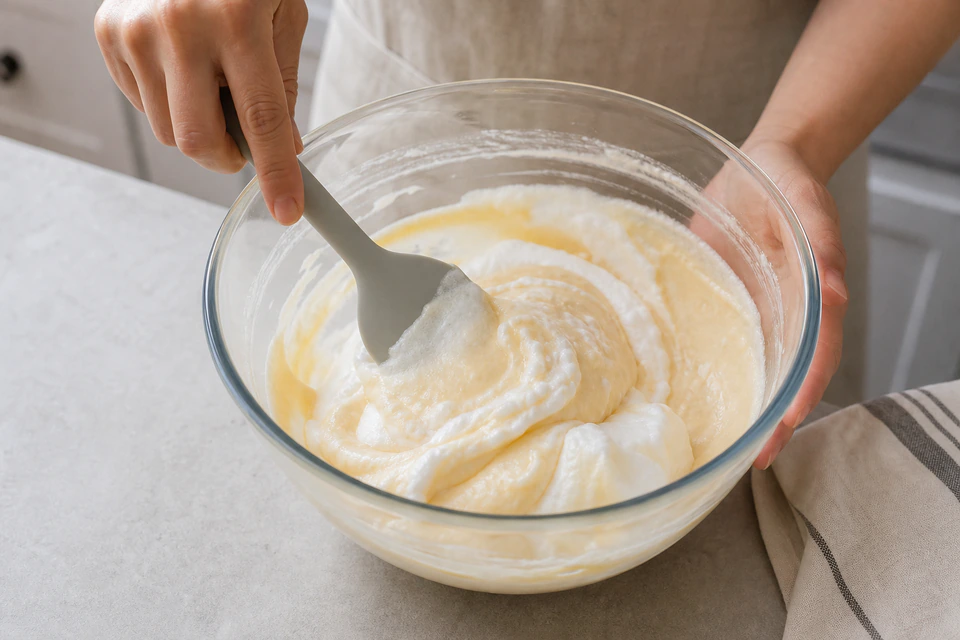
The process photograph illustrates partial incorporation. It does not define a mandatory foam stage or finished consistency. Use the picture as orientation, not as a quantitative endpoint.
5. Cook according to the chosen recipe
Use the pan, portion, heat guidance, turn cues, and completion method supplied by the recipe. This guide does not replace them with a fixed temperature or number of minutes. Surface bubbles, browning, and dry-looking edges can be recipe-specific cues, but none is a universal food-safety test.
6. Record one result before changing the next batch
Note the recipe, type of whites, whether they were whipped, how the batter was combined, and the observed crumb. Change one factor at a time. A modest batch log is more useful than simultaneously adding liquid, fat, leavener, and extra foam.
Adjusting texture and flavor
An egg-white formula may need design choices that a whole-egg formula does not. Adjustments belong to the recipe, not to a universal rescue chart.
If the pancakes seem dry, first verify that the recipe was followed and not overcooked. Then choose a tested recipe with an intentional source of fat or moisture rather than pouring an arbitrary amount into the remaining batter. A topping can make a finished pancake more pleasant to eat, but it does not retroactively change the crumb.
If the flavor seems lean or neutral, use serving ingredients or a recipe-tested flavoring. Fruit, spice, vanilla, yogurt, syrup, or savory toppings can change the eating experience, but the right choice depends on the formula and dietary needs. This page does not claim that one ingredient replaces yolk in every respect.
If the pancakes seem firm, separate cooking from mixing. A firm surface may reflect the cooking method; a springy crumb may reflect the formula or handling. Avoid assuming that more whipped air will automatically solve it. More foam can also make incorporation and portioning harder.
If the pancakes are fragile, do not immediately add another white. The batter may need a recipe-specific binder or a different ingredient balance, but the approved evidence does not release a universal correction ratio. Use a tested egg-white recipe or compare the current method with the whole-egg function guide.
Troubleshooting egg-white pancakes
Dense or low pancakes
Check whether the method actually called for whipped whites and whether they were incorporated as directed. Foam can be lost through rough handling, but low height is not proof that folding caused the problem. The recipe’s leavening, batter weight, pan method, and ingredient balance also matter. Use Why Are My Pancakes Flat? to keep the symptom separate from unsupported universal fixes.
Dry pancakes
Confirm the ingredients and the cooking method before altering the batter. Removing yolks can reduce richness, but dry texture does not establish one cause. Do not add an unmeasured splash of liquid to the whole bowl and assume the issue is solved. Try a recipe intentionally balanced for whites only.
Rubbery or springy pancakes
Egg-white proteins provide structure, but “more structure” is not always a better bite. Review whether the recipe used a large amount of white, whether the batter was worked more than directed, and whether the pancakes were cooked beyond the selected method. These are checks, not a categorical diagnosis. The rubbery or gummy pancake guide explains why a tough bite and a wet center must be treated as different symptoms.
Fragile pancakes that tear when turned
Use the recipe’s portion size and turn method. A fragile pancake does not automatically need more white, more flour, or longer cooking. Check whether the base batter and folded foam were combined evenly and whether any ingredient was omitted or substituted. Then use the original tested formula for the next comparison.
White streaks or foam pockets
Visible streaks can indicate incomplete incorporation. If the recipe calls for folding, continue gently only to the degree the method requires. Avoid turning this into a prescribed fold count: bowl size, tool, batter quantity, and foam condition vary.
A wet or uncertain center
Do not taste the batter or a visibly undercooked center to diagnose it. Return to the exact recipe’s cooking directions. Appearance alone is not a safety test, and this guide does not publish a universal time or internal endpoint for all pancake formulas.
Carton and powdered egg whites
Carton whites and powdered egg-white products can be convenient, but they are not automatically equivalent to freshly separated shell whites in every method. Processing and product formulation may affect how a product is intended to be measured, reconstituted, whipped, stored, or cooked.
Follow the label for the exact product. Use its stated conversion only for that product, and check whether the manufacturer presents it as suitable for whipping. Do not transfer a spoon or volume conversion from one brand or form to another.
Pasteurized egg products still require label-directed storage and handling. “Pasteurized” does not mean the opened container can remain unrefrigerated indefinitely or that raw flour in pancake batter becomes safe to taste. Product instructions and the complete batter state still control the workflow.
Powdered whites must be reconstituted or used according to their package directions. This article does not provide a blanket water ratio. If the product is designed for a different use, select one that explicitly supports the recipe method you plan to follow.
Nutrition: what can and cannot be claimed
Using whites instead of whole eggs changes the ingredients, but that fact alone does not establish that a finished pancake is “healthy,” supports weight loss, or has a particular number of calories or grams of protein. Nutrition belongs to the complete defined recipe and serving size, including flour, liquid, fat, sugar, toppings, and the quantity eaten.
If nutrition information matters, calculate it from the exact ingredients and amounts used or rely on a recipe with a documented analysis. Do not compare a white-only pancake with a whole-egg pancake unless both formulas and serving sizes are defined. Texture and nutrition are separate questions: a paler or less rich pancake does not prove a nutritional benefit.
Raw batter and egg safety
Do not taste raw pancake batter. Raw shell egg can carry food-safety risk, and flour is also a raw ingredient. A batter containing pasteurized carton whites may still include untreated raw flour or other ingredients that are not ready to eat.
Handle shell eggs and egg products according to USDA guidance and the product label. Keep preparation surfaces, bowls, and utensils clean, avoid cross-contact between raw ingredients and ready-to-eat food, and cook using the selected recipe’s safe handling instructions.
Do not use foam volume, batter smell, surface bubbles, pancake color, or a dry-looking edge as proof of safety. If you plan to keep mixed batter, use How to Store Pancake Batter Safely and apply the ingredient-specific, time-and-temperature boundaries there. A successful foam is a quality observation, not a storage extension.
Frequently asked questions
Can I replace whole eggs with whites in any pancake recipe?
Not with a guaranteed universal result. Whites can provide structure, but removing yolks also changes richness, tenderness, color, and emulsifying behavior. Use a recipe designed for egg whites or a tested variation.
How many egg whites equal one whole egg?
This guide does not publish a blanket substitution ratio. Shell eggs vary, and carton or powdered products have their own label directions. Follow a tested recipe and the exact product instructions.
Must I whip the whites?
No universal rule applies. Some methods use liquid whites directly; others whip them to carry air. Follow the selected recipe rather than assuming foam is always required.
Should the whites be at soft or stiff peaks?
Use the stage named by the recipe. The approved evidence supports foam formation but does not establish one peak stage for every pancake formula.
Why are my egg-white pancakes rubbery?
The protein structure, formula, mixing, and cooking method can all matter, so the symptom does not prove one cause. Verify the recipe and handling, then use the focused rubbery pancake guide.
Can I use carton egg whites?
Use them when the product label and selected recipe support the intended method. Follow the label’s measurement, whipping, storage, and cooking directions rather than assuming blanket equivalence with shell whites.
Are egg-white pancakes automatically lower in calories?
No automatic claim is justified for the finished dish. Calories and other nutrition values depend on the complete recipe and serving size.
Can I save leftover egg-white batter?
Do not infer a storage window from the absence of yolks. The batter may still contain raw egg product and raw flour. Follow the exact recipe and product instructions, and read the pancake batter storage guide.
Related Pancake World guides
For the role of the complete egg, continue with Why Include Eggs in Pancakes? after that same-batch page is integrated. For symptom-led help, use Why Are My Pancakes Flat? or Why Are My Pancakes Rubbery or Gummy?. For mixed-batter handling, see How to Store Pancake Batter Safely. For broader recipe and technique context, visit the American Pancakes hub.
The planned Pancake Ingredients hub should become the primary hub link only after /guides/pancake-ingredients/ is a released destination. It is intentionally not a clickable link in this preparation copy.
Sources and editorial references
- American Egg Board: Coagulation and thickening —
https://www.incredibleegg.org/professionals/manufacturers/real-egg-functionality/coagulation-thickening/ - American Egg Board: Whipping —
https://www.incredibleegg.org/professionals/manufacturers/real-egg-functionality/whipping/ - USDA Food Safety and Inspection Service: Shell eggs from farm to table —
https://www.fsis.usda.gov/food-safety/safe-food-handling-and-preparation/eggs/shell-eggs-farm-table - USDA Food Safety and Inspection Service: Egg products and food safety —
https://www.fsis.usda.gov/food-safety/safe-food-handling-and-preparation/eggs/egg-products-and-food-safety
For more practical food and breakfast guides, visit Pancakes World.
For the wider topic, start with Guides/pancake Ingredients.
For a closely related guide, see Separated-Egg Pancakes: Balance Yolk Richness and White Foam.
You can also continue with How to Fold Whipped Egg Whites into Pancake Batter.
