Soy milk pancakes
Direct answer for soy milk pancakes
At Pancakes World, yes: unsweetened soy milk can replace the unsweetened oat or almond milk one for one in King Arthur Baking’s tested vegan pancake formula. For eight 4-inch pancakes, use 3/4 cup (170g) soy milk with 1 1/2 cups (180g) self-rising flour, 1 tablespoon sugar, 1/4 teaspoon baking soda, 3 tablespoons each of unsweetened applesauce and canola oil, and 1 tablespoon lemon juice. Mix wet and dry ingredients separately, combine gently, rest five minutes, then cook 1/4-cup portions on a 350°F griddle or over medium-low heat. Read the soy-milk label first: flavoring, added sugar, and formulation vary by product.
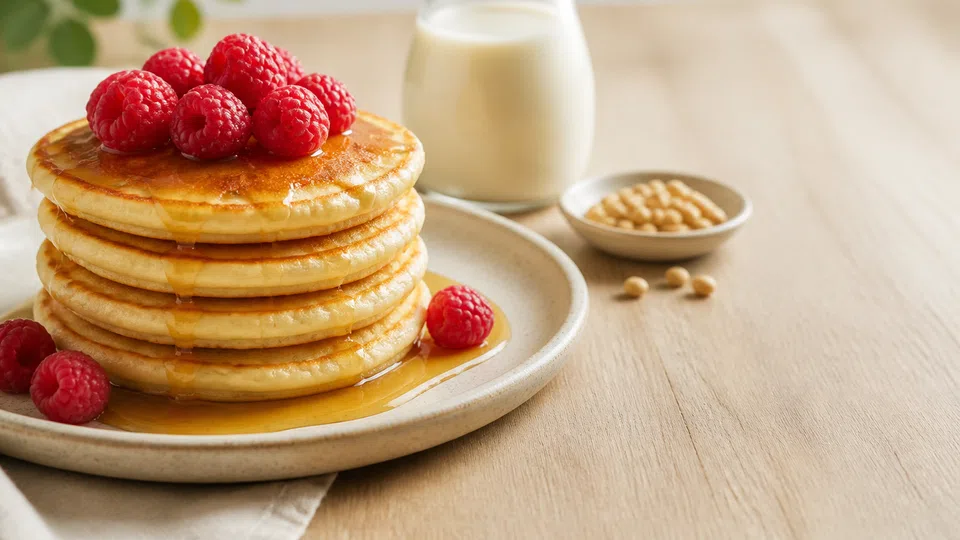
That is a source-traceable route, not a claim that any soy beverage can replace dairy milk in every pancake recipe. The rest of this guide explains which soy milk to choose, how to preserve the cited formula, what the batter checkpoints mean, and when a different pancake route is the more honest answer.
What soy milk pancakes means
Soy milk pancakes are pancakes in which a soy-based beverage supplies the recipe’s milk-like liquid. That definition does not automatically make the entire recipe vegan, dairy-free, egg-free, gluten-free, or suitable for an allergy. The other ingredients and their labels decide those questions. A conventional egg batter made with soy milk is still an egg pancake; a mix that contains milk remains a milk-containing product even when the added liquid is soy milk.
This page uses a specific vegan formula because the source explicitly authorizes soy milk as a 1:1 substitution. King Arthur Baking’s Easy Vegan Pancakes begins with unsweetened oat or almond milk, then states that soy or rice milk can be substituted one for one. That sentence supports the liquid swap inside that exact formula. It does not create a universal conversion for buttermilk, heavy cream, yogurt, evaporated milk, or an unknown boxed mix.
The route is therefore narrower than milkless pancakes, which is about making pancakes without milk when several replacement liquids may be available. It is also distinct from three ingredient pancakes, where a minimal flour-egg-milk baseline is the organizing constraint. Here, the user already chose soy milk and needs a reliable way to fit it into a pancake batter.
Soy milk is also not a neutral label. The FDA notes that plant-based milk alternatives vary with plant source, processing, and added ingredients. A carton may be unsweetened, sweetened, vanilla-flavored, fortified, shelf-stable, refrigerated, or formulated with gums, oils, salt, and other components. This article makes no nutrition ranking. It asks the cook to preserve the source formula by starting with an unsweetened product and to use the actual Nutrition Facts and ingredient list when composition matters.
Soybeans are one of the major food allergens identified in US federal labeling requirements. Replacing cow’s milk with soy milk may remove an obvious dairy ingredient, but it introduces soy and does not erase wheat or any other allergen in the recipe. For an allergy decision, read the full labels every time and consider cross-contact information; do not rely on the word “vegan” or the recipe title.
For the mechanics of hydration, leavening, and pan heat, use the Pancake Ingredients and Substitutions. This guide stays with the practical soy-milk task.
The source-based soy milk formula
King Arthur Baking publishes a vegan pancake recipe yielding eight 4-inch pancakes. Its ingredient list names unsweetened oat or almond milk, and its test-kitchen tip permits soy or rice milk as a 1:1 substitute. Using unsweetened soy milk preserves the closest disclosed match to the source’s starting liquid. Pancake World has not independently tested this batch and does not present it as a proprietary recipe.
Ingredients
- 1 1/2 cups (180g) self-rising flour
- 1 tablespoon (14g) granulated sugar
- 1/4 teaspoon baking soda
- 3/4 cup (170g) unsweetened soy milk
- 3 tablespoons (48g) unsweetened applesauce
- 3 tablespoons (37g) canola oil
- 1 tablespoon (14g) lemon juice
Optional vegan butter and maple syrup are serving additions, not part of the batter. If vegan status is important, verify every product rather than inferring from a generic ingredient name. Self-rising flour is a composite ingredient whose formulation can vary by market and brand; use the flour called for by the source rather than silently replacing it with plain flour.
Method with practical checkpoints
- Set up the holding option only if needed. The source preheats an oven to 200°F and places a cooling rack over a baking sheet. For immediate service to one or two people, the rack can still keep bottoms from steaming while the next pancakes cook. Do not invent a long holding period.
- Combine the dry ingredients. Whisk the self-rising flour, sugar, and baking soda in a large bowl so the small quantity of soda is distributed before liquid arrives.
- Combine the wet ingredients separately. Whisk the unsweetened soy milk, applesauce, oil, and lemon juice in another bowl. Separate mixing prevents prolonged agitation after flour is wet.
- Join gently. Add wet to dry and whisk only until combined. King Arthur explicitly advises leaving lumps rather than overworking the batter.
- Rest five minutes. Use the source’s rest while the griddle finishes heating. Do not extend it casually and assume the same leavening behavior.
- Heat the cooking surface. Set an electric griddle to 350°F, or place a large nonstick frying pan over medium-low heat. The source describes a water drop skittering and evaporating immediately as its pan-readiness cue.
- Portion consistently. Use about 1/4 cup per pancake. One trial portion lets you confirm spread, color, release, and center setting on the actual equipment.
- Turn once the first side is ready. The source says bubbles should form and pop while the underside becomes golden, at about two minutes. Flip, then cook the second side until golden, approximately another two minutes.
- Transfer to the rack. Keep the pancakes warm only as needed for the remaining batch. Serve promptly.
The formula contains both baking soda and lemon juice within a self-rising-flour batter. Preserve those named parts when using the 1:1 soy substitution. Omitting the acid, changing the flour, adding extra soda, or switching to a sweetened beverage creates a different experiment. It may still cook, but the cited recipe no longer validates the result.
Choosing the right soy milk
Start with unsweetened, unflavored soy milk
The source formula specifies an unsweetened plant milk before authorizing soy as a 1:1 substitute. An unsweetened, unflavored soy beverage therefore requires the fewest unverified changes. “Original” does not always mean unsweetened, and “plain” does not guarantee identical composition across brands. Read the front description, ingredient list, and Nutrition Facts panel.
Sweetened soy milk adds sugar beyond the tablespoon already in the formula. Vanilla soy milk adds flavor and may also add sugar. This article does not invent a sugar reduction for those products because the needed adjustment depends on the actual label and desired result. If sweetened soy milk is the only option, either accept that you are making a variation and watch browning carefully, or choose a tested recipe written for that product.
Shake and measure according to the package
Follow the carton’s storage and shaking directions. Some products can separate while standing. Use the source weight or volume accurately after the beverage is uniform. Do not pour “until it looks right” and then attribute a different hydration to the soy milk category.
Do not equate cooking performance with nutrition equivalence
A liquid can work in a batter without matching dairy milk nutritionally. FDA says plant-based beverages vary in nutrient profile and added ingredients. Because this page is about cooking performance, it does not claim a calorie, protein, vitamin, mineral, or health advantage. Anyone comparing nutrition should use the current labels of the actual products and appropriate dietary guidance.
Treat soy as an allergen, not an invisible swap
The FDA lists soybeans among the major food allergens that packaged-food labels must identify when present. A soy-milk pancake should be named clearly when served to others. Also check the self-rising flour, applesauce, oil, toppings, and any cooking spray. One identified allergen does not rule out others.
Decision table
| Starting situation | Recommended approach | What remains fixed | What needs special attention |
|---|---|---|---|
| Unsweetened, unflavored soy milk and all source ingredients available | Use the 170g soy-milk substitution in the cited vegan formula | Flour, sugar, soda, applesauce, oil, lemon juice, rest, portion, and heat method | First-pancake spread and browning |
| Sweetened or vanilla soy milk only | Treat it as a variation, not an exact execution | Keep the published structure unless using another tested recipe | Label sugar/flavor, faster coloring, changed taste |
| A dairy pancake recipe using ordinary milk | Use soy 1:1 only if that recipe or its developer authorizes it | Every other ingredient and method | Do not transfer the King Arthur permission universally |
| A buttermilk pancake recipe | Choose a formula specifically written for soy or plant milk | Nothing should be guessed from this article | Buttermilk is not simply ordinary milk; acid and thickness matter |
| A commercial pancake mix | Follow the current package | Package ratio and directions | Mix may contain milk, egg, soy, or wheat already |
| Soy allergy or uncertain guest requirements | Do not use soy milk | No recipe shortcut overrides the allergy boundary | Read labels and seek qualified guidance |
The first row is the evidence-backed center of the page. The remaining rows prevent a narrowly supported substitution from turning into a universal claim.
Reading the first pancake without rewriting the formula
Use the first pancake as an equipment check. If its diameter spreads far beyond the expected 4-inch scale, confirm that the portion was 1/4 cup, the batter received its five-minute rest, and no extra soy milk was added. If the bottom becomes dark before surface bubbles form and pop, lower the heat and let the pan settle. If the pancake remains pale and slow to set, allow the surface to recover before the next portion. A slightly irregular outline is not a reason to add flour blindly.
The useful observations are spread, release, surface bubbles, underside color, and whether the center is cooked when the second side is done. Record those before changing anything. Heat and portion corrections keep the cited ingredient ratio intact; adding more flour, acid, sugar, or leavener creates a new formula and needs new evidence.
Practical scenarios
Scenario 1: a vegan breakfast using unsweetened soy milk
Use the full King Arthur formula with the soy substitution, not merely soy milk plus a conventional egg-and-butter recipe. Verify that the self-rising flour, sugar, applesauce, oil, lemon juice, toppings, and pan products meet the intended vegan standard. Cook one 1/4-cup pancake first. If it spreads and browns on the source timeline, continue with equal portions.
This is the most coherent answer when both soy milk and a vegan batter are desired. The applesauce and oil are part of the tested formula; they should not be omitted because they look less central than the beverage.
Scenario 2: replacing dairy milk in a familiar family recipe
First ask whether the recipe uses ordinary milk or a cultured/acidified dairy product. A published 1:1 soy substitution inside one vegan formula does not prove behavior in every family recipe. If the recipe developer gives a plant-milk option, follow it. If not, make a small batch, record the exact product, and describe the result as a household trial rather than a universal conversion.
Keep every other variable stable for the first comparison: same flour, egg, fat, leavener, rest, portion, pan, and heat. If you also remove the egg or replace butter at the same time, you cannot isolate the soy-milk change. For an explicitly no-milk route with broader options, see milkless pancakes.
Scenario 3: soy milk from a newly opened shelf-stable carton
Read the package before cooking. Shelf-stable before opening does not mean shelf-stable after opening; the manufacturer’s storage statement controls. Shake if directed, measure 170g for the source formula, and refrigerate the opened carton as instructed. Do not invent a storage window from the fact that another brand uses similar packaging.
Scenario 4: sweetened vanilla soy milk must be used today
Recognize the tradeoff before mixing. The batter will no longer match the unsweetened source exactly. Keep the portion small and watch the first side closely because the product’s added sugars and flavor change the starting point. Do not publish a precise sugar subtraction without evidence from that product and formula.
If consistency matters more than using the carton immediately, select a recipe written for sweetened vanilla soy milk. If waste avoidance is the main goal, the variation can still be a transparent household choice; it simply should not inherit the exact-source claim.
Scenario 5: cooking for guests with different restrictions
Write down each restriction separately. “No dairy” does not mean “no soy,” “no egg,” or “no wheat.” The cited vegan formula contains soy when made this way and contains wheat through self-rising flour. Check every label each time, since FDA notes that ingredient information is the tool consumers use to identify major allergens. Keep serving utensils and toppings organized to avoid turning a clear batter into an unclear plate.
Common mistakes and recovery
Using any carton labeled “soy” without reading it
Products vary. Return to the label and identify whether the beverage is unsweetened, flavored, or sweetened, and whether the package requires shaking or refrigeration after opening. The route-specific correction is a product check, not a generic statement that all soy milk behaves the same.
Applying the 1:1 rule to buttermilk
The cited permission concerns the plant milk in one vegan recipe. It does not mention buttermilk. Use a recipe developed for the desired soy-based alternative or preserve the original cultured ingredient. The classic buttermilk pancake recipe is a separate route because its liquid system is a different intent.
Changing the flour and liquid simultaneously
Self-rising flour is part of the source formula. Switching to plain, whole-grain, gluten-free, quinoa, or tapioca flour changes structure and hydration alongside the milk. Choose the dedicated quinoa flour pancakes guide or another flour-specific route when flour identity is the main task.
Beating out every lump
King Arthur tells the cook to whisk gently and resist removing all lumps because overworking can make the pancakes tough. Stop once dry pockets are gone and use the five-minute rest. A few small lumps are not a reason for prolonged mixing.
Skipping the rest
The cited method includes five minutes. Treat that as part of the formula, not idle time. If your schedule requires a much longer hold, do not assume the batter will remain unchanged; choose a tested make-ahead method.
Filling the pan before testing heat
Cook one 1/4-cup pancake first. If the underside darkens before bubbles form and pop, reduce the heat. If the batter sits pale without setting, allow the pan to recover. Adjust heat before the next pour rather than repeatedly moving half-set pancakes.
Tasting raw batter
FDA states that flour is a raw food and advises never eating or tasting raw flour, dough, or batter. Use the cooked test pancake to assess flavor and texture. Clean hands, bowls, utensils, and counters after working with raw flour.
Calling the result allergen-free
Soy and wheat are both major allergens under US labeling rules, and other packaged ingredients may add more. Name the actual ingredients and check labels. “Dairy-free” and “vegan” are not synonyms for allergen-free.
Adding more soy milk before observing the rested batter
The source gives 170g and a five-minute rest. Follow both before deciding the batter is too thick. An immediate unmeasured splash changes the ratio and makes troubleshooting less precise.
Actionable checklist
Before mixing:
- Confirm that soy milk, not a general milkless or soy-free task, is the intended route.
- Choose unsweetened, unflavored soy milk for the closest source match.
- Read the entire soy-milk label and the labels of all other packaged ingredients.
- Confirm self-rising flour rather than plain flour.
- Measure 170g or 3/4 cup soy milk; do not estimate from the carton.
- Prepare the rack, sheet, bowl, whisk, 1/4-cup measure, and nonstick pan or griddle.
- Set the griddle to 350°F, or plan medium-low heat for a frying pan.
Mixing and cooking:
- Whisk flour, sugar, and baking soda together.
- Whisk soy milk, applesauce, canola oil, and lemon juice separately.
- Add wet to dry and mix gently only until combined.
- Rest exactly five minutes for the cited execution.
- Cook one 1/4-cup trial pancake.
- Turn when bubbles form and pop and the underside is golden.
- Cook the second side until golden and the pancake is cooked through.
- Use the cooked trial, never raw batter, for evaluation.
- Change only heat or portion management before the next pancake.
Before serving:
- Move cooked pancakes to a clean rack or plate.
- Keep raw-flour tools away from ready-to-eat toppings.
- Name soy clearly for guests and retain access to package labels.
- Serve promptly or use the source’s limited warm-holding setup during the batch.
- Follow the exact product’s refrigeration instructions for the opened soy milk.
Variations by ingredient and market
Egg-containing soy milk pancakes
Soy milk can be the liquid in a recipe that also uses eggs. That is a valid soy-milk pancake, but it is not the vegan source formula on this page. Follow a tested recipe that authorizes the substitution, and use current egg-safety guidance. Do not combine the ingredient list from one recipe with the method from another and call the hybrid verified.
Gluten-free soy milk pancakes
The cited formula uses wheat-based self-rising flour. A gluten-free version needs its own flour blend, leavening specification, hydration, and test record. Soy milk alone makes no gluten claim. A purpose-built formula is more reliable than a silent cup-for-cup flour exchange.
Blueberries or chocolate chips
King Arthur supplies tested quantities for these variations in its original plant-milk formula: about 70g blueberries or up to 33g vegan chocolate chips, sprinkled onto the first side during cooking. If using the chocolate option, verify the product for the intended dietary and allergen constraints. These are additions, not evidence that any amount of any mix-in will cook evenly.
Soya milk terminology
“Soy milk” is common US wording; “soya milk” appears in UK recipes. The ingredient still needs a label check. Do not infer identical formulation from the name alone. Good Food’s separate vegan strawberry pancake formula, for example, uses both 150ml soya milk and soya yogurt with wholemeal spelt flour; its ratio should not be transplanted into the King Arthur batter.
Fortified and unfortified products
FDA says composition varies among plant-based milk alternatives and discusses fortified soy beverages in nutrition guidance. Fortification is a label and dietary question, not a reason to alter the 170g cooking measure without recipe evidence. This article makes no claim that fortification improves or harms pancake performance.
Homemade soy milk
The 1:1 test-kitchen note does not specify homemade soy milk. Homemade products may differ in concentration, solids, sweetness, and handling. Use a recipe tested with that product or treat the batch as an unverified household trial. Food-safety and storage decisions should come from an authoritative method, not from this commercial-beverage formula.
Storage and planning notes
King Arthur’s recipe says the finished vegan pancakes can be stored well wrapped in the refrigerator for up to one day and reheated in the microwave. That short, recipe-specific instruction is the only finished-pancake storage window adopted here. It should not be stretched because another pancake recipe offers a longer period.
The opened soy-milk carton follows its own manufacturer instructions. Shelf-stable packaging before opening does not override “refrigerate after opening” directions. Mark the opening date if that helps your household follow the product label, but do not invent a universal number of days across brands.
For a group, measure the likely number of 1/4-cup portions and use the 200°F rack setup only while finishing the batch. Avoid tight stacking during holding because trapped steam can change the surfaces. If the service plan requires lengthy room-temperature display, choose a menu with current, appropriate holding guidance.
Do not mix raw batter far in advance. The published formula combines baking soda, lemon juice, and self-rising flour, then specifies a five-minute rest and immediate cooking. A next-day raw-batter plan is outside that evidence. Prepare dry and wet stations separately only if a trusted make-ahead source authorizes the workflow, or cook the pancakes and use the cited one-day refrigerated instruction.
The practical conclusion
The evidence-backed route is straightforward: use 170g unsweetened soy milk in King Arthur’s Easy Vegan Pancakes, where the test kitchen explicitly permits soy as a 1:1 substitute. Keep the rest of the formula, five-minute rest, 1/4-cup portions, and cooking method intact. Read the carton because soy beverages vary, name soy as an allergen, and do not transfer the substitution permission to buttermilk, an unknown mix, or a radically different flour system.
Find more ingredient-specific decision guides on Pancakes World, including homemade pancakes without eggs when egg removal—not soy milk—is the controlling task.
Sources and editorial references
- King Arthur Baking, “Easy Vegan Pancakes.” Full formula, eight 4-inch yield, five-minute rest, 350°F griddle, 1/4-cup portion, cooking cues, one-day leftover instruction, and test-kitchen 1:1 soy-milk substitution checked 2026-08-16.
https://www.kingarthurbaking.com/recipes/easy-vegan-pancakes-recipe - Good Food, “Vegan strawberry pancakes.” Separate soya-milk-and-soya-yogurt formula used only to document that soya recipes have formula-specific ratios; checked 2026-08-16.
https://www.bbcgoodfood.com/recipes/vegan-strawberry-pancakes - U.S. Food and Drug Administration, “Plant-Based Milk and Animal Food Alternatives.” Product-composition and label-variation boundaries checked 2026-08-16.
https://www.fda.gov/food/nutrition-food-labeling-and-critical-foods/plant-based-milk-and-animal-food-alternatives - U.S. Food and Drug Administration, “Have Food Allergies? Read the Label.” Major-allergen and repeat label-reading guidance checked 2026-08-16.
https://www.fda.gov/consumers/consumer-updates/have-food-allergies-read-label - U.S. Food and Drug Administration, “Handling Flour Safely: What You Need to Know.” Raw-flour, no-raw-batter, separation, and cleanup guidance checked 2026-08-16.
https://www.fda.gov/food/buy-store-serve-safe-food/handling-flour-safely-what-you-need-know
Editorial boundary: this is an Article-schema informational guide built around a published, test-kitchen-authorized soy substitution. Pancake World has not claimed an independent recipe test, nutrition outcome, medical suitability, product guarantee, or universal milk conversion. Publication and media clearance remain outside this draft.