Classic buttermilk pancake recipe
Quick answer for a classic buttermilk pancake recipe
At Pancakes World, for 14 to 16 medium 4-inch pancakes, whisk 2 cups (240g) all-purpose flour with 3 tablespoons sugar, 1 teaspoon baking powder, 1 teaspoon baking soda, and 1/2 teaspoon salt. Separately whisk 1 egg, 2 cups (454g) buttermilk, 2 tablespoons melted butter or vegetable oil, and optional vanilla. Combine until fairly smooth with small lumps remaining, rest 15 minutes, then portion 1/4 cup onto a lightly greased 350°F griddle. Cook 1 to 2 minutes per side, flipping when bubbles form and the underside is brown.
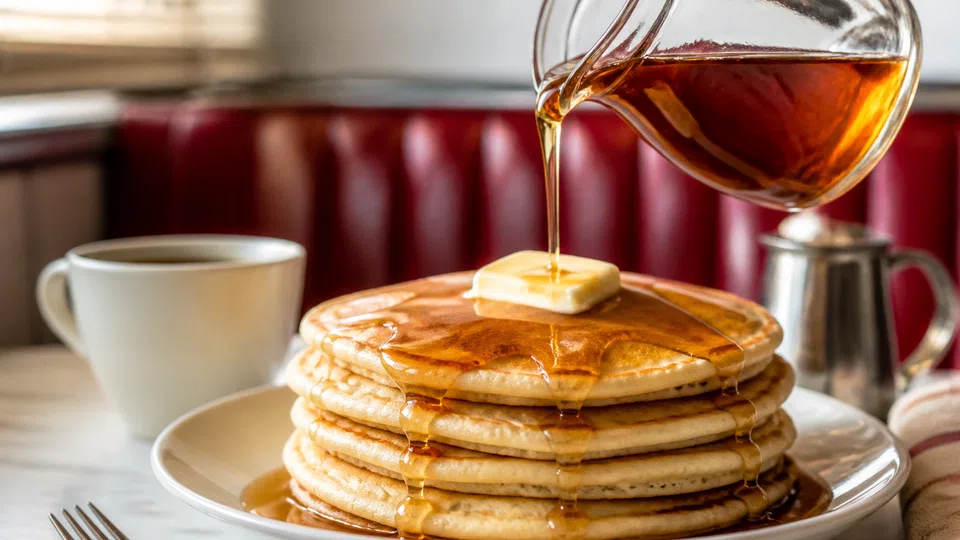
Those quantities and cues come from King Arthur Baking’s published recipe. Pancake World has not independently tested the batch, so the method is source-traceable but Recipe schema remains gated.
The source formula at a glance
King Arthur Baking publishes Charlotte Rutledge’s Buttermilk Pancakes with a ten-minute preparation time, a 45-minute total plan, and a yield of 14 to 16 medium pancakes measuring about 4 inches. The formula uses both baking powder and baking soda, gives weights for flour, sugar, buttermilk, and cooking fat, and includes a 15-minute uncovered batter rest.
This is the base recipe this guide preserves. “Classic” describes the route and the source’s buttermilk-pancake format; it is not a historical claim that the formula is original, universal, or older than another version.
For ingredient behavior and method choices beyond this exact formula, use the Pancake Ingredients and Substitutions. This page answers the narrower cooking task: make one source-defined buttermilk batch, judge the first pancake, and keep the portion and heat stable.
Ingredients
- 2 cups (240g) all-purpose flour
- 3 tablespoons (35g) granulated sugar
- 1 teaspoon baking powder
- 1 teaspoon baking soda
- 1/2 teaspoon table salt
- 1 large egg
- 2 cups (454g) buttermilk
- 2 tablespoons (28g) melted butter or 2 tablespoons (25g) vegetable oil
- 1 1/2 teaspoons vanilla extract, optional
- Butter or vegetable oil for lightly greasing the skillet or griddle
The source specifies its own unbleached all-purpose flour and vanilla products, but this article does not make product-performance claims. If using a different flour, check its label and expect results to depend on formulation and measurement.
Ingredient decision table
| Decision | Keep the base formula when | Choose another route when | Evidence boundary |
|---|---|---|---|
| Flour | Using all-purpose wheat flour at the source weight | Wheat flour is unavailable or unsuitable | Quinoa, tapioca, oat, and water-only routes are distinct formulas |
| Cultured dairy | Using 2 cups buttermilk | Buttermilk is unavailable | Use only the source’s documented yogurt-and-milk substitution or another complete recipe |
| Cooking fat | Choosing the source’s melted butter or vegetable oil option | Removing fat entirely | No fat-free result is validated here |
| Portion | Making 1/4-cup, roughly 4-inch pancakes | Making large diner pancakes or mini pancakes | Size changes timing and yield |
| Heat | Using a large skillet over medium or a 350°F griddle | Using an unfamiliar high-output outdoor surface | A trial pancake must establish control |
| Service | Serving immediately or holding briefly in a warm oven | Cooking far ahead for a large event | Use a complete make-ahead production plan |
The choices in the first column preserve the published route. The second column identifies a new formula or production problem rather than hiding it as a minor substitution.
Ingredients and substitutions
All-purpose flour
The source gives both a volume and weight: 2 cups or 240 grams. Weight provides a repeatable reference without claiming that every brand of flour absorbs identically. If measuring by cups, follow the flour producer’s method instead of compacting flour into the cup.
Replacing all-purpose flour with quinoa flour, tapioca flour, oat flour, almond flour, or a gluten-free blend changes more than flavor. Those ingredients can change hydration, structure, spread, browning, and handling. Use their own complete recipes. The flourless oat pancakes route owns one such intent; it is not a substitution paragraph for this recipe.
Sugar
Three tablespoons, or 35 grams, belong to the source formula. This article does not assign the sugar a nutrition value or claim it is needed for a specific medical purpose. Removing, replacing, or increasing it changes a tested-source quantity and may change browning and batter behavior; no result is promised here.
Baking powder and baking soda
The formula uses one teaspoon of each. Do not treat the two names as interchangeable or replace the total with two teaspoons of only one leavener. King Arthur’s method combines both with the dry ingredients before liquid is added.
The article does not claim a universal reaction rate or shelf life. Check product dates and package instructions. If the leavener is old or its storage history is unknown, the source formula cannot compensate for that uncertainty.
Salt
The source calls for one-half teaspoon table salt. Coarser salts occupy volume differently, so a volume swap is not necessarily equivalent. Use the specified ingredient or a weight-supported substitution from a reliable source.
Egg
One large egg is whisked with the wet ingredients. It is part of the source structure and liquid system. Replacing or omitting it produces a different recipe. Homemade pancakes without eggs answer that distinct task and require their own evidence.
Buttermilk
The formula uses 2 cups or 454 grams buttermilk. King Arthur supplies one documented alternative: whisk one small 5.3-ounce container plain Greek yogurt with enough milk to total 2 cups, about 1 1/3 cups milk. For yogurt from a larger container, its equivalent is 2/3 cup yogurt plus 1 1/3 cups milk.
That is the source’s substitution. A milk-and-vinegar mixture, plant beverage, plain milk, or powdered product is not silently inserted here. For a route designed without milk, use milkless pancakes rather than claiming the buttermilk base remains unchanged.
Melted butter or vegetable oil
The source gives two measured choices: 2 tablespoons melted butter, 28 grams, or 2 tablespoons vegetable oil, 25 grams. The same choices can lightly grease the cooking surface. Pick one batter fat and record it; do not change batter fat and griddle grease at the same time when diagnosing a batch.
Vanilla
One and one-half teaspoons vanilla is optional in the source. Omitting it keeps the rest of the formula intact. Adding extracts, spices, fruit, chips, or other ingredients is not required for a classic base and should not precede a clean first pancake.
What each key ingredient does in this method
Flour is the main dry ingredient. Sugar, baking powder, baking soda, and salt are distributed through it before wet ingredients arrive. Egg, buttermilk, and the chosen fat form the wet mixture. Optional vanilla changes flavor without changing the required ingredient count. Grease controls contact with the skillet or griddle.
Those are observable recipe roles and mixing positions. More detailed chemical claims belong in science references and should not be invented from the ingredient names alone.
Equipment and batch planning
Use two mixing bowls or one bowl plus a large measuring cup, a whisk, a flexible spoon or spatula, a 1/4-cup measure, a large skillet or electric griddle, a turner, and a rack or serving plate. A scale is useful because the source gives weights. An electric griddle offers a stated 350°F setting, while a skillet uses medium heat and observation.
Before mixing, count how many 4-inch pancakes the surface can hold without crowding. The source yield of 14 to 16 means the number of cooking rounds depends on that capacity. A griddle holding four needs roughly four rounds; a skillet holding two needs roughly seven or eight. That arithmetic is a service estimate, not a change to the recipe yield.
If all diners should eat together, decide between immediate small-batch service and brief warm-oven holding before batter is mixed. King Arthur permits a brief warm-oven hold but does not give a universal holding temperature or duration on the recipe page. Keep “brief” as a boundary rather than turning it into an invented promise.
Step-by-step method
1. Stage and measure everything
Place all ingredients and tools within reach. Melt the butter early enough that it is pourable but not aggressively hot when combined with the egg and buttermilk. If using oil, measure 25 grams or two tablespoons. Select the batter fat before beginning.
Measure the flour as 240 grams when possible, sugar as 35 grams, and buttermilk as 454 grams. Keep the one-teaspoon baking powder, one-teaspoon baking soda, and one-half-teaspoon table salt separate until all dry ingredients can be whisked together.
2. Mix the dry ingredients
In a large bowl, whisk the flour, sugar, baking powder, baking soda, and salt. The goal is even distribution before liquid begins hydration. Scrape around the bottom and sides so a pocket of leavener does not remain in one area.
3. Mix the wet ingredients separately
In a separate bowl or large measuring cup, whisk the egg, buttermilk, melted butter or oil, and optional vanilla. If melted butter begins solidifying because the buttermilk is very cold, the source does not supply a repair protocol; avoid aggressive reheating with raw egg present. Use ingredients and temperatures that allow safe, controlled mixing.
4. Combine without chasing perfect smoothness
Pour the wet mixture into the dry mixture. Stir until combined and fairly smooth. King Arthur explicitly allows some small lumps. Stop before repeated mixing turns the search for a perfectly smooth batter into a new method.
Scrape the bottom once to look for a dry pocket. If none remains, leave small lumps alone. Do not add extra buttermilk merely because the batter appears thicker than a crêpe batter; that comparison belongs to a different format.
5. Rest the batter for 15 minutes
Leave the mixed batter uncovered for 15 minutes, as the source directs. Use this exact period to heat the cooking surface, organize plates, and clear raw egg and batter tools from the serving area.
Do not stir repeatedly during the rest. The formula’s 45-minute total already includes its source workflow; adding an uncontrolled long hold is not validated here.
6. Heat and lightly grease the cooking surface
Set a large skillet over medium heat or preheat an electric griddle to 350°F. King Arthur’s water cue is a droplet that skitters across the surface. Use only a small amount of water and keep hands clear of steam and splatter. Lightly grease with butter or vegetable oil.
Wipe or spread excess grease so it does not pool around the pancake. Record which fat is on the surface because butter and oil can produce different visual behavior.
7. Cook one trial pancake
Portion 1/4 cup batter onto the hot surface. Keep the scoop close to the surface to control shape. Do not spread the batter into a larger diameter unless following a source for thin pancakes.
Cook the first side until bubbles form on top and the bottom is brown, about one to two minutes in the published recipe. King Arthur’s experienced-baker guidance adds that the edges should begin to look matte and bubbles on top should break before flipping. Peek under an edge if needed; bubbles alone are not permission to flip a pale, unset pancake.
8. Flip once and finish
Slide the turner underneath and flip with one controlled motion. Cook the second side until its bottom is brown, another one to two minutes in the source. The expert guidance says a cooked pancake should spring back when pressed; do not serve a center with wet batter.
Avoid pressing the pancake flat with the turner. The source method does not include compression, repeated flipping, or piercing the center.
9. Adjust one variable only
Judge the first pancake before filling the surface:
- If the outside browns before the center sets, reduce heat.
- If the pancake remains pale after the source range and the surface seems cool, allow the pan to recover and adjust heat slightly.
- If the pancake spreads much wider than 4 inches, verify the 1/4-cup portion and ingredient measurements before adding flour.
- If it is too thick to cook through, confirm no measurement error before changing liquid.
Make one change, cook another pancake, and observe. Changing heat, portion, grease, and batter together removes the ability to identify the cause.
10. Repeat with consistent portions
Cook as many 1/4-cup pancakes as the surface holds without touching. Leave space for the turner. Griddle temperature can drop after batter is added, so allow recovery between rounds when browning slows.
Serve immediately or hold briefly in a warm oven as the source permits. For a crowd, move finished pancakes to a rack in a single layer or overlapping like shingles before any brief holding; King Arthur’s pancake tips recommend airflow rather than a tight cooling stack to reduce sogginess.
Heat, timing, and doneness cues
| Stage | Source number | Observable cue | Do not infer |
|---|---|---|---|
| Batter rest | 15 minutes, uncovered | Batter is left undisturbed while surface heats | A longer rest is automatically better |
| Electric griddle | 350°F | Water droplet skitters; surface is lightly greased | Every stovetop “medium” equals 350°F |
| Portion | 1/4 cup | Roughly 4-inch pancake in the source system | A larger pancake keeps the same time |
| First side | About 1 to 2 minutes | Bubbles form, some break, edges turn matte, underside browns | Bubbles alone prove the center is set |
| Second side | About 1 to 2 minutes | Underside brown; pancake springs back; no wet batter | Dark color alone proves even cooking |
| Whole batch | 45-minute published total | 14 to 16 medium pancakes from consistent portions | Every pan and kitchen completes in 45 minutes |
Time and temperature are paired with cues because pan material, burner output, batter temperature, and batch recovery differ. The source range schedules observation; the pancake itself determines when to flip and remove.
Three practical batch scenarios
Scenario 1: one straightforward stack
Make the formula exactly once and use the 1/4-cup measure. Cook one trial pancake, then fill the griddle only after heat and timing are stable. Serve each round immediately when diners are already seated. Keep toppings at the table so the griddle operator performs no extra work.
This is the cleanest route for learning the formula because it preserves every quantity and minimizes holding.
Scenario 2: a crowd cooked in rounds
Count surface positions and estimate rounds before mixing. A four-position griddle needs about four rounds for 14 to 16 pancakes. Use the same scoop and leave space between portions. Brief warm-oven holding may help, but do not seal steaming pancakes in a deep stack.
If more than one batch is required, mix each batch separately unless a trusted source validates the larger vessel and mixing method. Doubling dry and wet quantities can be arithmetically correct while still changing mixing effort, rest timing, and the delay before later pancakes reach heat.
Scenario 3: toppings change, base stays fixed
Cook the plain source formula and put syrup, butter, or other selected toppings at the table. This separates topping preference from batter performance. Do not fold several add-ins into the bowl before the trial pancake; their weight, sugar, water, and pan contact can change cooking.
The base remains recognizable because portion, heat, and batter are stable. A topping does not create a new base recipe.
Scenario 4: buttermilk is unavailable
Use the King Arthur substitution exactly: one 5.3-ounce container plain Greek yogurt plus enough milk to make 2 cups, approximately 1 1/3 cups milk; or 2/3 cup yogurt plus 1 1/3 cups milk. Keep every other base quantity fixed and label the batch as the documented substitute version.
Do not compare that result with true buttermilk as if Pancake World ran a controlled test. The source supplies the substitution, not a local side-by-side record.
Actionable classic-pancake checklist
- [ ] Confirm the 14-to-16 pancake source yield fits the table.
- [ ] Measure flour and buttermilk by weight when possible.
- [ ] Use one teaspoon each baking powder and baking soda, not two teaspoons of one.
- [ ] Select butter or vegetable oil for the batter and record the choice.
- [ ] Whisk dry and wet ingredients separately.
- [ ] Combine until fairly smooth; leave small lumps.
- [ ] Rest uncovered for 15 minutes.
- [ ] Heat the griddle to 350°F or use a controlled medium skillet.
- [ ] Lightly grease without leaving pools.
- [ ] Portion exactly 1/4 cup for the trial pancake.
- [ ] Flip when bubbles form and break, edges turn matte, and the underside is brown.
- [ ] Cook until the second side is brown, the center has no wet batter, and the pancake springs back.
- [ ] Change only one variable after the trial pancake.
- [ ] Serve immediately or hold only briefly under the source boundary.
Troubleshooting common failures
Pancakes are flat
First check measurement and product condition: the formula requires one teaspoon baking powder and one teaspoon baking soda. Confirm both were mixed through the dry ingredients and that the correct 15-minute rest was used. Do not add extra leavener to finished batter without a validated correction.
If the batter was stirred until perfectly smooth or repeatedly during rest, record that deviation. Start a new batch when an accurate comparison is more useful than layering repairs onto uncertain batter.
Outside is dark while the center is wet
The surface is too aggressive for the pancake thickness, or the portion is larger than 1/4 cup. Reduce heat and keep the source portion. Wait for the center structure to set before flipping. A dark underside and early bubbles are not enough if the top remains fluid.
Pancakes are pale and slow
Allow the griddle to recover between rounds and confirm a 350°F setting or a genuinely preheated skillet. Too many cold portions at once can cool the surface. Do not immediately thin the batter when the first evidence points to heat.
Batter spreads into thin pancakes
Verify the flour weight, buttermilk weight, and portion. Confirm no extra liquid entered. The classic formula is not the flour and water pancakes route, and its hydration should not be improvised from another recipe.
Batter is very thick
Confirm the flour was 240 grams and buttermilk 454 grams. Cup-scooped flour can be compacted. Do not automatically add liquid until the measurement record is checked. The source accepts a batter that produces 4-inch pancakes from 1/4 cup and does not define crêpe-like flow as the target.
First pancake sticks
Confirm the surface was fully preheated and lightly greased. Give the first side time to brown and set before sliding the turner underneath. Adding a heavy pool of grease can change the edge and surface pattern without solving an underheated pan.
Pancakes turn soggy while waiting
Avoid a tight stack that traps steam. King Arthur’s expert guidance recommends cooling on a rack with space or in an overlapping shingle arrangement. For immediate service, move each round to diners. For brief holding, keep airflow and do not extend the undefined warm-oven boundary.
Yield is lower than 14
Check the portion. A rounded or overflowing 1/4 cup produces larger pancakes and fewer pieces. Batter left in bowls and scoops also affects the count. The published yield is a range, 14 to 16, not a promise of one exact number.
Serving, freezing, and reheating
Serve the pancakes immediately when possible. Arrange toppings separately so the base does not soften before it reaches the diner. A brief warm-oven hold is allowed by the source, but no exact universal time is supplied.
King Arthur states that leftover buttermilk pancakes can be frozen on the same day they are made and reheated in a 250°F oven. Cool them on a rack rather than enclosing visible steam, then package for freezing under current food-safety guidance. The recipe page does not provide a guaranteed frozen storage life, so this article does not invent one.
USDA’s general leftovers guidance calls for prompt refrigeration or freezing and reheating leftovers to 165°F. Apply the government endpoint while recognizing that a 250°F oven is an appliance setting, not the food’s internal temperature. Reheat until the food reaches the safe endpoint; elapsed time depends on pancake thickness, quantity, starting temperature, and arrangement.
Discard food when its time or temperature history is unknown. Smell and appearance cannot reconstruct that record.
Published variations and evidence boundaries
Greek yogurt and milk instead of buttermilk
This is the direct source substitution described above: 5.3 ounces plain Greek yogurt plus enough milk to total 2 cups, approximately 1 1/3 cups milk, or the equivalent 2/3 cup yogurt plus 1 1/3 cups milk. It preserves the source’s total liquid volume while changing the cultured dairy input.
Extra-fluffy source variation
King Arthur instructs the cook to separate the recipe’s egg, mix the yolk into the wet ingredients, reserve the white, add one additional egg white, whip both whites to medium-to-stiff peaks during the batter rest, and fold them in immediately before portioning. This is a documented variation, not the base method and not a Pancake World-tested result.
Richer, buttery source variation
The source points to an adaptation that doubles butter, adds an extra egg yolk, uses full-fat dairy, retains the rest, and cooks in additional butter. Because several variables change, it should be followed as its own complete published approach rather than used to troubleshoot the classic batch.
Different ingredient routes
The two-ingredient pancakes and three-ingredient pancakes pages answer minimal-formula intents. Quinoa flour pancakes and tapioca flour pancakes require flour-specific systems. None is a shorter version of this buttermilk formula.
Testing notes
The article preserves the recognized culinary formula, its portion, its 15-minute rest, its published pan cues, and its documented variations. It also distinguishes recipe claims from editorial workflow. The batch has not been cooked by Pancake World in this production stage, so no statement describes our own lift, tenderness, flavor, yield observation, or side-by-side substitution result.
For more evidence-bounded pancake work, visit Pancakes World.
Sources and editorial references
- King Arthur Baking, “Buttermilk Pancakes,” exact 14-to-16 pancake formula, ingredient weights, 15-minute rest, 350°F griddle, quarter-cup portion, cooking cues, yogurt-and-milk substitute, variations, freezing, and 250°F reheating oven:
https://www.kingarthurbaking.com/recipes/buttermilk-pancakes-recipe - King Arthur Baking, “I’ve baked over 18,000 pancakes. Here’s how to make your best,” matte-edge and broken-bubble flip cues, trial-pancake control, and rack cooling:
https://www.kingarthurbaking.com/blog/2021/10/26/best-pancake-tips - King Arthur Baking, “How to make fluffy pancakes,” spring-back and no-wet-batter completion cues and documented whipped-egg-white variation context:
https://www.kingarthurbaking.com/blog/2019/01/21/how-to-make-fluffy-pancakes - King Arthur Baking, “How to make decadent and buttery pancakes,” documented multi-variable richer-pancake variation:
https://www.kingarthurbaking.com/blog/2019/02/18/how-to-make-buttery-pancakes - USDA Food Safety and Inspection Service, “Leftovers and Food Safety,” prompt chilling or freezing and 165°F reheating endpoint:
https://www.fsis.usda.gov/food-safety/safe-food-handling-and-preparation/food-safety-basics/leftovers-and-food-safety
Release boundary: Pancake World did not independently test the base formula or variations. Recipe schema remains gated pending a genuine production test, exact test record, final editorial approval, and rights-cleared responsive media. The article makes no nutrition, medical, product-test, venue, universal-performance, publication, deployment, or indexing claim.