Flourless oat pancakes
Direct answer for flourless oat pancakes
At Pancakes World, flourless oat pancakes are pancakes made with oats or oat flour instead of wheat flour. For the most reliable first batch, use a source-tested oat-flour formula, or grind the type of oats named by a tested recipe and keep its eggs, liquid, oil, leavener, and portion unchanged. Blend the oats finely if a smooth crumb is wanted, let the batter rest only as directed, and cook one small pancake over moderate heat. Oats hydrate and set differently from wheat flour, so diagnose thickness after the rest rather than adding liquid immediately. “Flourless” does not automatically mean gluten-free; verify labelled gluten-free oats and every cross-contact point when that matters.
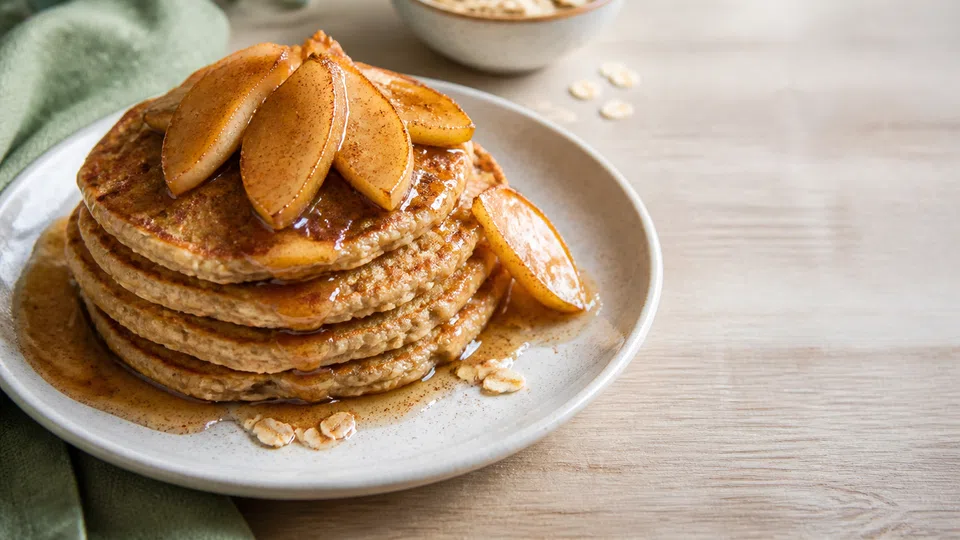
Quaker's oat flour pancake recipe demonstrates a complete flourless-oat system: oat flour is paired with liquid, eggs, oil, leavener, sweetener, and flavouring. Utah State University Extension also publishes an oat-flour pancake in a complete egg, milk, yoghurt, banana, and leavener system. These sources validate two formulas, not a universal oats-to-liquid ratio. For broader flour behavior, use the Pancake Ingredients and Substitutions and the separate oat bran pancake guide.
What “flourless oat” actually means
The label usually means no wheat flour is added. It may mean: See also Quinoa flour pancakes.
- packaged oat flour is the only flour;
- rolled or quick oats are ground into flour before mixing;
- oats are blended with the wet ingredients into a batter;
- some oats remain coarse for a textured pancake;
- banana or yoghurt is included in a complete oat-based formula.
It does not mean the recipe contains no flour in the literal sense: finely ground oats are oat flour. It also does not prove the finished pancake is gluten-free. Utah State University Extension's gluten-free guidance specifically lists oats with the condition that they be labelled gluten-free. A package statement, clean equipment, and a controlled preparation area matter when serving someone who must avoid gluten.
Keep this route distinct from oatmeal pancakes that intentionally combine oats with wheat flour. USU's oatmeal-nut pancake is a useful example of that other category: it contains whole-wheat flour plus uncooked oats. It can inform oat handling, but it is not a flourless formula.
Choose the oat form for the intended texture
Packaged oat flour
Choose packaged oat flour for the most consistent grind. Follow a recipe written for that product and use weights when supplied. Quaker's recipe uses oat flour as the flour base, which supports the basic feasibility of this route.
A fine grind generally makes a more even batter than visibly coarse flakes. However, the package brand, milling, and storage can still affect hydration. Do not assume every oat flour accepts the same liquid without checking the full formula.
Rolled oats ground at home
Choose rolled oats when the source recipe authorizes home grinding. Process them until the particle size is as even as your equipment can produce. Stop, stir, and process again so large flakes do not remain only at the top or bottom.
Record the starting oat and approximate grind. A home blender may leave a wider range of particles than commercial flour. That is not automatically a failure, but the batter may feel more textured and require the exact rest stated by the recipe.
Quick oats
Quick oats are cut or processed to hydrate faster than larger rolled flakes. Use them only when the recipe names them. Replacing rolled oats with quick oats can change thickness during the rest, while replacing oat flour with intact quick oats changes particle size.
Coarse oats left for texture
Choose a formula designed for visible oat pieces when a hearty texture is desired. Do not call a coarse, chewy result defective simply because it does not resemble a smooth oat-flour pancake. Keep the intent clear: smooth stack and textured oat cake are related but different results.
Decision table
| Goal | Oat starting point | Formula to choose | Main cue |
|---|---|---|---|
| Smooth American-style stack | Fine packaged oat flour | Tested oat-flour pancake | Even ribbon and set centre |
| Home-ground pantry version | Rolled oats ground fine | Recipe that authorizes blended oats | Particle size after blending |
| Hearty texture | Oats left partly coarse | Textured oatmeal-pancake formula without wheat | Fully hydrated flakes and clean turn |
| Gluten avoidance | Labelled gluten-free oat product | Verified gluten-free formula and clean process | Label and cross-contact controls |
| Banana-oat style | Oats plus banana in a tested system | Formula designed around banana's moisture | Centre set rather than surface colour alone |
The table does not claim one form is best. It prevents a cook from judging a coarse oat pancake by the standard of a finely milled one.
Ingredient roles in a flourless oat formula
Oats or oat flour supply the dry bulk. They do not form the same elastic gluten network as wheat flour, so the recipe depends on other ingredients and on a manageable pancake size.
Eggs or another binder help the pancake set and hold. Quaker's published formula uses eggs; USU's oat-flour formula uses egg with milk, yoghurt, and banana. Those examples do not prove an egg can be removed without a replacement system.
Liquid hydrates the oat particles. Oats continue absorbing liquid during a rest, so an early correction can make the later batter too thin. Use the formula's rest and adjustment rules.
Yoghurt or banana may add moisture, solids, flavour, and thickness in a recipe designed for them. They are not generic binders to add by guesswork.
Leavener supports lift in a batter capable of setting around the gas. Adding more does not fix coarse oats, excess liquid, or a weak binder.
Oil or other fat affects tenderness and release. Keep it in the test formula. A greased pan and fat inside the batter are separate variables.
Sweetener, salt, and spice shape flavour and browning. Do not omit them during a texture comparison unless the source provides an alternative.
A source-led method
Choose one complete oat-flour or blended-oat recipe. Use its quantities and any product-specific instructions.
- Confirm the oat type. Identify oat flour, rolled oats, quick oats, or a commercial mix.
- Verify dietary labels. If gluten avoidance matters, use labelled gluten-free oats and review every other ingredient and surface.
- Grind only when directed. Process oats to the texture the formula expects.
- Measure by weight where possible. A cup of coarse oats and a cup of packed oat flour are not equivalent measures.
- Mix dry ingredients evenly. Distribute leavener, salt, and spice through the oat flour.
- Mix wet ingredients separately when directed. Break up egg and smooth thick ingredients before combining.
- Combine to the source endpoint. Scrape dry pockets from the bowl, but do not keep blending merely to warm the batter.
- Use the stated rest. Oat batter can thicken as particles hydrate. Do not invent a long rest.
- Preheat the pan. Use stable moderate heat and a thin film of grease if the recipe requires it.
- Cook a small pancake first. A smaller diameter is easier to support while the oat structure sets.
- Inspect the centre. Let the test stand briefly, then cut it. Distinguish moist tenderness from raw or gluey batter.
- Adjust one variable. Change water or milk only in a measured amount allowed by the formula; change heat without altering the bowl.
FDA guidance treats flour as raw food and advises never eating raw dough or batter. Oat flour should not be sampled raw as a texture test. Keep raw batter away from ready-to-eat toppings and clean hands, bowls, tools, and surfaces after contact.
Read oat batter after the rest
A useful thick ribbon
For an American-style pancake, the batter should usually fall from the scoop and slowly settle. If it stays in a rigid lump, verify the oat measure and rest length. If it runs into a thin puddle, check liquid, egg size, banana or yoghurt amount, and whether the correct oat form was used.
Do not compare it with a wheat batter by appearance alone. The oat formula's own portion and cues control. A thicker batter may still spread under its own weight, while a coarse mixture may need gentle shaping according to the source.
Visible coarse pieces
Large dry flakes mean the grind or hydration differs from the intended smooth formula. If a textured formula is being followed, visible oats may be correct; confirm they have hydrated and the centre cooks cleanly. Do not blend the entire finished bowl after leavener has been added unless the recipe tells you to.
Thickening between batches
Record the mixing time and the time of each pancake. Later portions can thicken as oats absorb liquid. Stir gently only as allowed. If cooking the batch takes too long, make a smaller batch next time rather than repeatedly diluting it.
Diagnostic first pancake
| Observation | What to record | Next check |
|---|---|---|
| Spread | Diameter from the same scoop | Oat form, measure, and rest |
| Edge | Stable, ragged, or dry | Heat and hydration |
| Surface | Wet shine, bubbles, or cracks | Recipe turn cue, not bubbles alone |
| Release | Clean, stuck, or tearing | Pan heat, grease, and set |
| Centre | Tender, gummy, dry, or coarse | Thickness, time, and formula accuracy |
| Flavour | Oat-forward, balanced, or stale | Package condition and seasoning |
Use more than one cue. A tearing pancake can be under-set, too large, stuck, or structurally weak. A gummy centre can result from excess liquid, a thick portion, insufficient cooking, or a formula mismatch. The test narrows the next move; it does not prove a single cause.
Troubleshooting flourless oat pancakes
The pancake breaks when turned
Wait for the first side to set according to the recipe, use a broad turner, and make the next pancake smaller. Confirm the eggs or specified binder were included. If the batter was altered, return to the source formula before adding more oat flour.
The centre is gummy
Reduce the portion size or thickness and cook at stable moderate heat. Let the cooked test rest briefly before cutting. Verify liquid, banana, yoghurt, and oat measurements. A dark surface does not prove the middle is ready.
If the centre remains gluey in an accurately measured formula, compare your oat grind and product with the source. Do not add dry oats directly to the full bowl; they may hydrate unevenly.
The pancake is dry
Check whether oat flour was packed, whether the batter rested longer than intended, and whether the pancake cooked too slowly. Confirm fat and liquid were not omitted. If adjustment is allowed, add a small measured amount of liquid to a mini-batch rather than changing everything.
The texture is coarse or gritty
For a smooth target, grind oats more evenly in the next batch or use packaged oat flour. Use the source's hydration rest. For a deliberately textured pancake, judge whether the oat pieces are hydrated and pleasant rather than demanding a flour-like crumb.
The batter becomes too thick
Record standing time. Add liquid only within the recipe's guidance, a spoonful at a time, and stir gently. Avoid restoring the first-bowl appearance after every pancake; excessive repeated correction makes the final portion a different formula.
The pancake sticks
Let the pan preheat, apply the specified grease, and wait until the underside forms. Oat pancakes can be delicate before set. If only the first pancake sticks, the pan may not have stabilized; if every pancake sticks, review surface, heat, fat, and formula.
The outside browns too quickly
Lower the heat and/or make a smaller pancake. Banana, sweetener, milk solids, and oil can all affect browning inside different recipes. Keep the batter constant while correcting the pan.
The outside stays pale and the pancake dries
Confirm preheat and formula ingredients. Raise heat modestly only after the pan is stable. Do not extend cooking simply to match a photo; use the source's centre and turn cues.
The oat flavour tastes stale
Stop and check the package date and storage. Oats contain components that can develop off aromas during poor or prolonged storage. Do not cover an abnormal taste with syrup. Replace the ingredient if its smell or flavour is not sound.
Three practical flourless oat styles
Plain oat-flour stack
Use a tested oat-flour recipe and cook it plain before adding fruit or chips. This is the cleanest diagnostic for texture. Serve toppings separately so the base can be evaluated.
Banana-oat pancakes
Use a formula designed around banana rather than adding one to an oat-flour recipe at random. Banana changes moisture, solids, sweetness, and browning. Mash or blend it to the source's endpoint and keep pancake size modest so the centre can set.
Savoury oat pancakes
Choose a low- or no-sugar formula that has been tested for savoury use. Add cooked vegetables or cheese only as directed, or serve them on top. Wet additions can soften the centre and heavy additions can make turning harder.
For a different three-ingredient route, see three-ingredient pancakes. Do not assume every banana-oat-egg combination is interchangeable with a fuller oat-flour formula.
Controlled comparison: grind and rest
If developing a personal batch, divide the work into two separate comparisons.
First compare grind: use the same oat, weight, liquid, binder, leavener, portion, and pan. Grind one sample finer than the other. Record spread, edge, centre, and mouthfeel.
Then compare rest using the preferred grind. Keep all ingredients unchanged and cook samples at two planned times. Alternate the cooking order in a later repeat so pan heating does not always favour the later sample.
Do not call one breakfast a tested public recipe. A proper project claim would require exact weights, product identity, equipment, multiple batches, recorded results, and review. The comparison here is a household diagnostic.
Keep flourless oat pancakes separate from related routes
Several neighbouring recipes contain oats, but they answer different questions. Maintaining those boundaries prevents an apparently helpful article from becoming a generic oatmeal page.
Oat flour only versus oats plus wheat flour
A flourless oat pancake uses oat flour or ground oats for all of the flour role. An oatmeal pancake may add intact oats to a wheat-flour batter. Utah State University Extension's oatmeal-nut recipe is in the second category because its ingredient list includes whole-wheat flour and uncooked oats.
Neither category is inherently better. The oat-plus-wheat version can rely on wheat structure and keep some visible oat texture. The flourless version requires a formula designed to set without that wheat flour. Do not copy the liquid or egg quantities from one category into the other.
Oat pancakes versus banana pancakes
Banana-oat recipes are popular because banana supplies flavour, moisture, and solids, but banana is not a neutral binder. Ripeness, size, and weight change the batter. A recipe specifying mashed banana should give a useful quantity or clear endpoint. Adding “one banana” to a working oat-flour formula without measuring it creates a different experiment.
Keep the first pancake plain enough to inspect. A soft banana-rich centre can be properly cooked yet tender, while an excessively thick pancake can remain wet. Use the source's portion and cooking method; do not rely only on sweetness or browning.
Oat pancakes versus protein pancakes
Adding cottage cheese, protein powder, or extra eggs creates a separate formula. Those ingredients change solids, liquid, set, and flavour. Do not attach a “high protein” label unless the exact formula has verified nutrition data and meets the applicable definition. This article makes no nutrition calculation.
Oat flour versus oat bran
Oat bran is a different milled fraction and does not substitute automatically for oat flour. A bran-heavy batter may absorb liquid and feel coarse in another way. Use the dedicated oat-bran route for its hydration problem rather than folding it into the flourless-oat answer.
Scale a successful batch without losing the comparison
Do not double a first attempt before one complete batch works. When scaling a source-tested formula, multiply every ingredient by the same factor and keep the original unit precision. Weighing is particularly helpful because several rounded cups can accumulate more error than one small bowl.
A larger batch may stand longer while the pan cycles. Record when mixing finished and compare an early pancake with a late one. If the late portion is much thicker, the production problem is holding time, not necessarily the original hydration. The next useful change may be two smaller bowls mixed in sequence.
Keep the scoop, pancake diameter, and pan loading consistent. Crowding the surface can lower its temperature; cooking one pancake at a time can lengthen batter standing. Choose a repeatable number that fits the pan without merging edges.
For a group, separate service from testing. Validate the recipe before guests arrive, retain ingredient labels, and prepare toppings in advance. Cook the oat pancakes in planned rounds. Do not leave raw egg- or dairy-containing batter at room temperature beyond current official guidance merely to keep the table supplied.
Choose toppings that preserve the pancake's job
The base should work before toppings are used to disguise it. Then match toppings to texture.
- For a soft fine-oat stack, use fruit, yoghurt, or syrup at the table so each portion stays visible.
- For a coarse hearty pancake, add a smooth topping such as yoghurt or cooked fruit rather than more dry oat texture.
- For a savoury version, use cooked mushrooms, greens, egg, cheese, or beans according to dietary needs and safe handling.
- For a portable pancake, keep wet toppings separate and choose a formula strong enough to fold after cooling.
Retain packaging where allergies matter. Nuts, milk, egg, sesame, and other toppings are separate from the flourless claim. Use dedicated utensils so a labelled gluten-free pancake is not immediately cross-contacted at the topping station.
Gluten-free and allergen boundary
Oats themselves may be selected as part of a gluten-free diet only with appropriate labelled products and controls. USU Extension's guidance explicitly lists oats with the qualifier “labelled GF.” The article therefore does not call an unlabeled bag or a shared blender suitable.
Check baking powder, flavourings, toppings, and any commercial oat product. Clean the blender, bowl, scoop, pan, and storage area according to the eater's needs. If coeliac disease, wheat allergy, or another medical condition is involved, use qualified guidance rather than this general recipe article.
Egg, milk, yoghurt, nuts, and other additions create their own allergen questions. “Flourless” says nothing about them. Keep labels and serving utensils available.
Storage and reheating
Follow the chosen recipe and current official guidance. A plain oat-flour pancake with egg and milk, a banana-heavy pancake, and a plant-based version do not automatically share one safe storage life.
For quality, cool pancakes before closing the container so heavy condensation does not wet the surfaces. Separate layers if they stick. Reheat only the needed portion: a toaster may suit a firm thin pancake, a skillet can restore the surface, and a microwave often softens it. None of these methods replaces a safety endpoint.
If the time history of a perishable pancake or topping is uncertain, appearance and smell cannot extend an official limit.
Common mistakes
- Assuming “flourless” means no ground flour or automatic gluten-free status.
- Swapping intact oats and oat flour by equal cups.
- Grinding one batch fine and the next coarse without recording it.
- Adding liquid before the recipe rest is complete.
- Removing egg from a formula that depends on it.
- Adding banana or yoghurt to fix texture without measuring.
- Making large pancakes before a small one holds together.
- Judging doneness only from surface bubbles or colour.
- Tasting raw oat batter.
- Publishing a personal single batch as proven testing or nutrition evidence.
Questions about flourless oat pancakes
Are flourless oat pancakes gluten-free?
Not automatically. Use oats specifically labelled gluten-free and verify all ingredients, equipment, and cross-contact when gluten avoidance matters.
Can rolled oats replace oat flour?
Only when the recipe directs you to grind or blend them. The weight may be comparable within that formula, but particle size changes hydration and texture. Do not substitute by volume without source guidance.
Why do oat pancakes fall apart?
They may be too large, turned too early, stuck, under-bound, or made from a formula mismatch. Start with size and set, then verify binder and measurements before adding ingredients.
How long should oat batter rest?
Use the time in the selected recipe. Oats hydrate while standing, but a longer rest is not always better and can change leavening or storage conditions.
Can I make the batter overnight?
Only when the recipe supports it. Egg, dairy, banana, and leavener add both storage and performance concerns. A safer unsupported shortcut is to measure dry ingredients ahead and mix the batter when directed.
Final checklist
- Choose packaged oat flour or a recipe-approved oat grind.
- Verify labelled gluten-free oats when needed.
- Keep the full binder, liquid, leavener, and fat system.
- Weigh oats where possible.
- Use the recipe's rest.
- Cook one small diagnostic pancake.
- Check centre set after brief cooling.
- Never taste raw batter.
- Change grind, rest, hydration, or heat one at a time.
- Record the exact oat product for the next batch.
Also record whether the oats were commercially milled or ground at home; that single detail makes later texture and hydration comparisons much easier to interpret.
Pancakes World keeps flourless oat pancakes practical by separating the oat form, formula, and dietary verification instead of treating one label as the whole answer.
Sources and editorial references
- Quaker Oats — “Oat Flour Pancakes” —
https://www.quakeroats.com/cooking-and-recipes/oat-flour-pancakes - Utah State University Extension — “Healthy Breakfast Pancakes to Kickstart Your Day” —
https://extension.usu.edu/createbetterhealth/blog/healthybreakfastpancakes - Utah State University Extension — “Oatmeal Nut Pancakes” —
https://extension.usu.edu/createbetterhealth/kitchen/oatmeal-nut-pancakes - Utah State University Extension — “Gluten-Free Eating: Making the Lifestyle Switch” —
https://extension.usu.edu/nutrition/research/gluten-free-eating - U.S. Food and Drug Administration — “Handling Flour Safely: What You Need to Know” —
https://www.fda.gov/food/buy-store-serve-safe-food/handling-flour-safely-what-you-need-know