Homemade pancakes recipe without eggs
Quick answer for homemade pancakes without eggs
At Pancakes World, for 16 small egg-free pancakes, whisk 300g self-raising flour, 1 teaspoon baking powder, 1 tablespoon sugar, 1 tablespoon vanilla extract, and a pinch of salt. Slowly whisk in 400ml plant-based milk until the batter is smooth and thick. Heat a little of 1 tablespoon vegetable oil in a nonstick pan over medium-low heat. Portion 2 tablespoons batter per pancake; cook two or three at a time for 3 to 4 minutes, until the edges set and bubbles appear. Flip, then cook 2 to 3 minutes until golden on both sides and cooked through.
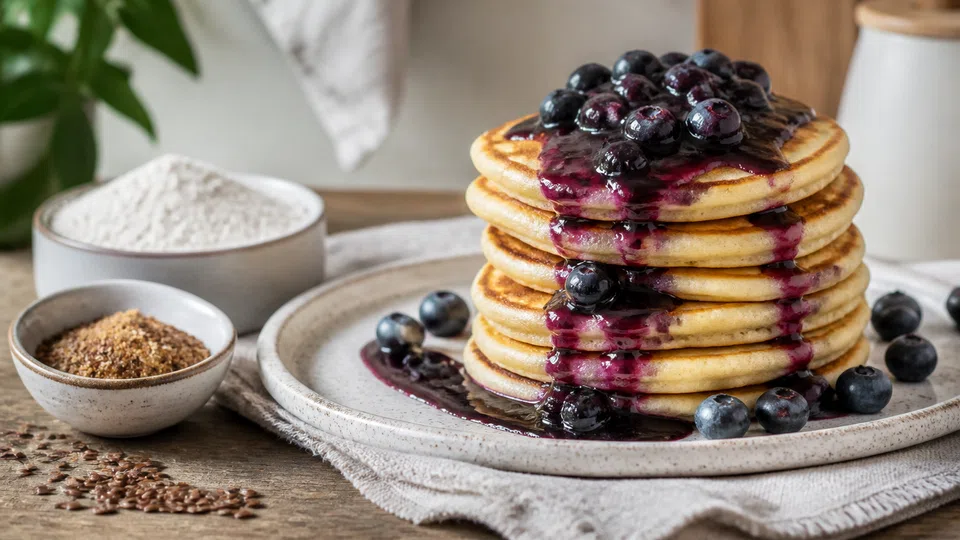
The formula and timings come from Good Food’s published easy vegan pancakes. Pancake World did not independently test it, and “without eggs” does not by itself establish allergy safety.
What this egg-free route does—and does not—answer
This recipe answers a narrow cooking problem: make small, American-style homemade pancakes from a complete formula that contains no egg ingredient. It is not the classic buttermilk formula with its egg deleted. It is also not a claim that every egg replacer, mashed fruit, seed gel, yogurt, or commercial mix can be swapped into any pancake recipe.
The source formula is vegan and uses plant-based milk, but the route’s primary intent is egg omission. A reader who specifically needs a milk substitution should use a formula built around that liquid rather than treating every plant beverage as identical. The Pancake Ingredients and Substitutions owns broader ingredient behavior; this page owns one traceable egg-free batch and the pan decisions needed to turn it.
“Egg-free recipe” describes the listed ingredients. It does not prove that a particular bag of flour, baking powder, sugar, vanilla, beverage, oil, topping, utensil, or kitchen is free from egg cross-contact. Check every label and the actual preparation environment when an allergy is involved, and follow qualified medical advice for individual decisions.
Source formula and yield
Good Food publishes Easy Vegan Pancakes as an easy recipe serving four to six and making 16 pancakes. Its preparation time is five minutes and its cooking plan is 30 minutes. The formula uses self-raising flour plus an additional teaspoon of baking powder, a small amount of sugar, vanilla, plant-based milk, and oil for the pan.
The source cooks small pancakes in batches of two or three over medium-low heat. A two-tablespoon portion keeps the format distinct from the quarter-cup buttermilk pancakes on the classic route. Preserve that portion until the first batch proves the heat and turning cues are under control.
Ingredients
- 300g self-raising flour
- 1 teaspoon baking powder
- 1 tablespoon sugar
- 1 tablespoon vanilla extract
- A pinch of salt
- 400ml plant-based milk, with oat, almond, or soy listed as source examples
- 1 tablespoon vegetable oil for cooking
Optional toppings belong outside the base batter. The source suggests choices such as banana slices, blueberries, maple syrup, vegan chocolate chips, and plant-based yogurt, but those are not required and their labels still need checking.
Egg-free pancake decision table
| Starting situation | Use this formula? | Keep fixed | Choose another route when |
|---|---|---|---|
| No eggs available | Yes, if all listed ingredients are available | 300g flour, 400ml beverage, 2-tablespoon portion | Only plain flour or water is available |
| Avoiding egg as a preference | Yes | Complete source formula | A different flavor or pancake style is wanted |
| Diagnosed egg allergy | Formula contains no listed egg, but labels and cross-contact must be assessed | Every package, tool, surface, and topping | Suitability cannot be established safely |
| Need dairy milk but no egg | Not as an untested swap | Plant-based beverage in this source formula | Use a published dairy-and-eggless formula |
| Need no milk and no egg | This formula may fit only if a chosen plant beverage and every product fit the requirement | Exact labels and source quantities | Water-only or another liquid system is required |
| Want large pancakes | No unchanged timing claim | Small 2-tablespoon portion | A source provides yield and timing for larger portions |
The table protects the recipe from two common errors: assuming an ingredient title proves allergy safety and assuming the removal of egg is the only difference between pancake formulas.
Ingredients and substitutions
Self-raising flour
The source uses 300 grams self-raising flour. That is a formulated flour, not plain flour with an unspecified amount of leavener. The recipe also adds one teaspoon baking powder. Do not replace the self-raising flour with 300 grams plain flour while leaving every other quantity unchanged unless a reliable recipe supplies the complete conversion.
Different flour packages can contain different ingredients and cross-contact statements. Read the label. For an oat-based route, flourless oat pancakes use a separate complete system rather than an improvised swap.
Baking powder
One teaspoon is added in addition to the raising agents already present in self-raising flour. Mix it through the dry ingredients. The article does not assign a universal shelf life; check the package date and storage instructions.
Sugar and vanilla
The source uses one tablespoon of each. Sugar type is left open by the culinary recipe, while the vanilla quantity is explicit. This article does not supply nutrition claims or promise identical results from liquid sweeteners, flavored syrups, or omitted sugar.
Plant-based milk
The formula uses 400 milliliters. Good Food names oat, almond, and soy as examples. Those are source-permitted categories, not a Pancake World claim that they taste, thicken, brown, or perform identically. Select one product, record it, and keep it fixed through the batch.
If soy milk is the defining ingredient rather than egg omission, soy milk pancakes own that intent. If the search task is broader milk omission, use milkless pancakes. Route titles do not turn product labels into allergen evidence.
Vegetable oil
The source allocates one tablespoon for cooking, added a little at a time. It is not mixed into the listed batter. Use enough to lightly control the pan surface without creating pools. A different fat changes the source method and may introduce different labels or cross-contact considerations.
What each key ingredient does in this method
Self-raising flour, the additional baking powder, sugar, vanilla, and salt are whisked together before liquid is added. Plant-based milk turns that dry mixture into the source’s smooth, thick batter. Vegetable oil prepares the pan surface. No ingredient is presented as a direct one-for-one replacement for egg; the formula is designed as a whole without one.
Those are method roles. The article makes no medical, nutrition, performance, or chemical-rate claim beyond what the culinary source demonstrates through its recipe.
Equipment and batch plan
Use a large mixing bowl, balloon whisk, metric scale, liquid measure, tablespoon measure, nonstick frying pan, thin turner, and a rack or warm plate. A low oven is optional because the source permits keeping finished pancakes warm while later batches cook.
At two or three pancakes per batch, 16 pancakes require six to eight pan rounds. That range is simple arithmetic from the published yield and batch size. It does not guarantee the full cook will take exactly 30 minutes in every pan; surface capacity, recovery, and the first trial affect elapsed time.
Decide whether diners will eat each round immediately or wait for the full batch. Small egg-free pancakes need a stable turn more than a hurried large surface. Do not overload the pan simply to shorten service.
Step-by-step method
1. Check the complete ingredient set
Read the labels before opening packages when egg avoidance is required. Include self-raising flour, baking powder, vanilla, beverage, oil, and every topping. Clean the pan, turner, whisk, bowl, scale surface, and measuring tools according to the actual household requirement.
This is a verification step, not a guarantee. When cross-contact control is medically important, use qualified guidance specific to the person and products.
2. Measure by weight and volume
Weigh 300 grams self-raising flour. Measure one teaspoon baking powder, one tablespoon sugar, one tablespoon vanilla, and 400 milliliters plant-based milk. Keep the tablespoon of vegetable oil beside the pan rather than pouring it into the batter.
Choose one plant beverage for the whole batch. Switching beverages halfway through destroys the usefulness of the first-pancake observation.
3. Whisk the dry ingredients and vanilla
Good Food directs the cook to whisk flour, baking powder, sugar, vanilla, and a pinch of salt together. Because vanilla is liquid, add it as the source states but expect the mixture to remain predominantly dry until the beverage arrives. Distribute the baking powder thoroughly.
4. Add the plant beverage slowly
Pour in the 400 milliliters plant-based milk gradually while whisking. The source target is a smooth, thick batter. Scrape around the bowl so no dry flour pocket remains.
Do not add extra beverage merely because the batter is thicker than a crêpe batter. This recipe makes small American-style pancakes. Changing hydration before a trial pancake removes the evidence supplied by the source proportions.
5. Preheat over medium-low heat
Set the nonstick pan over medium-low. Add a little of the measured vegetable oil. Give the surface time to heat evenly; the source does not specify a griddle temperature, so this article does not invent one.
Avoid an oil pool. Spread the small amount over the cooking area. A pan that smokes or browns residue before batter arrives is too aggressive for the source’s controlled 3-to-4-minute first side.
6. Portion a single trial pancake
Use two tablespoons batter for one small round. Starting with one pancake gives space for the turner and reveals whether heat, oil, and batter thickness are working together. Do not spread it into a wide crêpe.
Record how far it spreads and when the edge begins to set. No ingredient should be changed during this first observation.
7. Read all three first-side cues
Cook for the source’s 3 to 4 minutes while watching for set edges, bubbles on the surface, and enough structure to lift. Time alone does not authorize the flip. If the bottom is dark while the top edge remains fluid, lower the heat before the next pancake.
Slide the turner under the pancake only when it supports itself. An egg-free formula should not be judged by the turning behavior of the egg-containing classic buttermilk pancake recipe; the portions and published times differ.
8. Flip once and finish
Turn the pancake in one controlled motion. Cook the second side for the source’s 2 to 3 minutes, until both sides are golden and the pancake is cooked through. Check the center of the trial pancake rather than relying on surface color alone.
Do not press it flat with the turner. Compression is not part of the source method and cannot repair an unset center.
9. Adjust one operational variable
If the trial is dark outside and wet inside, reduce heat. If it is pale after the source range, allow the pan to recover and raise heat slightly. If it spreads far beyond the expected small round, confirm the two-tablespoon portion and 300g-to-400ml measurement before changing batter.
Do not add flour, milk, baking powder, and more oil together. One change followed by one observation preserves diagnostic value.
10. Cook two or three at a time
Once the trial is controlled, portion two or three pancakes with space between them. Keep each at two tablespoons. Add a little more of the measured oil only as necessary between batches.
Let the pan recover when a new round starts slower. Transfer finished pancakes to diners, a rack, or the source’s low-oven hold while the remaining batter cooks.
Heat, timing, and doneness cues
| Stage | Published amount or range | Observable cue | Boundary |
|---|---|---|---|
| Batter | 300g flour to 400ml beverage | Smooth and thick | Do not compare with thin crêpe batter |
| Portion | 2 tablespoons | Small round with room to turn | Larger size changes timing |
| Pan | Medium-low heat | Oil remains controlled; batter cooks without scorching | No exact surface temperature is sourced |
| First side | 3 to 4 minutes | Edges set; bubbles appear; pancake supports the turner | Cues and time must agree |
| Second side | 2 to 3 minutes | Golden on both sides; cooked through | Color alone does not prove the center |
| Batch | Two or three at a time | Space remains around each pancake | Crowding can obstruct turning and recovery |
The source’s longer first side gives the egg-free batter time to set before it is moved. The article does not call that process universally better; it is simply the documented method for this formula.
Four practical scenarios
Scenario 1: eggs are missing, but the pantry is otherwise ready
Use the source formula exactly. Confirm self-raising flour, baking powder, vanilla, one plant beverage, and oil. Make one trial pancake and preserve the two-tablespoon portion. This solves a missing-egg problem without pretending a conventional recipe can tolerate deletion.
Scenario 2: cooking for an egg allergy
Treat the formula as only one part of the decision. Review every package and topping, the preparation area, utensils, and the pan. Do not label the meal safe solely because no egg appears in the ingredient list. If the required cross-contact control cannot be established, stop and use qualified guidance.
Scenario 3: all 16 pancakes should reach the table together
Use batches of two or three and move cooked pancakes to a rack or a low oven, as the culinary source allows. Keep the hold as short as practical and avoid sealing steaming pancakes in a deep stack. Put toppings and plates in place before the first batch.
Scenario 4: only plain flour is available
Choose a recipe written for plain flour with exact leavener quantities. Do not guess how much baking powder converts 300 grams of a particular self-raising flour because formulations vary. The flour and water pancakes route is another distinct minimal-pantry system, not a direct conversion of this one.
Actionable egg-free pancake checklist
- [ ] Confirm the exact route: small American-style pancakes without eggs.
- [ ] Check every ingredient and topping label when egg avoidance matters.
- [ ] Weigh 300g self-raising flour.
- [ ] Add the source’s extra 1 teaspoon baking powder.
- [ ] Measure 1 tablespoon each sugar and vanilla plus a pinch of salt.
- [ ] Choose one plant beverage and measure 400ml.
- [ ] Keep 1 tablespoon vegetable oil for the pan.
- [ ] Whisk to a smooth, thick batter without adding unsourced liquid.
- [ ] Preheat a nonstick pan over medium-low.
- [ ] Cook one 2-tablespoon trial pancake.
- [ ] Wait for set edges and surface bubbles during the 3-to-4-minute first side.
- [ ] Cook the second side 2 to 3 minutes until golden and cooked through.
- [ ] Change only heat or another single operational variable after the trial.
- [ ] Cook later rounds two or three at a time with turning space.
Troubleshooting common failures
Pancake breaks during the flip
It probably moved before the source cues aligned. Wait for set edges, surface bubbles, and enough underside structure to support the turner. Keep the two-tablespoon size and medium-low heat. A large pancake demands a longer unsupported span and is not validated by this timing.
Outside browns before the middle sets
Reduce the heat. The source allocates 3 to 4 minutes to the first side and 2 to 3 to the second. High heat can create color before the thick center cooks. Do not thin the batter until heat has been tested independently.
Pancakes are pale and slow
Allow the pan to preheat and recover. Adding several cold portions lowers surface temperature. Increase heat slightly only after verifying that the source portion and ingredient measurements are correct.
Batter is too thin
Confirm that the flour is self-raising, was weighed to 300 grams, and the beverage was measured to 400 milliliters. Check whether extra liquid vanilla or beverage entered. Do not add unmeasured flour as the first reaction; identify the measurement error.
Batter is too stiff to portion
Confirm no flour was compacted or overweighed and that all 400 milliliters beverage was incorporated. Scrape the bowl. A different self-raising flour or beverage may behave differently, but this article does not invent a correction ratio. A new, correctly measured small batch may produce better evidence than repeated additions.
Pancakes stick
Use the nonstick pan and a little of the measured oil. Let the first side set before inserting the turner. Too much oil does not substitute for sufficient structure and may alter the surface.
Later batches differ from the first
Keep beverage, portion, heat, and oil application consistent. Stir only when a visible separation makes it necessary; the source does not direct repeated beating between rounds. Let the pan recover and note how long the batter has waited, but do not claim a universal hold limit without evidence.
Serving, storage, and reheating
Serve finished pancakes immediately or keep them warm in a low oven while the source batch finishes. Keep toppings separate so the base does not soften before service. When egg avoidance is relevant, toppings require the same label and cross-contact review as the batter.
The Good Food recipe does not state a refrigerated or frozen storage life on the recipe page. This article therefore does not invent one. USDA’s general leftovers guidance calls for prompt refrigeration or freezing and reheating leftovers to 165°F. Cool pancakes without enclosing visible steam, then store under current government guidance.
Reheat only the amount needed. A skillet, oven, toaster, or microwave can change texture and timing; follow appliance and product guidance. The internal 165°F leftover endpoint controls safety, while crispness or softness is not guaranteed.
Published variations and source boundaries
Change the plant beverage, not the whole formula
Good Food lists oat, almond, and soy beverages as examples. Selecting one is within the source. Comparing their performance would require controlled batches that Pancake World has not conducted. Change only the beverage and keep every other ingredient, portion, and pan decision stable.
Add toppings after cooking
Banana slices, blueberries, syrup, chocolate chips, or plant yogurt are source-listed serving ideas. Putting them on finished pancakes preserves the base batter. Folding wet fruit or chips into the batter creates another cooking variable and is not tested here.
Egg replacer crêpes are a separate format
Good Food also publishes thin eggless pancakes made with 125 grams plain flour, a commercial egg-replacer amount equivalent to one egg, 300 milliliters milk, a 20-minute rest, and butter for frying. Those are thin crêpe-style pancakes, not a substitute instruction for this small American-style batch.
Minimal-ingredient routes are separate recipes
Two-ingredient pancakes and three-ingredient pancakes answer ingredient-count intents and may use completely different structural ingredients. A classic buttermilk pancake recipe contains egg and belongs to a different route.
Testing notes
The direct formula, yield, portion, heat level, batch size, time ranges, and completion cues come from Good Food’s published recipe. The allergy boundary, label checks, first-pancake method, and one-variable correction are disclosed practical controls. They are not claims that Pancake World tested a named product or kitchen.
For more evidence-bounded pancake guidance, visit Pancakes World.
Sources and editorial references
- Good Food, “Easy vegan pancakes,” exact 16-pancake egg-free formula, serving range, preparation and cooking plan, medium-low heat, two-tablespoon portion, two-or-three-pancake batches, flip cues, completion cues, low-oven holding, and source-listed toppings:
https://www.bbcgoodfood.com/recipes/easy-vegan-pancakes - Good Food, “Eggless pancakes,” separate eight-crêpe formula using commercial egg replacer, milk, plain flour, a 20-minute rest, and butter:
https://www.bbcgoodfood.com/recipes/eggless-pancakes - King Arthur Baking, “I’ve baked over 18,000 pancakes. Here’s how to make your best,” first-pancake observation, flip timing, and rack or shingle-style cooling principles:
https://www.kingarthurbaking.com/blog/2021/10/26/best-pancake-tips - USDA Food Safety and Inspection Service, “Leftovers and Food Safety,” prompt refrigeration or freezing and 165°F reheating endpoint:
https://www.fsis.usda.gov/food-safety/safe-food-handling-and-preparation/food-safety-basics/leftovers-and-food-safety
Release boundary: Pancake World did not independently test the source formula, beverage choices, or variations. Recipe schema remains gated pending a genuine production test, route-level test record, final editorial approval, and rights-cleared responsive media. No medical, nutrition, allergy-safety, product-performance, venue, publication, deployment, or indexing claim is made.