Father’s Day brunch recipes
Quick answer for Father’s Day brunch recipes
At Pancakes World, for a practical Father’s Day brunch, make one hot centerpiece, one no-cook side, and one drink station. A source-based steak-and-eggs plate for four is a strong centerpiece when the guest of honor likes a savory breakfast: sear a 1-pound, 1-inch-thick sirloin in cast iron, finish it in a 350°F oven, rest it, and serve it with two eggs per person. Verify the whole steak reaches at least 145°F and rests for three minutes; cook eggs until both yolks and whites are firm. Add fruit and bread only if they require no competing last-minute pan work.
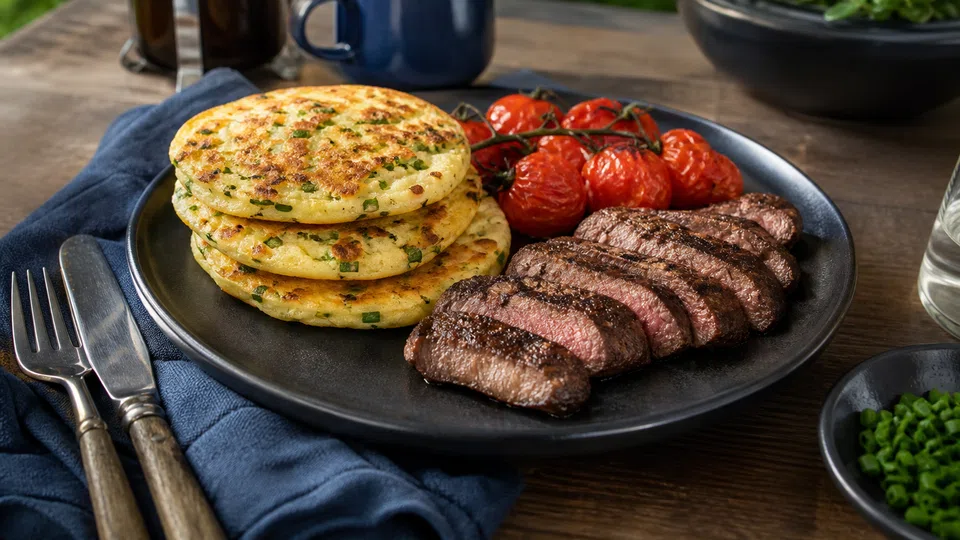
This is a service plan, not a claim that every father wants steak, that one menu suits every household, or that Pancake World tested the recipe. The formula comes from Food Network Kitchen, while the safety endpoints come from USDA and FDA guidance.
Choose the meal before choosing a recipe list
Father’s Day brunch can mean a quiet breakfast for two, a plated family meal, or a backyard gathering. Those are different production jobs. A long collection of attractive dishes does not solve the central problem: what must be hot at the same moment, who is cooking it, and whether the guest of honor would actually enjoy it.
Start with three questions:
- What does the guest of honor prefer? Choose savory or sweet, seated or casual, and indoor or outdoor without relying on stereotypes.
- How many people need a hot plate at once? Four steak-and-eggs plates are a different task from a twelve-person buffet.
- What is the limiting cooking surface? A cast-iron skillet, an oven, a griddle, and a grill cannot all be treated as interchangeable.
The current Food Network Father’s Day breakfast collection illustrates the range of the occasion: it includes steak and eggs, potato-chorizo hash, chilaquiles, eggs Benedict, chicken and waffles, and pancake-based options. That supports menu variety, not a universal ranking. This guide narrows the choice to a cookable plan with one source-traceable centerpiece.
For broader occasion planning, use the Brunch at Mr. Pancake Munich: A Focused Guide. This page keeps its unique intent: a Father’s Day menu that protects the moment of service instead of turning the cook into a short-order kitchen.
Father’s Day brunch decision table
| Situation | Practical centerpiece | Supporting food | Last-minute work | Choose it when |
|---|---|---|---|---|
| Four people, seated indoors | Cast-iron steak and eggs | Fruit; toasted bread | Slice steak and finish eggs | One oven and two pans are available |
| Two people, quiet breakfast | One smaller source-tested recipe or leftovers handled under their own guidance | Coffee and fruit | One hot plate at a time is acceptable | Intimacy matters more than a large spread |
| Six to eight people | Two independently cooked steak-and-eggs batches, or a different tested casserole | Cold sides in small platters | Batch handoff is written down | A second cook or adequate holding plan exists |
| Backyard meal | Source-tested grilled steak and eggs | Chilled fruit; bread | Grill, thermometer, and clean cooked-food platter | Weather and equipment are stable |
| Pancake-focused family | One complete pancake formula | Earlier-prepared fruit and drinks | Measured griddle batches | Pancakes are the requested centerpiece |
| Staggered arrivals | A verified hot-held dish or small repeated batches | Cold food held at 40°F or below | Replace small platters | Arrival times make a single plated service impossible |
The table is a routing tool. It does not imply that steak is more celebratory than pancakes, that a backyard meal is inherently easier, or that every published recipe scales linearly.
Source-based cast-iron steak and eggs for four
Food Network Kitchen publishes an easy steak-and-eggs recipe with a 40-minute total time and about four main-course servings. The published formula uses one 1-pound sirloin steak, one tablespoon vegetable oil, two tablespoons unsalted butter, and eight large eggs. It starts the steak in cast iron, finishes it in a 350°F oven, and cooks the eggs while the steak rests.
The version below keeps those quantities and the source sequence. It adds government temperature controls and chooses fully cooked eggs. Pancake World did not independently test this recipe, so the page does not claim a Pancake World recipe result and does not request Recipe schema.
Ingredients
- 1 tablespoon vegetable oil
- One 1-pound sirloin steak, about 1 inch thick
- Kosher salt
- Freshly ground black pepper
- 2 tablespoons unsalted butter
- 8 large eggs
For the simple supporting menu:
- A ready-to-serve fruit plate, kept refrigerated until service
- Four portions of bread or another label-checked ready item, optional
- Coffee, tea, or another chosen drink, prepared without blocking the steak-and-egg pans
The fruit, bread, and drinks are planning suggestions, not part of the Food Network formula. No quantity is invented for them because appetite, fruit size, product labels, and the rest of the menu vary.
Ingredients and substitutions
Sirloin steak: The source specifies one 1-pound steak about 1 inch thick. A thinner steak will move through the source’s sear-and-oven sequence differently; a much thicker steak may require a different oven interval. Do not transfer the source timing unchanged to a different cut or thickness. If substituting, use a complete recipe written for that cut or rely on temperature rather than a promised time.
Vegetable oil: The tablespoon of oil is added after the dry cast-iron skillet has preheated. The article does not claim that every oil is interchangeable at high heat. If using another oil, follow its product guidance and the appliance limits.
Butter: The source divides two tablespoons between two egg skillets. That division supports cooking four eggs in each pan. Replacing butter with another fat changes flavor and pan behavior; it is not validated here.
Eggs: Eight eggs provide two per serving in the published four-serving formula. FDA advises cooking eggs until yolks and whites are firm. The Food Network source also provides a covered-pan option for yolks cooked through. People at higher risk of foodborne illness should avoid raw or undercooked eggs; when a recipe intentionally uses eggs that will not be thoroughly cooked, FDA advises using pasteurized eggs or pasteurized egg products.
Seasoning: The source calls for kosher salt and freshly ground black pepper without publishing a fixed amount. Season deliberately rather than inventing a universal measure. Dietary limits belong to the diner and qualified advice, not assumptions made by this article.
What each key ingredient does
The steak is the centerpiece and establishes the rest period during which the eggs can be cooked. Oil supports the high-heat searing step in the published method. Butter supplies the cooking fat for the eggs. Eggs create four plated portions without adding another meat or a separate casserole. Salt and pepper season the two main components.
These are recipe roles, not nutrition claims. “Two eggs per serving” reports the source allocation; it is not a dietary recommendation. The article supplies no calorie, protein, or health values.
Step-by-step method
1. Write the serving time backward
Choose the moment the four plates should reach the table. Reserve the final ten minutes for the source’s steak rest and the egg cook. Put fruit, plates, cutlery, drinks, and optional bread in position before the skillet gets hot. This is the main Father’s Day improvement: the cook should not be washing fruit or finding mugs while the eggs are setting.
2. Prepare separate work zones
Use one board or plate for the raw steak and a clean board for the rested, cooked steak. Keep raw meat and its utensils away from fruit, bread, plates, and cooked food. Wash hands after handling raw meat. Place a clean instant-read food thermometer where it can be reached without opening a drawer with contaminated hands.
3. Preheat the oven and skillet
Set the oven to 350°F, as the Food Network recipe directs. Preheat a large cast-iron skillet over medium heat for about five minutes. The source then raises the heat to high and adds one tablespoon vegetable oil.
Pan temperature, stove output, ventilation, and smoke behavior differ. If the oil smokes aggressively or the surface scorches before the steak can brown, reduce the heat. The published five-minute preheat is a planning reference, not proof that every pan has reached an identical temperature.
4. Season and sear the steak
Season the 1-pound, 1-inch-thick sirloin with kosher salt and black pepper. Put it in the hot oiled skillet. Food Network’s method browns it for about four minutes per side, turning once.
Use the time to schedule the turn, not to declare doneness. Browning on the exterior cannot establish a safe internal temperature. USDA specifically advises using a food thermometer because color is not a reliable endpoint.
5. Finish in the oven
Move the cast-iron skillet with the steak into the 350°F oven. The culinary source gives another five minutes for a medium-rare result, but this article does not adopt appearance or elapsed time as the final control. USDA’s safe minimum for beef steaks is 145°F followed by a three-minute rest. Insert the thermometer into the thickest area and avoid measuring against the pan.
If the steak has not reached the chosen safe endpoint, continue cooking and check again. If it is thinner, thicker, colder, or a different cut than the source specifies, expect the schedule to change.
6. Rest the steak
Transfer the steak to the clean cutting board, cover it loosely with foil, and rest it for the source’s ten minutes. The USDA minimum includes a three-minute rest for whole beef steaks; the culinary recipe’s longer ten-minute rest also creates the egg-cooking window.
Do not return the cooked steak to the raw-meat plate. Do not use the raw-meat tongs at service unless they have been washed correctly.
7. Cook the eggs through
While the steak rests, heat two skillets over medium-low. Melt one tablespoon butter in each. Crack four eggs into each skillet, season lightly, and cook. The source says the whites are just set after about three and a half minutes and offers another one to two minutes under a cover when cooked-through yolks are wanted.
For this guide, use the cooked-through option and verify the whites and yolks are firm. A lid traps heat, so monitor closely rather than assuming the extra interval will be identical on every stove. Eggs left liquid are outside this article’s conservative service plan.
8. Slice and serve
Slice the rested steak diagonally into thick slices. Divide it across four warmed plates and add two eggs to each plate. Bring the plates to the table promptly. Put fruit and optional bread on the table only when their storage and handling are controlled.
The method deliberately ends with four plates, not a crowded buffet. If people are not seated, delay egg cooking rather than allowing finished eggs to wait without a holding plan.
Heat, timing, and doneness cues
| Component | Source timing cue | Controlling endpoint | Observable planning cue |
|---|---|---|---|
| Empty cast-iron skillet | Medium heat, about 5 minutes | No universal surface temperature claimed | Pan is preheated without uncontrolled smoking |
| 1-inch sirloin | About 4 minutes per side, then source gives 5 minutes at 350°F | At least 145°F plus a 3-minute rest for whole beef steak | Exterior is browned; thermometer controls the center |
| Steak rest | Source gives 10 minutes | USDA minimum rest for whole steak is 3 minutes | Egg station starts only after steak reaches clean board |
| Eggs | About 3½ minutes, then cover 1–2 minutes more for cooked-through yolks | Yolks and whites firm | No liquid egg remains in the chosen conservative service version |
| Plated meal | Serve immediately in the culinary method | Do not leave perishable food uncontrolled beyond official limits | Guests and plates are ready before eggs start |
The source’s 40-minute total is useful for a four-serving schedule using the specified steak. It is not a guarantee. A cook serving eight should not simply double every item in the same pan and assume the same 40 minutes.
Three Father’s Day service scenarios
Scenario 1: four-person seated brunch
Use the source quantity exactly. Set the table and cold side first. Preheat the oven and skillet, sear and finish the steak, then rest it while two pans cook the eggs. One person slices the steak; another can pour drinks without entering the raw-meat or hot-pan zone.
This is the cleanest fit for the published four-serving formula. It also protects the guest of honor from receiving a cold first plate while everyone else waits for separate orders.
Scenario 2: pancakes are the requested meal
Do not force steak and eggs into the menu merely because it appears in a Father’s Day collection. If pancakes are the actual request, choose one complete formula such as the classic buttermilk pancake recipe after its evidence and media gates are satisfied. Prepare fruit and drinks first, then use the griddle for measured batches.
Adding eggs to order and breakfast sausage creates two more temperature-sensitive jobs. Include them only when cookware, staffing, and a raw-meat separation plan make that service realistic.
Scenario 3: backyard steak brunch
Use a recognized recipe written for the grill rather than pretending the indoor cast-iron timing transfers directly. Food Network’s published grilled steak-and-eggs version for four uses four 6-ounce, 1-inch flatiron steaks and a separate green sauce. It gives grill times, a ten-minute rest, eggs cooked in cast iron, and grilled bread. That is a distinct formula, not a casual substitution paragraph.
USDA advises keeping raw and cooked foods separate at the grill, using a clean platter for cooked meat, and never partially grilling meat to finish later. Whole beef steaks still require at least 145°F followed by a three-minute rest. Weather, grill zones, and outdoor holding add operational variables, so the indoor menu should remain the fallback if those controls are not stable.
Scenario 4: six to eight guests arriving in waves
The four-serving steak-and-eggs formula is not automatically an eight-serving formula. Two 1-pound steaks may crowd one skillet, cool the surface, and change the sear. Sixteen eggs do not fit the same two-pan sequence. Either cook independently controlled batches, use more equipment and another cook, or choose a source-tested dish designed for the group size.
If service becomes a buffet, FDA says hot food should be held at 140°F or warmer and cold food at 40°F or colder. Use several small cold platters and replace a nearly empty dish rather than topping it up. Do not assume a decorative warmer maintains the required temperature; verify with a thermometer and the appliance instructions.
Actionable Father’s Day checklist
- [ ] Ask what the guest of honor wants; do not infer preferences from the occasion.
- [ ] Confirm guest count and one precise serving time.
- [ ] Select one hot centerpiece with a source-appropriate yield.
- [ ] Check that the steak cut and thickness match the formula.
- [ ] Confirm oven, cast-iron skillet, egg pans, lids, clean board, and thermometer are available.
- [ ] Put cold sides, plates, utensils, and drinks in position before preheating.
- [ ] Separate raw-meat tools and surfaces from ready-to-eat food.
- [ ] Cook whole beef steak to at least 145°F and allow at least a three-minute rest.
- [ ] Cook eggs until yolks and whites are firm for this service plan.
- [ ] Start the eggs only when guests and plates are ready.
- [ ] If serving buffet-style, verify hot and cold holding temperatures.
- [ ] Refrigerate perishable leftovers within two hours, or one hour above 90°F.
Troubleshooting common failures
The steak is browning before the center reaches temperature
Reduce the heat and let the 350°F oven finish the interior. The source intentionally combines a skillet sear and oven finish. Do not interpret a dark exterior as evidence that the center is ready. Measure the thickest part and keep the minimum endpoint and rest.
The steak reaches temperature earlier than the schedule
Remove it from heat and begin the clean-board rest. A thinner steak or a hotter pan can shorten the cook. Do not keep cooking simply to satisfy the printed minutes. Use the rest window to finish eggs and bring the side to the table.
The eggs spread or merge in the pan
The source divides eight eggs across two skillets, four per pan. Use that capacity instead of crowding one pan. Crack each egg first into a small clean bowl if shell fragments or placement are a concern, then transfer it promptly. Do not let raw egg sit at room temperature while the steak cooks.
The whites set but the yolks remain liquid
Use the source’s covered-pan continuation and cook until both are firm for this plan. Lower heat plus a lid helps the top receive heat without relying only on aggressive bottom heat. Exact time depends on the pan, burner, egg temperature, and lid.
The first plate waits for the last plate
The service sequence is overloaded. For four people, use two egg pans as the source does and have all plates ready. For a larger group, choose batches or a different source-tested centerpiece. Do not solve the problem by leaving cooked eggs at room temperature while repeated orders finish.
A guest does not eat steak or eggs
Choose a separate complete recipe that fits that person rather than calling a removed ingredient a validated variation. A vegetarian casserole, pancakes, or another dish needs its own formula, label checks, allergen review, and cooking guidance. Preference should be confirmed before shopping.
The grill plan becomes unreliable
Move to the indoor plan before raw food goes outdoors. Rain, wind, fuel uncertainty, or insufficient clean surfaces are valid reasons to change routes. Do not partially grill the steak and plan to finish it later; USDA advises against partial grilling followed by delayed completion.
Serving, storage, and reheating
For a seated meal, serve steak and eggs promptly after slicing. Keep fruit refrigerated until the table is ready. If brunch becomes a buffet, maintain hot food at 140°F or above and cold food at 40°F or below. FDA recommends putting out smaller portions and replacing platters rather than adding fresh food to food already on display.
Perishable food should not remain at room temperature for more than two hours, or more than one hour when the ambient temperature is above 90°F. Mark the time food leaves temperature control. The limit is not a target holding duration; shorter exposure and prompt refrigeration simplify the plan.
Divide leftovers into shallow containers and refrigerate promptly. USDA’s safe-temperature chart gives 165°F for leftovers and casseroles when reheated. Reheating steak to that leftover endpoint will not reproduce the original freshly rested texture, so cook only the portion likely to be served when possible. Eggs are also best treated as a just-cooked component rather than a make-ahead centerpiece.
Storage life is not invented here. Follow current government guidance and any product-specific instructions, and discard food when its time or temperature history is unknown.
Published variations and evidence boundaries
These variations are “tested” only in the sense that recognized culinary sources publish their own complete recipes. Pancake World did not perform an independent kitchen test, so none is presented as a Pancake World-tested result.
Grilled steak and eggs with green sauce
The Neelys’ Food Network recipe uses four 6-ounce, 1-inch flatiron steaks, a parsley-caper green sauce, fried eggs, and grilled baguette. It is a suitable source route for an outdoor menu. Apply current USDA thermometer endpoints and choose thoroughly cooked eggs under FDA guidance instead of inheriting a runny-yolk cue without qualification.
Steak and eggs Florentine
Food Network Kitchen publishes a four-serving version with sirloin, spinach, English muffins, poached eggs, and a butter-lemon sauce. It is a more involved plated brunch with boiling water, a skillet, a saucepan, and toast coordination. It is not the practical default when the goal is minimal last-minute work, and its softly cooked egg and sauce handling require a separate safety review.
Pancake-and-savory plate
For a family that explicitly wants pancakes, make pancakes the only active centerpiece and use a fully validated formula. Flourless oat pancakes and milkless pancakes answer specific ingredient intents; they are not silent substitutions for a standard batter. A two-ingredient pancake route likewise has its own formula and evidence limits.
Make-ahead brunch instead of à la minute eggs
When guests arrive at different times, easy make-ahead brunch ideas owns the prepare-store-reheat decision. That is a different intent from this Father’s Day plated centerpiece. Choose it when the timing problem is more important than steak-and-eggs service.
Keep the occasion personal without inventing facts
A Father’s Day menu is personal because someone asked and listened, not because a recipe is marketed as masculine, indulgent, or universally loved. Write the preferred meal, serving time, and one thing the guest of honor should not have to do. That might be cooking, washing pans, choosing between dishes, or waiting for everyone else’s order.
The practical gesture can be small: preheat plates, make the requested coffee, serve the fruit already portioned, or clean the kitchen after brunch. None requires a health, nutrition, or performance claim. For a different occasion and a make-ahead family format, see Mother’s Day brunch recipes. For a holiday oven-and-buffet problem, use easy Christmas brunch recipes.
For more source-bounded recipe and planning work, visit Pancakes World.
Sources and editorial references
- Food Network Kitchen, “Steak and Eggs,” four-serving cast-iron formula, ingredients, 350°F oven sequence, published timing, rest, and cooked-through egg option:
https://www.foodnetwork.com/recipes/food-network-kitchen/steak-and-eggs-2102881 - Food Network Kitchen, “24 Father’s Day Breakfast Ideas,” updated May 19, 2026, used only to establish the range of occasion-specific menu formats:
https://www.foodnetwork.com/holidays-and-parties/packages/fathers-day/fathers-day-breakfast-and-brunch-recipes - The Neelys / Food Network, “Grilled Steak and Eggs,” complete four-serving outdoor variation and green-sauce formula:
https://www.foodnetwork.com/recipes/patrick-and-gina-neely/grilled-steak-and-eggs-recipe-2040781 - Food Network Kitchen, “Steak and Eggs Florentine,” complete four-serving published variation:
https://www.foodnetwork.com/recipes/food-network-kitchen/steak-and-eggs-florentine-5478050 - USDA Food Safety and Inspection Service, “Safe Minimum Internal Temperature Chart,” beef-steak, egg-dish, casserole, and leftover endpoints:
https://www.fsis.usda.gov/food-safety/safe-food-handling-and-preparation/food-safety-basics/safe-temperature-chart - USDA Food Safety and Inspection Service, “Grilling Food Safely,” thermometer use, separation, minimum endpoints, and no delayed completion after partial grilling:
https://www.fsis.usda.gov/food-safety/safe-food-handling-and-preparation/food-safety-basics/grilling-food-safely - U.S. Food and Drug Administration, “What You Need to Know About Egg Safety,” firm-yolk and firm-white guidance and pasteurized-egg advice:
https://www.fda.gov/consumers/consumer-updates/what-you-need-know-about-egg-safety - U.S. Food and Drug Administration, “Serving Up Safe Buffets,” hot/cold holding, small-platter, replacement, and time-control guidance:
https://www.fda.gov/food/buy-store-serve-safe-food/serving-safe-buffets - USDA Food Safety and Inspection Service, “Leftovers and Food Safety,” prompt refrigeration, shallow-container cooling, and 165°F reheating guidance:
https://www.fsis.usda.gov/food-safety/safe-food-handling-and-preparation/food-safety-basics/leftovers-and-food-safety
Editorial and release boundary: This article was fact-checked against the sources above, but Pancake World did not independently cook the formula or variations. Recipe schema remains gated pending a genuine production test, a route-specific test record, final editorial approval, and rights-cleared responsive media. No nutrition values, product tests, venue facts, publication, deployment, or indexing are claimed.