Easy Christmas brunch recipes
Quick answer for easy Christmas brunch recipes
At Pancakes World, build Christmas brunch around one overnight main dish, one fresh side, one ready-to-serve baked item, and one drink station. For 12 servings, Trisha Yearwood’s published sausage breakfast casserole is a practical anchor: layer white bread, fully cooked sage pork sausage, and sharp Cheddar in a greased 9-by-13-inch dish; pour over half-and-half mixed with dry mustard, salt, and eggs; cover and refrigerate eight hours or overnight; then bake covered at 350°F for about 50 minutes and rest 15 minutes. Verify the casserole reaches 165°F. Keep cold buffet food at 40°F or below and hot food at 140°F or above.
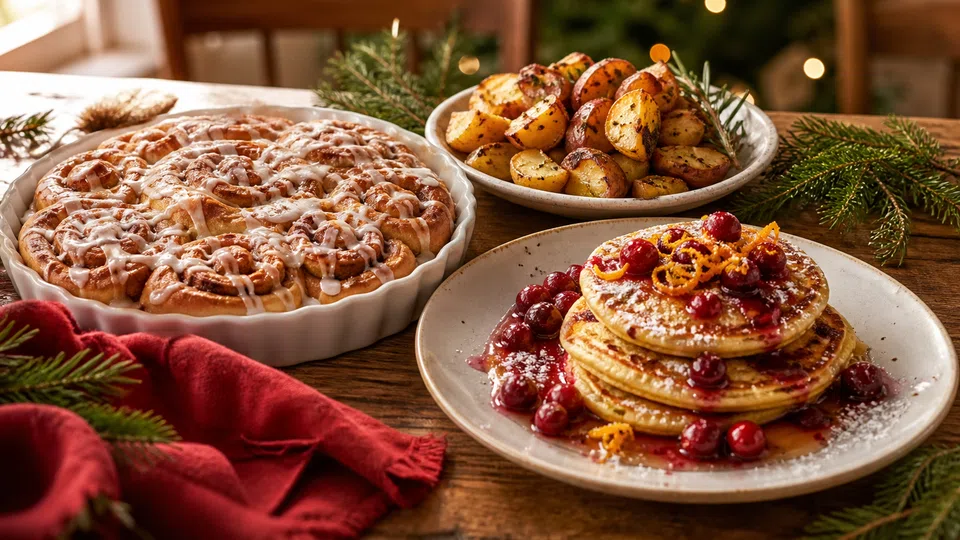
This holiday plan is easy because Christmas-morning heat and attention are reserved for one dish. It does not claim that one recipe fits every family, tradition, allergy, or schedule. The casserole quantities and method come from a recognized culinary source; the cooking and buffet controls come from FDA and USDA guidance. Pancake World did not perform an independent recipe test.
What makes Christmas brunch a distinct planning problem
Christmas brunch is not simply ordinary brunch with seasonal decorations. Guest arrival may overlap with gifts, travel, church, calls, children’s schedules, and a later holiday meal. The oven may be needed again. People can arrive in waves, turning a short meal into a buffet. The route therefore needs a clear service window and a replenishment plan, not a long list of unrelated recipes.
Use four roles:
- Hot centerpiece: one casserole, strata, or other source-tested dish.
- Cold fresh side: fruit or another chilled dish, held correctly and served in small quantities.
- Ready baked item: a product or tested bake prepared earlier, with its own storage instructions.
- Drink station: self-serve only when it does not create another cooking queue or unsafe dairy hold.
The approach differs from easy make-ahead brunch ideas, which owns the general prepare-store-reheat workflow. Here, the controlling intent is Christmas morning: predictable oven timing, staggered arrivals, a festive table, and no competition with later meal preparation.
For a broad set of formats, see the Brunch at Mr. Pancake Munich: A Focused Guide. This article stays with an evidence-bounded holiday system and one exact centerpiece formula.
Source-based Christmas sausage casserole
Food Network publishes Trisha Yearwood’s sausage breakfast casserole as a 12-serving, overnight dish associated with holiday and Christmas-morning use. It requires roughly eight hours of refrigeration and about one hour of cooking in the source schedule. The exact ingredient facts are retained below without copying promotional language.
Ingredients
- Butter for greasing the dish
- Half a loaf of sliced white bread
- 1 pound fresh bulk pork sausage seasoned with sage
- 10 ounces sharp Cheddar, grated
- 2 cups half-and-half
- 1 teaspoon dry mustard
- 1 teaspoon salt
- 5 large eggs, lightly beaten
The source uses a 9-by-13-by-2-inch casserole dish. Bread is cut into 1-inch cubes. The overnight structure depends on that bread, egg, dairy, and cheese system. A gluten-free loaf, plant beverage, egg substitute, different meat, or reduced-fat product may behave differently and is not validated here.
What each ingredient does in the recipe plan
Bread forms the base and receives the liquid mixture during the overnight rest. Bulk sausage supplies the cooked savory layer without a casing-removal step. Cheddar is spread above the sausage. Half-and-half and lightly beaten eggs form the pourable mixture; dry mustard and salt season it. Butter prepares the dish surface.
Those are route-specific functions, not nutrition claims. The article does not assert that white bread, pork, cheese, or half-and-half is superior to alternatives. It explains why silent substitutions would create a different formula.
Step-by-step method
- Prepare a raw-meat zone. Keep pork sausage, its packaging, and its tools away from bread, cheese, fruit, and other ready-to-eat foods.
- Grease the dish. Use the source’s 9-by-13-by-2-inch casserole dish and butter.
- Build the bread layer. Cut half a loaf of white bread into 1-inch cubes and spread them evenly across the base.
- Cook the sausage fully. Brown the bulk sage pork sausage in a medium skillet over medium heat. Break it up while cooking. USDA requires ground pork to reach 160°F; use a thermometer rather than the source’s visual “no longer pink” cue alone.
- Drain and layer. Lift the cooked sausage from the skillet with a slotted spoon so excess pan fat remains behind, then distribute it over the bread.
- Add the cheese. Spread the 10 ounces grated sharp Cheddar over the sausage.
- Mix the liquid. Combine 2 cups half-and-half, dry mustard, salt, and five lightly beaten eggs.
- Pour and cover. Pour the egg mixture over the layered dish. Cover with foil and refrigerate for eight hours or overnight.
- Bake on Christmas morning. Preheat the oven to 350°F. Bake the covered casserole for about 50 minutes in the source method.
- Verify doneness. The source looks for a set and lightly golden result. USDA’s safe-temperature chart gives 165°F for casseroles; check the center and more than one spot where necessary.
- Rest before service. Food Network directs a 15-minute rest after baking. Keep the service clock visible if the dish will join a buffet.
The recipe’s time range is for planning, not proof of doneness in every oven. Dish material, refrigerator temperature, actual depth, ingredient temperature, and oven performance can alter elapsed time. The thermometer endpoint controls.
Christmas brunch decision table
| Christmas-morning situation | Main dish | Supporting food | Final task | Risk to remove before choosing |
|---|---|---|---|---|
| Twelve guests arriving together | Overnight sausage casserole | Chilled fruit in small platters; ready baked item | Verify casserole and pour drinks | Refrigerator space and 50-minute oven window |
| Guests arriving over two hours | Casserole held at 140°F or above only with capable equipment | Cold food at 40°F or below, replenished in small dishes | Replace platters rather than topping up | Unverified warmer and lost buffet clock |
| Small family table | Half-size formula only if a tested source supplies it; otherwise choose a smaller recipe | One fruit side and one bread item | One hot dish | Do not invent halved dish timing |
| Vegetarian group | Complete tested vegetarian breakfast casserole | Label-checked sides | Bake and verify source endpoint | Do not simply remove sausage from this formula |
| Pancake tradition | Pancakes are the one active hot item | Fruit and earlier-prepared baked items | Cook measured batches | Pan capacity and waiting diners |
| Later Christmas dinner uses the oven | Earlier brunch window or no-oven tested menu | Cold sides | Clear, cool, and clean kitchen on schedule | Oven conflict and delayed leftover refrigeration |
The table uses Christmas logistics to choose a route. It does not call the sausage casserole universally best or make a diet recommendation.
Three complete Christmas brunch plans
Plan 1: overnight casserole for 12
On Christmas Eve, cook the sausage to 160°F, assemble the exact casserole, cover it, and refrigerate. Prepare the serving utensils, thermometer, trivets, and small cold-food platters. Keep fruit whole or prepare it under a source-supported refrigerated plan. Do not put dairy drinks out overnight.
On Christmas morning, preheat the oven on a written schedule. Bake the casserole covered, verify 165°F in the center, and rest it 15 minutes. Put out the first small cold platter just before service. Keep backups refrigerated. This plan creates one hot finish and one cold replenishment job.
Plan 2: pancakes as the Christmas ritual
Choose pancakes as the only active cooking task. Set the table, toppings, fruit, plates, and drinks before the pan heats. Use a complete formula such as the classic buttermilk pancake recipe after its own evidence gate, not an improvised holiday batter. Count pan positions and batches from the expected guest number.
Do not also add eggs to order and sausage patties unless another cook, pan, raw-meat zone, and safe service sequence are available. A best breakfast sausage recipe is a separate recipe task, not an automatic pancake side.
Plan 3: staggered Christmas buffet
Use a hot-holding appliance only if its label and thermometer checks show it can maintain food at 140°F or above. FDA warns that some warmers operate below that threshold. Keep the backup cold foods at 40°F or below. Serve them in several small dishes rather than one large platter.
Replace a nearly empty dish with a fresh dish; do not add new food to the older food. Mark the time each uncontrolled perishable platter went out. Discard it after two hours, or one hour if the environment is above 90°F. The time limit is an outer safety boundary, not a target display duration.
Plan 4: Christmas brunch before travel
Select a short, seated service rather than an open buffet. The overnight casserole can work when its bake and rest finish well before departure. Portion promptly, refrigerate leftovers within two hours, and clean the raw-meat and serving areas before leaving.
Do not transport a warm casserole in a car without a verified hot or cold temperature-control method. USDA holiday guidance says transported cold foods belong in a cooler with ice or gel packs at 40°F or below and hot foods need insulation that maintains them above 140°F.
Plan 5: Christmas brunch before a large dinner
Schedule brunch so the casserole exits the oven, rests, serves, and clears before the dinner mise en place begins. Keep the menu compact: one casserole, fruit, one baked accompaniment, drinks. A second oven dish can create a cleaning and temperature-control overlap that erases the convenience.
Label dinner ingredients separately from brunch ingredients. Do not use the same raw-meat cutting board or unwashed serving tools. Return leftovers to shallow containers promptly so the refrigerator can be reorganized for the later meal.
Christmas Eve preparation timeline
Morning or early afternoon
- Confirm guest count, arrival range, dietary constraints, refrigerator space, dish size, and oven availability.
- Shop with a plan to keep sausage, eggs, cheese, and half-and-half cold.
- Read labels for milk, egg, wheat, pork, mustard, and other relevant ingredients.
- Confirm a working food thermometer and capable buffet equipment if used.
Evening, before the kitchen is crowded
- Clear and sanitize the casserole workspace.
- Cut bread and grate cheese with clean tools.
- Open raw sausage only after ready-to-eat preparation is complete or on a separate controlled surface.
- Cook sausage to 160°F and drain it.
- Assemble bread, sausage, cheese, and egg mixture in the correct order.
- Cover, label, and refrigerate for eight hours or overnight.
- Write the oven start, expected check, rest, and service times.
Before bed
- Return all perishables to a refrigerator at 40°F or below.
- Put small cold serving platters and clean utensils together.
- Keep raw-meat tools out of the clean service set until washed.
- Place the thermometer where it is easy to find but safely protected.
- Do not leave the casserole on the counter to “come to room temperature” overnight.
Christmas morning service sequence
- Check that the casserole remained properly refrigerated.
- Preheat the oven to 350°F at the planned time.
- Keep cold foods refrigerated while the casserole bakes.
- Prepare drinks without blocking the hot-food landing area.
- Check the casserole at the expected source time, then continue until the center reaches 165°F.
- Rest the casserole 15 minutes on a protected surface.
- Put out only the first small cold platter.
- Start a visible buffet clock for perishable food not held hot or cold.
- Replace dishes with fresh ones instead of combining old and new food.
- Refrigerate leftovers promptly in shallow containers.
The sequence is deliberately plain. “Festive” comes from the occasion and presentation; safety and timing come from repeatable actions.
Buffet controls that matter
FDA advises holding hot food at 140°F or warmer and cold food at 40°F or colder. Measure rather than trusting a warmer’s indicator. Some warming equipment may not reach the required hot-holding temperature, so its current product instructions and actual thermometer reading matter.
Keep cold backup dishes in the refrigerator. If a cold platter will remain out beyond two hours, FDA recommends placing it on ice to retain the chill, but the food itself still needs to stay at 40°F or below. A decorative ice bowl without temperature control is not evidence.
Small platters reduce the amount exposed at once. They also let the host replace the whole dish instead of adding fresh food to food that guests have already handled. Label platters when different allergen profiles are present and use separate utensils.
For egg dishes refrigerated and served later, FDA advises thorough reheating to 165°F. Hot holding at 140°F is not the same step as reheating from cold. First reheat safely, then hold hot with capable equipment.
Troubleshooting common Christmas brunch failures
The casserole center is below 165°F after 50 minutes
Continue baking and recheck. Do not remove it because the top is golden. If the top is becoming darker, any shielding adjustment must preserve safe cooking; the numeric center endpoint remains the gate.
The sausage was not fully cooked before assembly
The source explicitly browns it until fully cooked before layering. Do not rely on the casserole bake to correct a knowingly skipped step. Restart with a properly executed formula rather than claiming the same recipe.
The bread floats or the layers look uneven
Confirm 1-inch bread cubes, even layers, the exact dish size, and the full eight-hour rest. Do not press or add liquid by intuition after baking starts. A visual difference is not automatically failure, but the final casserole must be set and temperature-verified.
Guests are an hour late
Do not leave the dish at an undefined “warm” temperature. Hold at 140°F or above with measured capable equipment, or cool and refrigerate under current guidance for later reheating. The 15-minute recipe rest does not authorize an hour-long counter hold.
The buffet warmer reads only “low”
Use a food thermometer. FDA notes that some warmers hold food below 140°F. If the equipment cannot maintain the threshold, serve smaller amounts and return to a controlled storage-and-reheat plan.
Cold fruit is warming on the table
Replace it with a fresh small platter from the refrigerator rather than topping it up. Nesting on ice helps only when the food remains at 40°F or colder. Track the time.
A guest needs a dairy-free or egg-free dish
This casserole is not the route. It contains half-and-half, cheese, eggs, butter, wheat bread, pork, and mustard. Use a complete tested formula for the exact restriction and control cross-contact. Removing several ingredients would not preserve the source recipe.
The oven is needed for dinner
Move brunch earlier, select a no-oven source-tested menu, or reduce the later oven conflict. Do not partly bake the casserole and finish it hours later without an authoritative method.
Ingredients, substitutions, and explicit limits
The exact casserole calls for sage-seasoned bulk pork sausage. The best breakfast sausage recipe page documents a from-scratch patty mixture, but it is not automatically a substitute here because patty seasoning, water, and fat were developed for another form. Use the sausage named by the source or a tested casserole variation.
White bread, sharp Cheddar, half-and-half, eggs, dry mustard, salt, and butter are all structural or flavor parts of the source. No cup-for-cup plant beverage, egg substitute, reduced-fat dairy, gluten-free bread, or meatless crumble is authorized by the evidence reviewed for this article.
A fruit side can be adapted more freely at the menu level, but its preparation and storage still need appropriate guidance. Choose whole or cut fruit based on service time, keep it cold where required, and identify any toppings separately.
Ready-baked items should retain their package or recipe storage instructions. “Bought from a bakery” does not tell you whether a custard-filled pastry needs refrigeration. Read labels or ask the seller.
Serving, storage, and reheating
Refrigerate perishable leftovers within two hours, or within one hour above 90°F. Use shallow containers to cool large amounts more quickly. Keep the refrigerator at 40°F or below.
USDA generally advises using cooked leftovers within three to four days and reheating to 165°F. Food Network’s page gives a longer five-day statement for this casserole, but this article adopts the more conservative USDA three-to-four-day boundary rather than presenting conflicting windows as interchangeable.
When reheating casserole portions in a microwave, cover, rotate or stir when practical, allow the specified standing time, and check several places because heating can be uneven. Reheat sauces, soups, or gravy according to current official guidance rather than assuming the casserole rule covers every dish.
Do not repeatedly top up a buffet pan and cool the remaining mixture. Serve in smaller measured batches, preserve untouched backup food under temperature control, and replace the complete serving dish.
Tested variations and source boundaries
Food Network’s Christmas casserole collection documents many distinct formulas—pancake casseroles, croissant casseroles, hash-brown dishes, strata, and vegetarian bakes. Their existence supports menu variety, not free substitution inside this recipe. Select a complete published formula and follow its own dish, rest, temperature, and timing.
For a pancake-centered Christmas table, cook pancakes as the one live task and prepare other components ahead. For a vegetarian centerpiece, choose a recipe explicitly developed without meat. For a smaller family, use a source with a smaller yield rather than halving this 12-serving casserole and guessing its pan and baking time.
For other occasion-specific plans, Father’s Day brunch and easy Easter brunch recipes own different service constraints. Holiday names should not be used to duplicate the same generic menu copy.
Scaling the service without scaling the recipe blindly
The published casserole already serves 12. If the guest list is smaller, leftovers may be acceptable only when the household has a prompt cooling, refrigerator, and reheating plan. If the guest list is larger, adding a second identical 9-by-13-inch dish changes oven airflow, shelf position, refrigerator space, bake timing, thermometer work, and buffet capacity. Multiplying the ingredients is not the whole decision.
For two dishes, confirm that both fit level in the refrigerator and oven without blocking circulation or touching heat sources. Plan separate center checks for each dish; one reading cannot verify the other. Decide whether they bake together under a source-tested method or in sequence. If no source supports simultaneous baking, sequential service or a different second centerpiece is more transparent than inventing a universal time extension.
The cold side should scale through small replenishment platters, not one deeper communal bowl. Keep reserve portions refrigerated and assign a clean utensil to every new dish. For drinks, put out only the amount that can stay within its product-specific temperature requirements. Milk, cream, juice, and prepared beverages do not gain room-temperature stability because the event is busy.
For a very small table, choose a recipe whose published yield and pan match the group. Halving eggs, bread, half-and-half, sausage, and cheese may be arithmetically possible, but the correct dish dimensions and bake time are not established by this source. A smaller tested recipe reduces leftovers and uncertainty more effectively than a guessed half-pan.
Write the service count on the menu: expected guests, casserole portions, number of cold platters, and replenishment times. That record does not guarantee consumption, but it makes the plan auditable and prevents the host from exposing every backup portion at once.
Keep a clean spare serving spoon beside the reserve platters so a dropped or contaminated utensil does not force an improvised reuse during the busiest service period.
Actionable Christmas brunch checklist
- Pick one hot centerpiece and confirm its yield.
- Reserve a level refrigerator space for the covered dish.
- Verify the exact 9-by-13-by-2-inch pan.
- Cook ground pork sausage to 160°F before assembly.
- Assemble the casserole eight hours or overnight ahead.
- Keep the refrigerator at 40°F or below.
- Write oven start, temperature-check, rest, and service times.
- Bake at 350°F and verify 165°F in the center.
- Rest 15 minutes as the source directs.
- Hold hot food at 140°F or above only with capable equipment.
- Hold cold food at 40°F or below.
- Serve cold food in small platters and replace rather than top up.
- Track the two-hour buffet boundary.
- Use separate utensils for distinct allergen profiles.
- Refrigerate leftovers promptly in shallow containers.
- Reheat leftovers to 165°F.
- Leave only one live cooking task for Christmas morning.
Practical conclusion
An easy Christmas brunch is a controlled service plan, not the largest possible recipe list. The 12-serving overnight sausage casserole provides one evidence-backed center: bread, fully cooked sage pork sausage, Cheddar, half-and-half, mustard, salt, and eggs assembled the night before, baked covered at 350°F, verified at 165°F, and rested 15 minutes. Add one cold fresh side, one ready baked item, and drinks without creating another hot queue.
Find more occasion-focused planning on Pancakes World, including Mother’s Day brunch recipes for a different guest and service intent.
Sources and editorial references
- Trisha Yearwood / Food Network, “Sausage Breakfast Casserole” —
https://www.foodnetwork.com/recipes/trisha-yearwood/breakfast-sausage-casserole-2165813 - Food Network Kitchen, “18 Christmas Breakfast Casseroles To Make Your Morning Merry and Bright” —
https://www.foodnetwork.com/holidays-and-parties/packages/holidays/holiday-central-christmas/christmas-breakfast-casseroles - U.S. Food and Drug Administration, “Serving Up Safe Buffets” —
https://www.fda.gov/food/buy-store-serve-safe-food/serving-safe-buffets - USDA Food Safety and Inspection Service, “USDA Explains Why Food Safety Should Be at the Top of All of Our Holiday Lists” —
https://www.fsis.usda.gov/news-events/news-press-releases/usda-explains-why-food-safety-should-be-top-all-our-holiday-lists - USDA Food Safety and Inspection Service, “Leftovers and Food Safety” —
https://www.fsis.usda.gov/food-safety/safe-food-handling-and-preparation/food-safety-basics/leftovers-and-food-safety
Testing note: this Recipe-guide draft uses one published holiday casserole formula and government buffet controls. Pancake World has not claimed an independent kitchen test, universal substitution, nutrition outcome, medical suitability, product performance, or holiday tradition fact. Recipe schema, media, and release remain gated; no site write or publication is implied.