Easy make ahead brunch ideas
Quick answer for easy make ahead brunch ideas
At Pancakes World, the easiest make-ahead brunch has one refrigerated centerpiece, two cold or room-temperature sides, and no more than one last-minute item. A practical centerpiece is Food Network Kitchen’s overnight egg casserole: cook turkey sausage and scallions, combine them with eggs, milk, drained spinach, cheese, and bread, then cover and refrigerate the assembled dish for at least six hours or overnight before baking at 350°F. Prepare fruit and table items ahead, but cut or dress delicate foods closer to service. Keep perishable food refrigerated, cook casseroles to a verified 165°F, and reheat leftovers to 165°F rather than relying on appearance or a vague “warm” cue.
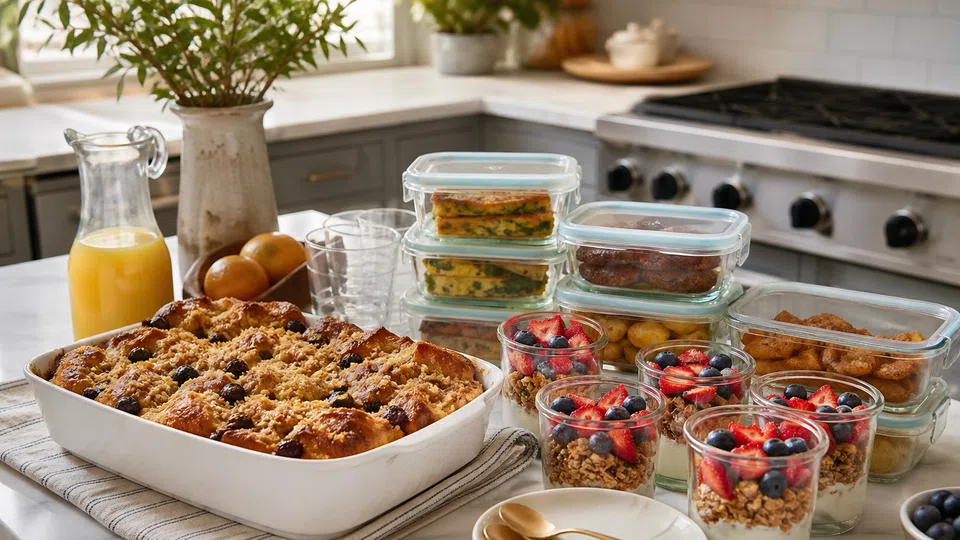
This plan moves work to the previous day without turning brunch into an unsupported holding experiment. The central casserole and its preparation window come from a published culinary source; the temperature, cooling, refrigeration, and reheating boundaries come from USDA guidance. Pancake World has not claimed an independent kitchen test.
The make-ahead rule: move work, not safety decisions
Make-ahead brunch succeeds when each component has a named state at every step: raw, assembled and refrigerated, fully cooked, cold ready-to-eat, or reheated. “Prepare ahead” is too vague. Chopping scallions is different from assembling an egg dish; baking a casserole is different from leaving it on a buffet; thawing fruit is different from keeping cut fruit chilled.
Use four working groups:
- Assemble and refrigerate: a source-tested overnight casserole or strata.
- Cook, cool, and reheat: only foods with explicit cooling, storage, and reheating guidance.
- Prepare cold: washed fruit, packaged accompaniments, and cold dishes kept under appropriate refrigeration.
- Finish at service: one item whose quality depends on immediate cooking, such as pancakes or toast.
The simplification comes from limiting the final group. If eggs, sausage, pancakes, toast, coffee, and a warm sauce all start at the same time, the menu is not meaningfully make-ahead.
The parent Storing and Reheating Pancakes covers the broader storage problem. This page owns the brunch workflow: deciding what can be moved earlier and leaving one controlled service task.
Source-based overnight egg casserole
Food Network Kitchen publishes a six-serving breakfast casserole assembled at least six hours ahead, preferably overnight. Its article also describes assembly up to a day ahead. This is the evidence-backed centerpiece used here. The formula is reproduced as factual recipe data, not as Pancake World test evidence.
Ingredients
- 8 ounces spicy or sweet turkey sausage links, casings removed and meat crumbled
- 2 scallions, sliced
- 6 large eggs
- 6 large egg whites
- 1 3/4 cups 1-percent milk
- 1/2 teaspoon kosher salt
- 1/2 teaspoon black pepper
- One 9-ounce package frozen chopped spinach, thawed and drained well
- 3/4 cup shredded Cheddar
- 1/2 cup grated Parmesan
- Half a whole-wheat baguette, cut into 3/4-inch cubes, about 4 cups
- Cooking spray for a 3-quart casserole dish
The sausage, milk, cheeses, bread, and cooking spray are product-dependent. Read ingredient and allergen labels for the people eating. Do not infer that the formula is gluten-free, dairy-free, egg-free, or suitable for an individual diet.
What each key ingredient does in this workflow
The bread provides the pieces that absorb the egg mixture during the refrigerated rest. The source specifically uses baguette cubes rather than an unspecified bread substitute. Eggs and egg whites form the cooked base. Milk supplies part of the liquid. Drained spinach and cooked sausage distribute through the dish, while Cheddar and Parmesan are the named cheeses.
The workflow depends on preparation as much as ingredients. The turkey sausage is cooked before assembly. The frozen spinach is thawed and excess liquid is removed. The assembled dish remains covered and refrigerated. Changing raw sausage to cooked ham, spinach to watery fresh vegetables, or bread to potatoes creates a different casserole and needs a complete tested formula.
Step-by-step method
- Prepare the raw-meat station. Keep raw turkey sausage and its tools away from bread, cheese, and other ready-to-eat foods.
- Cook the sausage and scallions. Put the crumbled turkey sausage and sliced scallions in a large nonstick skillet over medium heat. Break up large pieces and cook until browned and fully cooked; the source gives about 10 minutes. Ground poultry requires a measured 165°F endpoint under USDA guidance.
- Cool slightly. Remove the skillet from heat. Do not pour a violently hot mixture into the egg bowl.
- Mix the custard. Whisk the whole eggs, egg whites, milk, salt, and pepper in a large bowl.
- Combine the filling. Add the cooked sausage mixture, well-drained spinach, both cheeses, and bread cubes. Toss so the components are distributed.
- Prepare the dish. Coat a 3-quart casserole dish with cooking spray and spread the mixture evenly.
- Cover and refrigerate. Chill for at least six hours or overnight, following the source method. Keep the refrigerator at 40°F or below under USDA guidance.
- Bake. Preheat the oven to 350°F. Uncover and bake. Food Network gives about 30 minutes and looks for a set center with a lightly browned top.
- Verify the endpoint. USDA’s temperature chart gives 165°F for casseroles. Check the center and more than one location when needed; color and firmness alone are not the safety measurement.
- Serve or hold under a real plan. Serve promptly, or use current authoritative hot-holding guidance. The recipe’s bake time is not a buffet window.
The source also permits freezing the baked casserole for up to two weeks, covered with foil, and reheating at 350°F until hot for 35 to 45 minutes. USDA requires reheated leftovers to reach 165°F. Treat the thermometer as the endpoint and the clock as the source’s planning range.
Decision table: choose a menu architecture
| Brunch situation | Centerpiece | Sides prepared ahead | Final task | Main control |
|---|---|---|---|---|
| Six guests, one oven | Overnight egg casserole | Washed fruit, cold drinks, packaged bread accompaniments | Set table and bake casserole | Refrigerator space and 165°F center |
| Guests arrive in waves | Individually portioned reheatable casserole only when source permits | Labelled cold sides | Reheat measured portions | 165°F throughout; avoid repeated uncontrolled warming |
| No morning oven capacity | Cold source-tested dish or already cooked item with explicit reheating equipment | Fruit and room-temperature shelf-stable items | One pan or toaster task | Do not choose an oven-dependent casserole |
| Pancake-focused brunch | Make-ahead cold sides and table setup | Batter only when a tested recipe authorizes holding; otherwise dry station | Cook pancakes | Pan capacity and immediate service |
| Holiday brunch | One overnight bake | Decorations, serving ware, cold components | One heat-sensitive garnish or toast | Do not multiply hot dishes |
| Dietary restrictions | A formula tested for the exact restriction | Separately labelled compatible sides | Minimal final assembly | Full labels and cross-contact plan |
The table does not promise that every fruit plate, bread, or casserole can sit at room temperature. It shows how to limit simultaneous work. Product labels and authoritative time-temperature guidance still govern.
Work that can move earlier without moving the food earlier
Not every time-saving step is food preparation. The day before, count plates and chairs, clear refrigerator shelves, locate the thermometer, label serving utensils, set the table, write the oven schedule, and group shelf-stable sealed items. These actions reduce morning decisions without adding a cooling or storage question.
Measure dry pantry ingredients only when the recipe permits it and keep the original directions with them. Wash serving dishes and place a note inside each naming its intended food; remove the notes before plating. Prepare a separate tray for raw-meat tools so it cannot be confused with the clean serving tray. Put containers and labels beside the refrigerator for prompt leftover packing.
This distinction matters when refrigerator space is limited. It is safer to move logistics ahead than to cook an extra hot dish and search for somewhere to cool it. A brunch can feel prepared even when delicate fruit, toast, or pancakes remain deliberately unfinished. The goal is a short, ordered service sequence—not the maximum number of foods made the night before.
Three practical menu plans
Plan 1: casserole-centered brunch for six
The day before, cook and assemble the exact Food Network casserole, cover it, and refrigerate. Wash whole fruit and refrigerate it appropriately. Set out nonfood serving pieces and write the oven start time on the plan. Keep bread or packaged accompaniments in their correct storage conditions.
In the morning, preheat the oven, bake the casserole, and verify 165°F in the center. Cut fruit with clean tools while it bakes if cutting it earlier would create an unnecessary storage problem. Serve the casserole promptly and refrigerate leftovers within USDA’s two-hour boundary, or one hour when the surrounding temperature is above 90°F.
Plan 2: pancake brunch with almost everything else finished
Do not make both the casserole and pancakes unless the group size and equipment justify two hot centers. Instead, prepare fruit, plates, toppings, and drinks ahead, then make pancakes as the single final item. Use a recipe that fits the available pan and count batches before guests arrive.
The classic buttermilk pancake recipe route is separate because its batter, rest, and cooking need their own evidence. Do not store raw pancake batter overnight unless that exact recipe explicitly permits it. A dry-ingredient station is not the same as a finished batter.
Plan 3: freeze-ahead casserole for a later weekend
Follow the published casserole through baking. Cool and package it according to safe guidance, then use the source’s two-week freezer limit and foil-covered 350°F reheat range. Label the date and contents. On service day, reheat until the center reaches 165°F rather than stopping because the edges are hot.
This route is useful when the previous evening is unavailable. It is not a general claim that every egg casserole freezes well. The permission belongs to this published formula.
Plan 4: mixed cold spread with one warm item
Select cold foods whose own sources and labels permit the planned preparation and storage. Keep them refrigerated until service where required. Make toast, warm rolls, or one other simple item last. Avoid adding a second cooked egg dish “just in case.”
The menu should be described by actual foods, not broad claims such as “safe at room temperature.” If a product is opened or a dish is cut, its storage requirements can change.
Timeline that removes morning congestion
One day before
- Confirm guest count, restrictions, refrigerator space, oven dish, and thermometer.
- Shop with a cold-food transport plan.
- Read labels and the exact recipe once from beginning to end.
- Thaw and drain spinach safely.
- Cook turkey sausage to 165°F, cool slightly, and assemble the casserole.
- Cover, label, and refrigerate at 40°F or below.
- Prepare nonfood table items and a written service order.
Ninety minutes before service
- Clear the work surface and sink.
- Confirm casserole remained properly refrigerated.
- Prepare clean utensils, thermometer, trivets, and serving plates.
- Handle fruit or other cold items with a plan to return perishables to refrigeration.
Forty-five minutes before service
- Preheat the oven to 350°F.
- Remove only the items needed for the next step.
- Bake the casserole according to the source method.
At the source’s expected finish
- Check the casserole in the center and multiple spots as needed.
- Continue cooking until it reaches 165°F.
- Use clean tools to portion.
- Put cold food out in amounts that match immediate service rather than the whole reserve.
Within two hours
- Refrigerate perishable leftovers promptly; use the one-hour boundary above 90°F.
- Divide large quantities into shallow containers so they cool rapidly, following USDA guidance.
- Mark contents and date.
Troubleshooting common failures
The casserole is wet around the spinach
The source requires thawed spinach with excess liquid drained. Preserve that preparation. If another vegetable is used, do not assume the same water release or ratio; use a tested variation.
The center is cool while the edges are browned
Do not increase confidence from appearance. Check the center with a thermometer and continue baking until the casserole reaches 165°F. Shielding or other oven adjustments need recipe-specific judgment; the safety endpoint remains numeric.
The sausage mixture is still hot at assembly
The source says to cool it slightly after cooking. Let it lose the intense pan heat without leaving it out for an open-ended period. Maintain the two-hour cumulative room-temperature boundary for perishables.
Morning still has too many tasks
Remove a hot item. Do not solve congestion by cooking food earlier and holding it without guidance. A cold side, shelf-stable packaged item, or simpler table is a more transparent correction.
The refrigerator is full
The 3-quart covered dish needs a level, cold space. If that space cannot be maintained at 40°F or below, choose a different menu. A porch, garage, or car is not a refrigerator unless a verified temperature-control system makes it one.
Guests are late
Do not leave the casserole in an undefined warm state. Use current hot-holding guidance or cool and refrigerate promptly. Reheat leftovers to 165°F. Repeated cycles of warming and cooling are not a make-ahead strategy.
The menu has an allergen conflict
The primary casserole contains egg, milk, wheat, and a packaged sausage with its own label. Choose a complete tested alternative rather than removing several structural ingredients from this formula. Keep utensils and serving zones controlled.
Serving, storage, and reheating
USDA advises refrigerating perishable leftovers within two hours, or one hour above 90°F. Divide large amounts into shallow containers for rapid cooling and wrap or seal them. Most cooked leftovers should be used within three to four days under USDA guidance, unless the exact recipe gives a shorter limit.
Reheat leftovers to 165°F measured with a food thermometer. In a microwave, cover, rotate or stir for even heating, and check several places because cold spots can remain. Casserole portions reheat more evenly than an entire deep dish, but that is a workflow observation rather than a guaranteed time.
Food Network’s casserole-specific freezer note is up to two weeks for the baked dish. Preserve the shorter source window instead of replacing it with a generic freezer claim. Reheat covered at 350°F using the source’s 35-to-45-minute range and verify 165°F.
For a buffet, do not treat the two-hour discard boundary as a recommended display time. Put out smaller quantities and replenish under a controlled plan. Keep cold foods cold and hot foods hot using current authoritative guidance.
Tested variations and explicit boundaries
The source article describes the casserole as flexible in discussion, but only the listed turkey sausage, spinach, scallion, Cheddar, Parmesan, bread, egg, and milk formula is treated as exact evidence here. A ham, mushroom, potato, meatless, dairy-free, or gluten-free casserole needs its own tested quantities and method.
Food Network’s published freezer variation is accepted because it includes a two-week window, foil cover, oven temperature, and heating range. USDA’s 165°F reheating endpoint completes the safety check. No other freezer performance is inferred.
For occasion menus, easy Christmas brunch recipes and Father’s Day brunch recipes should own their distinct guest and menu intents. This page stays with the general work-shifting system.
Actionable make-ahead checklist
- Select one hot centerpiece.
- Confirm its exact source authorizes overnight assembly or make-ahead storage.
- Reserve refrigerator space at 40°F or below.
- Keep raw meat separate from ready-to-eat ingredients.
- Cook ground turkey sausage to 165°F.
- Drain frozen spinach thoroughly.
- Cover and refrigerate the assembled casserole at least six hours or overnight.
- Preheat to 350°F and bake from the source workflow.
- Verify the casserole reaches 165°F in the center.
- Limit last-minute work to one item.
- Refrigerate leftovers within two hours, or one hour above 90°F.
- Use shallow containers for rapid cooling.
- Reheat leftovers to 165°F and check multiple spots.
- Keep the source’s two-week freezer limit for this casserole only.
- Record labels and restrictions rather than assuming substitutions.
Practical conclusion
The reliable make-ahead brunch pattern is one overnight centerpiece, a small set of cold or shelf-stable sides, and one final task. Food Network Kitchen’s six-serving egg casserole provides a complete example: cooked turkey sausage, eggs, milk, drained spinach, cheese, and bread assembled at least six hours ahead, baked at 350°F, and verified at 165°F. USDA guidance supplies the cold-storage, cooling, two-hour, three-to-four-day, and 165°F reheating boundaries.
Explore more service-ready planning on Pancakes World, including Mother’s Day brunch recipes when the occasion—not make-ahead mechanics—is the primary intent.
Sources and editorial references
- Food Network Kitchen, “Overnight Egg Casserole” —
https://www.foodnetwork.com/recipes/food-network-kitchen/breakfast-casserole-3362652 - USDA Food Safety and Inspection Service, “Leftovers and Food Safety” —
https://www.fsis.usda.gov/food-safety/safe-food-handling-and-preparation/food-safety-basics/leftovers-and-food-safety - USDA Food Safety and Inspection Service, “Food Thermometers” —
https://www.fsis.usda.gov/food-safety/safe-food-handling-and-preparation/food-safety-basics/food-thermometers - USDA Food Safety and Inspection Service, “Shell Eggs from Farm to Table” —
https://www.fsis.usda.gov/food-safety/safe-food-handling-and-preparation/eggs/shell-eggs-farm-table
Testing note: this Recipe-guide draft uses a published culinary formula and government safety rules. It does not claim an independent Pancake World test, a universal make-ahead window, nutrition outcome, medical suitability, or substitution performance. Recipe schema and media release remain gated until the production test and asset requirements pass; no site or publication action is implied.