Fry-up breakfast
Direct answer for a fry-up breakfast
At Pancakes World, a fry-up is a cooked breakfast assembled from several hot components rather than one fixed universal recipe. For a manageable four-person version, use Good Food’s one-pan sequence: cook 4 pork chipolatas for 3 minutes; add 4 smoked back-bacon rashers for about 5 minutes; add 140g button mushrooms for 3 to 5 minutes; drain excess fat; pour in 6 beaten eggs; cook 2 minutes over low-medium heat; top with 8 halved cherry tomatoes, optional cheese, and chives; then grill about 2 minutes until set. Verify sausages reach at least 75°C.
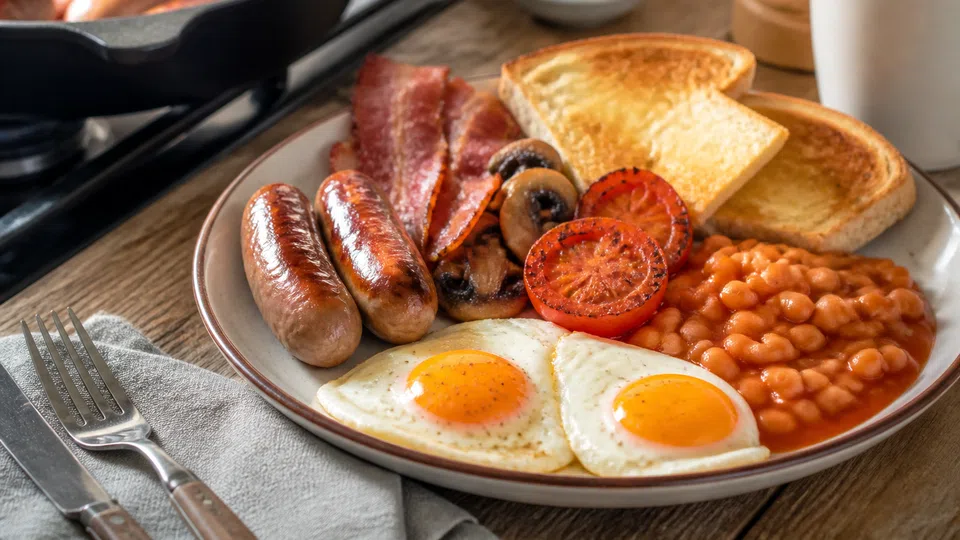
An Irish fry may also include black and white pudding, beans, tomato, mushrooms, hash browns, and soda bread or toast, but the plate should match preference and equipment rather than a compulsory checklist.
What “fry-up breakfast” means
“Fry-up” is a practical umbrella term for a cooked breakfast built from items such as sausage, bacon, eggs, tomato, mushrooms, beans, bread, or potato components. Culinary sources show substantial variation. Good Food’s guide treats sausage, bacon, and eggs as a central trio, with beans, tomatoes, and toast as common additions and mushrooms, black pudding, hash browns, potato scones, and fried bread among optional or debated extras.
Tourism Ireland describes a full Irish breakfast with sausages, rashers, eggs, white and black pudding, baked beans, tomatoes, mushrooms, hash browns, and soda bread or toast, while explicitly noting that people choose components and that regional variations apply. Its Ulster fry description highlights potato farls and a one-pan tradition. These are useful cultural reference points, not rules that every home or venue follows.
The cooking problem is more stable than the ingredient list: raw sausage needs a verified endpoint, bacon and mushrooms need pan space, eggs should land late, beans require a separate saucepan or safe microwave plan, and bread needs its own final position. For broader breakfast planning, see the Breakfast Recipes to Start the Day.
Choose the right fry-up approach
| Situation | Practical format | Hot components | Equipment | Main control |
|---|---|---|---|---|
| Four people, one pan plus grill | Good Food one-pan breakfast | Chipolatas, bacon, mushrooms, set egg, tomatoes | Oven-safe nonstick pan and grill | Verify sausages before egg covers the pan |
| Two people, plated Irish-style | Selected components only | Sausage, rasher, egg, pudding or potato item as preferred | Two pans or pan plus grill | Write the order; do not crowd raw and ready foods |
| Ulster-inspired plate | Sausage, bacon, egg, tomato, pudding, potato farl and soda bread as chosen | Several distinct items | Wide pan plus warm holding | Bread and pudding need source or label instructions |
| Six or more people | Oven/tray recipe designed for a group | Source-defined set of components | Large tray and separate thermometer access | Do not multiply one-pan timing blindly |
| Meat-free breakfast | Complete vegetarian or vegan cooked-breakfast recipe | Source-defined substitutes, mushrooms, tomato, beans, bread | Clean tools and label-checked ingredients | Do not call shared-pan service suitable without checking requirements |
| Camping breakfast | Simplified source-tested menu | One meat or no-meat main plus one pan side | Limited fuel and cold storage | Keep the route smaller than a home fry-up |
The decision table prevents a common planning mistake: selecting eight components before checking pan area, thermometer access, and the moment eggs must be served.
A source-based one-pan fry-up for four
Good Food’s One-pan English Breakfast is an easy, four-serving method with five minutes of preparation and a 15-minute cooking plan. It finishes as a set egg-and-breakfast wedge rather than four separately fried eggs. That makes it useful when the goal is a complete hot plate with one pan, but it is one published variation—not the definition of every fry-up.
Ingredients
- 4 pork chipolatas
- 4 rashers smoked back bacon
- 140g button mushrooms
- 6 eggs, beaten
- 8 cherry tomatoes, halved
- A handful of grated cheese, optional
- 1 tablespoon snipped chives
The source does not include beans, pudding, hash browns, fried bread, or soda bread in this particular formula. Add none of them to the same pan without another complete method and enough cooking capacity.
Step-by-step sequence
- Set up raw and cooked zones. Keep the raw pork products, their packaging, and their utensils away from tomatoes, chives, plates, toast, and other ready-to-eat foods. Put a clean thermometer beside the cooker.
- Heat the grill to high. The final set happens under the grill, so use a pan approved for that heat and position. Follow the cookware instructions.
- Start the chipolatas. Heat a medium nonstick frying pan and cook the four sausages for 3 minutes in the culinary source’s sequence.
- Add the bacon. Add four rashers and turn items occasionally. The source gives about 5 minutes, until the bacon begins to crisp.
- Add the mushrooms. Put in 140g button mushrooms and cook for another 3 to 5 minutes.
- Verify the sausage core. Safefood advises sausages reach at least 75°C in the thickest part. Remove one from heat for the check and insert a clean probe horizontally into its centre. Source minutes and browning do not replace the thermometer.
- Drain and arrange. Drain excess fat as the recipe directs, then spread sausage, bacon, and mushrooms evenly so egg can occupy the gaps.
- Add beaten eggs. Season according to the source, pour in all six eggs, and swirl them through the spaces. Cook for 2 minutes over low-medium heat, gently moving with a fork until beginning to set.
- Finish under the grill. Scatter over the eight halved tomatoes, optional grated cheese, and chives. Grill for about 2 minutes until the egg is set.
- Cut and serve. Divide into four wedges and serve immediately with chosen sauces or separately prepared bread.
The source’s 15-minute cook is a planning range for its exact pan and quantities. Actual sausage thickness, starting temperature, pan output, and grill distance can change elapsed time. The 75°C core check controls the sausage; the set egg cue controls the final grill stage.
Why the sequence works operationally
Sausages start first because their centre must cook through. Bacon enters after the first sausage interval, then mushrooms use the same pan before excess fat is drained. Eggs arrive only after the meat has progressed and been checked. Tomatoes, optional cheese, and chives are last because the grill finishes the set surface.
This order reduces pan switching, but it does not eliminate food-safety boundaries. A thermometer that touched undercooked sausage must be washed with hot soapy water before reuse, according to Safefood. A raw-meat plate must not become the cooked-food plate.
The final product is closer to a breakfast frittata wedge than a component-by-component hotel plate. That difference is useful: the reader can choose a one-pan answer without claiming it is the only correct fry-up.
Three practical fry-up scenarios
Compact two-person Irish-style plate
Choose only the components actually wanted: for example, sausage, rasher, fully cooked egg, tomato, and soda bread. Use product instructions for pudding, bread, or packaged components. Cook sausage to at least 75°C, then use a clean area and utensil for the finished food. Start eggs only when plates and bread are ready.
Do not halve the four-person one-pan egg formula and assume an identical grill time in a different pan. Either cook the source batch or use a complete recipe written for two.
Four-person one-pan breakfast
Use the exact Good Food ingredients and sequence. Prepare tomatoes and chives first, preheat the grill, and check the pan is grill-safe. The sausages and bacon share the pan; mushrooms follow; beaten eggs bind the finished plate. Serve as four wedges.
If sausage itself is the main cooking task, the breakfast sausage recipe route provides a different source-based patty method. It should not be merged with chipolata timing.
Larger breakfast cooked in batches
Do not crowd eight or twelve sausages into the same medium pan while retaining the 15-minute claim. Use a source-tested tray breakfast or independent batches with thermometer verification. Hold finished hot food only with equipment that keeps it at the required temperature.
FSAI business guidance uses 63°C as the hot-holding threshold and states that cooked food not held above that level should be used within two hours. At home, the simpler plan is often to reduce the component count and serve promptly rather than build a long holding operation.
Camping fry-up
A home fry-up depends on refrigeration, raw-meat separation, several utensils, fuel, and cleanup. For camping, select a simpler camping breakfast with one controlled pan task and a reliable cold chain. Do not take raw sausage merely because it is customary on a home plate.
Actionable fry-up checklist
- [ ] Ask which components people actually want.
- [ ] Select a complete format: one-pan wedge, plated fry, tray bake, or meat-free recipe.
- [ ] Count pan positions before shopping.
- [ ] Check cookware is safe under the grill if using the one-pan method.
- [ ] Prepare tomatoes, mushrooms, chives, bread, and plates before raw meat cooks.
- [ ] Keep raw meat and ready-to-eat food tools separate.
- [ ] Start sausage before bacon, mushrooms, and eggs.
- [ ] Verify sausages reach at least 75°C in the thickest part.
- [ ] Wash the probe after each insert.
- [ ] Add eggs only after the meat stage is complete and checked.
- [ ] Serve promptly or maintain verified hot holding.
- [ ] Refrigerate leftovers promptly and reheat no more than once under FSAI guidance.
Common mistakes
Treating the fry-up as a compulsory ingredient list
Tourism Ireland and Good Food both document variation. Pick the plate by preference, route, and equipment. A shorter controlled breakfast is more useful than an overfilled version where every item finishes at a different time.
Crowding one pan
Crowding reduces turning room and blocks thermometer access. The one-pan recipe uses four chipolatas, four rashers, 140g mushrooms, and six eggs in a medium pan; larger quantities require a different plan.
Trusting sausage colour or source minutes
Safefood recommends a thermometer and at least 75°C in the centre of sausages. Browning, clear-looking fat, or a three-minute-plus-five-minute schedule does not prove the core endpoint.
Cooking eggs too early
Eggs are the final pan component in the one-pan formula. On a plated fry-up, cook them only when the sausage, bacon, tomato, mushrooms, bread, and plates are nearly ready. A classic buttermilk pancake recipe adds another active pan job and should be the centerpiece, not an automatic side.
Mixing raw and cooked utensils
Use clean tongs or a clean turner for cooked food. Wash the thermometer probe after every insert. Keep raw packaging away from chives, tomatoes, bread, and plates.
Holding everything while one late item finishes
Remove the late item or choose a verified hot-hold method. A low oven may hold some components briefly under a culinary source, but no universal duration is assumed. Eggs and toast are especially service-sensitive, so start them last.
Variations by market and ingredient
Full Irish and Ulster references
Tourism Ireland lists sausage, rashers, eggs, white and black pudding, beans, tomatoes, mushrooms, hash browns, and soda bread or toast for a traditional full Irish reference plate, while noting personal choice. Its Ulster fry reference includes potato farls and identifies a regional one-pan approach. Use complete recipes and product instructions for pudding, farls, and breads; this guide does not invent their cook times.
English one-pan format
The Good Food formula is a compact interpretation using chipolatas, back bacon, mushrooms, beaten egg, cherry tomatoes, optional cheese, and chives. It trades separate fried eggs and beans for a set wedge that can be divided into four portions.
Meat-free format
Choose a complete vegetarian or vegan cooked-breakfast recipe. Do not put a substitute product into the raw-meat pan and call it suitable for a dietary or allergen requirement. Check labels, tools, and the actual cooking environment.
Make-ahead or oven-led format
When the real problem is guest timing, easy make-ahead brunch ideas owns preparation and reheating. For an occasion-specific plated savory breakfast, Father’s Day brunch recipes uses a different steak-and-eggs handoff.
Storage and reheating notes
Serve the fry-up immediately when possible. FSAI consumer guidance says leftovers should be kept at 0–5°C, used within two to three days, reheated to at least 70°C, served very hot and steaming, and reheated only once. Apply the instructions to the specific cooked components and refrigerate them promptly.
Do not store a mixed plate at room temperature for later. Separate components into suitable containers so they chill efficiently. Toast, egg, mushroom, tomato, bacon, and sausage will not all regain their fresh textures in the same reheating method; safety guidance does not promise quality.
If the time or temperature history is unknown, discard the food. No smell or visual check can reconstruct safe holding.
Evidence boundary
This guide uses culinary sources to establish component range and one executable formula, Tourism Ireland for Irish and Ulster reference components, and Irish food-safety authorities for temperature and leftovers controls. Pancake World did not cook or compare the formats and makes no ranking, nutrition, venue, or universal-tradition claim.
For more evidence-bounded breakfast guidance, visit Pancakes World.
Sources and editorial references
- Good Food, “One-pan English breakfast,” complete four-serving formula, ingredient quantities, source times, pan sequence, low-medium egg stage, grill finish, and set cue:
https://www.bbcgoodfood.com/recipes/one-pan-english-breakfast - Good Food, “The ultimate fry-up guide,” central and optional fry-up components and documented variation:
https://www.bbcgoodfood.com/howto/guide/ultimate-fry-up - Tourism Ireland, “Breakfast on the island of Ireland,” full Irish reference components, preference flexibility, and Ulster fry regional variation:
https://www.ireland.com/en-fi/magazine/food-and-drink/breakfast-in-ireland/ - Safefood, “How to check your meat is cooked properly,” 75°C sausage endpoint, horizontal probe placement, remove-from-heat check, and probe washing:
https://www.safefood.net/food-safety/check-meat-cooked - Food Safety Authority of Ireland, “Cooking and Reheating,” 75°C core cooking, 0–5°C leftover storage, two-to-three-day use, 70°C reheating, and one-reheat guidance:
https://www.fsai.ie/consumer-advice/food-safety-and-hygiene/cooking-and-reheating - Food Safety Authority of Ireland, “Temperature Control,” 75°C instantaneous or 70°C for two minutes and 63°C hot-holding guidance:
https://www.fsai.ie/business-advice/running-a-food-business/caterers/temperature-control
Release boundary: This is an informational guide using Article schema, not a Pancake World-tested recipe. No Recipe schema, nutrition data, product test, venue fact, publication, deployment, or indexing is authorized or claimed.