
Quick answer
“Pancakes in Japan” does not describe one recipe. It can refer to thick Western-style hotcakes, modern meringue-supported soufflé pancakes, the filled confection dorayaki, or savory dishes such as Osaka-style and Hiroshima-style okonomiyaki. Negiyaki, monjayaki, and rice-cooker pancakes add further distinctions. They differ in batter, thickness, cooking method, filling or toppings, meal role, and cultural context.
If you want a sweet café breakfast, choose hotcakes or soufflé pancakes. If you want a portable sweet, choose dorayaki. If you want a savory meal cooked around cabbage, batter, sauce, and other ingredients, choose okonomiyaki and then identify the regional style. Do not ask which one is the “authentic Japanese pancake” as though the other traditions are imitations; name the dish you mean.
A practical comparison
| Style | Defining form | Typical role | Main method clue |
|---|---|---|---|
| Japanese hotcake | Thick, round, cake-like sweet pancake | Breakfast, café plate, snack | Pourable leavened batter on a griddle |
| Soufflé pancake | Tall, airy, delicate sweet pancake | Immediate café-style serving | Whipped egg-white foam, gentle folding, covered cooking |
| Dorayaki | Two small cakes enclosing a sweet filling | Confection or snack | Matched rounds filled after cooking |
| Osaka-style okonomiyaki | Savory batter mixture commonly integrating cabbage and additions | Meal | Mixed ingredients cooked as one round |
| Hiroshima-style okonomiyaki | Layered savory construction, commonly including noodles | Meal | Components layered rather than mixed into one batter |
| Negiyaki | Thin savory pancake centered on abundant green onion | Meal or snack | Green-onion-forward mixture cooked on a flat pan |
| Rice-cooker pancake | One large cake shaped by the appliance bowl | Shared home cake | Recipe designed for a compatible rice cooker |
These are useful orientation points, not complete definitions for every restaurant, household, region, or product. Ask what the kitchen actually serves.
Japanese hotcakes
Japanese hotcakes belong to the history of Western-style pancake adaptation in Japan. They are generally thicker and more cake-like than a thin crêpe, but they are not automatically the same as a contemporary soufflé pancake. A hotcake can be made with a conventional leavened batter and may be served with butter, syrup, fruit, or cream.
At a café, look for a compact round with an even browned surface and a tender interior. Height alone is not enough to identify it: a thick hotcake may be tall without relying on meringue, while a soufflé-style pancake is built around foam and a different cooking system.
For a home version, use a recipe explicitly labeled for Japanese-style hotcakes. Measure the batter, control the pan heat through the recipe’s cues, and avoid pressing after the turn. Do not add whipped whites to an unrelated mix and call the result an evidenced traditional formula.
Modern Japanese soufflé pancakes
Soufflé-style pancakes are tall, airy sweet pancakes whose batter relies heavily on whipped egg whites. The American Egg Board explains the general function of egg-white foam, while contemporary recipes document recipe-specific meringue, folding, portioning, and covered cooking. No single peak stage, pan temperature, ring, or timer applies to every formula.
Two home systems are common in published recipes. A ring-supported method contains the batter and can create straighter sides. A ringless method pipes or spoons compact layers directly onto the pan. Choose one complete recipe instead of mixing the portion from one with the heat and turn from another. The guide to making Japanese soufflé pancakes without a mold explains that boundary.
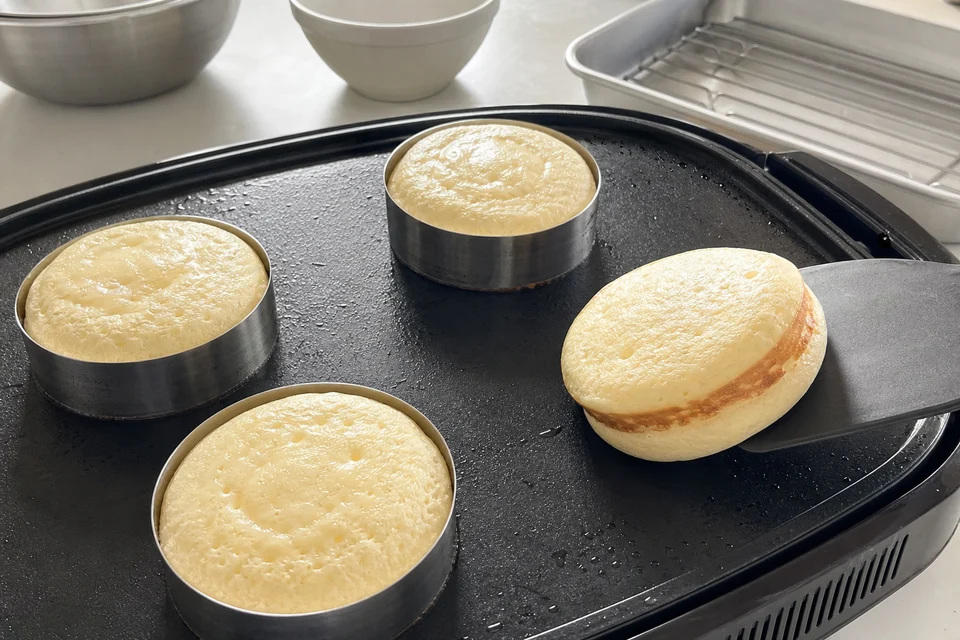
Serve promptly. Foam-supported pancakes can settle, and at least the cited King Arthur formula notes loss of soufflé texture as it sits. If height disappears dramatically, use why Japanese soufflé pancakes deflate rather than assuming that every shorter pancake was made incorrectly.
Dorayaki
Dorayaki is not a plated soufflé pancake. It uses two small cooked cakes to enclose a filling, commonly sweet red bean paste. The National Diet Library’s reference material preserves historical records and competing accounts; it does not support reducing dorayaki to a single invented date repeated without context.
The practical form is easy to recognize. The cakes are relatively thin, matched by size, and flexible enough to sandwich the filling. The filling belongs inside, not piled on top like a café stack. Taiyaki and imagawayaki may also contain sweet bean paste, but their molded enclosing methods and shapes are different.
For a home workflow, follow a dedicated dorayaki guide: prepare the filling, cook evenly sized rounds through the chosen recipe, cool or rest them as directed, match pairs, portion the filling, and close without squeezing it out. Do not transfer the tall meringue method to this confection.
Osaka-style okonomiyaki
Okonomiyaki is a savory meal, not a sweet pancake with unusual garnish. Japan’s Ministry of Agriculture, Forestry and Fisheries documents Osaka-style okonomiyaki as a regional dish and describes a method in which ingredients such as cabbage are combined with batter before cooking. Exact household and restaurant formulas vary.
At the table, expect a savory round finished with sauce and other toppings according to the preparation. Ask about pork, seafood, egg, wheat, soy, fish-derived ingredients, and mayonnaise when allergies or dietary restrictions matter. The name alone does not supply a complete ingredient list.
At home, use a reliable Osaka-style recipe. Cut ingredients to the specified size, keep the batter and additions in proportion, cook the first side until the structure can be turned, support the whole round, and complete the center. Do not press repeatedly to force faster cooking; that changes texture and can squeeze moisture.
Hiroshima-style okonomiyaki
The Hiroshima style uses a layered construction and is commonly associated with noodles. MAFF’s regional material distinguishes it from the mixed Osaka approach. Calling one “real” and the other “wrong” erases established regional difference.
The layered method asks for organization. Prepare every component before assembly, follow the recipe’s sequence, and use tools broad enough to support the stack. A casual substitution of mixed-batter timing can leave layers poorly coordinated. For ordering, ask whether the serving includes soba or udon noodles and which meat, seafood, egg, and sauces are used.
Negiyaki and other savory relatives
Negiyaki centers green onions and is usually thinner than a cabbage-heavy okonomiyaki. It has its own balance of batter, onions, glaze, and optional additions. Use the negiyaki guide rather than treating it as an okonomiyaki topping variation.
Monjayaki is looser and cooked and eaten differently from a firm round pancake. Its texture can surprise visitors who expect a sliceable cake; that difference is part of the dish, not evidence of undercooking by the standards of another recipe. A page about pancakes in Japan should identify it carefully without pretending a short overview is a complete regional or restaurant guide.
The rice-cooker pancake is another separate method
A Japanese rice-cooker pancake is one large cake whose shape comes from the appliance bowl. It is not an oversized soufflé pancake. Use only a formula designed for a compatible machine, keep the steam vent clear, respect fill limits, and follow the manufacturer’s instructions. The Japanese rice-cooker pancake guide covers appliance boundaries and serving.
Never pour a tall foam batter into an appliance simply because both results are described as fluffy. Heating profile, headroom, retained moisture, and release are different.
How to choose what to order
Choose by meal role first. For a sweet breakfast you can eat slowly, hotcakes are sturdy and familiar. For a dramatic airy serving that should be eaten promptly, choose soufflé pancakes. For a handheld or packaged sweet, choose dorayaki. For lunch or dinner, choose okonomiyaki or negiyaki and identify the style and ingredients.
Then ask practical questions: Is this dish sweet or savory? Is it a stack, sandwich, mixed round, or layered construction? Does it include noodles? Which filling or sauce is used? Is it made to order? Those questions reveal more than a menu translation that says only “Japanese pancake.”
Do not infer that every tall pancake is soufflé style, every filled cake is dorayaki, or every cabbage pancake is prepared the same way. Observe the construction and use the specific name.
Build a useful tasting flight
If you can obtain suitable examples, compare small portions rather than full plates. Begin with a plain hotcake, continue to a lightly topped soufflé pancake, then taste dorayaki. Treat savory okonomiyaki as a separate course. This order keeps strong sauces and fillings from masking the subtler sweet bases.
Record structure, not scores alone: thickness, crumb, sweetness, filling, surface, and service timing. A tasting flight cannot prove authenticity or national popularity. It helps a diner learn why the foods should not share one generic description.
Common mistakes
Calling every style “fluffy Japanese pancakes”: That phrase loses dorayaki, okonomiyaki, negiyaki, and hotcake distinctions.
Inventing one origin story: The traditions have different records. Do not assign one inventor to all pancakes in Japan.
Using a modern café photograph as history evidence: Appearance today does not prove the first venue, date, or person.
Combining recipes: Ring-supported and ringless soufflé methods, hotcake batter, and dorayaki rounds are not modular pieces of one formula.
Ignoring savory ingredients: Okonomiyaki and negiyaki may involve wheat, egg, meat, seafood, soy, and fish-derived seasoning. Ask directly.
Treating exterior color as doneness: Tall sweet pancakes and thick savory rounds need their centers completed through the selected method. Use the Pancake Troubleshooting hub when the result is raw or scorched.
Current-batch help and next-batch planning
If a sweet pancake is already cooked but shorter than expected, serve it if it reached the recipe’s safe endpoint and treat height as a quality observation. Do not press, restack, or return it to a mold to restore lost foam. If dorayaki rounds differ in size, pair the closest matches and reduce filling where the edge is narrow. If a savory round threatens to tear, stop moving it, allow the recipe’s first-side structure to develop, and use broader support.
Before the next batch, choose the dish first. Read one complete recipe, prepare its equipment, and record its intended thickness and service. Change only one variable after a failed attempt. That turns “Japanese pancake” from a vague aspiration into a reproducible named method.
Limitations and respect for variation
This guide is an orientation, not a census of Japanese regional food. It cannot represent every household, café, festival stall, packaged mix, or contemporary invention. Japanese names, local context, and practitioner accounts should take priority over a simplified international taxonomy.
“Authentic” is not a visual badge that Pancake World can award from a round shape. A responsible description names the dish, region or style when evidenced, ingredients, and method. It also distinguishes a home adaptation from documentary proof of a venue or tradition.
FAQ
What are Japanese fluffy pancakes called?
The tall airy modern style is commonly called Japanese soufflé pancakes. Japanese hotcakes can also be thick and fluffy but use a different structure. Use the specific recipe and name.
Are okonomiyaki pancakes?
They are often described in English as savory Japanese pancakes, but Osaka and Hiroshima styles have distinct constructions, ingredients, and meal contexts. They are not sweet hotcakes with savory toppings.
What is the difference between dorayaki and soufflé pancakes?
Dorayaki uses two smaller cakes to enclose a filling. Soufflé pancakes are tall, foam-supported plated pancakes served promptly.
Do Japanese soufflé pancakes require molds?
Not always. Some recipes are written for rings, while others build freestanding mounds. Use a complete method designed for the chosen system.
Which Japanese pancake should I try first?
Choose hotcakes for a sturdy sweet breakfast, soufflé pancakes for airy texture, dorayaki for a filled confection, or okonomiyaki for a savory meal. There is no single required starting point.
Related Pancake World guides
Continue with different kinds of Japanese pancakes, dorayaki, negiyaki, the rice-cooker pancake, or the focused mold-free soufflé pancake guide. Explore more international pancake traditions from Pancakes World.
Sources and editorial references
- National Diet Library Collaborative Reference Database: Hotcake and Dorayaki Records —
https://crd.ndl.go.jp/reference/entry/index.php?id=1000203322&page=ref_view;https://crd.ndl.go.jp/reference/entry/index.php?id=1000215401&page=ref_view - Ministry of Agriculture, Forestry and Fisheries Japan: Osaka and Hiroshima Okonomiyaki —
https://www.maff.go.jp/e/policies/market/k_ryouri/search_menu/5798/index.html;https://www.maff.go.jp/e/policies/market/k_ryouri/search_menu/2805/index.html - King Arthur Baking Company: Japanese Soufflé Pancakes —
https://www.kingarthurbaking.com/recipes/japanese-souffle-pancakes-recipe - American Egg Board: Egg White Whipping Functionality —
https://www.incredibleegg.org/professionals/manufacturers/real-egg-functionality/whipping/
For the wider topic, start with Japanese Pancakes.
For a closely related guide, see Okonomiyaki in Japan: Styles, Ingredients, and Variations.
A useful next comparison is Eating Japanese Pancakes: A Style-by-Style Guide.
You can also continue with How to Enjoy Sweet Japanese Pancakes.
Related reading
- History of Japanese Pancakes: Who Invented the Pancake?
- Takoyaki: A Guide to Japan’s Griddled Street Food
Image note: Editorial images were created and refined with AI.
