
Quick answer
Yes. Japanese soufflé-style pancakes can be made without ring molds when the recipe is designed for freestanding batter mounds. Expect softly rounded, slightly irregular sides rather than the straight cylinder produced by a ring. The method depends on a stable whipped-egg-white foam, gentle folding, controlled portions, layered piping or spooning, a lidded pan, patient heat, and a supported flip.
Do not simply remove the rings from a ring-specific recipe and assume its portion, heat, timing, and turning method remain correct. King Arthur Baking’s cited formula is built around parchment-lined English-muffin rings. Good Food publishes a different method that pipes batter upward in concentric layers directly onto a lidded pan. Those examples show why “with a mold” and “without a mold” are two systems, not one interchangeable final step.
This guide explains the legacy question’s Japanese-pancake context. It is not about dorayaki, ordinary hotcakes, okonomiyaki, a rice-cooker pancake, or pancakes cut into decorative shapes.
What the mold changes
A ring contains the batter laterally. It encourages straight sides, helps a soft mixture remain compact, and gives the cook a firm outer boundary during a ring-specific turn. It does not create the foam inside the batter. The rise in soufflé-style pancakes still depends heavily on whipped egg whites and how the batter is mixed and cooked.
Without a ring, the batter must hold a mound on its own. The portion spreads somewhat as it warms, so the result is usually wider and less geometrically even. That is not automatically a failed pancake. Judge whether the center is fully set, the crumb is airy, the pancake can be lifted intact, and the eating texture suits the chosen recipe. A perfectly vertical wall is a shape goal, not a safety or quality test.
Choose a recipe written for ringless cooking
Start with a source that portions batter directly onto the pan. Good Food’s ringless approach uses a piping bag to build a tall mound with concentric layers, then covers and turns the pancakes through its specified method. That provides evidence that a mold-free system is workable. It does not authorize transferring the exact height, time, heat, or ingredient ratios to another formula.
By contrast, the cited King Arthur method lines rings with parchment, fills them, and turns pancake, parchment, and ring together. If that is the recipe you selected, use the equipment and sequence it specifies. Removing the ring changes the support, contact area, portion shape, and flip.
Before mixing, read the complete selected recipe and answer four questions: Is it explicitly ringless? Does it pipe or spoon the mound? Does it require a lid and added steam? What signs or timing does it give before the turn? If those points are unclear, choose a better-documented method rather than inventing a hybrid while delicate batter waits.
The mold-free workflow
Prepare the pan and tools first
Use the pan, lid, and heat source specified by the chosen recipe. Confirm that the lid fits without touching the planned batter height. Prepare the piping bag or portioning spoons, flexible spatula, timer, plate, and toppings before the meringue is folded. Soufflé batter loses useful air while it waits, so equipment decisions should not happen after mixing.
Apply fat exactly as the recipe directs. An excessive pool can fry the edge and encourage sliding, while an unprepared surface may stick. Do not infer a universal burner number; pan material, burner size, and appliance control differ.
Make the base and meringue through the selected formula
Separate eggs cleanly. Mix the yolk-based portion as directed. In a clean bowl, whip the whites to the recipe’s named stage, adding sugar or stabilizing ingredients in its specified sequence. The American Egg Board explains the general whipping function of egg whites: beating incorporates air while egg-white proteins help stabilize the bubble structure. That general science does not set one universal peak stage for every pancake formula.
Use the visual endpoint in the chosen recipe. Underdeveloped foam may not hold a useful mound. Foam taken past the recipe’s useful stage can become difficult to combine evenly. If the bowl contains dry-looking chunks that resist folding, beating longer is not an automatic cure.
Fold gently and completely
Lighten the heavier base with an initial portion of foam if the recipe directs it, then add the remaining meringue in stages. Cut through and around the mixture while turning the bowl. Stop when the formula’s endpoint is reached: large white islands should not remain, but repeated stirring removes air.
Do not count folds as though every bowl, whisk, and batch were identical. Watch the batter. It should be cohesive and able to sit in a mound for the ringless technique. A runny batter that immediately flattens is a warning to stop and review the recipe rather than piling on more and hoping the lid will create height.
Build upward, not outward
Pipe or spoon the first compact round onto the prepared pan. Add the next portion on top of the first rather than widening the footprint. Leave generous space between pancakes so a spatula can approach from more than one direction. Make fewer pancakes per batch if crowding would compromise the turn.
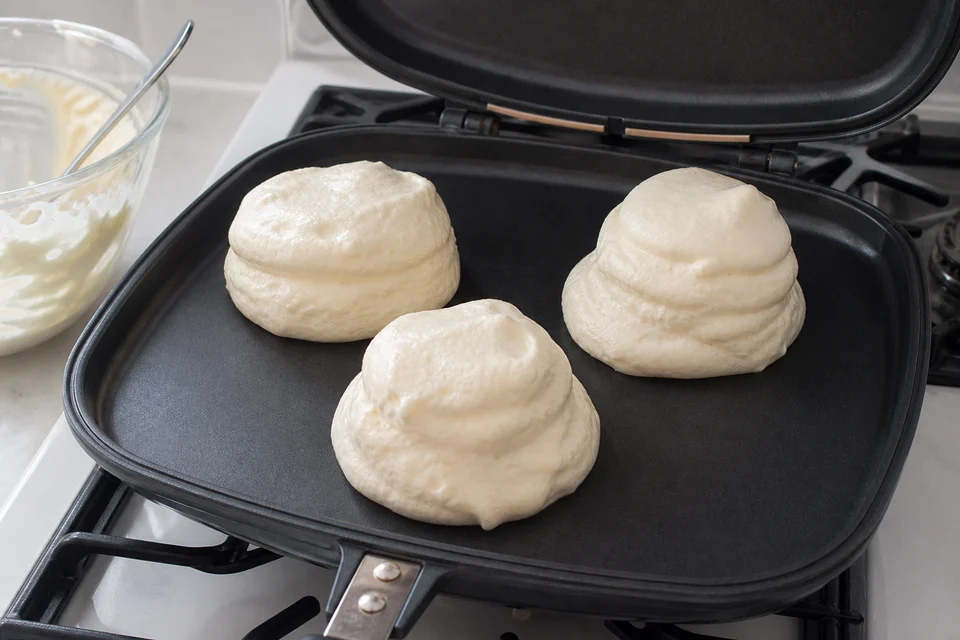
Cover and cook through the documented method
Use the lid when the ringless recipe specifies it. Some methods add a measured amount of water away from the batter to create a humid covered environment; others rely on the covered pan without that step. Follow the selected directions and keep water off the batter. Lift the lid carefully so condensation does not pour onto the mounds.
Do not raise heat aggressively because the surface appears pale. Tall portions need time for the interior structure to set while the exterior colors. Excess heat can darken the outside while the middle remains unset. Use the recipe’s heat and readiness guidance rather than a generic dial position.
Support the flip
Clear space first. Slide a broad spatula fully under the pancake and turn it with a controlled motion. Do not press the top. If the mound bends, tears, or sticks, record that observation for the next batch instead of squeezing it into shape.
After the turn, replace the lid if directed and complete the recipe’s second stage. The pancake should be fully cooked through the method’s endpoint. Height, jiggle, surface color, and springiness can be useful recipe cues, but none by itself proves safety.
Food-safety boundary for the center
Soufflé-style does not mean intentionally liquid egg or raw flour in the center. USDA Food Safety and Inspection Service guidance for shell eggs advises cooking egg dishes to 160°F / 71°C. Apply the safety directions appropriate to the complete recipe and equipment. Do not use an attractive browned exterior or a dramatic jiggle as a substitute for the required cooking endpoint.
If the outside is coloring too quickly while the center remains visibly wet, do not serve it as a special texture. Return to the selected recipe’s heat, portion, and covered-cooking system. For the broader symptom, use the Pancake Troubleshooting hub.
Mold-free result versus a ring result
| Feature | Ringless mound | Ring-supported method |
|---|---|---|
| Side shape | Rounded and slightly irregular | Straighter, more cylindrical |
| Portioning | Piped or spooned upward in layers | Filled within a defined boundary |
| Turning | Broad spatula supports the pancake | Recipe may turn the ring and pancake together |
| Main risk | Spreading or leaning | Sticking to ring or difficult ring handling |
| Best evidence | A recipe written for direct pan mounds | A recipe written for prepared heat-safe rings |
Neither approach is universally superior. A ring can make shape more repeatable, while a ringless method avoids special molds and can produce a credible airy pancake. Compare outcomes only within the chosen recipe’s goal.
Current-batch problems and bounded fixes
The batter spreads immediately: Do not keep stacking large amounts. Make one smaller test portion and review the meringue and folding endpoint. Do not add arbitrary flour to a finished foam batter; that changes the formula and can create lumps.
The mound leans: Leave more space, build a wider first layer, and add the upper layer centrally on the next pancake. A small lean is cosmetic if the pancake cooks intact.
The bottom darkens too early: Follow the recipe’s response for excess pan heat. Do not rely on the dark surface as proof that the center is ready.
The pancake tears during turning: Wait for the ringless recipe’s readiness point, use a broader spatula, and support the full base. Do not turn by grabbing the soft sides.
The center remains wet: Continue only through the documented cooking method and safe endpoint. For the next batch, keep the portion and heat within the recipe instead of making taller mounds.
The pancake deflates after plating: Some settling is expected in foam-supported pancakes. A dramatic collapse needs a separate diagnosis involving meringue, folding, waiting, cooking, and handling. Use why Japanese soufflé pancakes deflate rather than blaming the absence of a ring automatically.
Prevent the next batch from spreading
Read the complete recipe before separating eggs. Set out the pan, lid, piping bag, spatula, and plate. Cook one batch of batter at a time. Build equal mounds with the same footprint, record how many layers each received, and leave room to turn.
Change one variable on the next attempt. If the batter held its mound but the pancake tore, focus on the turn. If it spread before cooking, review foam and folding. If the outside browned before the center set, review the recipe’s heat and portion. Changing peak stage, fold method, mound size, pan, and heat together makes the result impossible to interpret.
Serve promptly. The cited King Arthur method notes that its soufflé texture diminishes as the pancakes sit. That observation belongs to that recipe, but it supports the practical plan of having plates and light toppings ready before the batch leaves the pan.
Limitations
This guide does not promise café height without molds, reproduce a named Japanese venue, or establish one authentic national formula. “Japanese pancake” covers multiple foods, and even soufflé-style recipes vary. For those distinctions, compare different kinds of Japanese pancakes and dorayaki.
Do not improvise disposable cardboard, coated containers, printed paper, plastic, or unknown metal as a hot-pan mold. If you later choose a ring method, use food-contact equipment suitable for the heat and follow that recipe’s preparation and handling instructions.
FAQ
Do I need ring molds for Japanese soufflé pancakes?
No. A recipe designed for direct pan mounds can work without rings. Rings create straighter sides and support a different portioning system, so do not remove them from a ring-specific recipe without changing to a documented ringless method.
Why do mold-free soufflé pancakes spread?
Possible contributors include foam that does not reach the recipe’s useful stage, excessive folding, batter waiting too long, a wide first portion, or adding batter outward instead of upward. Observe when spreading begins before changing one variable.
Can I use a piping bag without a mold?
Yes, when the selected recipe specifies it. Pipe a compact base and build concentric layers upward, leaving enough pan space for a supported turn.
Will they be as tall as ring-mold pancakes?
Not necessarily. A ringless result is usually rounder and may be wider. Judge a mold-free batch by the chosen recipe’s fully cooked texture and handling, not by a universal height promise.
How do I know the center is cooked?
Use the complete recipe’s cues and the applicable safety endpoint. Exterior color or jiggle alone is insufficient. USDA shell-egg guidance advises 160°F / 71°C for egg dishes.
Related Pancake World guides
For lost height, use why Japanese soufflé pancakes deflate. Compare different kinds of Japanese pancakes, the separate Japanese rice-cooker pancake, and dorayaki. For center and heat symptoms, start at the Pancake Troubleshooting hub.
Sources and editorial references
- Good Food: Fluffy Japanese Soufflé Pancakes —
https://www.bbcgoodfood.com/recipes/fluffy-japanese-pancakes - King Arthur Baking Company: Japanese Soufflé Pancakes —
https://www.kingarthurbaking.com/recipes/japanese-souffle-pancakes-recipe - American Egg Board: Egg White Whipping Functionality —
https://www.incredibleegg.org/professionals/manufacturers/real-egg-functionality/whipping/ - USDA Food Safety and Inspection Service: Shell Eggs from Farm to Table —
https://www.fsis.usda.gov/food-safety/safe-food-handling-and-preparation/eggs/shell-eggs-farm-table
For more practical food and breakfast guides, visit Pancakes World.
For the wider topic, start with Japanese Pancakes.
For a closely related guide, see Japanese Soufflé Pancakes: How Their Fluffy Texture Works.
A useful next comparison is Eating Japanese Pancakes: A Style-by-Style Guide.
You can also continue with Fluffy Japanese Pancakes Without Ring Molds.
