
Quick answer
Japanese soufflé-style pancakes get their remarkable height from a meringue-supported batter cooked slowly in thick portions. Egg whites are whipped with sugar so they hold many small air bubbles, then folded into a yolk batter. Gentle covered heat expands that air and steam while egg proteins and starch set enough structure to support the cake.
The method is a balance. Underwhipped meringue provides weak lift; overworked or badly folded foam loses air; heat that is too high browns the exterior before the center sets; a delayed serve allows normal settling to become more visible. The goal is not a permanently rigid tower. A successful pancake is cooked through, tender, fine-crumbed, and airy, with enough structure to reach the plate.
Japanese hotcakes are related but distinct. A hotcake is usually thick and tidy yet more stable and cake-like; it does not necessarily depend on separately whipped whites. For the wider family, see different kinds of Japanese pancakes.
Where the fluffiness comes from
Meringue is the main source of incorporated air in this style. Whisking unfolds some egg-white proteins and distributes air through the liquid. Sugar is added according to the recipe to support a smoother, more stable foam. Folding disperses that foam through the yolk base without intentionally knocking all the air out.
Cooking then transforms a fragile mixture into a cake. Heat expands gases and turns water into steam; egg proteins set; flour starch absorbs moisture and contributes body. A covered pan slows surface drying and traps warmth around the tall portion. Some recipes add drops of water to the empty area of the pan to create steam, but only when the recipe and pan setup direct it. Water should never be splashed into hot oil.
No single step works alone. Strong meringue cannot rescue a liquid base, an enormous portion, or a pan that scorches. A well-mixed batter can still collapse if it waits too long. “Fluffy” is an interaction between foam, formula, portion, heat, and timing.
Soufflé pancakes versus Japanese hotcakes
| Feature | Soufflé-style pancake | Japanese hotcake |
|---|---|---|
| Main lift strategy | separately whipped egg-white foam | recipe leavening and batter structure; meringue not required |
| Shape | very tall, often domed or stacked | thick, neat round but usually less towering |
| Texture | airy, delicate, soft, sometimes slightly custardy | stable, fine, cake-like crumb |
| Cooking | gentle covered heat, often staged batter | griddle or mold method with moderate heat |
| Service | immediately, because foam-built height settles | generally more tolerant of a short hold |
Do not use the names as guarantees. A café may label a product for audience recognition, and home recipes vary. Read the method to know what is being made.
A controlled home formula
For four small tall pancakes, use a recipe-tested formula such as:
- 2 large eggs, separated cleanly;
- 50 g cake flour or the flour specified by the recipe;
- 40–50 ml milk;
- 20 g fine sugar, divided as directed;
- 1/2 teaspoon baking powder if the selected formula includes it;
- neutral oil for a very thin pan coating;
- optional vanilla or lemon zest.
This is a starting framework, not a universal Japanese standard. Egg size, flour, pan, mold, and mixer alter the result. If following the Japanese Ministry of Agriculture recipe in the sources, use its published amounts and directions as a complete formula rather than combining parts from multiple methods.
Step-by-step method
1. Prepare before whipping
Separate cold eggs without yolk entering the white. Use a clean, dry bowl and whisk. Measure every ingredient, prepare a lid, and set out a broad thin spatula. Once the foam is folded, the batter should not wait while equipment is found.
2. Make the yolk base
Whisk yolks with milk and flavoring. Sift in flour and any recipe leavener, then mix only until smooth. The base should be thick enough to hold folded foam but not a dry paste. Do not add unmeasured liquid after the meringue is ready.
3. Whip a stable meringue
Begin whipping the whites until foamy, then add sugar in the stages specified by the recipe. Stop at the recipe’s target. A glossy foam with defined peaks is more useful than a dry, broken-looking mass. Bowl cleanliness and accurate sugar matter more than dramatic mixer speed.
4. Fold in stages
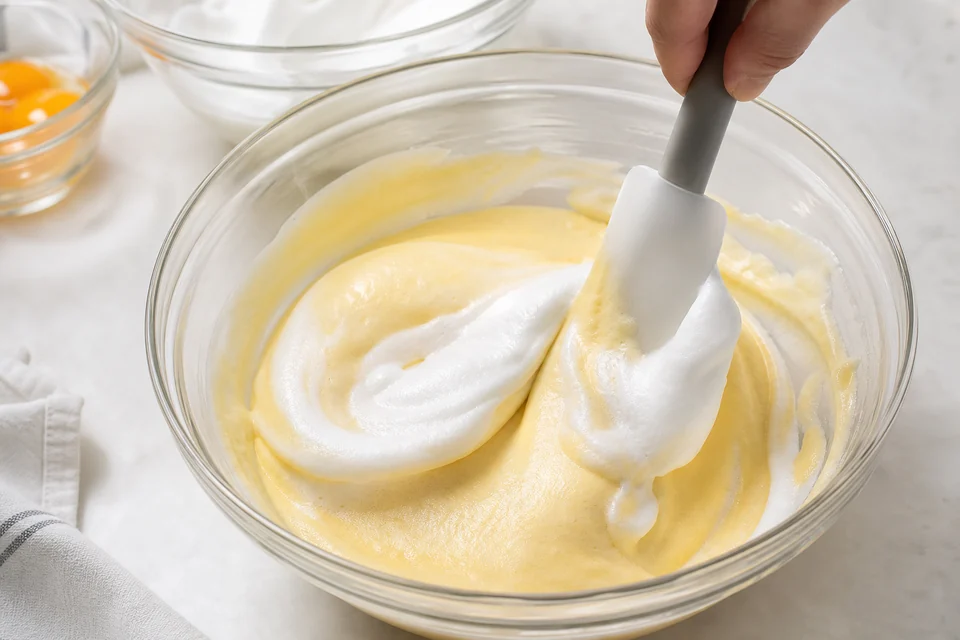
Stir a small portion of foam into the yolk base to lighten it. Add the rest in two additions, cutting down through the center and lifting batter over the top. Rotate the bowl. Stop when no large white pockets remain; continued folding removes useful air.
5. Portion and cover
Warm a nonstick or well-prepared pan over low heat. Wipe on a thin film of oil. Mound or pipe small portions with space between them, or use prepared rings only if the recipe supports them. Cover and cook gently. Some methods add a second small mound after the first layer begins to set.
6. Turn with support
Turn when the base releases and the sides have enough structure to survive the movement. Use a broad spatula and a decisive but gentle turn. If using rings, follow the exact release method. Cover again and cook until the center is set.
7. Serve immediately
Move the pancakes directly to warm plates. Add restrained toppings so the delicate cakes remain visible. A small amount of butter, cream, fruit, or syrup is enough. Photograph after serving, not while the remaining batch dries in the pan.
Diagnostic table
| Observation | Likely checkpoint | Next-batch action |
|---|---|---|
| batter becomes runny after folding | foam was weak or folding too forceful | stop whipping at the recipe stage and fold fewer, broader strokes |
| pancakes spread instead of rising | base too loose, foam lost, or pan not ready | verify weights and cook immediately after folding |
| outside dark, center wet | heat too high or portion too large | lower heat and make smaller rounds |
| pancake tears during turn | underside not set or tool too narrow | wait slightly longer and use a broad spatula |
| height drops in the pan | structure did not set before steam escaped | cook more gently and verify center before removal |
| height drops on the plate | some settling is normal; severe drop suggests weak structure | review meringue, folding, portion, and doneness |
| crumb is rubbery | excessive mixing, too much protein for formula, or overcooking | return to tested amounts and reduce handling |
The dedicated deflation guide gives a deeper symptom-by-symptom workflow.
Molds, free-form mounds, and pan choice
Ring molds create clear sides and can help contain batter, but they add handling difficulty. They must be suitable for cooking, prepared as the recipe directs, and never filled so deeply that the outside sets while the middle remains raw. Free-form mounds avoid mold release but demand a batter that holds its shape.
A heavy flat pan moderates temperature swings. A thin pan may develop hot spots. Pan color, burner size, and induction cycling change heat delivery, so copy the visual signs in the recipe rather than assuming one dial setting means the same temperature everywhere.
Do not crowd. Tall portions need room for a spatula and for the lid to sit securely. Cook fewer pancakes per batch if that gives you control.
Flavor and topping choices
The base usually has a mild egg, dairy, and vanilla profile. Fresh berries add acidity and color without heavy weight. A lightly sweetened cream supports the café-style presentation; a large dense scoop can compress the cakes. Citrus zest can brighten the batter, but acidic liquid should be added only when the formula accounts for it.
Soufflé pancake flavor is not created by height alone. Salt, fresh eggs, milk, and clean cooking fat matter. A burnt pan film or excessive oil is more obvious in a delicate cake than in a heavily topped plate.
Safety, doneness, and storage
Do not taste raw batter. Flour and egg are raw ingredients, and a browned exterior does not prove that a thick center is cooked. Follow a tested recipe’s doneness instructions and current local food-safety guidance. If the center remains wet or flows like batter when cut, return to cooking rather than serving it as a desirable “soufflé” texture.
These pancakes are best fresh. If leftovers are cooled and stored, expect texture and height to change. Use the leftover Japanese pancake guide for a bounded plan. Refrigeration does not freeze the original foam structure in time.
Mistakes and limitations
Avoid chasing social-media height with enormous raw portions. Do not use a dark exterior as proof of a cooked center. Do not beat the meringue indefinitely, and do not mix several recipes’ sugar, acid, flour, and timing instructions into one untested method.
This guide presents a plausible home result, not a named Japanese café or a guarantee that every shop uses rings. The article does not claim one inventor or a single national formula. The American pancakes hub provides a useful contrast with another thick breakfast style without implying a shared origin.
Frequently asked questions
Why are Japanese soufflé pancakes so fluffy?
Whipped egg whites supply a foam that expands during gentle cooking, while egg proteins and flour starch set enough structure to support the pancake.
Do I need ring molds?
No. Some recipes use them and others mound or pipe the batter. Follow a complete method designed for the chosen approach.
Can I make the batter ahead?
Not for this foam-driven method. Once folded, the batter should be cooked promptly. Prepare measured ingredients and equipment ahead instead.
Why did my pancakes deflate?
Possible causes include weak or damaged foam, a loose base, rough folding, high heat, an oversized portion, or an under-set center. Some modest settling is normal.
Are Japanese hotcakes the same thing?
No. Hotcakes are usually thick and tidy but more stable and cake-like. They do not necessarily use separately whipped whites.
Can I use boxed pancake mix?
Only with a method specifically developed for that mix and soufflé structure. Adding whipped whites to any box formula does not guarantee a balanced batter.
What is the best topping?
Use a light topping that suits the delicate cake: berries, a small spoonful of cream, butter, or restrained syrup. “Best” depends on the diner and recipe.
Related Pancake World pages
Compare the complete family in different kinds of Japanese pancakes, diagnose lost height with why Japanese pancakes deflate, and use the Pancake World troubleshooting hub when the dominant symptom is burning, gumminess, or an undercooked center.
Sources and editorial references
- Japan Ministry of Agriculture, Forestry and Fisheries, Soufflé pancake recipe and egg functions —
https://www.maff.go.jp/j/pr/aff/2404/spe1_04.html - U.S. Food and Drug Administration, Flour is a raw food and other safety facts —
https://www.fda.gov/consumers/consumer-updates/flour-raw-food-and-other-safety-facts
For more practical food and breakfast guides, visit Pancakes World.
For the wider topic, start with Japanese Pancakes.
For a closely related guide, see Can I Make Japanese Soufflé Pancakes Without a Mold?.
You can also continue with Eating Japanese Pancakes: A Style-by-Style Guide.
