
This guide is specifically about Japanese soufflé pancakes: tall, airy pancakes whose batter depends heavily on whipped egg whites. It does not cover ordinary Japanese-style hotcakes, dorayaki, okonomiyaki, or every pancake served in Japan. Those are different foods with different structures and methods.
The short answer
Some settling after cooking is expected. A hot foam-supported pancake is not a permanent structure, and a freshly cooked serving may become a little shorter as it cools. Severe or sudden collapse, however, can point to several possible failures: the meringue did not form a useful foam, too much air was lost during mixing, the batter waited too long, the portion and heat did not suit the recipe, the centre was not sufficiently set, or the pancake was handled roughly.
Do not change all of those variables at once. First identify when the height disappeared. Then compare your actions with the exact recipe you followed. A useful diagnosis is conditional: the same lid, ring mold, heat setting, timing, or meringue stage cannot be prescribed for every formula and pan.
When did the collapse happen?
Before the flip
If the batter spreads or sinks while the first side cooks, look back to the foam and folding stages. The whites may not have formed the stage required by the recipe, the foam may have been mixed down, or the assembled batter may have stood while you prepared the pan. Also check portioning. A mound that is wider, taller, or wetter than the cited method expects may not develop enough support before it must be turned.
Watch the sequence rather than judging only the final plate. Did the batter hold a mound when portioned? Did the mound gradually spread, or did it stay tall until touched? Did water from a covered cooking method collect and drip onto the batter? Those observations help separate a mixing problem from a pan-management problem without pretending that one visual clue proves the cause.
During or just after the flip
A pancake that survives the first stage but collapses during turning may have been moved before the structure was ready for the recipe’s flip. A fast or off-centre turn can also compress the soft portion. Use a tool that supports the pancake, clear enough room to rotate it, and follow the cited recipe’s readiness signs rather than forcing a universal number of minutes.
If the outside tears, sticks, or folds, record that separately from height loss. Sticking may make the turn rough even when the foam was reasonable. A deformed pancake is not automatic evidence that the meringue was wrong.
On the plate
If the pancake looks tall in the pan and then settles after removal, compare gentle settling with a dramatic inward collapse. King Arthur Baking’s Japanese soufflé-pancake recipe says to serve the pancakes immediately and notes that they lose their soufflé texture as they sit. That is evidence for the behavior of that recipe, not a universal percentage or time limit.
A sharp collapse on the plate can still be consistent with an interior that had not set enough to support the shape, but appearance alone cannot establish doneness or safety. Review the recipe’s cooking instructions and your portion size. If you cut a pancake and the centre looks wet or raw, stop treating height as the main problem and use the undercooked-pancake guide.
Meringue formation
Whipped egg whites create a foam by incorporating air while egg-white proteins help stabilize the bubble surfaces. The American Egg Board describes this general whipping function, but it does not establish one universal peak stage, bowl material, speed, volume increase, or result for every soufflé pancake.
For your batch, use the meringue stage named by your chosen recipe. If the whites remain fluid and cannot hold the form the recipe shows, the batter may have too little foam structure. If the foam is taken beyond the useful stage for that method, it can become harder to combine evenly. Large dry-looking clumps that will not blend without force are a practical warning to stop and compare with the recipe rather than beating automatically for longer.
Start with a clean bowl and beaters. Keep yolk out of the separated whites as carefully as you can. Those controls reduce avoidable variation, but they do not guarantee height. Egg temperature, sugar addition, equipment, batch size, and the recipe itself can change how the stage appears.
Do not use a stopwatch alone. Note how the foam moves, whether it holds the recipe’s stated peak, and whether it remains cohesive. Take a quick photo for your own comparison if needed. On the next batch, change only one whipping variable so the observation remains useful.
Folding without losing too much air
Folding brings the meringue and base batter together while trying to retain useful bubbles. King Arthur Baking’s recipe uses gradual incorporation and gentle folding. That supports the general need for care in that named method; it does not supply a universal fold count.
Begin by loosening the heavier base with the first portion of meringue if your recipe directs that sequence. Add the remaining foam in the specified portions. Move the spatula through and around the mixture deliberately, turning the bowl as needed. Stop when the recipe’s target consistency is reached rather than continuing because a fixed number sounds precise.
Two opposite problems can look similar later. Vigorous stirring can remove too much air, while stopping with large unmixed foam pockets can produce an uneven batter. Aim for the recipe’s described consistency with no large white islands, accepting that a faint streak may be less damaging than repeatedly working an already combined batter.
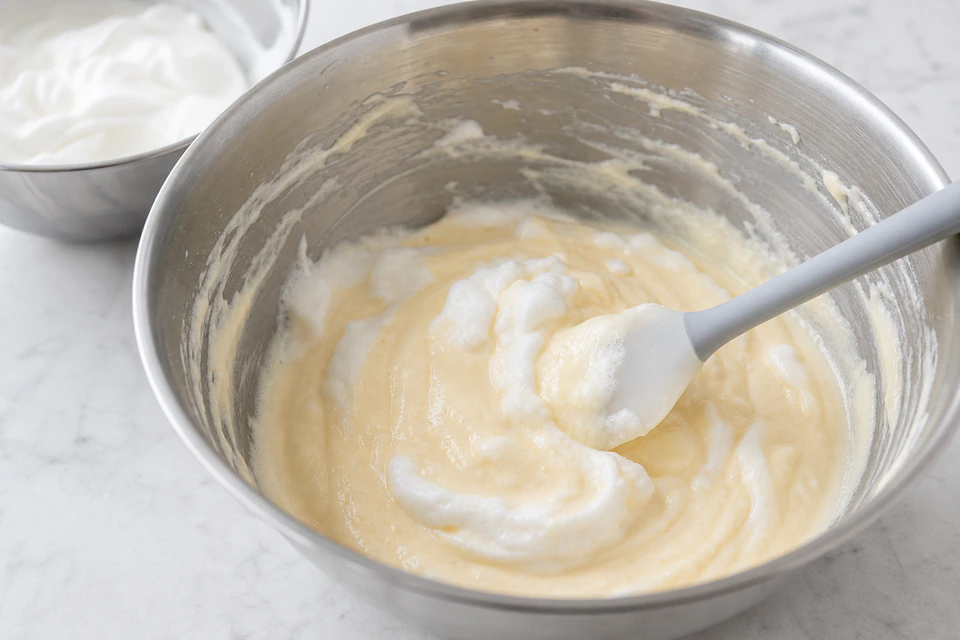
The process photograph shows a plausible folding stage for orientation. It is project-generated, not a controlled experiment or proof that one exact appearance causes a particular result.
Portion, mold, pan, lid, and heat
These variables work as a system. A taller portion generally asks the cooking method to set more interior structure before service, but that does not mean “smaller is always better.” Use the portion and layering approach specified by the recipe. If you change the amount placed in the pan, you have also changed the conditions the stated cooking directions were designed around.
Ring molds can support a shape in methods written for them. Other methods form mounds without rings. Do not add or remove a mold casually and expect every other instruction to remain valid. If you use rings, prepare and handle them exactly as the recipe directs and use heat-safe equipment.
A lid can alter the cooking environment and retain moisture in methods that specify covered cooking. It is not a universal cure for deflation. Too much condensation or an unsuitable lid setup may create a different handling problem. Follow the named method, lift the lid carefully, and observe whether water is collecting above the batter.
“Low heat” is equipment-dependent. Burner size, pan material, pan thickness, portion size, and the stove all affect the result. The King Arthur Baking recipe is a useful example of a covered low-heat method, but its exact directions belong to that formula and equipment context. Do not transfer an exact time or dial position from one recipe to another without validation.
Avoid trying to fix slow setting by suddenly increasing heat. A browned exterior can coexist with a centre that still needs attention. If browning races ahead of the recipe’s internal progress, record the pan and burner setup and revise one variable on the next attempt.
Doneness and egg safety
Height, surface color, jiggle, and bubbles are cooking observations; none alone is a complete food-safety test. USDA Food Safety and Inspection Service guidance for shell eggs advises cooking egg dishes to 160°F / 71°C. Apply the safety directions appropriate to the recipe and ingredients you are using, and do not serve a visibly raw or liquid egg centre as if it were an intentional soufflé texture.
If you are unsure whether the batch is cooked through, do not taste the wet centre to investigate it. Continue only in a way the recipe and equipment safely allow, or stop and discard the uncertain portion. The goal is a fully cooked pancake with an airy texture, not a dramatic height achieved by leaving the middle raw.
Can a collapsed batch be saved?
You cannot reliably re-inflate a cooked pancake after its structure has collapsed. Pressing, restacking, or returning a fully collapsed pancake to a mold does not restore the lost foam. Focus first on whether the food is fully cooked and safe.
If a collapsed pancake is fully cooked, it can still be served as a flatter pancake. Add fruit, cream, or syrup only after making that doneness decision; garnish cannot correct an undercooked centre. If the middle needs further cooking and your recipe supplies a safe correction, follow that instruction with realistic expectations: additional cooking may make the pancake safe, but it may not restore the original height or texture.
For the current batch, separate present-tense decisions from next-batch fixes. Current batch: assess cooking, serve promptly if fully cooked, and accept the lower profile. Next batch: review the timeline, choose the most likely stage, and alter one controlled variable.
Prevention checklist
- Confirm that your recipe is specifically for Japanese soufflé pancakes and read the full sequence before separating eggs.
- Prepare the pan, lid, tools, molds if specified, and serving plates before the final batter is mixed.
- Keep the egg-white bowl and beaters clean, and separate the eggs carefully.
- Whip to the stage required by the named recipe, not to a generic number of minutes.
- Fold in the stated sequence, gently enough to retain foam but completely enough to avoid large white pockets.
- Portion the batter according to the recipe; do not enlarge the mound without revalidating the cooking method.
- Use the pan, mold, lid, heat, and timing instructions as one recipe-specific system.
- Support the pancake during turning and avoid pressing it.
- Treat a wet-looking centre as a doneness question, not as desirable proof of fluffiness.
- Serve promptly, since at least the cited King Arthur Baking version loses soufflé texture as it sits.
- Record when collapse occurred and change one variable on the next batch.
Frequently asked questions
Is it normal for Japanese soufflé pancakes to shrink?
Some settling can be normal, especially as a foam-supported pancake cools. A sudden or deep collapse deserves a stage-by-stage review. There is no approved universal percentage that separates normal settling from failure for every recipe.
Did I overwhip or underwhip the egg whites?
Compare the foam with the stage required by your recipe. Fluid whites that cannot hold the specified shape may be underdeveloped; dry-looking clumps that resist incorporation may have gone beyond the useful stage. The final collapse alone cannot prove which one occurred.
Does a lid stop soufflé pancakes from deflating?
Not by itself. Some recipes use a lid as part of a covered, low-heat method. The lid, portion, pan, heat, and timing must be considered together, and condensation must be managed.
Can I make the pancakes taller by adding more batter?
Adding batter changes the portion the cooking directions must set. A larger mound is not a reliable shortcut to a stable pancake and may create a doneness problem if the rest of the method is unchanged.
Can I re-inflate a collapsed pancake?
No dependable method restores the lost foam after collapse. If the pancake is fully cooked, serve it flatter. If it is not fully cooked, follow a recipe-specific safe correction or discard it; do not prioritize height over doneness.
Should Japanese soufflé pancakes be served immediately?
The cited King Arthur Baking recipe recommends immediate service and says its pancakes lose soufflé texture as they sit. Treat that as recipe-specific guidance rather than a universal countdown for every formula.
Related Pancake World guides
Use the Pancake Troubleshooting hub for the broader diagnostic collection. Compare the general guide to flat pancakes when the batter is not a soufflé style, and use why pancakes are not cooked through when the centre is the main concern. The five pancake fails guide offers a shorter overview of common symptoms.
Sources and editorial references
- American Egg Board —
https://www.incredibleegg.org/professionals/manufacturers/real-egg-functionality/whipping/ - USDA Food Safety and Inspection Service —
https://www.fsis.usda.gov/food-safety/safe-food-handling-and-preparation/eggs/shell-eggs-farm-table - King Arthur Baking Company —
https://www.kingarthurbaking.com/recipes/japanese-souffle-pancakes-recipe
For more practical food and breakfast guides, visit Pancakes World.
For the wider topic, start with Japanese Pancakes.
For a closely related guide, see Japanese Soufflé Pancakes: How Their Fluffy Texture Works.
A useful next comparison is How to Flip Japanese Pancakes.
You can also continue with Japanese Soufflé Pancakes: Foam, Shape, and Gentle Heat.
