
Quick answer: what are blini?
Blini are griddle-cooked pancakes strongly associated with Russian and wider Eastern European food traditions. In English, the word often covers both broad, thin pancakes that can be folded around fillings and smaller, thicker pancakes used as bases for toppings. Actual naming, flour, leavening, thickness, and service vary by language, region, household, and occasion.
That variation is the main lesson. Blini are not universally buckwheat, not always yeasted, not always tiny, and not limited to luxury toppings. They may be made with wheat, buckwheat, or blends; served sweet or savory; and eaten as a snack, meal component, celebration food, or home-cooked everyday dish. The number fourteen comes from an older collection and does not by itself define the food.
Blin, blini, bliny, and neighboring names
Transliteration creates confusion before batter reaches the pan. In Russian, a single pancake is commonly transliterated as blin and the plural as bliny. English usage often treats blini as the plural and may even use it collectively. Menu spelling therefore cannot by itself tell you size or recipe.
Neighboring cuisines have their own pancake words, related forms, and transliterations. Ukrainian mlyntsi, for example, are often discussed alongside thin filled pancakes, but they should not be erased under a single Russian label. Belarusian, Polish, Baltic, Balkan, and other regional pancake traditions also have distinct names and methods. “Eastern European pancakes” is a useful browsing category, not proof that all dishes share one origin or formula.
When ordering, ask a concrete question: are these thin pancakes to fold, small raised cakes, or filled parcels? That answer is more useful than arguing over an English plural.
Thin versus small and raised: a practical distinction
| Form | Texture and shape | Typical use | Method focus |
|---|---|---|---|
| Broad thin blini | Flexible, lightly browned, easy to roll or fold | Filled with cheese, mushrooms, meat, fruit, or preserves; served with sour cream | Batter flow, thin spreading, clean flipping |
| Small thicker blini | Soft or spongy, sometimes yeasted or buckwheat-rich | Base for small savory or sweet toppings | Fermentation or leavening, controlled portion, full center cooking |
| Filled and folded pancakes | Thin pancake enclosing a prepared filling | Snack, main dish, or dessert depending on filling | Filling moisture, folding, optional second browning |
These categories overlap. A home cook may call a medium pancake a blin, while an international restaurant may reserve “blini” for bite-size canapé bases. Read the description rather than assuming the international catering convention defines the whole tradition.
Flour and leavening choices
Buckwheat is historically and culturally important in discussions of blini, but many current recipes use wheat flour, and blends are common. Buckwheat brings an earthy flavor and changes batter behavior because it does not build the same gluten network as wheat. A high-buckwheat batter therefore needs a tested formula rather than a blind cup-for-cup swap.
Yeasted blini require time for the batter to become active and aerated. Other versions use chemical leavening, cultured dairy, eggs, or no added leavener in a very thin batter. None of these facts makes every pancake interchangeable. The leavening system determines whether the cook should wait, how gently the batter is handled, and how the center sets.
Milk, cultured dairy, or water may provide liquid. Eggs, butter or oil, sugar, and salt vary. A savory filled pancake usually benefits from restrained sweetness, while a small canapé-style blin may be formulated for softness and a neat round. The recipe’s purpose should guide the formula.
How thin blini are cooked
A thin blin starts with batter fluid enough to spread rapidly across a hot skillet but substantial enough to form one connected sheet. The cook pours a measured amount and tilts or rotates the pan so the batter reaches the edge in a thin layer. Once the top loses its wet shine and the edge releases, the pancake is turned briefly to finish the second side.
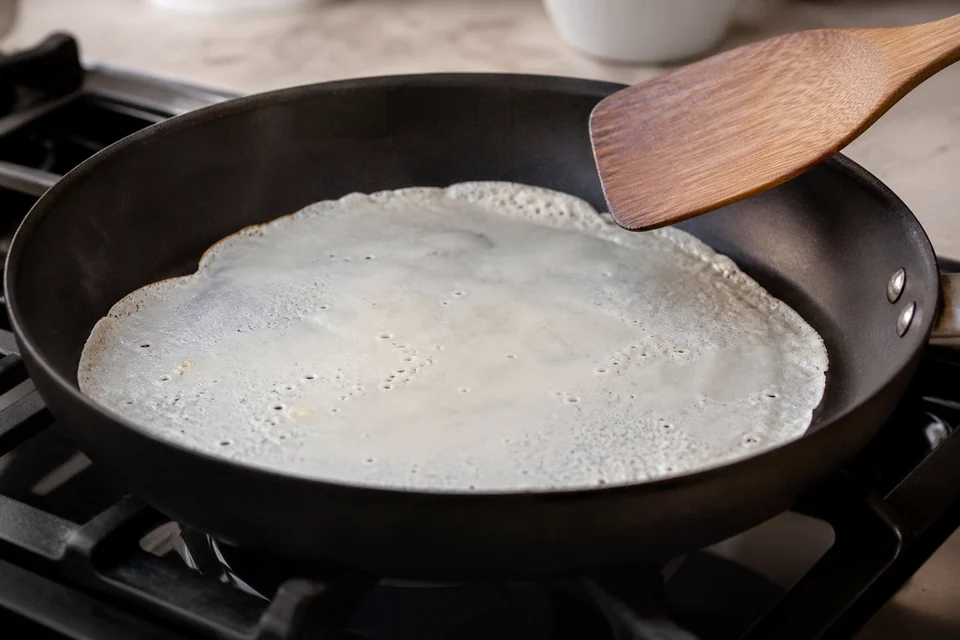
The pan should be hot enough to set the layer but not so hot that the first contact point burns before the batter spreads. A heavy pan can hold heat steadily; a lighter pan responds quickly to burner changes. Greasing needs depend on the pan and batter fat. Too much loose oil can produce fried patches instead of an even surface.
Stack cooked thin blini and cover them lightly so retained steam keeps them flexible. If they will be filled later, let them cool enough that condensation does not make the stack gummy. The generated image illustrates a generic process and does not document a named household or regional apparatus.
How small raised blini differ
Small raised blini are portioned rather than swirled into a paper-thin layer. A yeasted version needs visible batter activity before cooking, while a chemically leavened formula may need prompt cooking. The goal is a set, tender center and a surface strong enough to carry a topping.
Use moderate heat and a small consistent scoop. Bubbles and a matte edge help indicate when the first side is set, but a thick cake may need more time than its color suggests. Split a test piece to check the center. If the outside darkens before the middle cooks, lower the heat and make smaller portions.
Avoid turning a thin-pancake recipe into a thick blin merely by pouring more batter. The hydration, leavening, and cooking method may not support that depth.
Sweet ways to serve blini
Thin blini can be folded around farmer-style cheese fillings, fruit, cooked apples, or preserves. Sour cream or another cultured dairy accompaniment may add tang. Honey, sugar, or jam can be served in a modest amount according to preference. Fresh berries and lightly sweetened compote offer a juicier contrast.
For a filled cheese pancake, use a recipe that specifies the cheese type, filling moisture, and whether the parcel returns to the pan. A very wet filling can leak and soften the wrapper. Fruit also releases liquid, so thickening or pre-cooking belongs to the filling recipe rather than guesswork.
Small raised blini can carry a spoonful of cream and fruit, but place wet toppings immediately before serving. A neat canapé is a serving style, not the definition of all blini.
Savory fillings and toppings
Mushrooms with onion or dill make a practical savory filling. Cook mushrooms until their released moisture has reduced before enclosing them. Soft cheese, cooked meat, fish, cabbage, potato, or egg fillings appear in different recipes and regional contexts. Each brings its own seasoning and food-safety requirements.
The internationally familiar combination of small blini, cultured cream, and fish roe is only one presentation. It should not make caviar seem mandatory or turn an everyday pancake into a luxury stereotype. Smoked fish, chopped egg, vegetables, or mushrooms may be more accessible alternatives where they fit the diner’s needs.
| Filling or topping | Best structural match | Practical caution |
|---|---|---|
| Mushrooms and herbs | Folded thin blini | Reduce excess moisture before filling |
| Soft cheese | Folded or rolled thin blini | Keep chilled ingredients properly refrigerated |
| Cooked meat | Folded parcel, sometimes browned again | Use fully cooked filling and reheat safely |
| Smoked fish and cultured cream | Small blini or folded thin blini | Check salt, allergens, and refrigeration |
| Preserves or compote | Thin folded blini | Add late to avoid sogginess |
| Fresh fruit | Thin or small blini | Wash, drain, and serve promptly |
Choosing blini in a restaurant or shop
Start with form: thin, small and thick, or filled. Then ask about flour. A buckwheat-rich recipe will taste and handle differently from a mild wheat version. Ask whether the batter or filling contains dairy, egg, wheat, fish, nuts, or other allergens that matter to you. Shared pans and prep surfaces can create cross-contact.
For filled blini, identify whether the filling is sweet or savory and whether the item arrives folded, rolled, or browned as a parcel. For small topped blini, ask how long they stand before service; delicate bases can soften under wet toppings.
Do not use price, garnish, perfectly round edges, or a rustic plate as an authenticity test. Those features describe one service. Cultural accuracy comes from clear naming and evidence, not décor.
Troubleshooting thin blini
| Problem | What to inspect | Controlled response |
|---|---|---|
| Batter will not cover the pan | It may be too thick, the pan may be too cool, or the pour too small | Compare batter flow and portion with the recipe; adjust liquid only in tiny measured amounts |
| Pancake tears during flipping | It may be under-set, too thin for the formula, or stuck | Wait for the edge to release; verify pan preparation |
| Thick center and crisp edge | Batter was not spread quickly or evenly | Practice the rotation with a smaller pan and consistent ladle |
| Pale and rubbery | Pan may be too cool or pancake overworked | Preheat more fully and avoid repeated flipping |
| Brittle after cooking | Overcooking or uncovered holding may have dried it | Shorten second-side cooking and cover the stack lightly |
The same symptom can have several causes. Cook a test pancake and change one variable rather than “correcting” the whole bowl repeatedly.
Storing, freezing, and reheating
Cool unfilled blini before packing, then separate portions with suitable sheets if sticking is likely. Refrigerate or freeze according to the tested recipe. Thin pancakes generally freeze more conveniently when laid flat in small stacks. Thaw gently and reheat covered or briefly in a pan so they regain flexibility without drying.
Filled blini follow the shortest storage requirement of wrapper and filling. Dairy, cooked meat, fish, and egg fillings need careful refrigeration. A frozen filled parcel may reheat well when the recipe was designed for it, but a fresh fruit or cream filling may separate or become watery.
Do not leave a large stack warm for an indefinite period, and do not use flexibility or smell as a safety test. Keep serving utensils clean, particularly when several fillings share a table.
Cultural and editorial limits
Blini have rich cultural associations, including seasonal celebrations, but a short food guide should not claim that one festival, religious meaning, or symbolic explanation defines every cook’s experience. Historical accounts need their own qualified sources. This page focuses on identifiable food forms and practical use.
The hero image is a project-generated finished-dish illustration with mushrooms, dill, and cultured cream. It is not a photograph of a real Eastern European household or proof of one national standard. Likewise, the article does not assign every neighboring pancake to the blini category.
Frequently asked questions
Are blini Russian or Eastern European?
They are strongly associated with Russian food traditions and sit within a wider region of related but distinct pancake cultures. Avoid using one label to erase neighboring names and methods.
Are blini always made with buckwheat?
No. Buckwheat is important, but wheat and flour blends are also common. Check the actual recipe or menu.
Are blini the same as crêpes?
Thin blini can resemble crêpes in form, but ingredients, naming, cultural context, fillings, and leavening may differ. The terms are not exact synonyms.
Why are restaurant blini sometimes tiny?
Small raised blini are convenient bases for toppings and canapés. That international service style does not mean all traditional or home blini are tiny.
Can blini be savory and sweet?
Yes. A neutral thin pancake can hold cheese, mushrooms, meat, fruit, preserves, or other prepared fillings. Small blini can also carry sweet or savory toppings.
Do blini contain yeast?
Some recipes are yeasted; others use baking powder, cultured ingredients, eggs, or no added leavener in a thin batter. Follow the specific formula.
How do I keep thin blini soft?
Avoid overcooking, stack them after cooking, and cover lightly to retain enough moisture. Cool before tightly packing to prevent heavy condensation.
Can I make blini ahead?
Many unfilled thin versions can be made ahead and stored using a tested method. Keep fillings separate when possible, especially wet or refrigerated ones.
Related Pancake World pages
Continue with Greek tiganites or compare arepas and cachapas.
Sources and editorial references
- Encyclopaedia Britannica, blini —
https://www.britannica.com/topic/blini
For more practical food and breakfast guides, visit Pancakes World.
For the wider topic, start with World Pancakes.
For a closely related guide, see French Crepes: A Thin, Flexible Home Recipe.
A useful next comparison is Delicious Pancakes: Styles, Flavours, and Serving Ideas.
You can also continue with Peking Duck Pancakes: Wrappers and Assembly.
