
Peking duck pancakes are thin wheat wrappers, not fluffy breakfast pancakes. Their job is to stay soft around sliced cooked duck, cucumber, scallion, and sauce while the fillings keep their individual textures.
The duck pancake wrappers method gives measurable starting points, observable checks, a current-batch repair path, and a next-batch record. Start with the stated formula, then use the cooked result to decide whether liquid, portion size, heat, or handling needs one bounded adjustment.
Quick answer
Peking duck pancakes are thin, soft wheat wrappers served with slices of cooked roast duck, cucumber, scallion, and a dark savory-sweet sauce. Make the wrappers separately, keep them covered and flexible, then assemble only at the table so the duck skin and vegetables retain texture.
Use the first cooked duck pancake wrappers portion as evidence. Note how far this specific mixture spreads, whether it releases, how quickly it colors, and what its cut center looks like. Do not taste raw batter or assume a dark surface proves the interior is ready.
What you need
- 250 g plain flour
- 160 ml just-boiled water, handled carefully
- 1 teaspoon toasted sesame oil for paired rolling
- fully cooked roast duck, sliced for serving
- cucumber cut into thin batons
- scallions cut into fine strips
- hoisin or sweet bean sauce, label checked
- extra flour only for controlled dusting
Equipment
Use a heatproof bowl, chopsticks or sturdy spoon for the hot-water dough, rolling pin, dry skillet, clean towel, bamboo steamer or covered plate, sharp knife, and separate utensils for raw preparation and cooked duck.
These quantities and tools belong to this duck pancake wrappers method, not to every pancake style. Ingredient brands, flour milling, egg size, cookware, and stove response vary, so the measured test is part of the recipe rather than an optional sacrifice.
Step-by-step method
1. Make the hot-water dough
Pour just-boiled water into the flour gradually while stirring with chopsticks. When cool enough to handle, knead into a smooth soft dough and rest it covered.
2. Pair and roll
Divide into small equal pieces, flatten two pieces, brush a very thin sesame-oil film between them, and roll the pair into a thin round.
3. Dry-cook the wrappers
Cook the paired round in a dry skillet until pale spots and small bubbles appear, turn briefly, then separate the two pancakes while still warm enough to peel.
4. Keep them supple
Stack the separated wrappers under a clean towel or in a covered steamer. Exposure to air dries the edges and makes folding difficult.
5. Prepare and assemble the filling
Slice fully cooked duck, cucumber, and scallion. Spread a small amount of sauce, add modest fillings, fold the bottom, and roll or fold without overpacking.
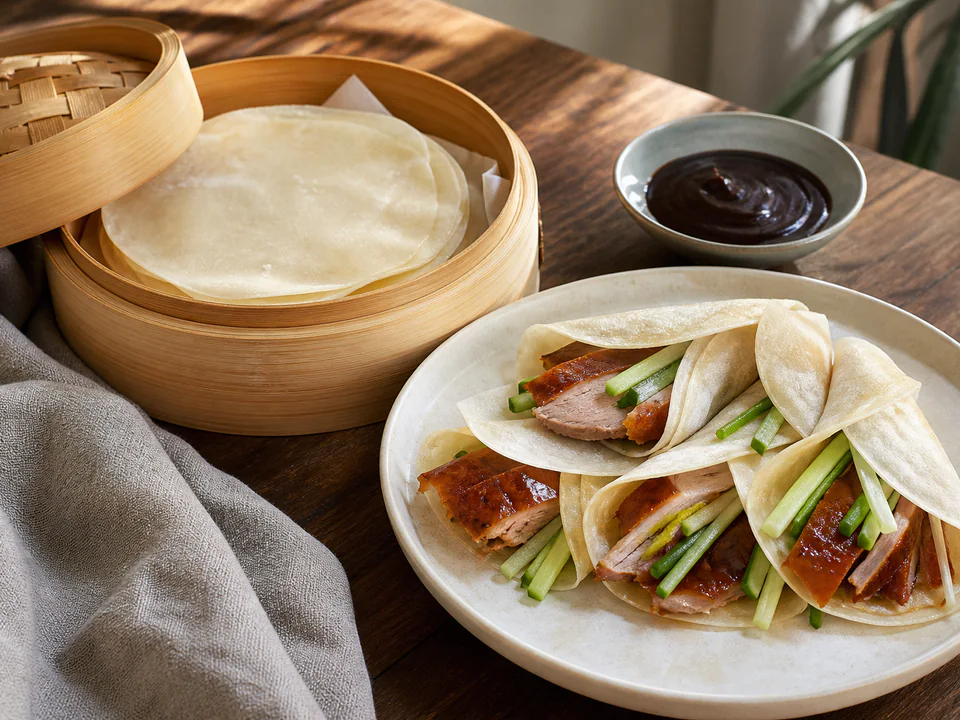
The close image shows the finished duck pancake wrappers clearly enough to inspect surface, filling distribution, or crumb. Use those visible features as comparison points while allowing for normal differences in ingredients, cookware, and portioning.
Why the method works
The pancake is a wrapper
It should be thin, soft, and flexible rather than fluffy or browned like an American breakfast pancake. The name refers to its role in the dish.
Hot water changes dough handling
The method creates a pliable dough suited to thin rolling. Handle boiling water carefully and let the dough cool before kneading by hand.
Paired rolling supports thinness
The oil layer lets two dough pieces be rolled together and peeled apart after cooking. Too much oil makes the pair slide; too little can make separation harder.
Assembly timing protects contrast
Warm duck, cool cucumber, fresh scallion, soft wrapper, and sauce each contribute a different texture. Preassembled rolls soften and leak.
Diagnose and fix the current batch
Do not discard the whole duck pancake wrappers batch at the first imperfect result. Hold the formula constant where possible, choose the symptom that actually matches the cooked test, and make one bounded correction.
The pancakes shrink while rolling. Rest the dough longer and keep unused pieces covered. Roll from the center outward, rotating often rather than forcing one direction. After the correction, compare the next piece with the same portion and describe the center, surface, and release before changing another variable.
The pair will not separate. Peel while warm, verify a complete thin sesame-oil film, and avoid compressing the edges excessively. Do not tear at a cold brittle pair. After the correction, compare the next piece with the same portion and describe the center, surface, and release before changing another variable.
The wrappers are dry. Cook more briefly, stack immediately under a towel, and reduce excess bench flour. Rewarm gently with steam rather than scorching them in the skillet. After the correction, compare the next piece with the same portion and describe the center, surface, and release before changing another variable.
The wraps split during assembly. Use fewer fillings, cut duck and vegetables thinner, and place sauce away from a dried edge. A soft wrapper still has a practical capacity. After the correction, compare the next piece with the same portion and describe the center, surface, and release before changing another variable.
The plate becomes greasy. Use sliced cooked duck in controlled portions and keep rendered fat out of the wrapper. Sauce should be a thin layer, not a pool. After the correction, compare the next piece with the same portion and describe the center, surface, and release before changing another variable.
If the duck pancake wrappers smell spoiled, contain visibly raw animal ingredients, or have been mishandled, a texture adjustment is not the answer. Culinary rescue does not override food-safety judgment.
Serving directions that fit this article
- Classic duck, cucumber, scallion, and sauce
- Extra cucumber and scallion for a fresher roll
- A mushroom-based filling prepared as a separate vegetarian variation
- Wrappers served in a covered basket for table assembly
Choose one duck pancake wrappers serving direction and build a coherent plate. Keep one plain piece available for comparison; toppings and sauces can improve the meal, but they can also hide which part of the base needs adjustment.
Food safety and storage
Treat the wrappers, cooked duck, raw vegetable garnish, and sauce as separate components during preparation. Keep raw poultry and its utensils away from ready-to-eat cucumber, scallion, wrappers, and sauce. Use a current official poultry endpoint for duck cooking, then cool and store leftovers under current official guidance. A crisp skin, dark glaze, or hot wrapper does not establish the condition of the meat.
For leftover duck pancake wrappers, label the container and keep wet sauces, fruit, vegetables, or garnishes separate when that protects texture and handling. Reheat only the portion needed until hot throughout, and check more than the surface when pieces are thick or filled.
Prevent the same problem next time
Record dough weight per piece, rest time, rolled diameter, skillet cue, separation result, and how many fillings each wrapper carried cleanly. Wrapper consistency is measured by flexibility and repeatability, not only thinness.
A useful duck pancake wrappers batch note includes the exact ingredient or process change, not merely “better” or “worse.” Measured quantities and a short description of spread, browning, release, and center texture are enough to guide the next test.
Check the finished result before serving
Set one finished duck pancake wrappers portion aside before adding sauce or garnish. Look first at the surface and edges, then cut through the thickest or most heavily filled area. The goal is not to match a photograph exactly; it is to confirm that the visible result agrees with the method’s cues and that no wet batter remains.
Compare Prepare and assemble the filling with The pancake is a wrapper. If the surface, release, and center point to different problems, give the center priority and adjust heat or portion size before cooking more. Taste only the fully cooked test, then decide whether salt, acid, sweetness, or toppings belong on the plate. This short check keeps a presentation choice from hiding a cooking problem.
Related Pancake World guides
- Use the crispy duck pancake assembly for its separate, more specific focus.
- Use the duck with mole and Peking-style pancakes for its separate, more specific focus.
- Use the American Pancakes for its separate, more specific focus.
Frequently asked questions
Are Peking duck pancakes the same as American pancakes?
No. These are thin wheat wrappers used for a savory roast-duck dish, not leavened breakfast pancakes.
Can I buy the wrappers?
Yes. Check the label, thaw or warm them according to package directions, and keep them covered. Purchased wrappers change the preparation workflow but not the assembly logic.
Can I make wrappers ahead?
Cooked wrappers can be cooled, separated, covered, and stored under current guidance, then reheated gently with steam. Test the texture before planning a large meal.
What sauce should I use?
Hoisin or sweet bean sauce are common home options, but products vary in salt, sweetness, allergens, and labeling. Use a small amount and check the package.
Sources and editorial references
- Encyclopaedia Britannica, Peking Duck —
https://www.britannica.com/topic/Peking-duck - USDA Food Safety and Inspection Service, Safe Minimum Internal Temperature Chart —
https://www.fsis.usda.gov/food-safety/safe-food-handling-and-preparation/food-safety-basics/safe-temperature-chart - USDA Food Safety and Inspection Service, Leftovers and Food Safety —
https://www.fsis.usda.gov/food-safety/safe-food-handling-and-preparation/food-safety-basics/leftovers-and-food-safety
For more practical food and breakfast guides, visit Pancakes World.
For the wider topic, start with World Pancakes.
A useful next comparison is Blini in Eastern Europe: Styles, Batter Choices, Fillings, and Serving.
