
Quick answer
Store only fully cooked Japanese pancakes. Refrigerate or freeze them promptly in a shallow, covered container, placing unprinted parchment between delicate pancakes so they do not stick. The USDA advises refrigerating perishable leftovers within two hours of cooking, or within one hour when the surrounding temperature is above 90°F (32°C). Its general leftovers guidance gives a refrigerated window of three to four days. Freeze portions you will not use in that window.
For the best texture, let obvious cooking steam escape briefly, but do not leave the pancakes on the counter to “cool completely” for hours. Package them without wet toppings. Reheat gently and only as much as you plan to serve. A fluffy soufflé-style pancake will not return to its exact just-cooked height after storage; careful packaging mainly prevents avoidable drying, sticking, odour pickup, and crushing.
This guide is about cooked leftovers. It is not a storage guide for raw batter. If a pancake has a visibly wet or raw-looking centre, do not treat refrigeration or reheating as a way to complete an uncertain cook later.
What counts as a Japanese pancake here?
“Japanese pancake” can refer to more than one preparation. Tall soufflé-style pancakes depend on incorporated air and a delicate cooked structure. Hotcakes are usually lower, more cake-like, and sturdier. Savoury dishes such as okonomiyaki or negiyaki contain vegetables, sauces, meat, seafood, or other ingredients and need advice tailored to those ingredients. This page focuses on plain or lightly sweet cooked pancakes, especially tall soufflé-style portions.
That distinction matters because texture changes differently. A tall pancake can compress under its own weight. A hotcake is more tolerant of stacking. A pancake already covered with cream, custard, cut fruit, or sauce can absorb moisture and may also have a shorter ingredient-specific storage limit. Separate toppings whenever practical and follow the shortest safe limit that applies to the finished dish.
Refrigerator or freezer: choose before you pack
| Your situation | Best starting choice | Why |
|---|---|---|
| Serving within three to four days | Refrigerator | It stays within USDA general leftovers guidance and avoids a freeze-thaw cycle. |
| Keeping longer than four days | Freezer | Portioning now is more useful than waiting until the refrigerator window is nearly over. |
| Pancakes already topped with cream or cut fruit | Separate components if possible | Wet toppings soften the surface and may have their own shorter storage needs. |
| Centre looks visibly raw or wet | Do not store as a normal cooked leftover | Return to the original recipe’s doneness instructions; appearance alone cannot certify safety. |
| Pancakes sat out beyond the applicable two-hour or one-hour limit | Discard | Refrigeration does not reverse time spent outside safe temperature control. |
The three-to-four-day period is a safety-oriented upper boundary for general leftovers, not a promise that a soufflé pancake will stay equally lofty throughout it. Quality is usually best sooner. Label the container with the cooking date so the decision does not depend on memory.
How to refrigerate cooked Japanese pancakes
1. Remove toppings that can travel separately
Syrup, whipped cream, custard, and fruit compote can migrate into the pancake during storage. Move removable toppings into their own clean containers. Do not scrape aggressively if doing so would break the pancake; simply recognize that a pre-topped leftover will soften more quickly.
2. Give steam a short escape guide
Move cooked pancakes off the hot pan and place them in a single layer on a clean rack or plate. Wait only until active steam is no longer pouring from them. USDA guidance permits hot food to go directly into a refrigerator and emphasizes rapid cooling in shallow containers. The goal is therefore not a long countertop rest. It is a brief transition that avoids trapping a cloud of steam while still meeting prompt-refrigeration guidance.
3. Use a shallow container
Choose a clean, food-safe container that is wide enough to avoid squeezing the pancakes. A shallow container supports faster cooling and reduces the temptation to build a heavy stack. If the pancakes are tall and delicate, leave headroom so the lid does not press on the tops.
4. Separate layers
Place a small sheet of unprinted baking parchment between pancakes. Avoid printed paper, napkins that can adhere, or anything not intended for food contact. The separators reduce surface sticking and let you remove one portion without prying apart the batch.
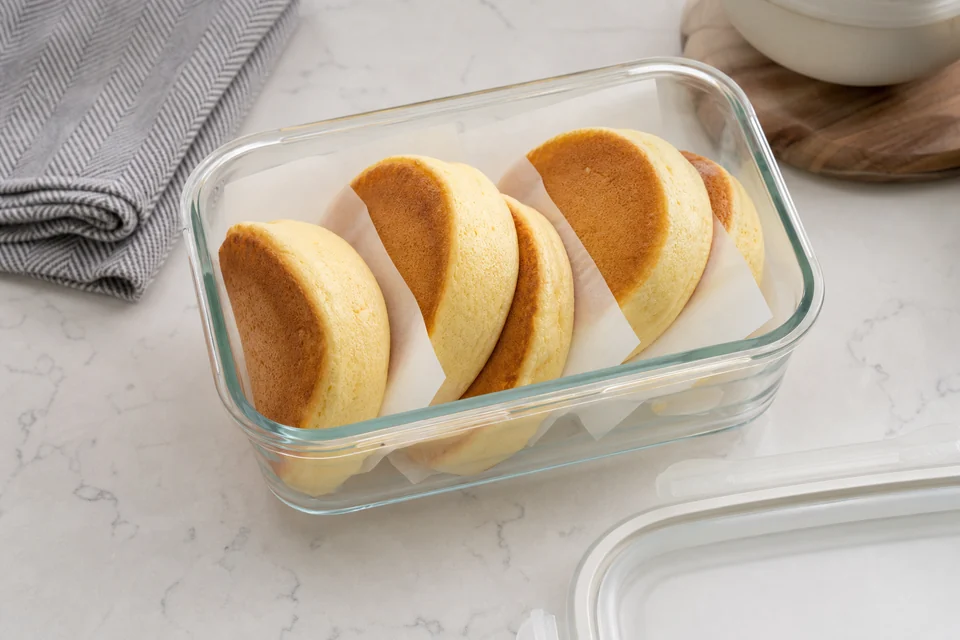
5. Cover, label, and refrigerate promptly
Close the lid once the container is ready. A covered container limits odour transfer and moisture loss. Mark the date and place it in a refrigerator held at 40°F (4°C) or below, consistent with FoodSafety.gov cold-storage guidance.
How to freeze them without creating one solid block
Freeze plain pancakes rather than pancakes soaked with syrup or topped with cream. Arrange them in one layer on a parchment-lined tray until firm, then transfer them to a freezer-safe container or bag with parchment between portions. Alternatively, package each serving separately from the start. Press out excess air without crushing the pancakes.
Freezer timing is mainly a quality question once food remains continuously frozen. USDA notes that frozen leftovers can lose moisture and flavour over time even though continuous freezing keeps them safe. For a delicate pancake, a short, clearly labelled freezer stay is more useful than treating a distant maximum as a target.
If the freezer is crowded, protect tall pancakes inside a rigid container. A thin bag alone will not prevent boxes or frozen foods from compressing them. Freeze the pancakes level before rearranging the container.
Thawing and reheating
The safest low-effort thaw is in the refrigerator. USDA also recognizes microwave thawing when the food is heated immediately. Small plain pancakes can often be reheated from frozen, but the best method depends on thickness and your appliance.
For one delicate soufflé-style pancake, start with gentle heat. A microwave is quick but can make edges rubbery if used too long. Cover loosely with a microwave-safe cover to reduce splatter and use short intervals, checking the centre between them. An oven or toaster oven heats more gradually and can handle several portions, although prolonged dry heat can firm the exterior. A covered skillet over low heat can work for a single sturdy hotcake; avoid pressing it with the spatula.
USDA guidance for reheating leftovers uses 165°F (74°C) as the safety endpoint. Use a food thermometer when the stored pancake or its toppings are perishable and safety verification matters. A warm-looking exterior does not establish that the centre reached the target.
For method-by-method choices, use the Pancake World guide to easy ways to reheat pancakes. For freezer organization beyond the Japanese-style texture questions here, see freezing homemade pancakes.
A practical texture diagnostic
| What you observe after storage | Likely handling issue | Useful response |
|---|---|---|
| Surface feels damp | Steam or a wet topping was trapped | Reheat uncovered briefly; separate toppings next time. |
| Edges feel dry | Air reached the pancake or reheating ran too long | Use a better-sealed container and shorter reheating intervals. |
| Pancakes tear when separated | Layers were stored in direct contact | Use food-safe parchment between portions. |
| Tall pancake is visibly compressed | Container or stack placed weight on it | Use a rigid, shallow container with headroom. |
| Centre remains cold while outside is hot | Heat was too aggressive or uneven | Lower the heat, use shorter cycles, rotate, and verify the centre. |
| Pancake smells sour, shows mould, or has an unexplained slimy surface | It may be spoiled | Discard it; do not taste to test safety. |
These observations help with the next decision, but they are not laboratory tests. A pancake can be unsafe without an obvious smell, while normal egg or dairy aromas can vary by recipe. Time and temperature controls remain more dependable than sniffing alone.
Common storage mistakes
The first mistake is packaging an undercooked pancake as if chilling will solve it. Storage pauses the meal; it does not substitute for the recipe’s complete cooking process. If the centre question began before storage, consult the guide to pancakes that are not cooked through rather than relying on a later warm-up.
The second is leaving the batch out for an extended “complete cool.” Prompt refrigeration matters more than avoiding every trace of warmth. Use a shallow container and a brief steam-release stage.
The third is stacking tall pancakes under pressure. A perfect cylinder is not a realistic storage goal, but a container that fits prevents needless deformation. If your pancakes collapse immediately after cooking, storage may not be the primary issue; see why Japanese pancakes deflate.
The fourth is reheating the whole batch repeatedly. Remove only the portion you intend to eat. Repeated warming and cooling adds handling and usually worsens texture.
Finally, do not use a paper towel as an all-purpose moisture fix. It may stick to the surface, compress a soft pancake, or shed fibres. Food-safe parchment is a cleaner separator; the container and prompt temperature control do the actual storage work.
Serving leftovers well
Reheat the pancake first, then add cold or room-temperature toppings. A spoonful of fruit compote, fresh fruit, syrup, or softly whipped cream can restore contrast without soaking the pancake during storage. Keep the portion modest until you see how much the pancake absorbs.
Serve immediately after reheating. Cutting one pancake open is a useful check for temperature distribution, especially with a thick soufflé-style portion. Do not press or flip repeatedly just to recreate the original height. The goal is a pleasant, evenly heated leftover, not a visual copy of the first plate.
Frequently asked questions
How long do Japanese pancakes last in the refrigerator?
Use USDA’s general leftovers window of three to four days when they were cooked and refrigerated promptly at 40°F (4°C) or below. Delicate texture may decline sooner. Toppings or fillings can impose a shorter limit.
Can I freeze Japanese soufflé pancakes?
Yes, when they are fully cooked and packaged in portions. Freeze them plain, use parchment separators, and protect them from crushing in a rigid container. Expect some loss of height and tenderness after thawing.
Should pancakes cool completely before refrigeration?
No long countertop cool is needed. Let obvious steam escape briefly while you prepare a shallow container, then refrigerate promptly within the applicable USDA two-hour or one-hour limit.
Can I store the batter instead?
This page does not cover raw batter. Soufflé-style batters can depend on incorporated air and raw ingredients require their own handling. Follow the specific recipe and a dedicated batter-storage guide rather than transferring cooked-leftover advice to batter.
Can I reheat them in the microwave?
Yes. Use a microwave-safe plate, a loose cover, and short intervals. Thick pancakes heat unevenly, so check the centre and avoid one long burst that can toughen the edges.
Why did my stored pancakes become wet?
Common quality causes include trapped steam and toppings stored on the pancake. Separate wet toppings, allow a brief steam-release stage, and use a covered shallow container.
Can I eat them cold?
Plain, fully cooked pancakes handled within safe time and temperature limits may be served cold, but toppings and fillings change the decision. When reheating perishable leftovers, USDA’s guidance uses 165°F (74°C).
Related Pancake World pages
Continue with freezing homemade pancakes for a general freezer workflow, easy ways to reheat pancakes for appliance choices, and why Japanese pancakes deflate when the loss of height starts before storage.
Sources and editorial references
- USDA Food Safety and Inspection Service: Leftovers and Food Safety —
https://www.fsis.usda.gov/food-safety/safe-food-handling-and-preparation/food-safety-basics/leftovers-and-food-safety - FoodSafety.gov: Cold Food Storage Chart —
https://www.foodsafety.gov/food-safety-charts/cold-food-storage-charts
For more practical food and breakfast guides, visit Pancakes World.
For the wider topic, start with Japanese Pancakes.
For a closely related guide, see Fluffy Japanese Pancakes Without Ring Molds.
A useful next comparison is A Guide to Japanese Pancake Styles.
You can also continue with Japanese Soufflé Pancakes: How Their Fluffy Texture Works.
