
Quick answer
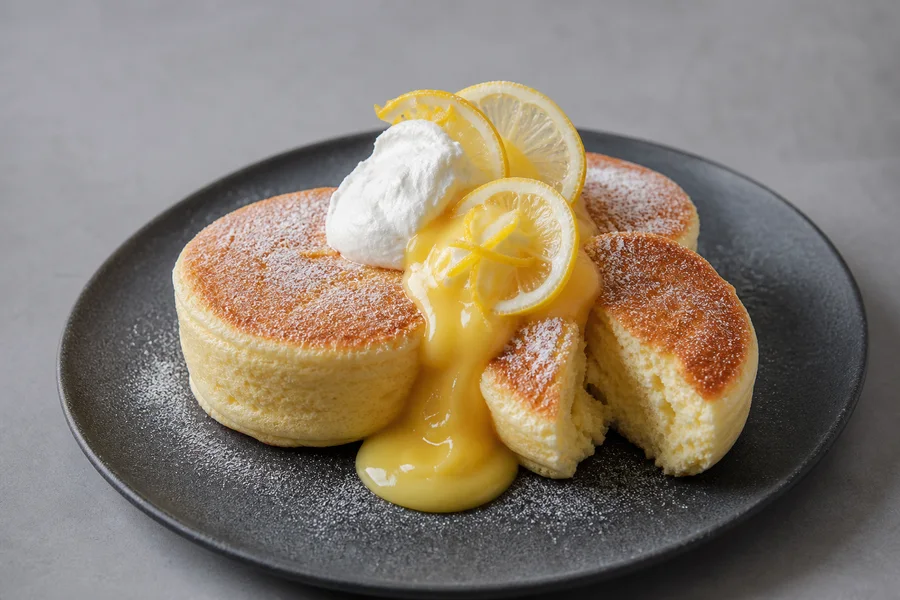
An accessible ring-free home method for fluffy Japanese pancakes, with mound shaping and immediate service. The practical target is a rounded, airy pancake that stays upright long enough to serve and has a fully cooked egg center. This version builds freestanding mounds without rings; the companion soufflé guide covers a ring-assisted method.
Begin the test for fluffy japanese pancakes without ring molds with “Prepare the base.” Watch how 2 large eggs, separated behaves as the edge sets and the underside releases, then inspect the thickest center for a rounded, airy pancake that stays upright long enough to serve and has a fully cooked egg center. That first result tells you more than borrowing a pan setting or cooking time from a different batter.
What success looks like
The finished result should show a rounded, airy pancake that stays upright long enough to serve and has a fully cooked egg center. It should also fit the promised serving format: a stack must remain stable, a fold must stay flexible, and a delicate foam or alternative-flour pancake must be supported during turning. Flavor, texture, and safety are separate judgments; a browned surface is useful culinary information but not proof that a raw egg center is safe.
The build plan runs from 2 large eggs, separated to water for steam beside the mounds, and the first method decision is “Prepare the base.” Keep those controls stable while calibrating portion and heat; otherwise a change in the formula can be mistaken for a pan problem.
Ingredients or build plan
- 2 large eggs, separated
- 30 g milk
- 35 g cake flour
- 1/2 teaspoon baking powder
- 25 g fine sugar
- 1/4 teaspoon lemon juice
- neutral oil for the pan
- water for steam beside the mounds
Treat 2 large eggs, separated as the opening control and water for steam beside the mounds as the final recipe-specific addition, not as parts of a universal pancake ratio. Make a measured adjustment only when the test pancake fails to approach a rounded, airy pancake that stays upright long enough to serve and has a fully cooked egg center.
Prepare before cooking
Preheat a lidded nonstick skillet over the lowest stable heat and lightly oil it. Set out a large spoon or piping bag, a narrow turning spatula, and a food thermometer before whipping the egg whites.
The mixture uses 2 large eggs, separated and water for steam beside the mounds. Handle raw egg batter with clean hands, bowls, utensils, and work surfaces, then cook until no liquid egg or raw batter remains. The relevant setup is: Preheat a lidded nonstick skillet over the lowest stable heat and lightly oil it. Set out a large spoon or piping bag, a narrow turning spatula, and a food thermometer before whipping the egg whites.
Method
Prepare the base
Whisk yolks and milk, then sift in flour and baking powder. Keep this mixture smooth and fairly thick. A loose base cannot support the foam or a layered mound.
Whip medium-stiff foam
Beat whites until foamy, add lemon juice, and gradually add sugar. Stop when the foam is glossy and a lifted peak bends slightly. Egg-white proteins surround incorporated air; careful handling preserves more of those bubbles.
Fold and mound
Lighten the yolk base with one third of the foam, then fold in the rest without streaks. Spoon three compact mounds into the skillet. After the base begins setting, add another spoonful on top rather than spreading outward.
Cook covered at low heat
Add water beside the pancakes and cover. Gentle heat gives the tall centers time to set. Turn only when the mounds support a spatula and slide cleanly.
Serve after verification
Continue covered after turning and verify the thickest center is fully set with no liquid egg or raw batter. Transfer directly to plates and add toppings lightly; long holding and heavy sauce compress the delicate crumb.
Fix the current batch
Start current-batch triage with “Mounds spread,” because it is the first likely failure for this formula. Preserve any pancake already showing a rounded, airy pancake that stays upright long enough to serve and has a fully cooked egg center, and change only the part of the process connected to that observed defect.
Mounds spread
The foam may be under-whipped or the base too loose. Layer a smaller second spoonful and reduce heat rather than building wider pancakes. Record what changed so the correction can be repeated or rejected on the next pancake.
Pancakes tear during turning
Wait longer, use two spatulas if necessary, and make the next mounds slightly smaller. Record what changed so the correction can be repeated or rejected on the next pancake.
Center remains wet
Lower the heat, add water beside the pancakes, and cover. Verify doneness instead of relying on the browned surfaces. Record what changed so the correction can be repeated or rejected on the next pancake.
Pancakes collapse on the plate
Serve sooner and use lighter toppings. Next time review foam peak, folding, and center set one variable at a time. Record what changed so the correction can be repeated or rejected on the next pancake.
Variations and serving
Lemon zest, vanilla, or a small amount of matcha can flavor the base, but powders change solids and should be added conservatively. A citrus curd and cream topping suits the ring-free mounds because it can be spooned beside them rather than stacked heavily on top.
Plate fluffy japanese pancakes without ring molds so a rounded, airy pancake that stays upright long enough to serve and has a fully cooked egg center remains visible. The serving direction begins “Lemon zest, vanilla, or a small amount of matcha can flavor the base, but powders change solids and should be added conservatively”; keep that addition restrained enough to show whether the pancake itself reached the intended texture.
Prevent problems in the next batch
Write down the pan, burner setting, portion size, and the one adjustment that improved the current batch. For fluffy japanese pancakes without ring molds, the most useful record is whether the result moved closer to a rounded, airy pancake that stays upright long enough to serve and has a fully cooked egg center. A note such as “lower heat” is incomplete without the pancake size and observed center.
After “Mounds spread,” alter only the correction named in that diagnostic before repeating “Prepare the base.” Changing portion, heat, and 2 large eggs, separated together would hide which action moved the result toward a rounded, airy pancake that stays upright long enough to serve and has a fully cooked egg center.
Use the first pancake to test the relationship between 2 large eggs, separated and water for steam beside the mounds. Its spread shows whether the build plan is coherent, its release tests the pan, and its center reveals whether “Prepare the base” produced a rounded, airy pancake that stays upright long enough to serve and has a fully cooked egg center.
Food safety
For fluffy japanese pancakes without ring molds, the raw mixture includes 2 large eggs, separated. Keep raw egg batter away from ready-to-eat toppings, clean contacted bowls and tools, and cook the thickest sample until no liquid egg or raw batter remains. The target a rounded, airy pancake that stays upright long enough to serve and has a fully cooked egg center describes texture, not a guarantee based on surface color.
A practical batch notebook
Before cooking, record the starting formula and the intended serving format. During cooking, note the first pancake’s diameter, visible edge behavior, underside color, and center texture. After cooking, record only the correction that genuinely improved a rounded, airy pancake that stays upright long enough to serve and has a fully cooked egg center. This creates evidence for the next batch without turning one kitchen result into a universal claim.
When changing 2 large eggs, separated or water for steam beside the mounds, restart with the same pan and portion used for “Prepare the base.” Compare the new result with a rounded, airy pancake that stays upright long enough to serve and has a fully cooked egg center, then apply the smallest correction suggested by “Mounds spread” instead of forcing the variation to behave like a different formula.
Frequently asked questions
Are these the same as ordinary American pancakes?
No. They rely heavily on separated-egg foam and a tall covered cooking method, while conventional American pancakes usually depend more on a quick batter and chemical leavening.
Why use no rings?
This method is designed for home cooks without molds. Layered mounds are less geometrically tall but avoid buying equipment.
Can I hold them in the oven?
Only briefly. They are most impressive and tender when served immediately, and extended holding encourages settling and dryness.
Is some deflation normal?
Yes. Hot trapped gases cool and the delicate structure relaxes. A dramatic collapse suggests reviewing foam handling or whether the center was fully set.
Related Pancake World pages
- why did my japanese pancakes deflate
- using only egg whites to make pancakes everything you need to know
- Pancake troubleshooting
Sources and editorial references
- Exploratorium, Science of Cooking: The Amazing Multi-Tasking Egg —
https://annex.exploratorium.edu/cooking/icooks/article_5-03.html - USDA Food Safety and Inspection Service, Shell Eggs from Farm to Table —
https://www.fsis.usda.gov/food-safety/safe-food-handling-and-preparation/eggs/shell-eggs-farm-table
For more practical food and breakfast guides, visit Pancakes World.
For the wider topic, start with Japanese Pancakes.
For a closely related guide, see Japanese Soufflé Pancakes: Foam, Shape, and Gentle Heat.
A useful next comparison is Can I Make Japanese Soufflé Pancakes Without a Mold?.
You can also continue with Japanese Soufflé Pancakes: How Their Fluffy Texture Works.
