
Explore more pancake traditions and breakfast culture on Pancakes World.
Baked pancakes turn one bowl of leavened batter into a large, tender slab that can be cut into breakfast squares. The pan dimensions, batter depth, toppings, and center cue matter more than copying one oven time across every dish.
The baked pancake squares method gives measurable starting points, observable checks, a current-batch repair path, and a next-batch record. Start with the stated formula, then use the cooked result to decide whether liquid, portion size, heat, or handling needs one bounded adjustment.
Quick answer
Pour a standard leavened pancake batter into a hot, greased rimmed pan and bake until the center is set and springs back lightly. The result is a tender slab cut into squares, not a custardy Dutch baby and not a layered breakfast casserole.
Use the first cooked baked pancake squares portion as evidence. Note how far this specific mixture spreads, whether it releases, how quickly it colors, and what its cut center looks like. Do not taste raw batter or assume a dark surface proves the interior is ready.
What you need
- 300 g plain flour
- 3 teaspoons baking powder
- 35 g sugar
- 3/4 teaspoon fine salt
- 3 large eggs
- 420 ml milk
- 60 g melted butter, plus more for the pan
- 1 teaspoon vanilla, optional
- 150 g berries or another dry, modest topping, optional
Equipment
Use a scale, two bowls, whisk, flexible spatula, 23 x 33 cm rimmed metal pan, pastry brush, and cooling rack. Pan material and dimensions affect browning and depth, so record what you actually use.
These quantities and tools belong to this baked pancake squares method, not to every pancake style. Ingredient brands, flour milling, egg size, cookware, and stove response vary, so the measured test is part of the recipe rather than an optional sacrifice.
Step-by-step method
1. Heat the oven and pan
Set a rack in the center and heat the oven to 220°C. Place the empty metal pan in the oven for several minutes while mixing, keeping handling safety in view.
2. Mix the batter briefly
Whisk dry ingredients, whisk wet ingredients separately, and fold together until no dry flour remains. Avoid extended beating.
3. Grease and fill carefully
Remove the hot pan to a stable heatproof surface, brush with butter, and pour in the batter. Scatter dry toppings evenly rather than creating wet piles.
4. Bake without repeated opening
Return the pan to the center rack and bake until the surface is golden, the middle looks set, and a tester in a batter-only area has no wet batter.
5. Rest, cut, and serve
Let the slab stand for several minutes so steam redistributes, then loosen the edges and cut squares. Serve promptly or cool on a rack before storage.
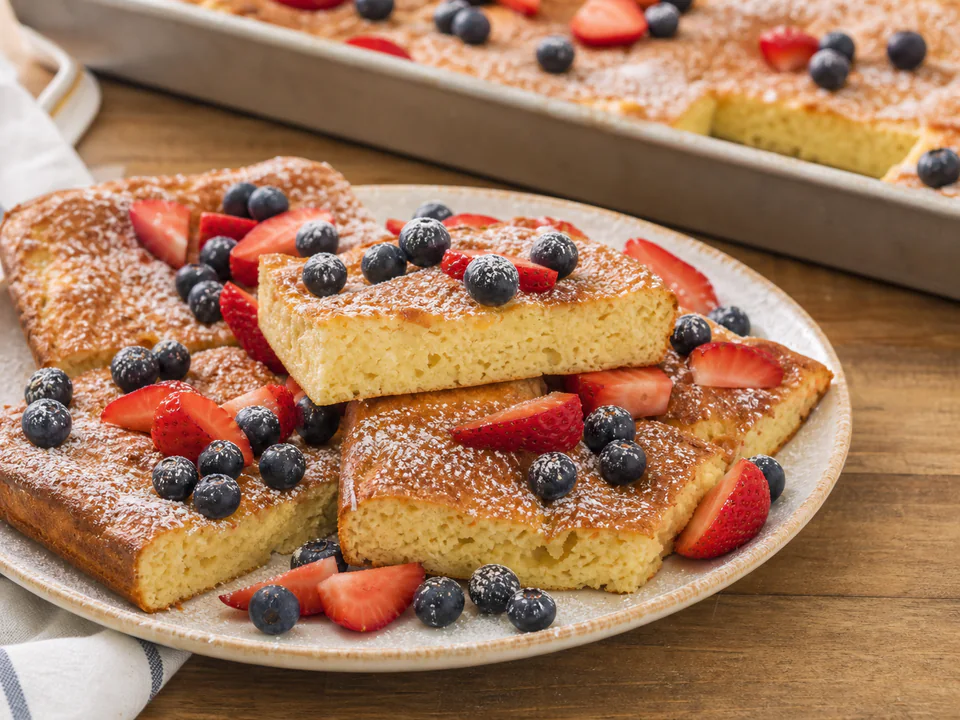
The close image shows the finished baked pancake squares clearly enough to inspect surface, filling distribution, or crumb. Use those visible features as comparison points while allowing for normal differences in ingredients, cookware, and portioning.
Why the method works
Batter depth controls the center
A smaller pan creates a deeper slab that needs more time; an oversized pan creates a thin, drier result. Pan dimensions are part of the formula.
Metal browns differently from glass
The recipe is written for a rimmed metal pan. Changing material alters heat transfer, so do not transfer a time blindly.
Wet toppings need limits
Berries, compote, and juicy fruit can create localized wet pockets. Use a modest amount and place sauces on the finished square.
Oven baking changes the workflow, not the safety boundary
The whole center must set. A golden edge does not establish the condition of the deepest middle.
Diagnose and fix the current batch
Do not discard the whole baked pancake squares batch at the first imperfect result. Hold the formula constant where possible, choose the symptom that actually matches the cooked test, and make one bounded correction.
The center is wet while the edges are done. Lower the rack only if top heat is the issue, shield excessive browning, and continue until the center sets. Next time use the specified pan size or reduce very wet toppings. After the correction, compare the next piece with the same portion and describe the center, surface, and release before changing another variable.
The baked pancake is dry. Verify the pan was not too large and the bake did not continue after the center set. Weigh flour and liquid rather than diagnosing only from the clock. After the correction, compare the next piece with the same portion and describe the center, surface, and release before changing another variable.
The bottom sticks. Grease the hot pan completely, include the corners, and let the slab rest briefly before loosening. Burned sugar or fruit residue requires cleanup before another batch. After the correction, compare the next piece with the same portion and describe the center, surface, and release before changing another variable.
The surface rises unevenly. Spread batter to the corners, distribute toppings, and verify the pan sits level. Uneven height is not automatically a leavener problem. After the correction, compare the next piece with the same portion and describe the center, surface, and release before changing another variable.
Berry pockets remain gummy. Check the crumb beside fruit, not only the plain center. Use fewer berries, keep them dry, or serve fruit as a topping in the next batch. After the correction, compare the next piece with the same portion and describe the center, surface, and release before changing another variable.
If the baked pancake squares smell spoiled, contain visibly raw animal ingredients, or have been mishandled, a texture adjustment is not the answer. Culinary rescue does not override food-safety judgment.
Serving directions that fit this article
- Berries and yogurt on individual squares
- Butter and maple syrup served at the table
- Savory herbs and grated cheese in a separately tested variation
- Warm compote kept off the slab until serving
Choose one baked pancake squares serving direction and build a coherent plate. Keep one plain piece available for comparison; toppings and sauces can improve the meal, but they can also hide which part of the base needs adjustment.
Food safety and storage
Flour and egg batter is raw food, so do not taste it or use surface browning as a safety test. Keep raw batter and its utensils away from ready-to-eat toppings, cook until the center has no wet batter, and clean preparation surfaces. Cool cooked baked pancake squares promptly and follow current official leftovers guidance rather than inventing a universal hold time. Quality cues and food-safety boundaries are separate decisions.
For leftover baked pancake squares, label the container and keep wet sauces, fruit, vegetables, or garnishes separate when that protects texture and handling. Reheat only the portion needed until hot throughout, and check more than the surface when pieces are thick or filled.
Prevent the same problem next time
Record the exact pan dimensions, material, batter weight, topping weight, oven rack, and observed center cue. Those details explain more than copying a baking time into a different pan.
A useful baked pancake squares batch note includes the exact ingredient or process change, not merely “better” or “worse.” Measured quantities and a short description of spread, browning, release, and center texture are enough to guide the next test.
Check the finished result before serving
Set one finished baked pancake squares portion aside before adding sauce or garnish. Look first at the surface and edges, then cut through the thickest or most heavily filled area. The goal is not to match a photograph exactly; it is to confirm that the visible result agrees with the method’s cues and that no wet batter remains.
Compare Rest, cut, and serve with Batter depth controls the center. If the surface, release, and center point to different problems, give the center priority and adjust heat or portion size before cooking more. Taste only the fully cooked test, then decide whether salt, acid, sweetness, or toppings belong on the plate. This short check keeps a presentation choice from hiding a cooking problem.
Related Pancake World guides
- Use the cinnamon-streusel pancake bake for its separate, more specific focus.
- Use the savory baked pancakes with Gruyere for its separate, more specific focus.
- Use the American Pancakes for its separate, more specific focus.
Frequently asked questions
Is this the same as a Dutch baby?
No. This method uses a leavened pancake batter and produces a tender, even slab. A Dutch baby is an egg-forward oven pancake with a different formula and dramatic edge rise.
Can I use a glass dish?
Not with identical expectations. Glass changes heating and handling; use a recipe tested for that dish or treat it as a separate trial.
Can I double the recipe?
Only with matching pan area or multiple pans. Doubling batter in one pan increases depth and changes the center-to-edge timing.
How do I reheat squares?
Cool and store cooked pieces under current leftovers guidance, then reheat only what you need until hot throughout. An oven preserves edges better than a microwave.
Sources and editorial references
- U.S. Food and Drug Administration, Flour Is a Raw Food and Other Safety Facts —
https://www.fda.gov/consumers/consumer-updates/flour-raw-food-and-other-safety-facts - U.S. Food and Drug Administration, What You Need to Know About Egg Safety —
https://www.fda.gov/food/buy-store-serve-safe-food/what-you-need-know-about-egg-safety - USDA Food Safety and Inspection Service, Leftovers and Food Safety —
https://www.fsis.usda.gov/food-safety/safe-food-handling-and-preparation/food-safety-basics/leftovers-and-food-safety
