
Quick answer
A cinnamon-streusel pancake bake is a large-format oven pancake with a crumb topping, closer in service to a breakfast casserole or coffee cake than a stack of griddle pancakes. Use one complete published formula. Prepare the streusel first, mix wet and dry batter components separately, fold them together only to the recipe’s endpoint, spread the batter in the specified dish, distribute streusel evenly, and bake until the center is cooked and the top is golden.
Betty Crocker’s cited cinnamon-streusel pancake casserole provides a documented example using a 13-by-9-inch glass dish, a pancake-mix batter, and a flour-brown-sugar-butter-cinnamon streusel. Its pan, ingredients, oven setting, and timing belong together. If you use another formula or pan, use that recipe’s directions rather than borrowing isolated numbers.
What this bake is—and is not
The batter is poured into one baking dish instead of portioned onto a griddle. Streusel sits on top and creates crumbly sweet contrast. The finished bake is cut into squares. It will not reproduce the browned faces and flexible edges of individually flipped pancakes.
It is also not French toast casserole: no stack of cooked bread or pancakes is soaked in custard here. Nor is it automatically coffee cake, although the crumb topping and square service overlap. Name it as a pancake bake so guests know to expect a tender batter base under streusel.
Use the complete formula
Gather the exact pancake mix or dry ingredients, leavener, brown sugar, cinnamon, buttermilk or named liquid, eggs, melted butter, vanilla, and streusel components required by the selected recipe. Check package sizes and labels; pancake mixes are not interchangeable flour.
Prepare the stated baking dish. Glass, metal, ceramic, and dark-coated pans heat differently, so a pan swap can change browning and bake time. If the recipe names glass, use glass or select another recipe tested for your pan.
Preheat fully. Starting in a cold oven changes the rise, melting, and center timing. Position the rack through the recipe’s instructions and clear enough space that air circulates around the dish.
Make the streusel
Combine the recipe’s flour, brown sugar, cinnamon, and butter until the mixture contains both small crumbs and some larger pieces. A uniform paste will melt differently; completely dry flour will taste raw. Keep the crumb mixture cool until assembly when the formula directs it.
Do not add arbitrary extra butter because the crumbs seem dry before mixing is complete. Butter temperature, flour measurement, sugar packing, and hand warmth all change the look. Use the published quantities and stop at its described coarse texture.
Nuts can add crunch only when the recipe permits the addition and diners’ allergies are known. An optional ingredient should never be hidden in the topping.
Mix the batter
Whisk the dry batter ingredients so leavener, sugar, cinnamon, and mix are distributed. In another bowl, combine the liquid ingredients. Pour wet into dry and fold just until combined through the recipe’s endpoint. A few small lumps may be acceptable in the cited formula; dry pockets are not.
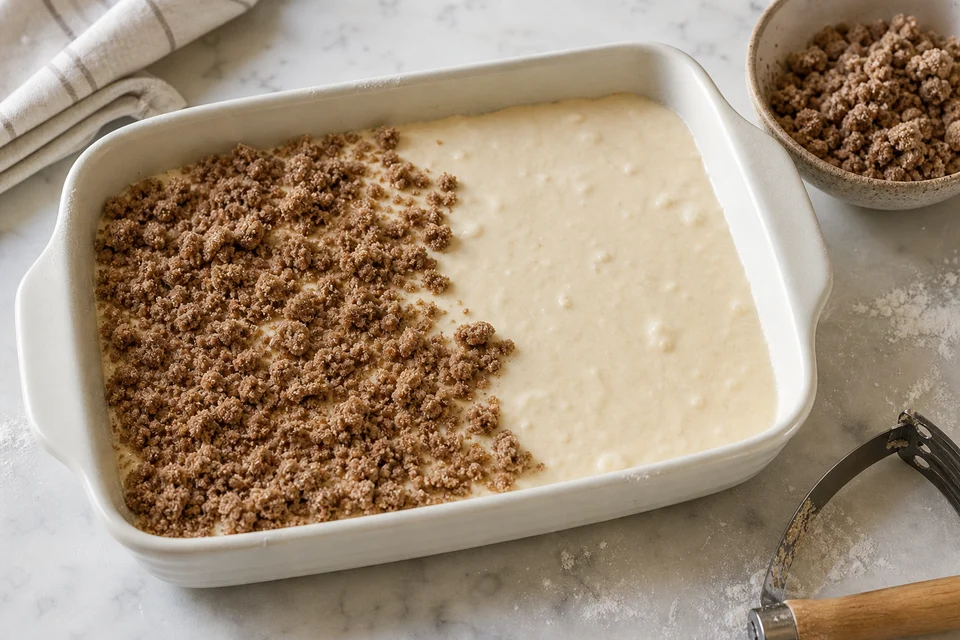
Spread batter level in the prepared dish. Scatter streusel across the entire surface, including the center and corners. Large bare areas cook and brown differently; a thick mound in the middle can slow the center.
Bake and check the center
Place the dish in the fully heated oven and avoid repeated door opening. Check near the recipe’s earliest time. Look for an evenly golden top, a set center, and the specific doneness cue given by the source. If using a skewer or toothpick, insert it into the batter area rather than a melted sugar pocket, which can look wet even when the crumb is set.
Exterior color is not proof of center doneness. If the edges are darkening but the middle is visibly liquid, do not serve it. Confirm oven accuracy, pan material, batter depth, and topping distribution for the next attempt. Covering or extending time should occur only as the recipe permits.
Allow the bake to rest for the stated period before cutting. The crumb finishes setting and steam redistributes. Cutting immediately can make a fully baked center look wetter and can tear the streusel.
Serving
Cut with a sharp knife and lift squares with a flat server. Begin with modest portions because streusel adds sugar and fat beyond a plain pancake. Serve warm with fresh fruit, plain yogurt, or a small maple drizzle if desired. Taste before adding syrup; the brown-sugar topping may already provide enough sweetness.
For a brunch table, keep wet toppings beside the dish. Pouring syrup over the whole bake softens streusel and removes diners’ choice. Use the sweet pancake toppings guide for alternatives.
Optional variations within a safe boundary
Add diced apple, berries, nuts, or chocolate only when the chosen recipe provides a tested variation. Fruit releases moisture and can change the center; nuts change allergens; chocolate changes sweetness and melting. Do not scatter a large unmeasured amount into the base and keep the original bake time as though nothing changed.
For an apple service without changing the batter, prepare a separate warm apple topping and spoon it onto individual squares. For nuts, offer toasted chopped nuts in a labeled side bowl. These service choices preserve the tested bake.
Current-batch troubleshooting
Streusel sank: The crumbs may have been too fine or wet, the batter too loose for the formula, or the topping pressed into the surface. Do not stir it back through a partially baked dish.
Top is powdery: Dry ingredients may not have combined with butter. If already baked and the center is done, serve the result as-is and correct measurement next time; do not pour raw butter over the whole hot surface blindly.
Center is wet: Continue only through the recipe’s safe bake method. Check a true batter area. Do not call liquid batter a custardy texture.
Edges are dry: The pan may be too large, dark, or overbaked. Stop heating when the center reaches the recipe’s endpoint and record pan material.
Bake is dense: Overmixing, an ingredient mismatch, wrong mix, expired leavener, or pan depth could contribute. Compare the exact formula before changing one factor.
Food safety
The U.S. FDA advises that flour and baking mixes containing flour are raw until cooked. Do not taste batter or unbaked streusel. Raw eggs also require clean handling. Keep raw batter away from fruit and toppings served without further cooking.
For leftovers, refrigerate promptly in shallow covered portions. USDA general leftovers guidance gives a three-to-four-day refrigerated window for many cooked leftovers and recommends reheating leftovers to 165°F / 74°C. Follow the shortest applicable instruction for dairy toppings or fruit served with the bake.
Storage and reheating
Cool only as long as the recipe requires for setting and service; do not leave the dish out for hours. Transfer portions to shallow containers or cover the pan when refrigerator space and cooling permit. Keep yogurt, whipped cream, and fruit separate.
Reheat individual squares in a microwave or several portions in an oven through a suitable method. The microwave softens streusel; dry oven heat may preserve more crunch but can dry the base. Heat only what will be served.
Freeze only when the recipe supports it. Wrap plain cooled squares separately and label. Add toppings after thawing and reheating. The pancake storage guide supplies the broader handling plan.
Common mistakes
Using flour in place of pancake mix: A formulated mix contains more than flour.
Changing the pan without adapting a tested recipe: Depth and material affect the center.
Making streusel paste: Aim for the source’s coarse crumbs.
Overmixing to remove every lump: Stop at the documented endpoint.
Piling topping in the center: Distribute it evenly.
Adding wet fruit without a variation: Moisture changes the bake.
Using surface color as the only doneness test: Check the center through the recipe.
Improve the next bake
Record mix or flour brand, pan material and dimensions, ingredient weights, oven setting, actual bake time, center cue, and rest. If the center was late, verify oven temperature and pan first. If the streusel melted flat, review butter amount and crumb texture.
Change only one factor. A new pan, extra fruit, different mix, and doubled streusel in the same attempt make the result impossible to diagnose.
Limitations
This page uses a published pancake-mix casserole as its concrete evidence base. It does not claim every scratch pancake batter can be baked under streusel, or that the named product is required for all pancake bakes. Choose a scratch recipe specifically designed for a baking dish if avoiding mix.
The finished shape is a square breakfast bake, not a griddle stack. That distinction preserves the legacy focus without promising identical pancake texture from a different cooking method.
FAQ
Can I use regular pancake batter for a pancake bake?
Only if the recipe is designed for oven baking. A griddle batter may not set correctly at casserole depth.
Why did the streusel sink?
Possible reasons include overly wet crumbs, pressing them into the batter, or using a different batter consistency. Compare with the exact source formula.
How do I know the center is done?
Use the recipe’s center cue, checking the batter rather than a melted-sugar pocket. A golden edge alone is insufficient.
Can I prepare it the night before?
Only when the selected recipe provides an overnight method. Leavener and streusel can change while standing; do not assume an assembled batter can wait.
What should I serve with it?
Fresh fruit, plain yogurt, or a small amount of maple syrup work. Keep wet toppings separate so the streusel remains crumbly.
Related Pancake World guides
Compare why make pancakes from scratch, sweet pancake toppings, tips for storing pancakes, and the Pancake Troubleshooting hub.
Sources and editorial references
- Betty Crocker: Cinnamon Streusel Pancake Casserole —
https://www.bettycrocker.com/recipes/cinnamon-streusel-pancake-casserole/110295f8-8a2e-4784-9afc-abe04969d096 - U.S. Food and Drug Administration: Handling Flour Safely —
https://www.fda.gov/consumers/consumer-updates/handling-flour-safely-what-you-need-know - USDA Food Safety and Inspection Service: Leftovers and Food Safety —
https://www.fsis.usda.gov/food-safety/safe-food-handling-and-preparation/food-safety-basics/leftovers-and-food-safety
For more practical food and breakfast guides, visit Pancakes World.
For the wider topic, start with Guides/pancake Ingredients.
For a closely related guide, see Cheesy Sausage, Egg, and Hash Brown Breakfast Casserole.
A useful next comparison is Blueberry Pancake Breakfast Casserole.
You can also continue with Shrimp and Grits Casserole: Timing, Texture, and Serving.
