
Quick answer
A blueberry pancake breakfast casserole turns fully cooked pancakes into a layered bake with blueberries and a lightly sweet egg-and-milk custard. The pancakes should be cool and slightly dry, the berries should be distributed rather than piled in one wet pocket, and the casserole must bake until the centre is fully set.
It is a practical make-ahead brunch dish because the pancakes can be cooked in advance and the casserole can absorb custard under refrigeration. It is not raw pancake batter baked in a deep dish. Using cooked pancakes controls structure and preserves the historical focus of a blueberry pancake casserole rather than becoming an ordinary blueberry sheet pancake.
Recipe at a glance
- Pan: approximately 23 cm square or a similar 2-litre baking dish
- Yield: 6 generous or 8 smaller servings
- Pancakes: about 500 g fully cooked plain pancakes
- Fruit: 250 g blueberries
- Texture: browned top, set custard, identifiable pancake pieces and berries
- Make ahead: assemble under refrigeration, then bake from cold with extra checking time
Use pancakes of similar thickness. Very thin crêpes collapse into layers, while exceptionally thick cakes can leave dry blocks in the centre.
Ingredients
- 500 g fully cooked plain pancakes, cooled
- 250 g fresh blueberries, washed and dried, or frozen blueberries kept frozen
- 6 large eggs
- 450 ml milk
- 60 g sugar
- 1 teaspoon vanilla
- 1 teaspoon finely grated lemon zest, optional
- 1/2 teaspoon ground cinnamon
- 1/2 teaspoon fine salt
- 20 g melted butter, cooled, plus more for the dish
- 2 tablespoons coarse sugar or sliced almonds for the top, optional
Frozen berries work, but they release colour and moisture as they bake. Do not thaw them into a puddle first. If using almonds, check allergens and keep them out of an otherwise nut-free serving.
Choose the pancakes
Day-old plain pancakes are useful because their surfaces have dried slightly and can absorb custard. Fresh pancakes can work after cooling fully in one layer. Avoid heavily syruped, filled, or iced pancakes; their sugar and moisture make the casserole unpredictable.
Cut pancakes into roughly 3 cm pieces. Uniform chunks absorb more evenly than a mixture of crumbs and large quarters. Keep some browned edges visible because they provide texture at the surface.
If cooking pancakes specifically for the casserole, make them fully cooked but not dark or dry. Handle raw flour and egg batter safely, then cool the cooked pieces promptly before assembly.
Prepare the blueberries
Sort fresh berries and remove stems or damaged fruit. Wash, drain, and dry them. Free water on the berries dilutes the custard. Keep frozen berries in the freezer until the dish is ready so they remain separate.
Very large cultivated blueberries can create wet pockets. Cut only the largest berries in half if needed, blotting the cut sides. Do not mash fruit into the custard; the goal is visible berries through the layers.
Mix the custard
Whisk eggs, milk, sugar, vanilla, lemon zest, cinnamon, salt, and melted cooled butter until uniform. The egg whites should no longer form ropey strands. Sugar must dissolve enough that it does not settle as a gritty layer.
Taste adjustments belong before raw egg enters the bowl, or after cooking a separate sample through a safe method. Do not taste the finished raw custard.
Assemble the casserole
Prepare the baking dish with butter. Add half the pancake pieces, then scatter half the blueberries. Repeat with the remaining pancakes and fruit. Keep a few browned pancake edges near the top.
Pour the custard slowly across the dish. Pause so it can move between the pieces. Press very lightly with a spatula, then stop; compacting turns the base into a dense pudding and pushes liquid to the edges.
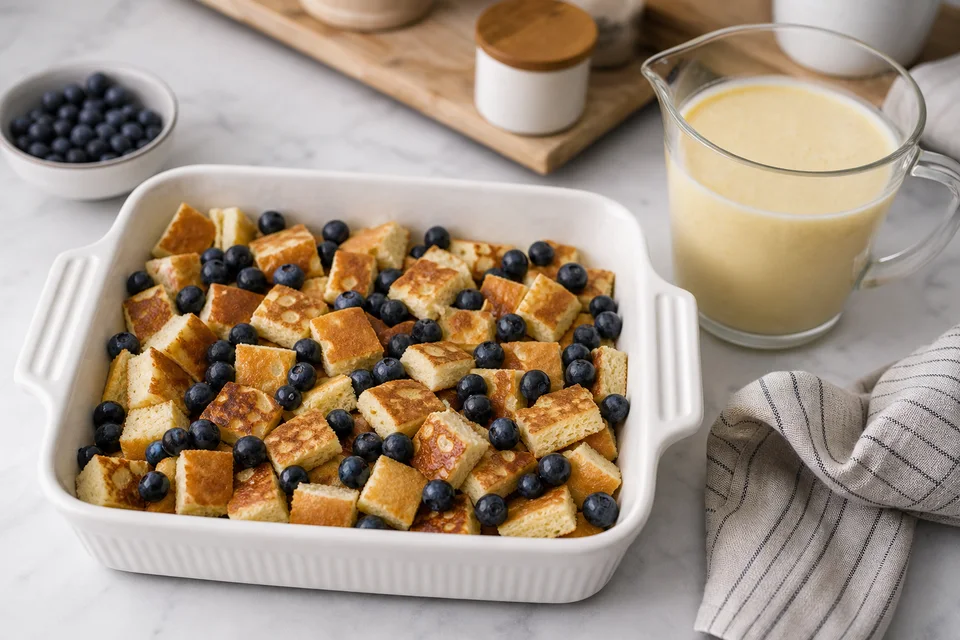
If the pieces float in a deep pool, hold back some custard. Pancake porosity varies, so the measured amount is a maximum rather than a reason to drown the dish.
Rest before baking
For immediate baking, let the assembled casserole stand for about 15 minutes while the oven heats. For make-ahead service, cover and refrigerate it promptly for several hours or overnight under an appropriate food-safety plan.
A long rest creates a softer, more uniform interior; a short rest leaves clearer pancake edges. Neither is automatically better. Do not leave the egg-and-milk dish on the counter for a prolonged soak.
Bake to a set centre
Heat the oven to 175°C / 350°F. Add coarse sugar or almonds if using. Bake on the middle rack until the top is golden, the edges are gently puffed, and the centre no longer moves like liquid when the dish is nudged. Start checking around 35 minutes, but rely on the centre because pan material, depth, and starting temperature change the time.
Insert a thin knife near the centre. It may pick up moist blueberry, but it should not be coated in raw egg custard. If the top browns early, cover it lightly and continue baking. A refrigerated casserole usually needs more time than a freshly assembled room-cool dish.
Rest for ten to fifteen minutes after baking so the custard firms enough to cut. Resting cannot make raw egg safe; return an undercooked centre to the oven.
Serve without making it soggy
Lift portions with a broad spatula. Serve with plain yogurt, fresh berries, lemon zest, or a modest amount of maple syrup. Put syrup on individual plates rather than flooding the baking dish.
For more fruit textures, use the fruit toppings guide. If you prefer a streusel-led large-format bake, cook the separate pancake bake with cinnamon streusel rather than adding a heavy crumb layer to this custard formula.
Fresh versus frozen berries
Fresh berries usually stay more distinct and release less colour. Frozen berries are convenient and can be excellent, but they cool the dish and release juice. Add them frozen, distribute them evenly, and expect purple streaks around some fruit.
Do not coat berries in an arbitrary quantity of flour to “seal” them. Flour on the surface can form pale paste pockets. The reliable controls are fruit amount, dryness, distribution, custard quantity, and a fully set bake.
Current-batch fixes
The centre is wet: Return the dish to the oven, covering the top if necessary. Check again near the centre rather than judging a berry pocket.
The top is dark too early: Cover lightly and reduce excessive top heat if the oven setup allows. Do not remove the casserole while the custard is liquid.
Liquid pools at the bottom: Too much custard, wet berries, or insufficient baking may be responsible. Finish the cooking endpoint first; reduce liquid or dry fruit better next time.
The casserole is dry: Stop baking. Serve with yogurt or fruit compote. Next time use the same pancake weight, retain enough custard, and check the centre earlier.
Pancake pieces feel gummy: The pieces may be too small, overly fresh, compressed, or soaked too long. Use larger uniform chunks and press less next time.
Slices fall apart: Let a fully cooked casserole rest and use a broad spatula. A raw centre still needs more heat.
Use the Pancake Troubleshooting hub for shared browning and texture symptoms.
Prevent the next batch from drifting
Weigh the cooked pancakes and fruit. Record pancake recipe, chunk size, fresh or frozen berries, custard used, pan dimensions, rest time, starting temperature, and actual bake endpoint. Those details explain the result more clearly than “one stack and one punnet.”
Test variations one at a time. If adding lemon zest, keep cinnamon stable. If using frozen berries, keep pancake weight and soak unchanged. If changing the pan, expect the depth and baking behaviour to change.
Variations
Blueberry and lemon: Increase zest slightly and omit cinnamon. Do not add a large volume of lemon juice to the custard.
Blueberry and almond: Add a small amount of almond extract and sliced almonds only when allergens are appropriately managed.
Mixed berry: Replace no more than half the blueberries with dry raspberries or chopped strawberries. Different fruit releases different water.
Less sweet: Reduce serving syrup first. Sugar in the custard also affects flavour and browning, so large formula changes should be tested.
Whole-grain pancakes: Use fully cooked whole-grain pancakes, but expect different absorption. Hold back custard and assess the assembled dish.
Storage and reheating
Cool leftovers promptly and refrigerate them in covered shallow portions under current official guidance. Reheat only the portion needed until hot throughout. An oven preserves the top better; a microwave is faster but can toughen the edge. The pre-made pancake reheating guide compares the methods.
Freeze fully cooled individual slices if the handling history is known, accepting that berries and custard may release moisture after thawing. Thaw in the refrigerator for more even reheating.
FAQ
Can I use pancake mix?
Yes, if you first make and fully cook the pancakes according to the package. Do not pour dry mix or raw batter into this casserole formula.
Can I assemble it the night before?
Yes under a planned refrigerated workflow. Cover promptly and account for the cold starting temperature during baking.
Should I thaw frozen blueberries?
No. Add them frozen and separated. Thawing can create a wet purple pool that changes the custard.
How do I know the casserole is done?
The centre should be set rather than liquid, and a knife near the centre should not show raw egg custard. Blueberry juice is not the same as raw custard.
Can I make it without egg?
Use a recipe developed with an egg-free binder. Removing six eggs from this formula eliminates its main setting system.
Related Pancake World guides
Compare pancake bake with cinnamon streusel, choose a serving accent from fruit toppings, and use reheating pre-made pancakes for leftover portions.
Sources and editorial references
- U.S. Food and Drug Administration: What You Need to Know About Egg Safety —
https://www.fda.gov/food/buy-store-serve-safe-food/what-you-need-know-about-egg-safety - U.S. Food and Drug Administration: Handling Flour Safely —
https://www.fda.gov/consumers/consumer-updates/handling-flour-safely-what-you-need-know - USDA Food Safety and Inspection Service: Leftovers and Food Safety —
https://www.fsis.usda.gov/food-safety/safe-food-handling-and-preparation/food-safety-basics/leftovers-and-food-safety
For more practical food and breakfast guides, visit Pancakes World.
For the wider topic, start with Guides/pancake Ingredients.
For a closely related guide, see Cheesy Sausage and Croissant Breakfast Casserole.
A useful next comparison is Croissant Breakfast Casserole: A Practical Make-Ahead Recipe.
You can also continue with Scrambled Egg and Crêpe Breakfast Casserole.
For another practical angle, read How to Adapt Pancake Recipes for Dietary Restrictions.
Related reading
Image note: Editorial images were created and refined with AI.
