
Quick answer
First confirm that the pancakes are fully cooked and pre-made, not raw batter, frozen raw portions, or dry mix. Follow the package whenever commercial directions are available. For homemade cooked pancakes, reheat only the portion you need: microwave for speed, oven for a batch, toaster for plain firm pancakes, or a covered skillet for surface control. Heat the center thoroughly, add toppings afterward, and serve promptly.
Exact time depends on pancake diameter, thickness, ingredients, starting temperature, appliance power, and quantity. Begin with the method’s short checked interval rather than adopting one universal number.
Identify what you have
| Product | What to do |
|---|---|
| Commercial frozen fully cooked pancakes | Follow package storage and heating directions |
| Homemade cooked refrigerated pancakes | Reheat through a suitable method |
| Homemade cooked frozen pancakes | Reheat from frozen or refrigerator-thaw as planned |
| Dry pancake mix | Add ingredients and cook according to the package; it is not pre-made food |
| Refrigerated raw batter | Use only within its recipe and storage boundary; cook as raw batter |
| Frozen raw batter or uncooked portions | Follow a tested product or recipe method, not this article |
If the label says “cook,” “heat and serve,” or gives a specific internal endpoint, that instruction controls. Do not replace manufacturer directions with a generic web shortcut.
Before reheating
Check the date and handling history. Commercial packaging should be intact and stored as labeled. Homemade pancakes should have been cooled and refrigerated or frozen through an appropriate plan. If perishable food sat out too long or the history is uncertain, reheating does not erase the earlier risk.
Remove syrup, whipped cream, fresh fruit, yogurt, and loose toppings when possible. They heat differently and can make pancakes soggy, scorch, or drip into an appliance. Separate frozen pancakes carefully; if they are stuck, thaw in the refrigerator or warm the package enough through a suitable method rather than prying with a sharp tool.
Arrange pieces in one layer or a loose overlapping layer so heat can reach them. A compressed frozen stack warms unevenly.
Microwave: fastest for one or two
Place one or two cooked pancakes on a microwave-safe plate. Cover with a microwave-safe cover or a slightly damp paper towel if the appliance and product directions allow it. Heat for a short interval, check the center, turn or rearrange, and continue in smaller intervals until hot throughout.
Rest briefly so heat distributes, then check the center before serving. Microwave power varies, and multiple pancakes need more attention than one. Overheating can make edges tough while trapped steam makes the surface rubbery.
Do not microwave metal, foil, unknown packaging, or a product in a wrapper unless the manufacturer explicitly says it is suitable. Add syrup and cold toppings after heating.
Oven: best for a batch
Preheat the oven to the setting specified by the package or chosen reheating recipe. Arrange pancakes in a single layer on a suitable tray. Cover if the method aims to reduce drying; uncover briefly only if the method calls for a drier surface. Heat until centers are hot, checking a pancake from the middle of the tray.
An oven takes longer to preheat but handles several pieces more evenly than repeated microwave batches. Avoid a deep stack, which shields interior pancakes. Do not leave a large batch holding for a long period; continued heat dries the edges and changes the crumb.
For frozen pancakes, follow best ways to reheat frozen pancakes for method-specific detail.
Toaster: only for suitable plain pancakes
A toaster can restore dry surface texture to a plain, firm pancake that fits safely in the slot. Use the package direction or a conservative setting, watch the first piece, and repeat only if needed. Remove it with the appliance’s normal mechanism after disconnecting power if a problem requires manual attention; never insert a metal utensil into an energized toaster.
Do not toast pancakes with loose chocolate, fruit, cheese, syrup, butter, sticky glaze, or fillings that can drip. Very soft, torn, thick, or oversized pancakes can jam. A toaster oven may be easier for those items when used through its instructions.
Skillet: useful for surface control
Warm a skillet through the selected method, using no fat or only the specified small amount. Add fully cooked pancakes in one layer, cover if the method needs help warming the center, then turn once or as directed. Keep heat gentle enough that the surface does not darken before the middle warms.
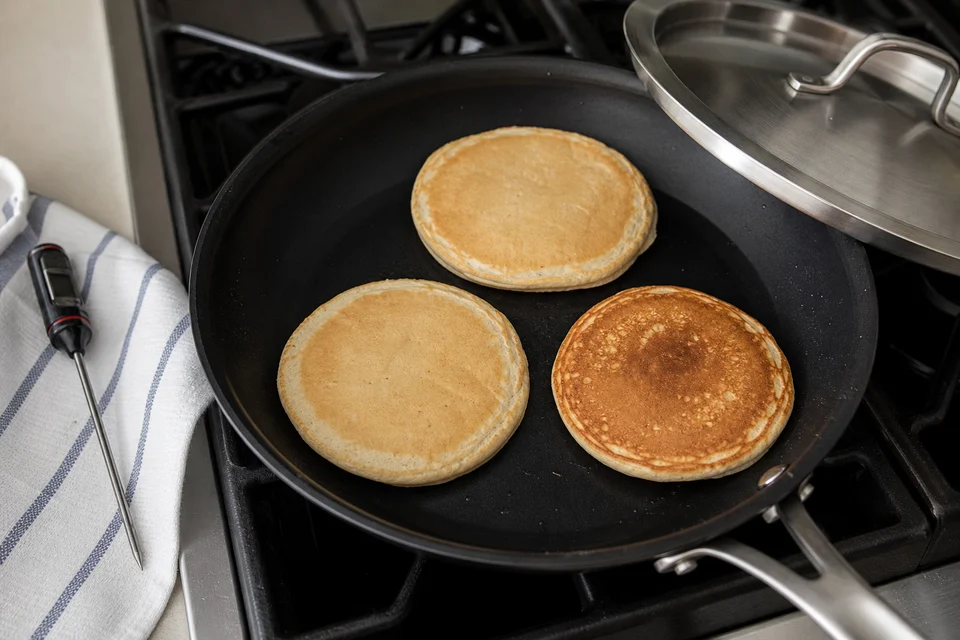
The skillet is useful when a microwave would soften the exterior, but it needs attention. Do not press the pancakes. Pressing does not warm the center more safely and can squeeze out moisture.
Air fryer and toaster oven
Use these only when the appliance manual and product allow it. Arrange pancakes so air circulates and toppings cannot blow into heating elements. Check early because small dry pancakes can firm quickly. Do not assume an air-fryer setting is identical to a convection-oven or toaster-oven setting.
Parchment and liners must be used only as the appliance manufacturer permits. Loose paper can lift into a heating element. The package’s method is the safest starting point for a commercial product.
Refrigerated versus frozen
Refrigerated pancakes usually need less heating and are easier to separate. Frozen pancakes can often be reheated directly, but thickness, filling, and packaging may make refrigerator thawing preferable. Never use a long room-temperature thaw as the default plan for perishable food.
Freeze homemade pancakes plain with separators when possible. Label the package and remove only the needed portion. Repeatedly warming and returning the whole batch degrades quality and complicates the handling history. Use can I freeze homemade pancakes? for the full packaging plan.
How to check the result
Touching the exterior is not enough. Open or cut the thickest pancake when necessary and check the center. For commercial products, use the label’s endpoint. For leftovers containing meat, egg, cheese, or other fillings, follow the relevant safe reheating instruction rather than a plain-pancake cue.
USDA leftovers guidance advises reheating leftovers to 165°F / 74°C. Apply that guidance to homemade leftover pancakes and use a suitable food thermometer when the structure permits an accurate reading. A steaming surface alone does not prove every center reached the endpoint.
Add toppings after heating
Warm syrup separately only through a suitable container and method. Add butter, yogurt, cream, compote, and fresh fruit after the pancake is hot. This keeps cold toppings fresh and avoids sending sticky ingredients through a toaster.
For a quick plate, use fruit and yogurt, maple syrup, or a small nut or seed topping. The sweet pancake toppings guide helps match additions without burying the reheated texture.
Common mistakes
Confusing a mix with a pre-made pancake: Dry mix still needs its package cooking process.
Heating a frozen block: Separate or arrange portions so centers warm evenly.
Using exact times from another appliance: Power and product size differ.
Adding syrup before a toaster: Sticky toppings can drip, scorch, and create an appliance hazard.
Trusting exterior warmth: Check the center and applicable endpoint.
Reheating the whole package repeatedly: Remove only what will be served.
Using reheating to rescue questionable storage: Heat does not undo an unknown handling history.
Fix the current batch
If the outside is hot but the center is cool, lower the intensity and continue with a method that brings heat inward, checking frequently. In a microwave, rearrange and use shorter intervals. In an oven, spread the pancakes out. In a skillet, cover briefly through the method and avoid scorching.
If the pancakes became dry, stop heating. Serve with a suitable moist topping rather than returning them to more heat. If they became soggy, uncover briefly in an oven or skillet only when the product and method allow it. No reheating method restores a delicate soufflé pancake to its exact fresh height.
Prevent the next batch from sticking together
Cool homemade cooked pancakes only through a prompt safe-storage plan, then place separators between portions and package tightly. Freeze in amounts you normally serve. Label the date and type, especially when fillings or allergen differences matter.
Choose the reheating appliance before freezing: flat plain pancakes suit a toaster; soft or filled pancakes may suit oven or microwave; a large family batch suits a tray. Planning the package around the later method saves forced separation and uneven heating.
FAQ
Can I cook pre-made pancakes from frozen?
Often yes, when the package or recipe supports it. Separate the portion, use the directed appliance, and check the center. Filled or very thick pancakes may need another plan.
How long do pre-made pancakes take to heat?
There is no universal time. Size, thickness, quantity, temperature, filling, and appliance power matter. Use package directions or short checked intervals.
Can I put frozen pancakes in a toaster?
Only if they are plain, fit safely, and the product and toaster instructions allow it. Never toast pancakes with loose or sticky toppings.
Should I thaw pancakes before reheating?
Not always. Many plain pancakes can reheat from frozen. Refrigerator-thaw if pieces are stuck or the product method calls for it; do not default to counter thawing.
Can I reheat pancakes more than once?
Plan single portions and heat only what you will serve. Repeated cycles reduce quality and complicate safe handling.
Related Pancake World guides
Compare easy ways to reheat pancakes, best ways to reheat frozen pancakes, tips for storing pancakes, and freezing homemade pancakes.
Sources and editorial references
- USDA Food Safety and Inspection Service: Leftovers and Food Safety —
https://www.fsis.usda.gov/food-safety/safe-food-handling-and-preparation/food-safety-basics/leftovers-and-food-safety - U.S. Food and Drug Administration: Safe Food Handling —
https://www.fda.gov/consumers/consumer-updates/food-safety-home
For more practical food and breakfast guides, visit Pancakes World.
For the wider topic, start with Guides/storing And Reheating Pancakes.
A useful next comparison is Reheat Pancakes in a Skillet Without Burning the Surface.
You can also continue with Reheating Pancakes Safely: Is This Leftover Still Eligible?.
