
Quick answer
Make pancakes from scratch when you want to choose every ingredient, scale the batch, adjust flavor through a tested formula, understand the method, or repeat a specific texture. A dry mix is useful when speed, fewer measurements, travel, or a predictable familiar product matters. Scratch is not morally better, automatically healthier, cheaper in every kitchen, or guaranteed to taste superior.
The strongest reason is control. You know which flour, liquid, egg, fat, sugar, salt, and leavener entered the bowl. That makes it easier to reproduce a good batch and investigate a bad one. Control works only when you measure, follow one complete recipe, and change one variable at a time.
Scratch versus mix
| Decision | Scratch recipe | Packaged mix |
|---|---|---|
| Ingredient choice | Full control within the recipe | Defined by product plus required additions |
| Measuring | More individual steps | Usually fewer steps |
| Scaling | Flexible when ratios are calculated accurately | Best within package directions |
| Troubleshooting | Each ingredient and step is visible | Product formulation may be unknown to the cook |
| Consistency | Depends on measurement and technique | Product is formulated for repeatability |
| Dietary suitability | Must verify every ingredient and kitchen condition | Must verify full label, additions, and kitchen condition |
| Time | More setup and cleanup | Often faster |
Neither column wins every breakfast. Choose the tool that fits the need and use it correctly.
What “from scratch” actually means
From scratch means building the batter from individual ingredients rather than starting with a formulated pancake mix. It does not require milling flour, churning butter, or making every topping. A scratch recipe may still use purchased flour, baking powder, milk, plant-based alternatives, spices, and syrup.
The useful boundary is recipe control. You can read each ingredient and see how the dry and wet mixtures come together. That does not make arbitrary substitutions safe or effective. Replacing flour, egg, milk, fat, or leavener changes the system and requires a formula designed for the replacement.
The basic workflow
- Read the complete recipe and check yield, equipment, and ingredient temperatures.
- Measure dry ingredients into one bowl and distribute leavener, salt, and sugar evenly.
- Combine the recipe’s liquid, egg, melted fat, and flavoring in another vessel when directed.
- Add wet to dry and mix only to the recipe’s endpoint.
- Rest only if the formula calls for it.
- Heat and prepare the pan through the recipe’s directions.
- Cook one test pancake, observe spread, browning, and center, then make one supported adjustment.
- Serve when fully cooked and record the result.
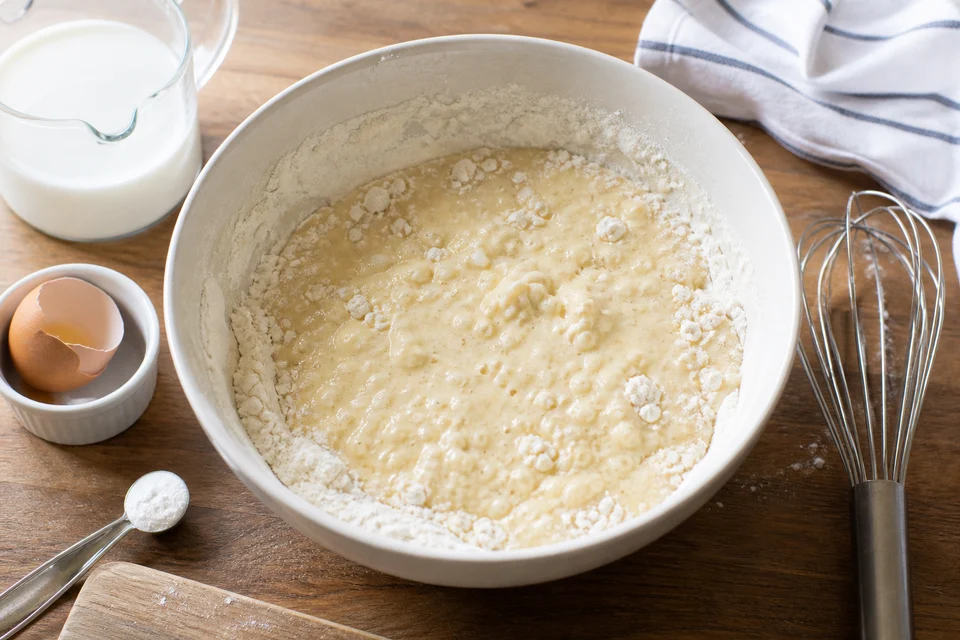
This sequence is more valuable than a universal “medium heat” instruction. Batter depth, pan, burner, recipe, and portion change cooking behavior. The University of Arkansas Extension’s pancake method supports using a test pancake and lowering heat when an over-hot griddle browns the outside while the inside remains raw.
Ingredient control without improvisation
Flour defines much of the batter’s structure, but different flours absorb liquid and behave differently. Use the flour named by the recipe. If you need almond flour, oat flour, or gluten-free flour, choose a formula tested for it rather than swapping cup for cup by instinct.
Liquid controls consistency and carries flavor. Milk, buttermilk, water, and plant-based products are not identical. The milk versus buttermilk guide explains that choice, while making pancakes with water covers a separate formula boundary.
Egg contributes several functions depending on the recipe. If you need an egg-white approach, use pancakes with egg whites rather than deleting yolks casually. Fat, sugar, salt, and leavener also work together; more baking powder is not a universal way to get more height.
Flavor that belongs in the base
Scratch cooking lets you choose vanilla, citrus zest, spice, cocoa, fruit, herbs, or savory seasoning through a compatible recipe. Taste should be planned before the batter is mixed. Stirring extra sugar, salt, or spice into a completed bowl can create pockets and makes the change hard to evaluate.
Start with one flavor direction. For apple pancakes, decide whether fruit belongs in the batter or topping. For chocolate, decide whether cocoa changes the dry ingredients or whether a finished sauce is enough. For savory pancakes, begin with an unsweetened formula rather than covering a vanilla batter with cheese.
If the cooked base tastes bland, toppings can make it enjoyable but do not reveal which formulation step needs attention. Keep one plain pancake for comparison and use the Pancake Troubleshooting hub.
Texture control
A scratch recipe gives you visibility into mixing and portion. Mix to the documented endpoint. Vigorous prolonged stirring can change texture; stopping with dry flour pockets creates another problem. The right endpoint belongs to the recipe, not a universal lump count.
Portion consistently. A large thick pancake asks the center to cook through a different distance than a small one. Use a scoop or ladle and record the amount. Do not press the pancake after turning unless a specific recipe directs it; pressing changes the structure and does not force an undercooked center safely to completion.
Cook one test pancake. Observe how far it spreads, when the underside releases, how the exterior colors, and whether the center is set. Adjust one supported variable for the second pancake. A test result is a local calibration, not proof of one root cause for all stoves.
Batch-size control
Scratch recipes can be scaled, but halve or double every ingredient accurately. Leavener, salt, and egg fractions need care. A kitchen scale often makes proportional changes easier. If a recipe uses one egg and you want half a batch, choose a smaller tested recipe or weigh a thoroughly mixed egg only when appropriate food-handling and recipe guidance support it.
Do not make a huge batch of delicate batter to save time if the recipe expects prompt cooking. For a crowd, choose a formula that scales and a holding plan that does not trap excessive steam or dry the pancakes. Cooked pancakes can also be prepared for later use through tips for storing pancakes.
Cost and convenience without clichés
Scratch can be economical when staple ingredients are already in the kitchen and used before they expire. It can be more expensive when a one-time recipe requires specialty flour, spices, or alternatives. A mix may reduce waste for an occasional cook, while a scratch dry blend prepared from a tested formula may be convenient for a frequent cook.
Compare actual local prices and how much of each package you will use. Do not claim scratch is always cheaper. Time has value too: measuring six ingredients on a rushed morning may be the wrong choice even when the pantry cost is lower.
Dietary and allergen visibility
Scratch makes ingredients visible, not automatically suitable. Wheat flour, egg, milk, nuts, soy, sesame, and other allergens may appear in the batter, toppings, or shared environment. Gluten-free status depends on products and cross-contact, not merely replacing one flour.
A mix has a label but still requires checking the added ingredients. A “just add water” product and a product requiring milk and egg create different complete batters. Follow the exact package and never assume an older remembered label still applies.
Food-safety boundary
The U.S. FDA notes that flour is a raw food. Do not taste scratch batter or let children play with it. Raw egg adds another reason to keep tasting until after cooking. Wash hands and tools appropriately and prevent raw batter from contacting ready-to-eat food.
Exterior color is not proof that the center is cooked. Follow the recipe’s endpoint and any applicable ingredient guidance. If pancakes are browned outside but raw inside, reduce the guesswork: compare portion and the recipe’s heat system rather than serving them under syrup.
Common mistakes
Changing several ingredients at once: You cannot learn which change produced the result.
Measuring leavener casually: Small ingredients still need accurate distribution.
Using a substitution blog tip in an unrelated formula: Choose a recipe designed for the needed ingredient.
Mixing until perfectly smooth by default: Stop at the selected recipe’s endpoint.
Skipping the test pancake: The first portion is useful calibration.
Calling a mix inferior: Convenience and predictability are legitimate goals.
Tasting raw batter: Wait until the pancake is fully cooked.
Rescue the current batch
If batter is slightly thicker or thinner than expected, do not add large amounts blindly. Compare with the recipe’s described consistency and make only its supported small adjustment. If the first pancake is too dark outside and raw inside, lower heat for the next through the cited test-pancake approach and keep portion constant.
If a cooked batch is merely less fluffy than hoped but fully cooked, serve it and record the method. No topping or extra flip restores lost structure. If the center is raw, do not disguise it; return to the correct cooking process or discard when safe correction is uncertain.
Prevent the next batch from drifting
Write down ingredient brands, weights, batter rest, portion, pan, and result. Keep the successful setup stable. If you want to test buttermilk, a different flour, or a larger pancake, change one in a recipe designed for that goal.
Pre-measure a scratch dry mix only when the formula supports storage, then label its contents and date. Keep leavener dry and use within the recipe’s intended window. Add wet ingredients only when ready to cook.
FAQ
Do pancakes from scratch taste better?
They can, because you choose the recipe and ingredients, but taste is not guaranteed. Measurement, ingredient freshness, mixing, heat, and preference all matter.
Are scratch pancakes healthier than a mix?
Not automatically. Compare the complete recipes, products, portions, and toppings. “Scratch” describes preparation, not a nutrition result.
Is pancake mix the same as flour?
No. A mix commonly includes flour plus leavener, salt, sweetener, fat, milk solids, flavoring, or other product-specific ingredients. Follow its label.
Can I prepare scratch batter the night before?
Only when the recipe is designed for it. Some leavening systems and batters change while standing. Consider a measured dry blend instead, adding wet ingredients later.
Why does the first pancake help?
It shows how this batter, portion, pan, and heat interact. Use it to make one recipe-supported adjustment before cooking the rest.
Related Pancake World guides
Start with American pancakes, compare milk and buttermilk, explore making pancakes with water, and diagnose results through the Pancake Troubleshooting hub.
Sources and editorial references
- U.S. Food and Drug Administration: Handling Flour Safely —
https://www.fda.gov/consumers/consumer-updates/handling-flour-safely-what-you-need-know - University of Arkansas System Division of Agriculture: Creating Perfect Pancakes —
https://www.uaex.uada.edu/counties/miller/news/fcs/grains-breads/Creating%20Perfect%20Pancakes%20for%20Your%20Family%20Breakfast.aspx
For more practical food and breakfast guides, visit Pancakes World.
For the wider topic, start with Guides/pancake Ingredients.
For a closely related guide, see What Are American Pancakes? Texture, Ingredients, and Serving.
A useful next comparison is How to Read a Pancake Mix Label.
You can also continue with Why Choose Eggless Pancakes? Tradeoffs and Options.
