
Quick answer
American pancakes are usually small-to-medium round griddle cakes made from a pourable but relatively thick batter containing flour, liquid, egg, fat, salt, and chemical leavening. They rise into a soft, tender crumb and brown on two flat sides. They are thicker than French-style crêpes, thinner and less egg-foam-dependent than Japanese soufflé pancakes, and distinct from the many savoury pancakes, flatbreads, and fermented batters made around the world.
“Usually” matters. American pancakes include buttermilk, whole-grain, cornmeal, blueberry, banana, chocolate, diner-style, boxed-mix, and regional household versions. Hotcake and flapjack can overlap with pancake in American English, but local usage and branded products vary. The useful definition is a family resemblance, not one legally fixed formula.
The defining features
Leavened batter: Baking powder, baking soda with an acid, or a combination commonly provides lift. Mechanical aeration and steam also contribute, but more leavener does not guarantee more height.
Moderate thickness: The batter spreads into a round but does not race across the pan. The cooked centre has visible depth and crumb.
Two-sided griddle cooking: The first side sets most of the structure. The pancake is turned, then the second side cooks more briefly.
Soft interior: A successful pancake is fully set yet tender, not wet, gummy, rubbery, or bread-dry.
Stackable form: Several rounds are often served together with butter, syrup, fruit, or savoury accompaniments, though a stack is not mandatory.
American pancake versus crêpe
| Feature | American pancake | French-style crêpe |
|---|---|---|
| Batter | Relatively thick | Thin and readily spread |
| Leavening | Common | Usually little or none |
| Pan coverage | Modest round | Broad thin sheet |
| Cooked texture | Soft risen crumb | Flexible thin layer |
| Typical handling | Stacked | Folded or rolled |
| Filling | Usually topping or mix-in | Often wrapped inside |
Both can be sweet or savoury. Thickness, not sweetness alone, separates the formats. A very thin American-style batter will not become a good crêpe automatically; formula, resting, pan movement, and turning method all change.
What “American” does and does not promise
The label describes a recognizable breakfast style, not the nationality of every ingredient or the identity of the cook. A pancake made outside the United States can still be American-style when it follows the leavened, thick-batter griddle form. Conversely, a pancake eaten in the United States may belong to another tradition entirely.
The name does not promise a specific diameter, number of pancakes, flour brand, syrup, sweetness, or restaurant presentation. It also does not establish that a recipe is original, healthier, more authentic, or superior to another pancake. Those are separate questions requiring their own evidence and context.
This distinction helps on international menus. “American pancakes” usually signals thick rounds rather than thin crêpes, but the menu description, ingredients, and allergen information still matter. Ask when a dietary or portion detail is important instead of relying on the style name alone.
American pancake versus hotcake or flapjack
Hotcake is widely used as a synonym for pancake in American English. Flapjack can also mean a griddle cake in the United States, while in Britain it commonly names a baked oat bar. Context matters more than trying to enforce one global vocabulary.
The classic hotcakes recipe uses the familiar fluffy griddle form. Restaurant menus may use “hotcakes” for branding or nostalgia without indicating a fundamentally different batter.
Diner pancakes and home pancakes
A diner may cook on a broad thermostatically controlled griddle, use a commercial mix, portion with a dedicated dispenser, and hold multiple orders through a service system. A home cook usually works with a smaller skillet, changing burner output, and a ladle. The same recipe can spread and brown differently in those settings.
At home, reproduce the useful controls rather than copying a restaurant’s apparent timer: weigh the mix, preheat gradually, portion consistently, and inspect the first centre. If you want a broad diner-style pancake, enlarge the portion only after the smaller test cooks through. A pan that cannot hold the full round without edge cooling will not imitate a commercial griddle.
Boxed mix is also common and valid. Follow its current label because “complete,” “just add water,” and mixes requiring egg or milk are not interchangeable. Adding extra egg, sugar, or leavener changes the formulated product and can reduce rather than improve consistency.
A reference home formula
This small batch demonstrates the style without claiming to be the only American pancake recipe.
- 200 g plain all-purpose flour
- 2 teaspoons baking powder
- 25 g sugar
- 1/2 teaspoon fine salt
- 2 large eggs
- 300 ml milk
- 40 g melted butter, cooled, or a suitable neutral oil
- 1 teaspoon vanilla, optional
- A little suitable fat for the pan
It makes roughly ten pancakes when portioned consistently. Flour, pan, scoop, and preferred diameter affect the actual yield, so consult the pancake size and yield guide before making a crowd calculation.
Mix for a tender crumb
Whisk flour, baking powder, sugar, and salt so the leavener is evenly distributed. In a second vessel, whisk eggs, milk, melted cooled butter, and vanilla. Pour wet into dry and fold until the dry flour disappears. Stop before vigorous prolonged mixing turns the batter glossy and elastic.
A few small lumps can remain. Large dry pockets cannot. Let the batter stand for five minutes, then assess it. It should fall in a thick ribbon and spread gradually. If it sits as a rigid mound, add milk one tablespoon at a time. If it flows like cream, confirm the measurements before adding a large rescue dose of flour.
Cook the first pancake as calibration
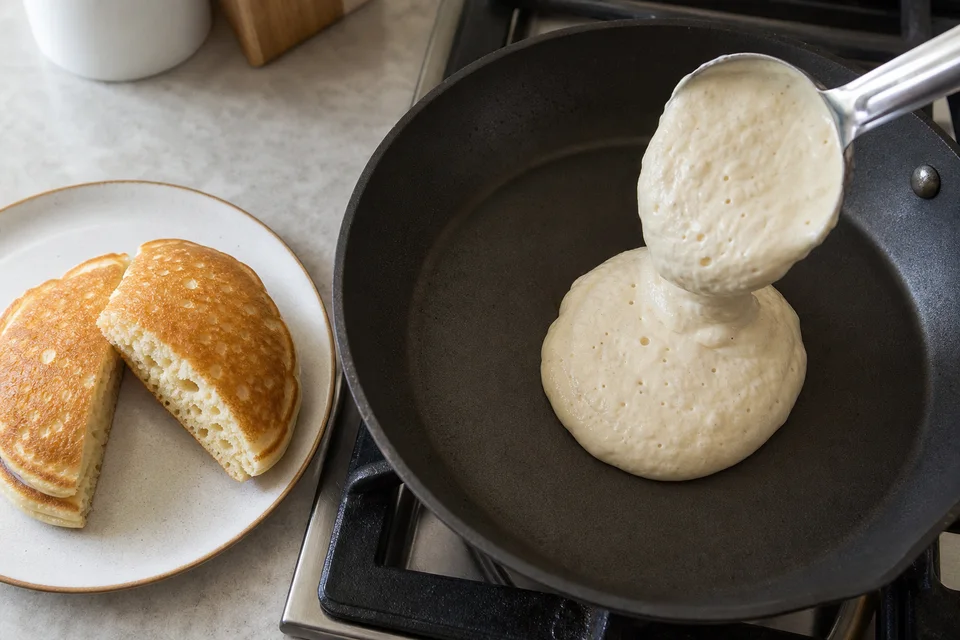
Warm the skillet gradually over moderate heat and apply a thin film of fat. Spoon one measured portion into the centre. Leave it alone while the underside sets. Bubbles should appear, the edges should lose their wet shine, and the turner should slide underneath without scraping liquid batter.
Turn once and cook until the centre is set. Cut the test pancake. Exterior colour is useful, but it is not enough: the crumb should be cooked through without a glossy paste line.
If the outside darkens while the centre remains wet, lower heat or reduce portion size. If the pancake is pale and greasy, the surface may be too cool. Make one change and keep the scoop fixed.
Why the pancakes rise
Chemical leaveners produce gas through moisture, heat, and, for baking soda, an appropriate acid. The batter must hold those bubbles long enough for heat to set the structure. Flour, egg, liquid, fat, sugar, mixing, rest, and pan intensity all interact.
Adding extra baking powder can create an unpleasant taste, weak structure, or dramatic rise followed by collapse. Deleting egg or changing milk also changes more than height. Use a complete formula designed for the ingredient you need.
Buttermilk pancakes often combine cultured acidity, distinctive flavour, and a thicker liquid. Ordinary milk and baking powder can still make fluffy pancakes; the complete method is in fluffy pancakes without buttermilk.
Typical size and thickness
Home American pancakes often range from small silver-dollar rounds to broad diner cakes. A diameter around 10 to 15 cm is manageable for many home pans, but batter depth matters as much as width. A large scoop creates a longer path for heat to reach the centre.
Use the same ladle and avoid spreading thick batter with force unless the recipe directs it. The first pancake establishes how far the portion spreads. Record that result rather than relying on the package photograph.
Common serving styles
Butter and maple syrup form the familiar image, but they are one choice. Fresh fruit, fruit compote, yogurt, nuts, seeds, cinnamon, chocolate, bacon, eggs, sausage, and savoury toppings all appear on American pancake plates. Portion and complete ingredients determine the meal; the word “pancake” does not dictate nutrition.
Serve wet toppings at the last moment. Syrup or compote softens the surface, especially in a tall stack. For a buffet, place toppings in separate bowls and let guests finish individual plates.
Common variations
Buttermilk pancakes: Use a complete buttermilk formula with its intended leavening balance.
Blueberry pancakes: Add dry berries in a controlled amount or scatter them onto each portion. Frozen berries can streak and cool batter.
Banana pancakes: Mashed banana changes sweetness, moisture, and structure. Use a banana-specific formula rather than adding it freely.
Whole-grain pancakes: Whole-grain flours absorb differently and can create a heartier crumb. A tested blend is more reliable than a complete blind swap.
Cornmeal pancakes: Cornmeal adds grain texture and requires enough hydration. Coarse and fine products behave differently.
Chocolate-chip pancakes: Keep chips modest, prevent scorching, and check the centre rather than judging melted chocolate as raw batter.
Current-batch fixes
Flat pancakes: Check leavener, measurement, batter age, mixing, and pan heat. Do not assume one cause from appearance alone.
Dense or rubbery pancakes: Prolonged mixing, a thick batter, excess egg, low leavening activity, or overcooking can contribute. Change one factor next time.
Burnt outside and raw inside: Lower heat and reduce the scoop. Do not press the pancake after turning.
Pale pancakes: Let the pan recover between batches and confirm sugar and milk were measured. Pale colour is not automatically undercooking, so inspect the centre.
Uneven circles: Pour from a consistent height into a level pan. Shape is secondary to full cooking and good texture.
The first pancake is poor: Treat it as calibration. Clean the pan if necessary, adjust one variable, and compare the second.
Use the Pancake Troubleshooting hub for a symptom-by-symptom path.
Prevent the next batch from drifting
Weigh flour and use fresh leavener within its storage instructions. Record milk, egg size, batter rest, scoop, pan, and heat sequence. Keep the successful formula stable before testing buttermilk, whole-grain flour, fruit, or extra height.
Preheat gradually and remove burnt residue between batches. Use one test pancake every time the pan, burner, recipe, or scoop changes. A timer alone cannot capture surface temperature and batter depth.
Food-safety boundary
Flour is a raw food and batter may contain raw egg. Do not taste batter. Keep raw mixture away from ready-to-eat toppings, wash hands and equipment appropriately, and cook the centre fully. If preparing for people at higher risk from foodborne illness, follow current official guidance and use suitable ingredients.
Cool leftovers promptly and refrigerate or freeze them under a known plan. Reheating does not repair unsafe storage.
FAQ
Are American pancakes always sweet?
No. Many contain a little sugar, but savoury and neutral versions exist. Texture and leavened griddle method are more useful identifiers than sweetness.
Are hotcakes different from pancakes?
In American English, hotcake commonly means pancake. A specific restaurant or product may use its own formula.
Why are American pancakes thick?
Their relatively thick batter, chemical leavening, portion depth, and two-sided griddle method create a risen crumb. Every factor must remain balanced.
Do American pancakes need buttermilk?
No. Buttermilk is one established direction. Milk-and-baking-powder formulas can also produce fluffy pancakes.
Are American pancakes the same as crêpes?
No. Crêpes use a thinner batter and cook as flexible sheets, while American pancakes are thicker and usually leavened.
Related Pancake World guides
Start at the American Pancakes hub, cook classic hotcakes, make fluffy pancakes without buttermilk, or plan portions with the pancake size guide.
Sources and editorial references
- Merriam-Webster Dictionary: Hotcake —
https://www.merriam-webster.com/dictionary/hotcake - King Arthur Baking: Simply Perfect Pancakes —
https://www.kingarthurbaking.com/recipes/simply-perfect-pancakes-recipe - U.S. Food and Drug Administration: Flour Is a Raw Food —
https://www.fda.gov/consumers/consumer-updates/flour-raw-food-and-other-safety-facts
For more practical food and breakfast guides, visit Pancakes World.
For the wider topic, start with Guides/pancake Ingredients.
For a closely related guide, see Cottage Cheese Pancake Variations: Sweet, Savory, and Flour Changes.
A useful next comparison is How to Make American Pancakes at Home.
You can also continue with Ingredients for the Perfect Pancake Texture.
