
The short answer: there is no universal pancake size
Make pancakes at a diameter that fits your pan, serving plan, batter behavior, and confidence with flipping. Four, six, and eight inches can be useful examples of small, medium, and large pancakes, but they are not official standards. A recipe does not automatically produce one of those sizes unless it states a portion or diameter.
The phrase “what size pancakes do these make?” needs two pieces of information: how much batter the recipe produces and how much batter you use for each pancake. Diameter alone is not enough because a thin six-inch pancake and a thick six-inch pancake use different portions. For a repeatable batch, choose one measurable portion, cook a test pancake, record the resulting diameter, and then use that same portion for the rest.
If the recipe already specifies a scoop volume, batter weight, or expected yield, start there. Treat the first pancake as calibration rather than forcing the entire bowl into an assumed size.
Useful small, medium, and large examples
The following diameters are optional planning examples, not definitions:
- About 4 inches / 10 centimeters: a small example that may suit a tasting plate, a child’s serving plan, or several pancakes arranged together.
- About 6 inches / 15 centimeters: a medium example that may be comfortable to portion and turn in many home pans.
- About 8 inches / 20 centimeters: a large example that requires more clear pan area and a tool that can support it during the turn.
These labels do not predict quality. A small pancake is not automatically fluffier, and a large one is not automatically thin, tough, or undercooked. Batter depth, formula, heat transfer, and cooking method all remain relevant. The examples simply give you three reference points for planning.
Measure the cooked test pancake across its widest central point if diameter matters to your presentation. Do not count an irregular drip or torn edge as the intended diameter. If the batter spreads asymmetrically, record both the portion and the spread rather than pretending the shape is exact.
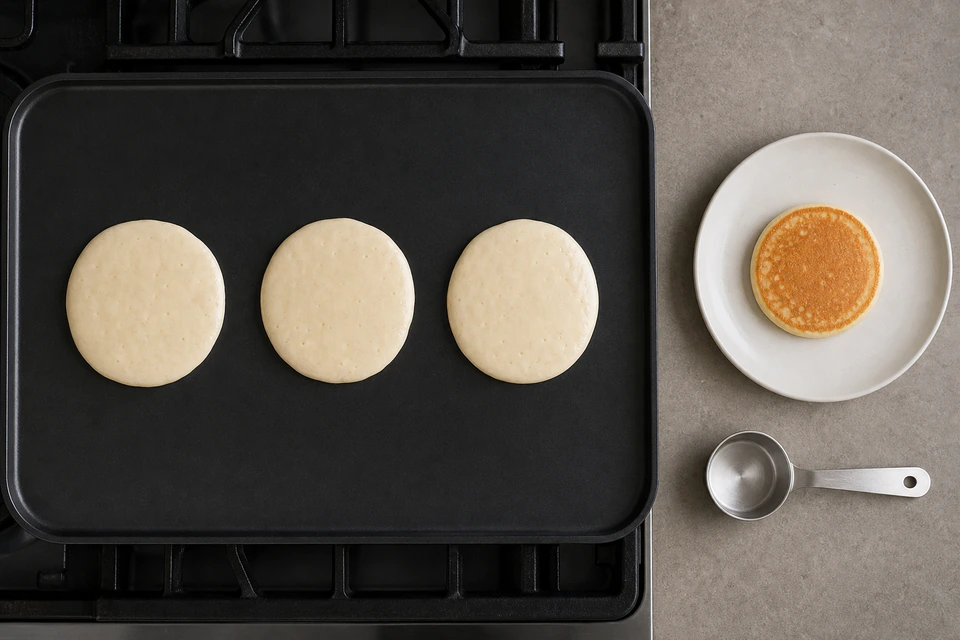
The hero photograph for this guide is illustrative. Its three finished pancakes are shown on one overhead plane so the relative sizes are easy to see, but the image is not a ruler or a documented universal 4/6/8-inch standard.
Choose a size for your pan, serving, and flipping comfort
Start with usable pan area. Leave enough room around a pancake for your spatula to approach and for batter to spread without touching another portion. A pan that can physically contain a large circle may still be awkward if its sloped sides or neighboring pancakes block the turn.
Next, consider the serving plan. If people will add several toppings, a smaller pancake may make it easier to build more than one combination. If the pancake is the base for one plated serving, a larger format may be convenient. These are presentation choices, not claims that one size provides the correct topping ratio.
Your flipping tool and technique matter too. The tool should support enough of the pancake that the unset or tender portion does not fold over its edge. If pancakes repeatedly tear, reduce crowding, confirm the cooking stage, or make a more manageable test portion before changing the recipe. The guide to pancakes that fall apart covers that symptom in detail.
Finally, remember that “serving size” and “pancake size” are different. One serving could contain one large pancake, several small pancakes, or another amount chosen for the recipe and diner. This article does not prescribe a nutrition serving or universal number per person.
Measure the portion, not just the diameter
Diameter is the visible result; portion is the input you can repeat. Choose one of two practical methods:
- Volume method: use the same unbranded ladle, cup, or scoop and fill it to the same level each time. Record the nominal volume only if the tool has a known measure.
- Weight method: place the batter bowl on a kitchen scale, note the reading before and after dispensing a portion, and use the difference as the batter weight. Follow the scale instructions and keep it away from heat and moisture.
Do not swap between a heaped scoop, a level scoop, and an estimated pour while expecting identical pancakes. Stirring or scooping can also change how much batter sits above the rim. Pick a method that you can repeat without delaying the cooking sequence.
Batter depth matters alongside diameter. Two equal-weight portions can spread differently if the formulas or rest conditions differ. Record what your chosen recipe actually does rather than borrowing a diameter from an unrelated photograph. If a recipe directs you to rest or gently stir the batter, follow that direction consistently before portioning.
Start with a test pancake
Use the first pancake to connect portion, spread, pan behavior, and cooking cues. Dispense one measured portion into a properly prepared pan, then observe it without adding more pancakes around it. When it is ready to turn according to the recipe’s method, flip it once with a suitable tool and finish cooking.
Afterward, check four things:
- Is the diameter practical for the pan and spatula?
- Is the thickness close to what the recipe intends?
- Does the cooked center match the recipe’s doneness expectation?
- Is the resulting portion useful for your serving plan?
If the answer is no, adjust the next portion modestly and record the change. Do not change portion, heat, batter formula, and cooking time simultaneously. The purpose of a test pancake is to isolate a practical setting for this batch, not to establish a permanent law.
A rough first pancake can still provide useful information. If it spread farther than expected, verify the portion and batter handling. If it remained thicker, consider whether your measured portion was larger or whether the batter had changed during its rest. Avoid adding flour or liquid solely to hit an imagined diameter unless the tested recipe specifically allows that correction.
Keep the batch consistent
Once the test portion works, repeat it. Set the scoop in the same place, fill it the same way, and allow each portion to leave the tool fully. Space pancakes so their edges do not merge and so the spatula has an approach path.
Pan conditions can change during a batch. After removing pancakes, give the surface whatever recovery the recipe and equipment require before adding the next portions. If later pancakes suddenly spread or color differently, note the sequence and pan condition instead of assuming the measured portion changed.
Use the same decision cues for each pancake, but do not force all of them to follow one timer when positions cook differently. A large griddle can have warmer and cooler areas. Rotate positions only if the cooking method permits it, and avoid pressing the pancake after the flip. Pressing changes the result rather than measuring it; see why flattening pancakes with a spatula is a mistake for the focused guidance.
For a large batch, write down the chosen portion before you start. A note such as “one level scoop from this tool” or “target batter weight per pancake” is more useful than “medium,” which different cooks may interpret differently.
Calculate the yield
Yield is a batch calculation:
usable batter amount ÷ batter amount per pancake = approximate pancake count
If a bowl contains 900 grams of usable batter and the chosen portion is 75 grams, the arithmetic example gives 12 pancakes. That is a worked calculation, not a promised yield for a particular recipe. Batter left on the bowl or tool, small portion variations, and a deliberately different test pancake can change the actual count.
With volume, use the same units. For example, divide the measured cups or milliliters of usable batter by the measured volume dispensed per pancake. Do not divide a weight by a volume unless you have separately established the conversion for that specific batter.
If the division leaves a remainder, decide whether to make one smaller final pancake or redistribute a modest amount before cooking the full batch. Do not call the remainder a full standard pancake. Record the actual count after cooking so the next batch plan is based on your recipe and tool.
To scale for guests, first establish one complete batch honestly. Then multiply the recipe and its expected count together, subject to the recipe’s scaling instructions and your available pan capacity. More batter does not create more cooking surface, so include the extra rounds and holding plan in your schedule.
Adjust cooking by observation
Changing diameter or depth can change how the pancake cooks, but there is no universal number of seconds to add or subtract. Follow the recipe’s temperature and method, then use its observable turning and doneness cues. Do not rely on bubbles, surface color, height, or a timer alone as a safety guarantee.
If the exterior darkens while the center remains visibly wet, avoid making an unsupported timing guess. Revisit portion depth, pan setting, and the recipe’s method, and use the not-cooked-through guide for the dedicated diagnostic. A smaller test portion may be easier to calibrate, but it does not by itself fix every center problem.
If a large pancake is difficult to turn, use more supporting tool area, make sure there is clear pan space, or reduce the next portion. If a small pancake cooks unevenly, check whether the portion landed on a hot spot or spread irregularly. Change one condition at a time.
Frequently asked questions
What is a standard pancake size?
There is no universal standard for home pancakes. Four, six, and eight inches are useful examples in this guide, not official definitions. Use the recipe, measured portion, pan, and serving plan.
How much batter should I use per pancake?
Use the amount specified by the recipe. If none is given, choose a repeatable scoop volume or batter weight, make one test pancake, and record its diameter and thickness before continuing.
Are smaller pancakes easier to flip?
They may be more manageable with a particular pan and tool, but size alone does not guarantee an easy turn. Cooking stage, batter structure, crowding, and technique also matter.
Does a bigger pancake need a fixed extra cooking time?
No universal adjustment applies. Diameter, depth, batter, equipment, and heat all influence cooking. Follow the recipe and judge by its method and verified doneness approach rather than adding a fixed number.
How do I know how many pancakes a recipe makes?
Measure the usable batter amount and divide by the measured portion per pancake. Treat the result as approximate, then record the actual count and any remainder.
Should every pancake in the batch be exactly the same?
Consistency helps serving and cooking, but handmade pancakes will vary slightly. Repeat the portioning method and spacing rather than chasing false precision.
Related Pancake World guides
Use the American Pancakes guide as the relevant recipe hub when applying this portion-and-yield method to a complete pancake formula. If turning is the problem, use why pancakes fall apart. If the middle remains visibly wet, use why pancakes are not cooked through. If pressing after the turn changes the height, read the pancake-flattening guide.
Sources and editorial references
Pancake World, recipe measurement and illustration record — measurement-record.json
For more practical food and breakfast guides, visit Pancakes World.
For the wider topic, start with Guides/pancake Yield.
For a closely related guide, see Pancake Shots and Bite-Size Pancake Treats.
A useful next comparison is A Pancake Production Sheet for Repeatable Batches.
You can also continue with Pancakes for a Crowd: A Two-Zone Cooking and Holding Workflow.