
Quick answer and tested home formula
American-style pancakes are thick, round griddle cakes with a tender set crumb and enough lift to form a soft stack. At home, reliable height comes from a balanced batter, fresh baking powder, minimal mixing, a short rest, consistent portions, and pan heat that allows the center to set before the exterior becomes dark.
For about ten 10 cm pancakes, use:
- 220 g plain flour;
- 30 g sugar;
- 10 g baking powder, about 2 1/2 level teaspoons;
- 1/2 teaspoon fine salt;
- 2 large eggs;
- 300 ml milk;
- 45 g butter, melted and cooled until warm, or 40 ml neutral oil;
- 1 teaspoon vanilla, optional;
- neutral oil or clarified butter for the griddle.
This page owns recipe execution: mixing, resting, portioning, heat, turning, and doneness at home. The American pancakes hub carries broader definition and comparison focus, while the separate hotcake and buttermilk pages answer their narrower questions.
What each ingredient contributes
Plain flour supplies starch that sets the crumb and proteins that form a supporting network. Sugar adds sweetness, helps browning, and retains some moisture. Baking powder creates gas, but adding extra does not produce unlimited height; too much can taste bitter and form large weak bubbles. Salt balances flavor.
Eggs add water, fat, emulsification, and heat-setting protein. Milk hydrates the flour and contributes flavor and browning solids. Butter brings flavor and tenderness. Vanilla is optional because the pancake should remain useful with savory as well as sweet toppings.
Ingredient temperature need not be laboratory-perfect, but ice-cold milk can make melted butter form hard droplets. Let refrigerated ingredients lose their sharp chill for a few minutes, and cool melted butter so it does not heat the eggs. If using oil, choose one with a neutral flavor unless a pronounced oil is intentional.
Measure before the pan heats
Weigh flour rather than scooping a compressed cup. Check the baking-powder date and level the measure. Set a 60 ml ladle, broad spatula, cooling rack, and clean plate beside the hob. Prepare toppings now; a mixed leavened batter should not wait while fruit is washed or syrup is found.
If cooking for a crowd, heat the oven to a low holding temperature and place a rack over a sheet pan. The rack allows steam to escape. Avoid a tight stack under foil, which softens surfaces and compresses the lowest pancakes.
Mix dry and wet separately
Whisk flour, sugar, baking powder, and salt in a large bowl for 20–30 seconds. In a jug, whisk eggs until combined, then whisk in milk, cooled butter, and vanilla.
Pour wet into dry. Fold with a spatula using broad strokes. Scrape the bottom once to find hidden flour, then stop as soon as no dry pockets remain. Small soft lumps will hydrate; a perfectly smooth batter achieved by vigorous beating is more likely to become tough.
Rest the bowl for 10 minutes. This lets flour absorb liquid, air bubbles from mixing settle, and the batter reach its final thickness. It should fall from the ladle as a broad ribbon, hold a mound for a second, then relax. It should not run like a crêpe batter or stand like dough.
If it is clearly too thick after resting, fold in milk one tablespoon at a time. If it floods flat, fold in one tablespoon flour and wait two minutes. Keep the correction modest; the first cooked pancake provides better evidence than the raw bowl alone.
Do not taste batter. Flour and eggs are uncooked ingredients, and a sweet smell does not indicate safety.
Preheat a stable cooking surface
A broad cast-iron, carbon-steel, or suitable nonstick skillet can work. The pancake skillet guide explains material tradeoffs. Whatever the surface, preheat over medium for several minutes. Wipe on a thin film of neutral oil or clarified butter.
Whole butter can be used, but its milk solids brown between pancakes. Keep heat moderate and wipe the pan if dark flecks accumulate. Pools of fat create lacy fried patches rather than a smooth golden surface.
A small batter drop should sizzle gently and set promptly. Smoke, instant blackening, or an acrid butter smell means the pan is too hot. A batter drop that sits pale and fluid means the pan needs more time.
Portion vertically and use visual cues
Stir the rested batter once gently. Hold the 60 ml measure above one spot and pour vertically. Let the batter spread by itself. Smearing it with the ladle presses out gas and creates uneven thickness. Leave space to slide the spatula around every pancake.
The surface changes in stages. Fresh batter is glossy. Small bubbles begin near the edge and then appear toward the center. The rim becomes matte and slightly raised. The pancake is ready to turn when bubbles are distributed across the surface, several holes stay open, and the edge looks set.
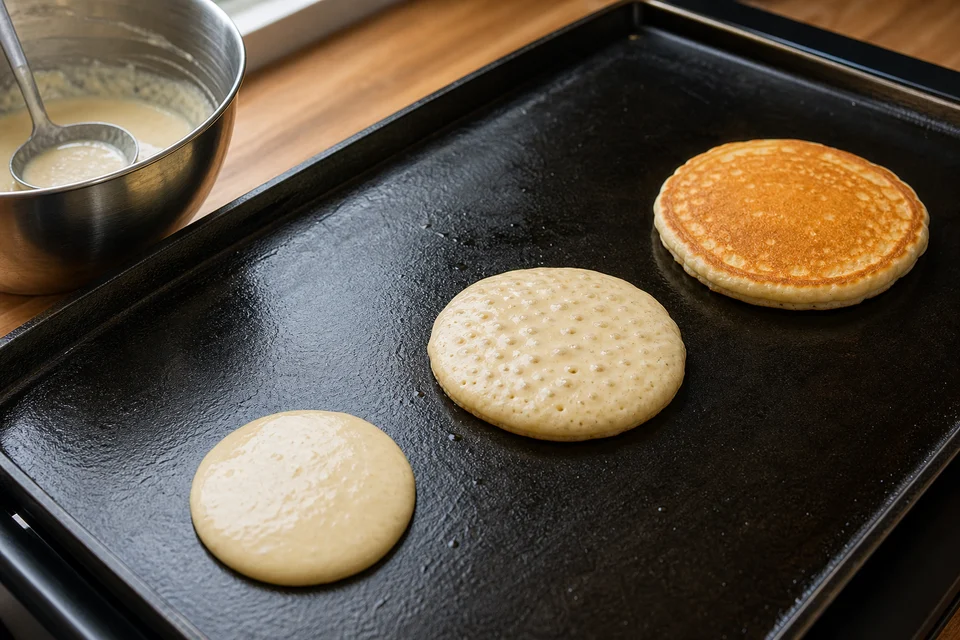
Slide a broad spatula fully underneath and turn once. A quick controlled turn loses less height than a hesitant half-fold. Cook the second side for a shorter time, until golden and the center springs lightly. Do not press; flattening releases gas and compresses the crumb.
Cut the first pancake
The first pancake is useful data, not an expendable mistake. Cut through its center. A cooked pancake has an even, set crumb without a glossy batter line, dense paste, or loose flour. Small air cells should extend through the middle rather than form only under the top surface.
If the outside is dark while the center is wet, lower the heat and reduce the next portion slightly. If the pancake is pale and dry, raise heat modestly so cooking finishes sooner. If it is dense, consider batter thickness, leavener, and mixing before adding more ingredients.
Taste the cooked test for salt and sweetness. Adjust the serving toppings first; changing a fully mixed bowl’s sugar or salt is difficult to distribute evenly.
Cook and hold the batch
Use the same measure each time. The pan may get hotter over successive rounds, so monitor the underside sooner and lower the burner if color accelerates. Wipe away browned fat and renew only a thin film.
Transfer finished pancakes to the rack. If serving immediately, a loose short stack is fine. If holding, use the low oven only briefly. Long holding dries the edges even when temperature is gentle. For the best result, bring people to the table before the final round.
Buttermilk and other substitutions
Do not replace ordinary milk with buttermilk and assume the leavener remains balanced. Buttermilk is acidic and often thicker; recipes may pair it with baking soda. Use the purpose-built buttermilk pancake guide or the dedicated fluffy pancakes without buttermilk depending on your ingredient.
Plant beverages differ in protein, sugar, fat, gums, and flavor. Start with an unsweetened product and reserve 30 ml until after the rest. Water can make a pancake, but milk’s missing solids change flavor and browning; follow the specific water-based adjustment guide.
For whole-grain pancakes, replace no more than one third of the flour on the first test and expect more liquid absorption and a heartier crumb. For chocolate, replace 15 g flour with cocoa and reserve liquid. For blueberries, place a few berries on each portion rather than stirring a heavy wet quantity into the whole bowl.
Toppings and serving
Butter and maple syrup are familiar choices. Fruit compote, fresh berries, yogurt, nut or seed butter, lemon and sugar, or cooked apples also work. Serve wet toppings at the table to preserve the surface. For a savory plate, reduce recipe sugar to 5 g and serve with eggs, cooked mushrooms, tomatoes, or herbs.
The phrase American pancake describes the cake here, not a mandatory topping. A measured portion of syrup lets the crumb remain visible. If breakfast needs more substance, add a side rather than increasing the pancake diameter until the center becomes hard to cook.
Diagnostics and current-batch fixes
Pancakes are flat
Old baking powder, very loose batter, overmixing, a cool pan, or long batter holding can contribute. For pancakes still to cook, confirm ribbon thickness and raise heat modestly if the first side stayed pale. Do not scatter extra baking powder into a wet bowl; it will distribute poorly.
Centers are wet
The heat is too high, portions too large, or batter too thick. Move the pan off heat briefly, lower the setting, and make one smaller test. Add milk one tablespoon at a time only if the rested batter barely falls from the ladle.
Pancakes are tough
Vigorous mixing, pressing after the turn, and prolonged low-heat cooking all work against tenderness. Stop stirring, turn once, never press, and remove each pancake when the center is just set. A moist topping can help the current plate but cannot rebuild the crumb.
Undersides are mottled
Too much pan fat or a surface with hot spots is likely. Wipe the pan nearly dry and place the next portion away from the most aggressive spot. Let cast iron recover evenly between rounds.
Batter thickens during cooking
Flour continues absorbing water. If late pancakes no longer spread to the target diameter, fold in one teaspoon milk at a time. Avoid a large adjustment based on a pan that may simply be too cool.
Pancakes stick
The surface may be underheated, damaged, insufficiently maintained, or approached before the base sets. Add a small amount of fat, wait for a matte edge, and loosen progressively. Switch to suitable cookware if the problem repeats in the same damaged area.
Prevent problems in the next batch
Weigh flour, verify fresh baking powder, cool melted butter, and preheat the pan before combining wet and dry. Use one 60 ml portion and target diameter. Record the pan, burner setting, first-side cue, and any liquid correction.
Change one variable at a time. If the center was wet and outside dark, lower heat before rewriting the formula. If batter was stiff before cooking, correct hydration before blaming the pan. Preserve the first-pancake cut as your diagnostic habit.
Food-safety and allergen boundaries
The base recipe contains wheat, egg, and milk. Plant beverages, butter alternatives, chocolate, nuts, seeds, toppings, and shared surfaces introduce other label questions. A dairy-free liquid does not make the final plate dairy-free if butter remains.
Keep raw-batter utensils away from cooked pancakes. Refrigerate cooked leftovers promptly within applicable guidance. Reheat only food that was cooled and stored safely; heating is not a remedy for uncertain history or spoilage.
Frequently asked questions
How thick should the batter be?
It should fall in a broad ribbon, mound briefly, and then relax. It should not pour like a thin crêpe batter or hold like dough.
Does it need to rest?
A 10-minute rest helps hydration and reveals final thickness. A long warm hold is not part of this method.
Why is the first pancake different?
It calibrates initial pan heat, surface fat, portion, spread, and timing. Cut it and use the evidence.
When should I flip?
Flip when bubbles appear across the surface, several holes remain open, and the rim looks matte and set.
Can I use buttermilk?
Use a formula balanced for buttermilk’s acidity and thickness rather than a blind one-for-one replacement.
How do I keep pancakes round?
Deposit one measured portion vertically in one spot and let it spread without pushing it around.
Related Pancake World pages
- Start at the American pancakes hub for broader context.
- Compare a reliable fluffy hotcake method.
- Learn how buttermilk changes pancakes.
- Use the recipe for fluffy pancakes without buttermilk.
- Choose equipment with the pancake skillet guide.
- Diagnose heat, centers, and flipping at the Pancake World troubleshooting hub.
- Review the benefits and tradeoffs of making pancakes from scratch.
Sources and editorial references
- U.S. Food and Drug Administration, raw flour and batter safety:
https://www.fda.gov/consumers/consumer-updates/flour-raw-food-and-other-safety-facts - USDA Food Safety and Inspection Service, cooked-leftover handling:
https://www.fsis.usda.gov/food-safety/safe-food-handling-and-preparation/food-safety-basics/leftovers-and-food-safety - King Arthur Baking, technical guide to baking powder:
https://www.kingarthurbaking.com/learn/guides/baking-powder
For more practical food and breakfast guides, visit Pancakes World.
For the wider topic, start with Guides/pancake Ingredients.
For a closely related guide, see Almond-Flour Pancakes: A Tender, Easy-to-Turn Recipe.
A useful next comparison is Grandma-Style Fluffy Pancakes.
You can also continue with Easy Pancakes from Scratch: A Reliable Golden Stack.
For another practical angle, read Spelt Pancakes: Hydration and Mixing for a Tender Stack.
