
Quick answer
A complete from-scratch American pancake recipe and method, with texture diagnostics rather than a comparison with boxed mix. The practical target is a tender, evenly cooked crumb beneath a softly browned surface. This page gives the complete practical recipe; the related scratch-versus-mix guide helps with the separate choice between convenience and control.
Begin the test for easy pancakes from scratch: a reliable golden stack with “Mix only to combine.” Watch how 240 g all-purpose flour behaves as the edge sets and the underside releases, then inspect the thickest center for a tender, evenly cooked crumb beneath a softly browned surface. That first result tells you more than borrowing a pan setting or cooking time from a different batter.
What success looks like
The finished result should show a tender, evenly cooked crumb beneath a softly browned surface. It should also fit the promised serving format: a stack must remain stable, a fold must stay flexible, and a delicate foam or alternative-flour pancake must be supported during turning. Flavor, texture, and safety are separate judgments; a browned surface is useful culinary information but not proof that a raw egg center is safe.
The build plan runs from 240 g all-purpose flour to 1 teaspoon vanilla, optional, and the first method decision is “Mix only to combine.” Keep those controls stable while calibrating portion and heat; otherwise a change in the formula can be mistaken for a pan problem.
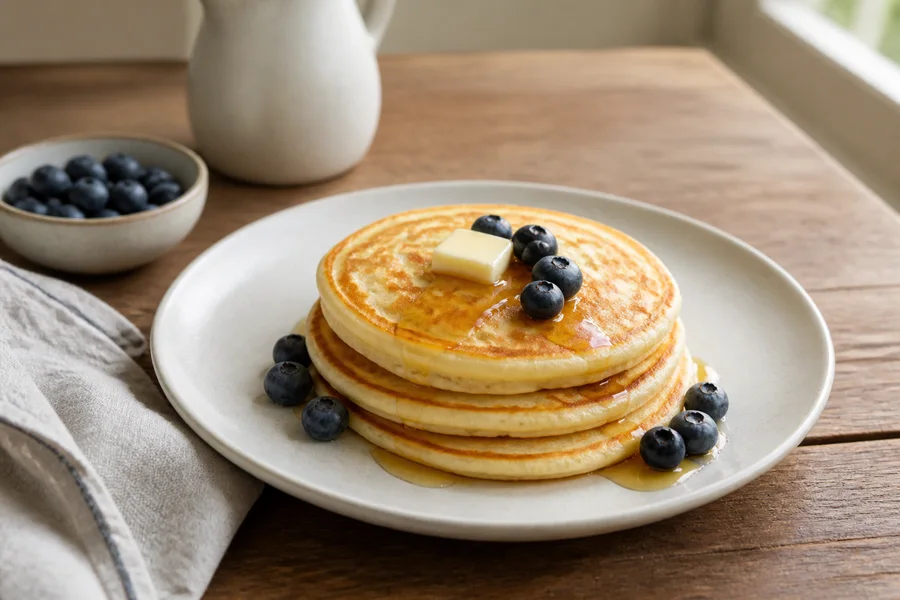
Ingredients or build plan
- 240 g all-purpose flour
- 25 g sugar
- 10 g baking powder
- 3 g fine salt
- 2 large eggs
- 360 g milk
- 45 g melted butter, cooled, plus a little for the pan
- 1 teaspoon vanilla, optional
Treat 240 g all-purpose flour as the opening control and 1 teaspoon vanilla, optional as the final recipe-specific addition, not as parts of a universal pancake ratio. Make a measured adjustment only when the test pancake fails to approach a tender, evenly cooked crumb beneath a softly browned surface.
Prepare before cooking
Whisk the flour, sugar, baking powder, and salt until no dense pocket of leavener remains. In another bowl, combine eggs, milk, cooled butter, and vanilla. Have a rack and a broad spatula ready before wet meets dry.
Because 240 g all-purpose flour is handled before cooking, do not taste the raw batter or dough. Clean hands, bowls, tools, and work surfaces after raw flour or egg contact. For this formula, the preparation control is specific: Whisk the flour, sugar, baking powder, and salt until no dense pocket of leavener remains. In another bowl, combine eggs, milk, cooled butter, and vanilla. Have a rack and a broad spatula ready before wet meets dry.
Method
Mix only to combine
Pour wet into dry and fold with a whisk or spatula. Stop when no dry flour remains; small soft lumps are preferable to beating until glossy. Let the batter stand while the pan heats, then judge flow from the first scoop rather than forcing a universal thickness.
Calibrate the pan
Warm a heavy skillet over medium heat and wipe it with a thin film of fat. Drop a teaspoon of batter as a test. It should begin setting without smoking or turning dark immediately. If it races toward brown, cool the pan before committing a full portion.
Portion consistently
Use about 60 ml batter for a medium pancake and leave room for spreading. The first pancake is a measurement tool: note its diameter, edge setting, and how quickly bubbles appear. Adjust only a spoonful of milk or flour at a time for the remaining batter.
Turn from structure, not a timer
Wait until the rim looks set, the underside releases cleanly, and bubbles have opened across part of the top. Slide the spatula fully underneath and turn once. Continue until the center springs back and a cut test on the first pancake shows no wet batter.
Hold without steaming
Move cooked pancakes to a rack in a low warm place. Avoid sealing a hot stack under a lid, where steam softens the surfaces. Serve once the batch is complete, or work with two pans only if both can be monitored accurately.
Fix the current batch
Start current-batch triage with “Batter spreads too far,” because it is the first likely failure for this formula. Preserve any pancake already showing a tender, evenly cooked crumb beneath a softly browned surface, and change only the part of the process connected to that observed defect.
Batter spreads too far
Cook the test pancake, then fold one tablespoon of flour into the bowl and reassess. A large dry correction can make the entire batch heavy. Record what changed so the correction can be repeated or rejected on the next pancake.
Pancakes stay thick and raw in the center
Lower the heat and use a slightly smaller portion. Cover the current pancake briefly, then uncover to finish the surface; verify the center before serving. Record what changed so the correction can be repeated or rejected on the next pancake.
Outside turns dark too soon
Move the pan off heat for a moment and wipe away scorched butter solids. Resume at a lower setting with a thin film of neutral oil or clarified butter. Record what changed so the correction can be repeated or rejected on the next pancake.
Texture is chewy
Stop further stirring and let the remaining batter rest. For the next batch, combine wet and dry only until the flour is hydrated. Record what changed so the correction can be repeated or rejected on the next pancake.
Variations and serving
For blueberry pancakes, scatter a modest spoonful of dry berries onto each portion after it reaches the pan. For lemon pancakes, rub finely grated zest into the sugar before mixing. For whole-grain practice, begin by replacing only one quarter of the flour and expect to fine-tune milk after the batter stands.
Plate easy pancakes from scratch: a reliable golden stack so a tender, evenly cooked crumb beneath a softly browned surface remains visible. The serving direction begins “For blueberry pancakes, scatter a modest spoonful of dry berries onto each portion after it reaches the pan”; keep that addition restrained enough to show whether the pancake itself reached the intended texture.
Prevent problems in the next batch
Write down the pan, burner setting, portion size, and the one adjustment that improved the current batch. For easy pancakes from scratch: a reliable golden stack, the most useful record is whether the result moved closer to a tender, evenly cooked crumb beneath a softly browned surface. A note such as “lower heat” is incomplete without the pancake size and observed center.
After “Batter spreads too far,” alter only the correction named in that diagnostic before repeating “Mix only to combine.” Changing portion, heat, and 240 g all-purpose flour together would hide which action moved the result toward a tender, evenly cooked crumb beneath a softly browned surface.
Use the first pancake to test the relationship between 240 g all-purpose flour and 1 teaspoon vanilla, optional. Its spread shows whether the build plan is coherent, its release tests the pan, and its center reveals whether “Mix only to combine” produced a tender, evenly cooked crumb beneath a softly browned surface.
Food safety
For easy pancakes from scratch: a reliable golden stack, 240 g all-purpose flour remains raw until cooked, so do not taste the batter. Handle raw eggs and flour with clean hands, bowls, tools, and surfaces. Cook the thickest sample until no liquid egg or raw batter remains; the target a tender, evenly cooked crumb beneath a softly browned surface is a quality cue, while surface browning alone is not a safety conclusion.
A practical batch notebook
Before cooking, record the starting formula and the intended serving format. During cooking, note the first pancake’s diameter, visible edge behavior, underside color, and center texture. After cooking, record only the correction that genuinely improved a tender, evenly cooked crumb beneath a softly browned surface. This creates evidence for the next batch without turning one kitchen result into a universal claim.
When changing 240 g all-purpose flour or 1 teaspoon vanilla, optional, restart with the same pan and portion used for “Mix only to combine.” Compare the new result with a tender, evenly cooked crumb beneath a softly browned surface, then apply the smallest correction suggested by “Batter spreads too far” instead of forcing the variation to behave like a different formula.
Evaluate texture after cooling briefly
Cut one representative pancake after a short rest and compare the center, edge, and surface. For this recipe, the central question is whether the sample shows a tender, evenly cooked crumb beneath a softly browned surface. A hot pancake can feel softer from steam, while a long uncovered wait can dry it, so make the comparison at a consistent point. Record the result in plain observable language instead of calling it perfect or failed.
Scale the batch without losing the method
When doubling easy pancakes from scratch: a reliable golden stack, mix in a bowl that still leaves room for gentle folding and cook from the same measured portion used in the test. A larger bowl of batter does not justify larger pancakes or higher heat. Keep the first successful pan conditions, hold finished pancakes without trapping steam, and reassess batter flow only if the longer cooking session changes it.
Match the pan to the promised result
A heavy skillet moderates rapid burner changes, while a thin pan responds quickly and may create hot spots. Neither pan guarantees a tender, evenly cooked crumb beneath a softly browned surface. Use the test pancake to map the actual pan, wipe away burned residue between rounds, and allow the cooking surface to recover after a cold ingredient or large portion changes its temperature.
Serve without undoing the texture
Plate close to eating. Heavy sauce, tightly covered holding, or a tall compressed stack can hide the useful texture established in the pan. Put extra topping beside the pancakes when necessary and let diners add it gradually. This keeps the finished dish recognizable and makes any remaining current-batch problem easier to diagnose.
Separate recipe precision from false certainty
Weighing the starting ingredients improves repeatability, but it does not erase differences among flour, produce, eggs, starter, cookware, or room conditions. Use the measured formula as a stable baseline, then permit only small evidence-led corrections. This gives the recipe useful depth without presenting a kitchen-specific observation as a categorical rule.
Frequently asked questions
Can I make the batter ahead?
A freshly mixed quick batter gives the most predictable lift. For a calmer morning, measure dry and wet mixtures separately, refrigerate the wet mixture, and combine them shortly before cooking.
Why is the first pancake different?
It absorbs the uncertainty of pan temperature and batter flow. Treat it as a calibration sample, make one small adjustment, and keep the rest of the method stable.
Should the batter be perfectly smooth?
No. Small hydrated lumps are acceptable in this style. Vigorous mixing can make a conventional wheat batter more elastic and the cooked crumb less tender.
How do I know the center is done?
Use several cues together: a set edge, resilient center, clean release, and a cut test on the thickest first pancake. Browning alone is not a safety check.
Related Pancake World pages
Sources and editorial references
- U.S. Food and Drug Administration, Flour Is a Raw Food and Other Safety Facts —
https://www.fda.gov/consumers/consumer-updates/flour-raw-food-and-other-safety-facts - USDA Food Safety and Inspection Service, Shell Eggs from Farm to Table —
https://www.fsis.usda.gov/food-safety/safe-food-handling-and-preparation/eggs/shell-eggs-farm-table
For more practical food and breakfast guides, visit Pancakes World.
For the wider topic, start with Guides/pancake Ingredients.
For a closely related guide, see Delicious Homemade Pancakes Recipe.
A useful next comparison is Almond-Flour Pancakes: A Tender, Easy-to-Turn Recipe.
You can also continue with How to Make Buttermilk Pancakes.
