
Quick answer
Almond-flour pancakes are easiest to cook when the batter is smooth, the pancakes are small, and the first side is allowed to set fully. Almond flour does not build the elastic wheat structure found in a conventional pancake, so egg provides much of the binding in this recipe. A broad spatula and medium-low heat protect the delicate round during turning.
The result is not a wheat pancake with an invisible substitution. It has a moist, fine, nutty crumb and browns readily. That difference is part of the recipe. It should not be “fixed” by adding an arbitrary amount of wheat flour or cooking at high heat.
Almond-flour pancake recipe
Makes about 10 small pancakes:
- 200 g finely ground blanched almond flour
- 1 teaspoon baking powder
- 1/4 teaspoon fine salt
- 3 large eggs
- 120 ml milk or unsweetened plant beverage
- 20 g sugar or maple syrup, optional
- 1 teaspoon vanilla extract, optional
- neutral oil for the pan
Whisk almond flour, baking powder, and salt. Break the eggs into a second bowl and whisk until no white strands remain. Add milk, sweetener, and vanilla. Pour the liquid into the almond mixture and whisk until smooth. Unlike wheat batter, this mixture does not require you to preserve small flour lumps.
Rest for five minutes. Fine almond flour absorbs liquid, and the batter should become thick enough to fall from a spoon in a slow ribbon. It will not have the same stretchy appearance as wheat batter. If it stands like paste, add milk one tablespoon at a time. If it pours like a thin drink, whisk in one tablespoon almond flour and wait another minute.
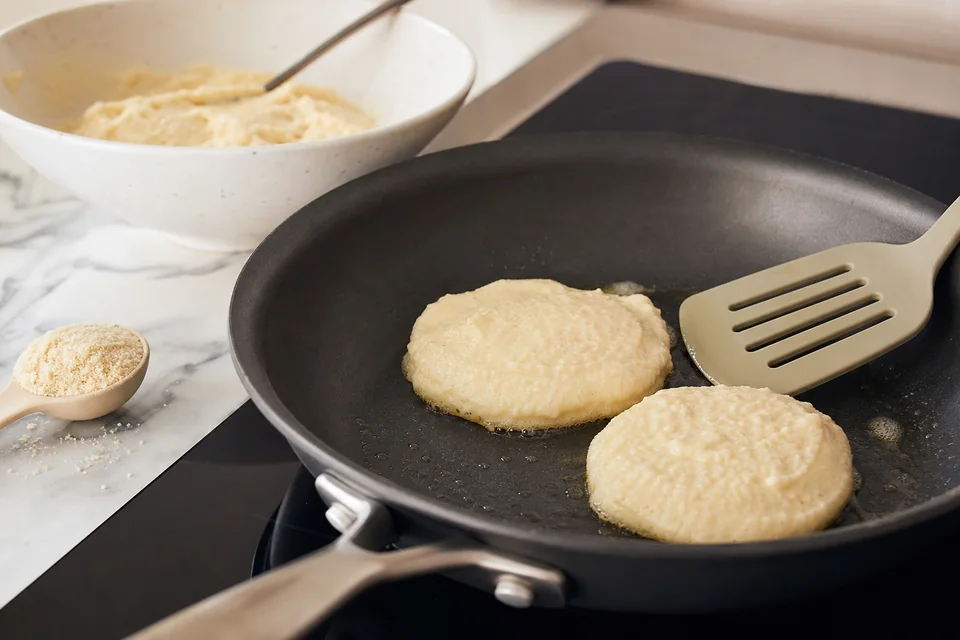
Heat a nonstick skillet over medium-low heat and brush it lightly with oil. Spoon about 2 tablespoons batter for one tester, forming a round about 8 cm or 3 inches wide. Do not spread it thin. Cook until the edge looks dry, the top is no longer fully wet, and the base releases without bending.
Turn with a broad, thin spatula that supports most of the pancake. Cook the second side until golden and the centre is set. Open the tester and look for a moist, cohesive crumb without liquid batter. Almond pancakes can brown before a thick centre is ready, so lower heat and reduce size if the outside is getting ahead.
Almond flour is not wheat flour
Wheat flour contains proteins that form gluten when hydrated and mixed. That network helps a conventional pancake stretch and hold gas. Almond flour is ground nuts; it brings fat, flavor, and fine particles but not the same network. The eggs and careful portion size therefore matter more to turning strength.
This difference also explains why a one-for-one flour swap is unreliable. A cup of almond flour does not absorb or structure batter exactly like a cup of all-purpose flour. Use a formula written around almond flour. The broader gluten-free flour-swap guide explains why ingredient identity and recipe function must be considered together.
Blanched almond flour is typically finer and has the skins removed. Almond meal may be coarser and include skin. A coarser product can produce a more fragile or grainy pancake and may require a different liquid amount. Read the package and record the exact product if you plan to repeat the recipe.
Diagnose a delicate batch
The pancakes break during the turn
Make the next round smaller and wait for a dry-looking rim. Confirm that the underside releases before committing to the flip. Slide the spatula fully under the centre. If a small, fully set tester still breaks, the batter may be too thin; whisk in one tablespoon almond flour and test after a minute.
Do not add extra egg immediately. Egg changes liquid, structure, flavor, and browning together. One small almond-flour correction is easier to evaluate. For more failure patterns, see why pancakes fall apart.
The outsides become dark quickly
Almond flour and any added sweetener can brown readily. Reduce the burner and wipe away darkened residue before the next pour. High heat does not create a stronger pancake; it can set a dark crust while the middle remains unset.
The centres are wet
Use less batter per pancake and maintain gentler heat. A domed, wide round asks the surface to hold together before its middle has cooked. Open the tester rather than relying on top color. Do not use browning alone as a safety conclusion.
The pancakes are dry
Check whether the almond flour was over-measured or whether a coarse meal absorbed differently. Also review cooking time: a small pancake left on the skillet after its centre sets can lose moisture quickly. Serve soon after cooking and note the correction for the next batch.
The batter seems grainy
The product may be coarse almond meal rather than fine flour. A short rest helps hydration, but it cannot make coarse particles disappear. The texture may still be pleasant if the pancake holds together; otherwise use a finer flour in the next batch.
Sweet flavor variations
For lemon-almond pancakes, rub lemon zest into the measured sweetener before mixing. Zest adds aroma without changing the liquid balance. Serve with berries rather than adding a large amount of juice to the batter.
For cinnamon-pear, whisk cinnamon into the almond flour and scatter very thin pear pieces on each poured round. Pear carries water, so keep the amount modest and use the tester to see whether it slows setting.
For blueberry, place a few small berries on top after portioning. Large frozen berries can cool and tear a small almond pancake. Let the plain tester establish the correct pan heat before adding fruit.
For chocolate, use finely chopped pieces and keep the pancake small. Melted chocolate can stick to the skillet after the turn. Wipe the surface between batches rather than adding more oil over burnt residue.
Savory direction
Omit sweetener and vanilla. Add black pepper, chopped herbs, or a small amount of finely grated hard cheese. Wet vegetables should be cooked or squeezed dry before joining the batter. For a dedicated savory formula and ingredient boundaries, use the guide to savory almond-flour pancakes.
Do not assume that almond flour automatically makes any recipe “keto.” That term depends on the full ingredient list, serving, and dietary context. This article makes no carbohydrate or medical-diet claim.
Allergen and gluten-free boundaries
Almond is a tree nut and a major food allergen in the United States. These pancakes are not suitable for someone avoiding almond. Read the milk, baking powder, toppings, and every other packaged ingredient, and control cross-contact according to the eater’s needs.
Almond flour itself does not intentionally contain wheat, but a home recipe is not automatically a verified gluten-free meal. Ingredient labels and the preparation environment matter. FDA’s gluten-free labeling rule applies to foods that carry the claim; use products that meet the required standard when that distinction matters.
Prepare and hold the batch
Cook almond pancakes in small batches and transfer them to a rack. They are delicate when very hot and firm slightly as steam escapes. A tall stack compresses the lower pancakes, so hold them in a loose single layer if possible.
To freeze, cool completely, separate with parchment, and seal. Reheat gently until hot through; high direct heat can darken the exterior before the centre warms. Label the package so a tree-nut pancake is not mistaken for a wheat-only or nut-free batch.
Improve the next batch
Record the almond-flour brand, gram weight, final liquid, scoop size, and the point at which the tester released. These variables explain more than a general note that the batter was “thick.” If you switch from blanched flour to meal, treat it as a new test rather than expecting your correction to carry over.
Change one feature at a time. A new plant beverage, extra fruit, and larger pancake can each affect setting. Keep the proven base stable while you learn what one addition does.
Food safety
Do not taste batter containing raw egg. USDA guidance calls for safe handling and thorough cooking of egg-containing foods. Wash the bowl, whisk, counter, and hands after contact. Cook the pancake until its centre is set; a dark almond-flour surface by itself does not confirm that.
Frequently asked questions
Can I replace almond flour with coconut flour?
No direct one-for-one swap is advised. Coconut flour absorbs liquid very differently and requires its own egg and hydration balance. Use a coconut-flour recipe rather than trying to rescue this batter after a full substitution.
Do I need a blender?
No. Fine almond flour can be whisked with the liquid until smooth. A blender may make the batter easy to combine, but it is not needed and can hide whether the product itself is coarse.
Why are the pancakes small?
Small rounds cook through and turn before their delicate centre has to support a large span. Once the tester succeeds, you can try a slightly larger pancake, but the pan heat and time will need to follow its thickness.
Can I make the batter ahead?
This recipe is intended for a short rest and immediate cooking. For faster preparation, measure the dry ingredients and liquid ingredients separately, refrigerate the egg mixture, and combine close to cooking time.
Related help
If the tester still fails after size and heat are corrected, use Pancake Troubleshooting and keep the almond-flour distinction visible in the diagnosis.
Sources and editorial references
- Ohio State Wexner Medical Center, “Almond Flour Pancakes” —
https://wexnermedical.osu.edu/nutrition-services/recipes/almond-flour-pancakes - UMass Chan Medical School Center for Applied Nutrition, “Plain Pancakes” —
https://www.umassmed.edu/nutrition/ibd-aid/breakfast/plain-pancake/ - U.S. Food and Drug Administration, “Food Allergies: What You Need to Know” —
https://www.fda.gov/food/buy-store-serve-safe-food/food-allergies-what-you-need-know - U.S. Food and Drug Administration, “Questions and Answers on the Gluten-Free Food Labeling Final Rule” —
https://www.fda.gov/food/nutrition-food-labeling-and-critical-foods/questions-and-answers-gluten-free-food-labeling-final-rule - U.S. Department of Agriculture Food Safety and Inspection Service, “Shell Eggs from Farm to Table” —
https://www.fsis.usda.gov/food-safety/safe-food-handling-and-preparation/eggs/shell-eggs-farm-table
For more practical food and breakfast guides, visit Pancakes World.
For the wider topic, start with Guides/pancake Ingredients.
For a closely related guide, see Western-Style Breakfast Pancakes: A Practical Recipe.
A useful next comparison is How to Make American Pancakes at Home.
You can also continue with Easy Pancakes from Scratch: A Reliable Golden Stack.
For another practical angle, read 14 Vegan Cheesy Savory Pancakes.
