
What “Western-style” means on this recipe
The legacy title uses Western pancakes, but that phrase does not name one universal cuisine. Pancakes across Europe, North America, and other places grouped under “the West” vary enormously: some are thin, some are yeast-raised, some are griddle cakes, and some are baked. On this page the term is narrowly defined as a familiar thick, round, lightly sweet breakfast pancake made with wheat flour, milk, egg, baking powder, and a little fat.
That scope matters. The recipe promises a tender stack with an even crumb, not a cultural taxonomy and not a claim that everyone in a vast region eats the same breakfast. The separate American pancakes hub carries the broader platform context. Here the useful question is how to execute one dependable breakfast formula.
Recipe at a glance
For about ten 10 cm pancakes, allow 15 minutes to mix and rest the batter and about 20 minutes to cook. You will need a mixing bowl, whisk, flexible spatula, 60 ml measure or small ladle, and a broad skillet or griddle.
The method has four controls: combine the wet and dry ingredients separately, mix only until no dry flour remains, rest briefly, and calibrate the pan with one test pancake. A high stack is not created by adding endless baking powder. It comes from a balanced batter that can expand and still set before the bubbles escape.
Ingredients
- 200 g plain flour;
- 25 g sugar;
- 8 g baking powder, about 2 teaspoons;
- 1/2 teaspoon fine salt;
- 2 large eggs;
- 280 ml milk;
- 40 g melted butter, cooled until warm, or 35 ml neutral oil;
- 1 teaspoon vanilla, optional;
- neutral oil or clarified butter for the cooking surface.
Use fresh baking powder and level the spoon rather than packing it. Too much can give a chemical taste and a coarse, fragile crumb. Milk brings water, milk solids, and flavor; if you want a water-based pancake, use the specific adjustment framework in making pancakes with water instead of assuming nothing else changes.
This formula uses ordinary milk and baking powder. Buttermilk is acidic and often thicker. A buttermilk recipe may balance it with baking soda as well as baking powder, so do not replace all the milk and leave every other measurement untouched. The buttermilk guide explains that interaction in its proper scope.
Mix without overworking the batter
Whisk flour, sugar, baking powder, and salt in a large bowl for at least 20 seconds. This distributes the small amount of leavener and prevents one pancake from tasting salty while another barely rises. In a second bowl, whisk eggs, milk, cooled butter, and vanilla.
Pour wet into dry. Fold with a whisk or spatula just until no islands of dry flour remain. Small soft lumps are acceptable. Vigorous beating hydrates more gluten-forming proteins and can turn a tender pancake springy or tough. Scrape the bottom once, because a hidden pocket of flour there is more troublesome than a few small lumps on top.
Let the batter stand for 10 minutes. It should fall from the ladle in a broad ribbon, mound for a moment, then spread. If it runs across the bowl like thin cream, the pancakes may spread flat. If it sits like muffin batter, the center may remain wet while the outside browns. Correct only after the rest: add milk one tablespoon at a time if too thick, or fold in one tablespoon of flour if clearly too loose.
Do not taste raw batter. Flour and eggs are uncooked ingredients; flavor testing waits until the first pancake is fully cooked.
Set the pan to useful heat
Preheat a heavy skillet or flat griddle over medium heat for several minutes. Wipe on a very thin coat of oil. Pools of fat make mottled, fried patches and encourage spreading. A dry surface can also work on suitable nonstick equipment, but never heat an empty coated pan beyond its manufacturer’s guidance.
A small drop of batter should sizzle gently and begin to set within a few seconds. If it stays pale and fluid, wait. If it blackens while the center is still liquid, cool the pan. Burner setting is not a portable temperature: pan material, diameter, hob, and room conditions all change the result.
Portion, flip, and verify doneness
Stir the batter once gently. Deposit 60 ml in one spot and let it spread without smearing it with the ladle. Consistent portions make timing and yield meaningful. Leave enough room to slide the spatula around each pancake.
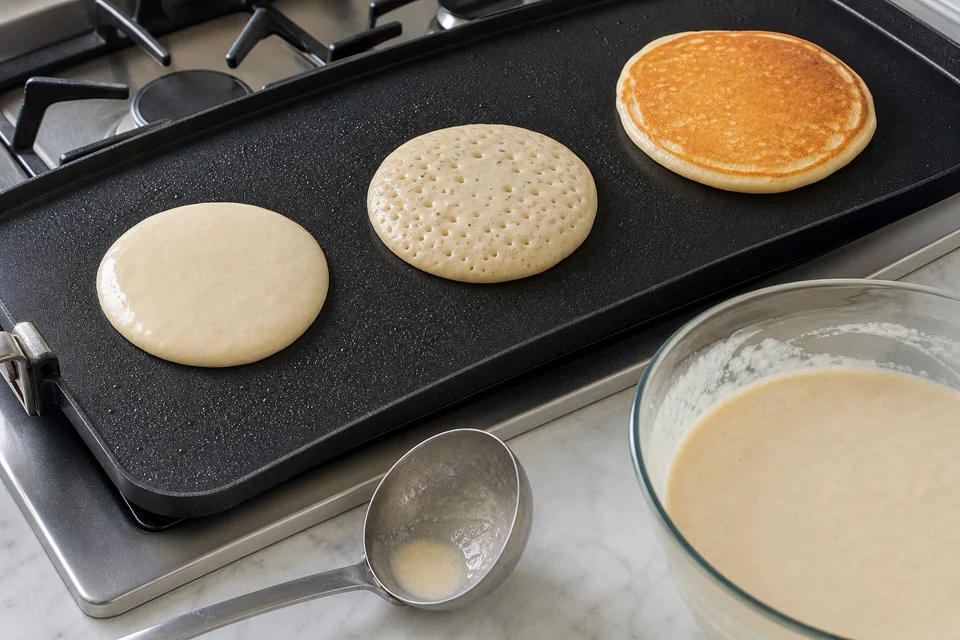
Watch the upper surface. At first bubbles form and disappear. The pancake is approaching the turn when bubbles appear across more than just the edge, several holes remain open, and the outer rim looks matte. Slide the spatula completely underneath and turn once. The second side normally needs less time because the center is already warm.
Cut the first pancake. The center should show an even set crumb, not a wet line, compressed paste, or raw flour. It should spring lightly when pressed. If the outside is already dark but the middle is wet, lower the heat and make the next pancake slightly smaller or thinner. If it is pale and dry, the pan may be too cool or cooking time too long.
Transfer cooked pancakes to a rack. To hold a short batch, place the rack in a low oven. Avoid a deep covered stack: trapped steam softens the surfaces and can compress the bottom pancakes.
Toppings that do not hide the pancake
Butter and maple syrup are familiar, but they are not compulsory. Fresh berries, a spoonful of cooked fruit compote, yogurt, toasted nuts, or citrus zest can provide contrast. Keep watery fruit and cold sauces modest if surface texture matters. Serve syrup at the table so each person controls sweetness.
For a savory direction, reduce sugar to 5 g, omit vanilla, and serve with cooked mushrooms, eggs, tomatoes, or herbs. Expect slightly less browning when sugar is reduced. Do not compensate by turning the pan dangerously high; allow the visual cue to change.
Diagnostics and current-batch fixes
Pancakes are flat
Likely causes include old baking powder, very loose batter, batter mixed until elastic, or a pan too cool to set the expanding structure. For pancakes still to cook, confirm the batter is not running like milk, raise heat in a small increment, and avoid stirring between every portion. Do not dump extra baking powder into a mixed bowl; it will distribute poorly and may taste bitter.
Outside is dark and center is wet
Heat is outrunning the center, the portions are too large, or the batter is excessively thick. Move the pan briefly off the burner, reduce the setting, and make one smaller test. If the rested batter barely falls from the ladle, fold in one tablespoon of milk. A lid may trap a little heat for one current pancake, but it also adds steam and is not the primary correction.
Pancakes are tough
Overmixing is the common formulation clue, while pressing with the spatula and prolonged low-heat cooking add mechanical and heat damage. Stop stirring the current bowl. Turn each pancake once and never flatten it after the flip. Tenderness cannot be fully restored, but a moist topping can make the served plate more pleasant.
Color is uneven
Too much pan fat creates pale pools and dark lace. Wipe the surface nearly dry between rounds. If your pan has a strong central hot spot, move portions or cook one at a time. The skillet guide helps diagnose equipment rather than blaming the recipe.
Batter has thickened during the batch
Flour keeps hydrating as it stands. If later pancakes no longer spread like the first, fold in milk one teaspoon at a time. Avoid making a large correction based on one pancake cooked on an overheated pan.
Prevent problems in the next batch
Check the baking-powder date and weigh flour instead of plunging a cup into the bag. Bring the pan to stable heat before mixing if your kitchen is cold, so the leavener does not sit in wet batter for an extended period. Use the same ladle and target diameter throughout.
Write down the useful heat setting for your pan and hob, but retain the bubble and edge cues. Melt butter early enough that it is warm rather than hot when it meets the eggs. Fold wet into dry only after every topping and serving plate is ready. Most importantly, treat the first pancake as calibration, not as a failure: cut it, decide whether heat, portion, or hydration is wrong, and change one variable at a time.
Safety, allergens, and leftovers
The batter contains wheat, milk, and egg unless purpose-built substitutes are used. Butter alternatives, plant beverages, and toppings can add soy, nuts, sesame, or other allergens. Check actual labels and cross-contact rather than inferring safety from a recipe nickname.
Keep raw-batter utensils away from cooked pancakes. Refrigerate cooked leftovers promptly under applicable food-safety guidance, separated so they cool efficiently. Reheat only pancakes that were handled and stored safely. If they show spoilage or their time and temperature history is unknown, reheating is not a rescue step.
Frequently asked questions
Are these the only “Western” pancakes?
No. The label is explicitly limited on this page to one thick breakfast style. Many distinct thin, fermented, baked, and griddled pancakes exist across the regions the word might imply.
Can I use self-raising flour?
Only with a formula designed for its included leavener and salt. Adding the full baking powder here as well can unbalance taste and rise.
When should I flip?
Wait for bubbles across the surface, some holes that remain open, and a matte edge. Clock time alone cannot account for pan and portion differences.
Can I reduce sugar?
Yes. The pancake may brown less and taste more neutral. Keep the heat controlled and choose toppings after tasting the cooked test pancake.
Why does my first pancake look different?
It absorbs information about initial pan heat and surface fat. Use it to adjust rather than expecting the first pour to match a stabilized griddle.
How can I make a larger batch?
Scale by weight and use two pans only if you can monitor both. Holding time grows with batch size, so a rack in a low oven is more useful than a covered plate.
Related Pancake World pages
- Start with the American pancakes hub for the platform’s broader breakfast context.
- Follow a focused reliable hotcake method.
- Compare the dedicated fluffy pancake recipe without buttermilk.
- Understand how buttermilk changes pancake batter.
- Solve sticking, scorching, and wet centers at the Pancake World troubleshooting hub.
- Review the practical reasons to make pancakes from scratch.
Sources and editorial references
- U.S. Food and Drug Administration, raw flour and batter safety:
https://www.fda.gov/consumers/consumer-updates/flour-raw-food-and-other-safety-facts - USDA Food Safety and Inspection Service, leftovers and cooling:
https://www.fsis.usda.gov/food-safety/safe-food-handling-and-preparation/food-safety-basics/leftovers-and-food-safety - King Arthur Baking, technical guide to baking powder:
https://www.kingarthurbaking.com/learn/guides/baking-powder
For more practical food and breakfast guides, visit Pancakes World.
For the wider topic, start with Guides/pancake Ingredients.
For a closely related guide, see Grandma-Style Fluffy Pancakes.
A useful next comparison is Delicious Homemade Pancakes Recipe.
You can also continue with How to Make American Pancakes at Home.
For another practical angle, read Mochiko Pancakes: Control Chew and Hydration.
