
Quick answer
The best skillet for fluffy pancakes is not a single brand or material. It is a pan that matches your hob, gives you controllable and reasonably even heat, releases your chosen batter without excessive fat, and remains comfortable through a full batch. A flat cooking area around 24–28 cm suits many home cooks; choose the usable base rather than the rim-to-rim marketing diameter. Low or gently flared sides make a spatula easier to insert, while a secure handle helps you move the pan without twisting your wrist.
For simple pancakes, a good non-stick pan is the easiest starting point. A well-seasoned cast-iron skillet offers strong heat retention but is heavy and slower to correct after overheating. Clad stainless steel is durable and responsive in capable hands, yet usually needs more deliberate preheating and fat. Carbon steel can bridge some of those qualities but requires seasoning and rust prevention. None of those materials creates fluffiness on its own: batter formulation, leavening, mixing, portion depth, and cooking still determine the rise.
This guide uses a criteria-led shortlist rather than pretending that untested current products are ranked. Model names, coatings, prices, warranties, and availability change. Use the decision table below to evaluate the pan in front of you.
What a pancake skillet can—and cannot—do
A skillet controls the contact between batter and heat. An even base can reduce isolated dark patches. A responsive pan makes it easier to lower the temperature when the first pancake browns too quickly. A surface that releases well lets you turn the pancake without tearing it. Suitable side geometry gives the spatula room to reach the centre.
The pan cannot supply missing leavening, repair overmixed batter, or guarantee an airy middle. “Fluffy” is therefore a result the whole method supports, not a performance claim attached to cookware. If height is the main problem, keep your pan evaluation separate from the flat-pancake diagnosis.
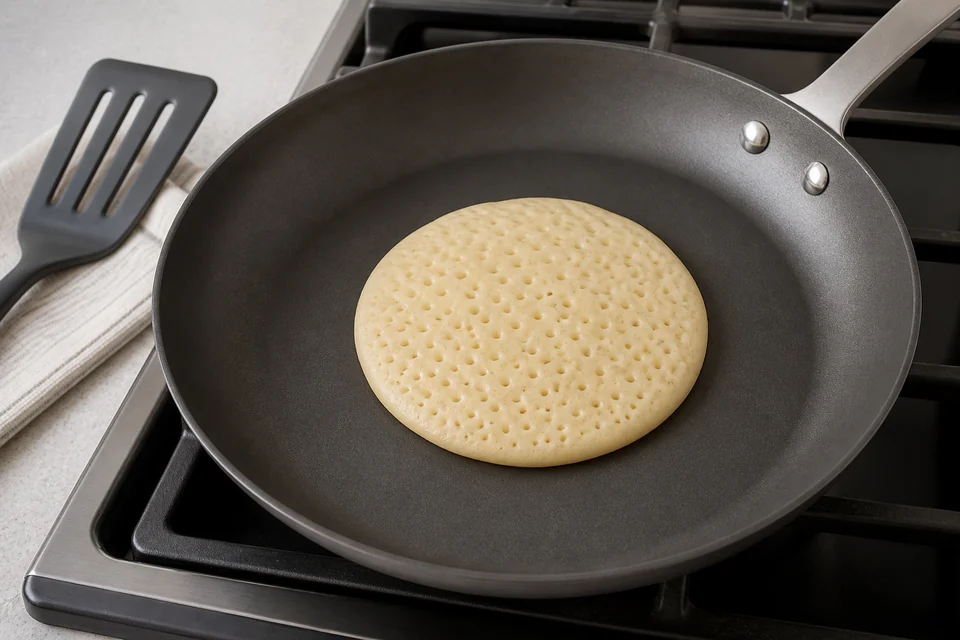
The generated hero photograph shows a plausible unbranded cooking context. It is not evidence that the pictured pan was laboratory tested, outperformed another model, or produced the pancakes beside it.
Skillet decision table
| Priority | Look for | Trade-off to accept | Red flag |
|---|---|---|---|
| Easy release | Intact food-contact surface, flat base, care instructions you will follow | Coated pans need gentler utensils and eventual replacement | Peeling, deeply scratched, or blistered coating |
| Stable heat | Base that sits flat and does not rock | Heavier pans heat and cool more slowly | Spinning or wobbling on the hob |
| Fast correction | Moderate weight and compatible construction | Very light pans can form hot spots | First pancake scorches before the top begins setting |
| Comfortable batches | Secure handle and weight you can lift safely | Helper handles add storage space | Loose handle or painful wrist angle |
| Easy turning | Low or flared sides and enough working room | Very shallow pans contain splashes less well | Tall vertical walls that block the spatula |
| Hob fit | Explicit gas, electric, ceramic, or induction compatibility | A universal base may add weight | Pan smaller than the heating zone or not induction-ready |
| Useful size | Base fits one or two pancakes without crowding | Larger pans need more even burners | Diameter quoted only at the rim |
Non-stick skillets
Non-stick cookware is the low-friction choice for beginners and for batters that are tender or low in added fat. It usually needs only a light film of cooking fat and releases the first side once it has set. The useful test is not whether a product is advertised as “stone,” “granite,” or “diamond.” Those terms can be marketing shorthand. Read the manufacturer’s material, temperature, utensil, dishwasher, and replacement instructions.
Choose a smooth, undamaged surface and a base thick enough not to buckle over your burner. Avoid empty high-heat preheating unless the maker expressly permits it. Use wood, silicone, or another allowed utensil. Replace a pan when its coating is damaged in a way the manufacturer says is unsafe or when release has deteriorated beyond practical cooking.
A non-stick skillet is especially useful when you want to compare batter variables. Because sticking is less likely to dominate the result, you can watch spread, bubbles, colour, and turning without adding large amounts of oil.
Cast iron
Cast iron retains heat strongly. That can support consistent browning once the pan and burner reach a stable balance, and it suits cooks who want a durable pan for many jobs. The same thermal mass makes mistakes slower to correct. If the surface becomes too hot, lowering the burner will not cool the iron immediately.
Seasoning quality matters. A dry, patchy, or neglected surface may grab a soft pancake. Preheat gradually, use a small amount of suitable fat, and allow the pancake surface to set before turning. Do not choose cast iron merely because “heavy equals even.” Burner size, pan casting, preheat, and portion placement still affect the pattern.
Weight is a genuine buying criterion. Lift the empty pan as if moving it from hob to sink, then imagine it hot and carrying food. A helper handle can make a larger skillet safer to carry. Follow the maker’s care instructions; arguments about one universal soap rule are less useful than preventing rust and keeping the surface functional.
Carbon steel
Carbon steel is usually thinner than cast iron and can respond faster to burner changes. With developed seasoning, it can release pancakes well. It is also lighter than a comparably sized cast-iron pan, although weight varies. The trade-off is maintenance: moisture can cause rust, acidic cooking can disturb seasoning, and a new surface may be less forgiving than a mature one.
Check whether the base stays flat on your hob and whether the handle is oven-safe if that matters for other dishes. Some carbon-steel pans arrive with protective coatings that must be removed according to the maker’s instructions before seasoning. Pancake day is not the best first test if you have not completed that preparation.
Stainless steel and clad pans
Uncoated stainless steel is durable, does not depend on a replaceable non-stick coating, and can be very useful beyond breakfast. For pancakes, technique matters more. Preheat over moderate heat, add an appropriate film of fat, and wait until the pancake releases rather than forcing a spatula underneath too early.
Construction matters because stainless steel itself conducts heat less evenly than aluminium or copper. Clad cookware sandwiches conductive material within stainless layers, but descriptions such as “tri-ply” do not by themselves prove perfect performance. Examine whether the conductive layer covers the whole pan or only the base, how the pan fits your burner, and whether the weight remains comfortable.
If your priority is the easiest first pancake, coated cookware is usually more straightforward. Choose stainless when durability, broad cooking use, and willingness to learn release cues matter more than low-effort turning.
Size, shape, and handle details
A 24 cm pan commonly suits one medium pancake or several small pancakes. A 28 cm pan gives more room but demands a burner that can heat its base adequately. Measure the flat interior. Two pans with the same stated diameter can have very different usable areas because of sloped sides.
Low sides ease spatula access, but a skillet still needs enough wall to hold melted butter and batter drips. A crepe pan’s extremely low rim is excellent for thin pancakes yet less versatile. For thick American pancakes, a conventional low-sided skillet is often the practical compromise.
Handle material and geometry affect a whole batch. A metal handle may become hot; a silicone sleeve can also heat or slip and must be used according to its instructions. Rivets should feel secure. A short heavy handle can reduce leverage, while a very long handle can be awkward in a small kitchen. Test the balance before buying when possible.
Test the pan you already own
You may not need a new skillet. Start with a clean, flat pan and the same batter portion for three pancakes. Preheat moderately. Make the first pancake, recording how quickly the underside colours relative to the top setting. Adjust one variable—usually burner level or preheat time—then cook the next. Do not change pan, batter amount, and heat simultaneously.
Rotate the pan between pancakes only if your burner has an obvious uneven pattern; do not swirl the wet batter unless the recipe is for a thin style. If the centre repeatedly darkens while edges remain pale, the burner may be small relative to the base. If one fixed patch burns, inspect the hob contact and pan flatness. If the whole underside becomes dark before the top sets, reduce heat and allow the pan time to respond.
When burning rather than buying is the urgent problem, use the Pancake World burning guide. A different skillet can help a known heat-control mismatch, but it should follow diagnosis rather than replace it.
How to compare products without a misleading “best” list
First exclude pans that are incompatible with your hob or unsafe for your intended use. Next compare usable base size, total weight, handle comfort, maximum temperature, allowed utensils, and care. Then compare warranty terms and replacement parts directly from the manufacturer. Treat retailer star ratings as owner reports, not standardized tests.
If two pans survive that screen, decide which trade-off fits you. Choose coated cookware for easy release and low-fat cooking; cast iron for retention and durability; carbon steel for a lighter seasoned surface; clad stainless for versatility and coating-free durability. A lower price can be sensible for a pan you expect to replace, while a higher price is justified only when its construction, service, and use match your needs.
Ignore rankings that do not state the hob, batter, pancake size, fat, preheat, temperature measurement, and number of batches. A single attractive stack does not test evenness. Likewise, an affiliate label is a disclosure, not proof of poor testing—but this page has no sponsored placement or affiliate ranking.
Care and replacement
Let a hot pan cool before sudden washing if the maker warns against thermal shock. Clean off sticky batter residue so the next batch begins on a uniform surface. Dry rust-prone materials promptly and maintain their seasoning. Stack pans with a protector if contact could scratch a coating.
Do not keep unsafe cookware for the sake of thrift. A loose handle, warped base, or damaged coating deserves assessment against the maker’s replacement advice. Conversely, ordinary staining on stainless steel is not automatically a performance failure. Separate cosmetic change from structural damage.
Frequently asked questions
Is cast iron or non-stick better for fluffy pancakes?
Non-stick is easier for release and quick heat correction. Cast iron retains heat and can brown consistently once stabilized, but it is heavy and slower to cool. Neither creates fluffiness by itself.
What skillet size is best?
Many cooks find 24–28 cm practical. Measure the flat cooking base, match it to your burner, and leave room to turn the pancake without crowding.
Do I need a special pancake pan?
No. A flat, compatible skillet with controllable heat and workable sides is enough. A specialized low-sided pan mainly improves spatula access and thin-pancake handling.
Is a heavier pan always more even?
No. Weight can accompany heat retention, but construction, burner coverage, preheating, and base flatness all matter. Heavy pans also respond slowly after overheating.
Why does the first pancake fail?
The pan may not yet be at a stable temperature, the fat may be uneven, or the batter portion may differ. Record the first result and change one variable for the second.
Can induction cookware work on gas?
Often, but rely on the manufacturer’s compatibility instructions. A magnetic base suitable for induction does not automatically answer handle heat, oven use, or gas-flame care.
When should I replace a non-stick skillet?
Follow the maker’s guidance. A peeling, blistered, deeply scratched, warped, or poorly releasing surface is a reason to stop and assess replacement rather than force another batch.
Related Pancake World pages
Use the American pancakes guide for a complete pancake context, why pancakes are flat when height is the real issue, and the burning-pancake guide when heat control is failing.
Sources and editorial references
- Good Food: Best pancake pans and buying criteria —
https://www.bbcgoodfood.com/review/best-pancake-pans-uk - Good Food: Cast-iron skillet testing criteria —
https://www.bbcgoodfood.com/review/best-cast-iron-skillet-pans/
For more practical food and breakfast guides, visit Pancakes World.
For the wider topic, start with Guides/pancake Equipment.
For a closely related guide, see Induction Pancakes: Match Pan Size, Power and Heat Response.
A useful next comparison is Pancake Spatulas Compared by Blade Material and Shape.
You can also continue with Pancakes on a Glass-Top Stove: Pan Contact and Heat Lag.