
Discover more recipes and practical cooking guides on Pancake World.
Quick answer
Cultured buttermilk can give pancakes a gentle tang, a thicker batter, and an acid component that reacts with baking soda to release carbon dioxide. In a recipe balanced for buttermilk, that reaction supports lift while the dairy contributes flavour, moisture, proteins, and sugars that affect tenderness and browning. It is not a magic ingredient: changing only the liquid in a milk-based formula can make the batter too thick or leave the leavening out of balance.
Use buttermilk in a recipe written for it. Mix wet and dry ingredients only until no large dry pockets remain, then cook promptly when baking soda supplies much of the lift. Judge the first pancake by spread, underside colour, and centre setting. Adjust heat or batter portion before rewriting the formula.
What “buttermilk” means now
Traditional buttermilk was the liquid left after churning cultured cream. The product sold as buttermilk in many modern supermarkets is cultured milk: selected bacteria ferment lactose and produce lactic acid, creating tang and a thicker texture. Labels and fat levels vary by market.
That means a carton can look slightly thicker and contain small soft curds without being spoiled. Follow the package date and storage instructions. An unpleasant rotten odour, mould, gas, or major separation beyond the product’s normal appearance is a reason to discard it. Do not taste questionable dairy to test safety.
Four ways buttermilk changes pancakes
1. It changes leavening chemistry
Baking soda is sodium bicarbonate. In batter, an acid can react with it and release carbon dioxide gas. Cultured buttermilk supplies acid, so many buttermilk pancake recipes include baking soda. Baking powder contains its own acid system and may also appear to provide lift at mixing and during heating, depending on the product.
The practical conclusion is not “more soda makes fluffier pancakes.” Excess soda can taste soapy, darken the exterior rapidly, and disturb the recipe. The acid and alkali must be balanced by the formula. Keep the specified amounts when changing batch size and use level measuring spoons.
2. It changes batter consistency
Cultured buttermilk is often thicker than ordinary milk. A direct volume-for-volume swap can therefore reduce spread. That can look promising for height but leave the centre slow to cook if the portion is too thick. Conversely, a thin buttermilk product may behave differently from the one used by a recipe developer.
Before adding extra flour or liquid, let the mixed batter sit only for the recipe’s stated interval, then observe how it falls from the scoop. Make one small pancake. If it stays as a tall raw mound, compare your measurements and buttermilk consistency with the recipe before improvising.
3. It contributes flavour
Lactic acidity creates a gentle tang that balances sweet toppings and rich butter. Fermentation also changes the dairy aroma. The aim is usually not a sharply sour pancake; it is a more complex base flavour. Old spoiled milk is not a substitute for cultured buttermilk.
4. It affects browning and tenderness
Dairy proteins and sugars participate in browning as the pancake cooks. Acidity, sugar, fat, and pan temperature all influence final colour, so buttermilk alone cannot guarantee an evenly golden surface. Its liquid and acidic environment also affect how flour proteins hydrate. In a balanced formula with restrained mixing, the result can feel tender; overmixing can still make pancakes chewy.
Buttermilk versus milk
| Feature | Cultured buttermilk | Ordinary milk |
|---|---|---|
| Acidity | Meaningfully acidic | Less acidic |
| Texture | Usually thicker | Usually thinner |
| Leavener pairing | Often baking soda plus or instead of some baking powder | Commonly baking powder-led |
| Flavour | Tangy fermented dairy note | Mild dairy flavour |
| Direct substitution | Requires recipe balance | Requires recipe balance |
The correct liquid is the one the formula expects. Compare ingredient lists and leaveners before choosing a recipe rather than treating the two liquids as automatic substitutes.
How to mix a buttermilk pancake batter
Measure flour by weight when possible. Whisk flour, sugar, salt, and leaveners so the baking soda is evenly distributed. In a second bowl, combine buttermilk, egg, and melted butter or oil as directed. If the melted fat is very hot, let it cool enough not to cook the egg on contact.
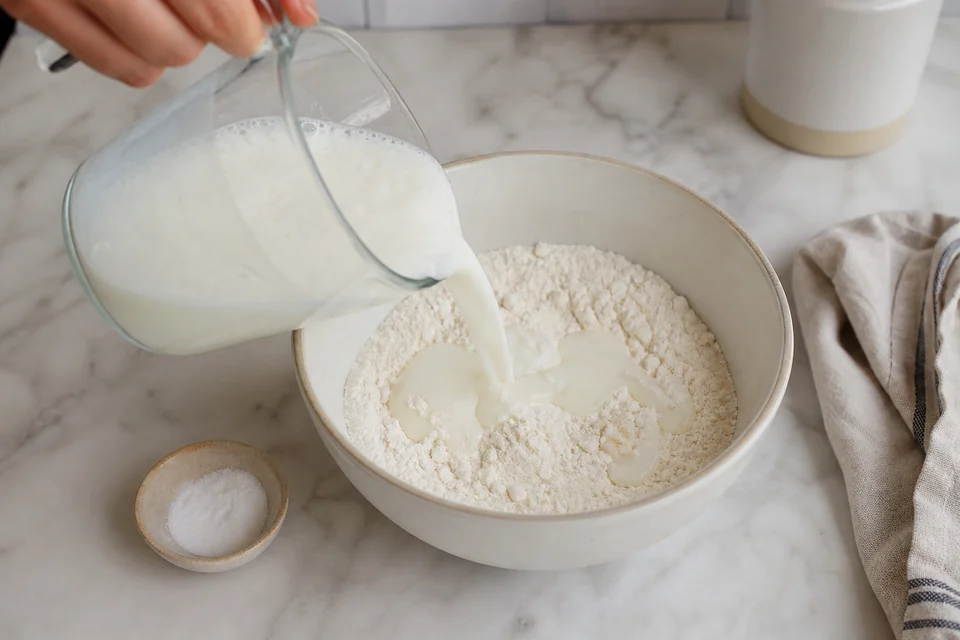
Pour wet into dry. Fold with a spatula or whisk gently until large dry pockets disappear. Small lumps can hydrate during the short rest if the recipe includes one. Repeated vigorous beating develops structure and also knocks out gas; a perfectly smooth bowl is not automatically better.
Cook soon after mixing when baking soda is present. Preheat the pan over moderate heat, grease lightly, and use a consistent portion. Wait for the underside to set and the top to show recipe-appropriate cues before turning. Cook the second side without pressing the pancake flat.
Substitutes and their limits
A common emergency substitute is milk acidified with lemon juice or vinegar. It can supply acidity but does not fully reproduce cultured buttermilk’s fermentation flavour, viscosity, or composition. Use a ratio from a tested recipe rather than adding an arbitrary splash to the batter.
Plain yogurt thinned with milk or water can work in recipes designed for that substitution. Kefir is another cultured dairy, but its acidity, carbonation, and thickness vary. Plant-based “buttermilk” mixtures may provide acid but differ in protein, sugar, and fat. A dairy-free recipe tested with the specific plant beverage is more dependable than assuming all liquids behave alike.
Do not use milk that spoiled unintentionally. Controlled cultured products and random spoilage are not equivalent.
Diagnostic table
| Result | Check first | Next-batch action |
|---|---|---|
| Pancakes spread too little | Buttermilk thickness and flour measurement | Use recipe’s consistency guidance; add liquid only in small measured amounts |
| Exterior darkens too fast | Pan heat and excess baking soda | Lower heat; verify leavener measurement |
| Pancakes taste soapy | Baking soda quantity or poor distribution | Re-measure and whisk dry ingredients thoroughly |
| Pancakes are flat | Leavener freshness, delay after mixing, overmixing | Follow the flat pancake guide |
| Centre looks wet | Portion size and heat balance | Make a smaller test pancake and cook more gently |
| Texture is tough | Mixing intensity and time | Stop once large dry pockets disappear |
| Flavour is sharply sour | Product condition and recipe balance | Check buttermilk freshness and use a tested formula |
Do not “fix” a mixed bowl by scattering soda directly into it. Uneven leavener creates bitter or soapy pockets. Record the batch and correct the next one.
Storage and food safety
Refrigerate buttermilk according to the package and keep it cold during preparation. Raw batter contains raw flour and often egg; do not taste it. The FDA notes that flour is a raw food and must be cooked as part of the finished recipe.
Cooked pancakes should be refrigerated promptly if not served. USDA general leftovers guidance sets a two-hour limit at room temperature, or one hour above 90°F (32°C), and a three-to-four-day refrigerated window. Store toppings separately and reheat only the portion you will eat.
Common claims to reject
Buttermilk does not guarantee the “fluffiest pancakes ever.” It does not make old baking soda active indefinitely, and it does not cancel the effects of an overheated pan. It does not make raw batter safe to taste. It is also not interchangeable with every sour dairy product without formula changes.
Its real value is more useful: acidity, viscosity, fermented flavour, and dairy components that a well-designed recipe can use together.
Frequently asked questions
Why does buttermilk need baking soda?
It does not always “need” it, but recipes often pair buttermilk’s acid with baking soda to produce carbon dioxide and balance acidity.
Can I replace milk with buttermilk one for one?
Not reliably. Thickness and acidity change, and the leavener system may need rebalancing. Use a recipe written for buttermilk.
Can I make a substitute with lemon juice?
Yes for recipes that approve it. Acidified milk supplies acidity but does not exactly reproduce cultured buttermilk.
Does buttermilk make pancakes fluffy?
It can support lift in a balanced recipe, but flour, leavening, mixing, portion size, and heat also determine height.
Why did my pancakes brown too fast?
The pan may be hot, the recipe may contain sugar, or excess soda may raise browning. Lower heat first and verify measurements.
Can I freeze buttermilk?
Follow the package or producer guidance. Freezing can separate it; thaw in the refrigerator and stir before using in a recipe that accepts thawed buttermilk.
Is lumpy buttermilk spoiled?
Cultured buttermilk can be naturally thick with small soft curds. Use date, storage history, odour, mould, gas, and the product label rather than texture alone.
Related Pancake World pages
Make a complete batch with American pancakes or diagnose lost height with why pancakes are flat.
Sources and editorial references
- King Arthur Baking: Buttermilk pancakes and leavening guidance —
https://www.kingarthurbaking.com/recipes/buttermilk-pancakes-recipe - U.S. Food and Drug Administration: Handling Flour Safely —
https://www.fda.gov/consumers/consumer-updates/handling-flour-safely-what-you-need-know - USDA Food Safety and Inspection Service: Leftovers and Food Safety —
https://www.fsis.usda.gov/food-safety/safe-food-handling-and-preparation/food-safety-basics/leftovers-and-food-safety
