
Quick answer
Fluffy pancakes do not depend on dairy milk. They depend on a batter that can hold gas without becoming so thick that the centre stays wet. In this method, water supplies hydration, baking powder supplies the main lift, and whipped egg white adds a second source of aeration. Gentle folding protects that foam, while small pancakes and moderate heat give the centre time to set before the surfaces become too dark.
The egg-white step is optional, not magic. If you prefer fewer bowls, whisk the whole eggs into the water and oil; the pancakes will still rise from the baking powder. Separating the eggs is useful when height is the goal and you are willing to handle a slightly more delicate batter.
Fluffy milk-free pancake recipe
This batch makes about 10 small, thick pancakes:
- 180 g all-purpose flour
- 25 g sugar
- 2 teaspoons baking powder
- 1/2 teaspoon fine salt
- 2 large eggs, separated
- 260 ml water, plus 1 to 2 tablespoons only if needed
- 30 ml neutral oil, plus a little for the skillet
- 1 teaspoon vanilla extract, optional
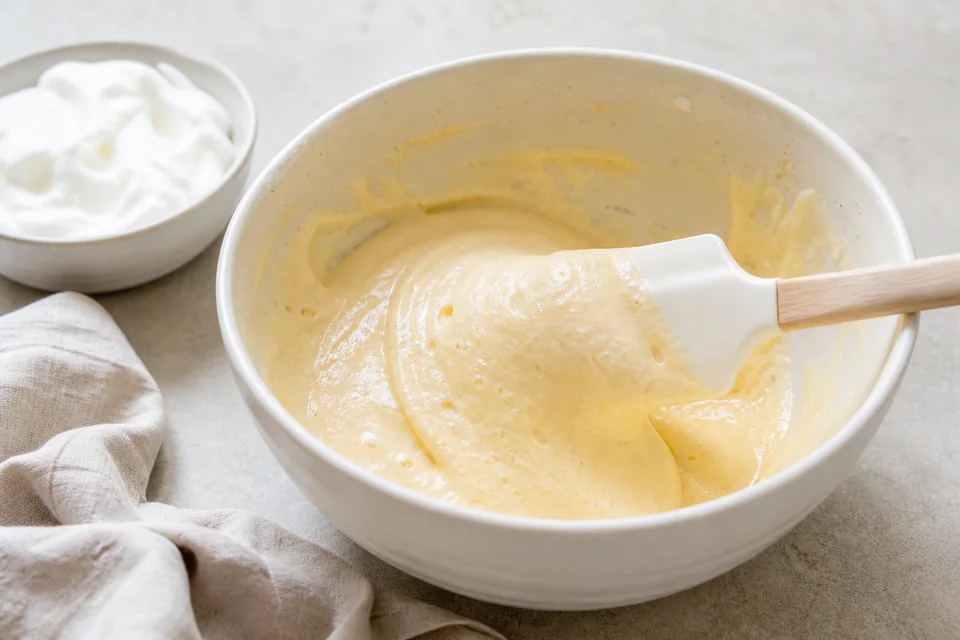
Whisk flour, sugar, baking powder, and salt in a wide bowl. In a jug, whisk the egg yolks, water, oil, and vanilla. Pour that mixture into the dry ingredients and fold until no dry flour remains. This first batter should be thick enough to fall slowly from the spatula; it will loosen slightly when the egg whites are folded in.
In a clean, dry bowl, beat the egg whites to soft peaks. At that stage, the foam holds a curved tip rather than a rigid point. Stir one quarter of the foam into the base batter to lighten it. Add the rest in two portions, cutting the spatula down through the centre, sweeping along the bottom, and lifting the batter over the foam. Stop when only a few pale streaks remain. Continued folding for visual perfection pushes out the air you just introduced.
Heat a nonstick skillet over medium-low to medium heat and wipe it with oil. Spoon about 3 tablespoons batter for one tester, keeping the diameter near 8 to 9 cm rather than spreading it wide. Wait until bubbles rise and open, the edge turns matte, and the base releases cleanly. Turn with a wide spatula. Cook the second side until it is golden and the centre gently springs back. Split the tester and check that the middle is set and airy, not shiny or custard-like.
Cook the rest in small rounds, leaving space between them. Avoid pressing after the turn. Pressing can force out gas and compress the crumb at the moment the structure is setting. If the batter waits for a long time, it may lose some volume; cook it steadily instead of trying to whip or whisk it back.
Why the method works without milk
Milk contributes water, proteins, sugars, and sometimes fat, but only the water portion is essential for hydrating flour. This formula supplies richness through egg yolk and oil. Because plain water does not brown exactly like dairy milk, the pancakes may have a lighter color at the point when the centre is ready. Judge them by the complete set of cues, not by a demand for deep brown surfaces.
Baking powder begins producing gas once it is moistened, with further action during cooking depending on the product. Even distribution matters: a pocket of leavener can create an irregular tunnel or bitter spot, while an un-leavened pocket stays dense. Whisk the dry ingredients thoroughly before they meet water.
Egg-white foam contributes existing air bubbles. Heat expands the gases and the surrounding batter sets around them. The foam does not replace flour structure or leavener; it supplements them. A batter that is extremely thin cannot hold those bubbles well, and a batter mixed harshly after folding loses much of the benefit.
Diagnose a flat or heavy tester
It spreads wide as soon as it reaches the pan
The batter may be too thin, but confirm that the surface is hot enough first. A cool pan delays setting and exaggerates spread. If a second small tester still runs, fold one tablespoon of flour into the remaining batter with as few strokes as possible. Give it one minute, then test again. Repeated large corrections would deflate the foam and make the result harder to interpret.
It rises in the pan and collapses on the plate
The centre may not have set before the pancake was removed, especially if the round was large. Lower the heat slightly and make the next one smaller. Wait for the upper bubbles to open and for the edge to look dry before turning. A very tall surface is not useful if the interior remains wet.
It is evenly cooked but dense
Review the mixing sequence. Was the flour beaten until smooth? Were the egg whites folded until every streak disappeared? Either can remove air or build a firmer wheat structure. Also check the baking powder rather than compensating with more: an old or poorly stored product may not behave as expected. The deeper dense-pancake diagnosis separates formula, mixing, and heat causes.
The first side burns while the top remains wet
The pan is delivering too much surface heat for the pancake’s thickness. Reduce the burner, pause briefly, and use a smaller spoonful. Do not thin the entire bowl simply to make an overheated pan work. Surface brownness is not proof that the centre has cooked.
It tears during the turn
The pancake may be under-set or too large for the spatula. Wait for a wider field of open bubbles and a dry-looking rim. Slide the tool fully under the centre and turn in one confident motion. The article on when to flip pancakes gives a closer visual decision flow.
A simpler version without whipping
For an everyday batch, leave the eggs whole. Beat them with water and oil, then fold the liquid into the dry ingredients until just combined. Rest for five minutes and cook as small rounds. This version relies on baking powder rather than egg foam and is more tolerant of a short delay.
Do not compare the two versions by changing the pan and portion size at the same time. Use the same skillet, fat film, and scoop. The comparison is most useful when the only deliberate change is egg handling.
Flavor additions that preserve volume
Add citrus zest or a small amount of ground spice to the dry ingredients. These distribute without adding much weight. Vanilla belongs in the liquid. For berries, place a few on each poured round instead of stirring a large volume through the foam. Heavy or wet additions can sink, tear the pancake, or cool the centre.
Finely chopped toasted nuts can be scattered after pouring, but they introduce an allergen and added weight. Chocolate pieces melt and can mark the pan, so use a restrained amount and wipe the surface between batches if needed. Avoid overloading a pancake that is intentionally small and thick.
Build a better next batch
Make a note of the egg-white stage. “Soft peaks with a curved tip” is more reproducible than “whipped for two minutes,” because mixer speed, bowl width, and egg temperature change the timeline. Also record the scoop size and the burner position that allowed the tester’s edge to set before its underside became too dark.
If you want more height, change one variable. Try a slightly smaller diameter before adding flour or leavener. If you want a more tender crumb, evaluate mixing before adding more oil. Changes that seem related can push in opposite directions: more flour thickens the batter but can also make the crumb heavy.
Use Pancake Troubleshooting when the symptom survives two carefully controlled testers. The useful question is whether the batch is flat, dense, undercooked, or simply paler than a milk-based pancake; each observation points to a different correction.
Food safety
Raw flour and raw egg batter should not be tasted. FDA guidance treats flour as a raw food, and USDA guidance calls for safe egg handling and thorough cooking of foods that contain eggs. Keep the whisk, spatula, bowls, and work surface that contacted raw batter away from the serving plate until washed. Color alone does not confirm a cooked middle, so open the first thick pancake and verify a fully set centre.
Frequently asked questions
Can sparkling water make the pancakes fluffier?
It can introduce bubbles, but it also changes the liquid system and is not required for this recipe. The benefit may be lost through vigorous mixing or a long wait. Master the still-water version first; then compare a half batch using the same flour, scoop, and pan.
Can I make these without eggs?
Not by simply omitting both eggs. The whites supply added aeration and the yolks contribute richness and structure. An egg-free formula can be successful, but it needs a deliberate binder and hydration balance. Use a recipe built for that purpose.
Why are my pancakes pale?
Water contains none of the milk solids that influence dairy-pancake browning. If the centre is set and the surfaces are dry, a lighter color may be normal. If both color and structure are weak, check preheating and leavener rather than adding a large amount of sugar.
Should I rest a batter with whipped whites?
Cook it promptly. The base batter can sit while the skillet heats, but fold in the whipped whites shortly before cooking. A long hold gives the foam more time to lose volume. For a make-ahead workflow, measure dry and wet ingredients separately, then mix and fold near serving time.
Sources and editorial references
- King Arthur Baking, “Don’t make this pancake mistake” —
https://www.kingarthurbaking.com/blog/2017/04/20/dont-make-this-pancake-mistake - King Arthur Baking, “Buttermilk Pancakes” —
https://www.kingarthurbaking.com/recipes/buttermilk-pancakes-recipe - University of Maryland Extension, “Banana Pancakes” —
https://extension.umd.edu/programs/family-consumer-sciences/snap-ed/eat-smart/recipes/banana-pancakes - U.S. Food and Drug Administration, “Handling Flour Safely” —
https://www.fda.gov/consumers/consumer-updates/handling-flour-safely-what-you-need-know - U.S. Department of Agriculture Food Safety and Inspection Service, “Shell Eggs from Farm to Table” —
https://www.fsis.usda.gov/food-safety/safe-food-handling-and-preparation/eggs/shell-eggs-farm-table
For more practical food and breakfast guides, visit Pancakes World.
For a closely related guide, see Must-Know Tips for Fluffy Pancakes.
A useful next comparison is Why Pancakes Do Not Form Bubbles on Top.
You can also continue with Why Are My Pancakes Not Fluffy?.
