
Quick answer
Milk and buttermilk can both make good pancakes, but they are not automatically interchangeable in every recipe. Milk is usually the quieter choice: it supplies liquid and dairy flavor without adding the same tang or acidity as cultured buttermilk. Buttermilk brings a more noticeable cultured flavor and changes the acid balance of the batter. Whether that produces a pancake you prefer depends on the flour, leavener, fat, egg, sugar, pan heat, and thickness already built into the recipe.
The most reliable rule is therefore simple: use the liquid named by a tested recipe. If you want to compare them, keep everything else fixed, make one small test pancake from each batter, and judge observable results such as spread, surface color, tenderness, and flavor. Do not assume that buttermilk is always fluffier or that plain milk is always lighter. Those are recipe outcomes, not properties a liquid can guarantee on its own.
What milk and buttermilk mean here
In this guide, “milk” means a plain dairy milk selected for the recipe. The fat percentage can differ, and that difference is another variable, so a comparison should record whether it uses whole, reduced-fat, or skim milk. “Buttermilk” means commercially cultured buttermilk, not the liquid left from churning butter and not milk that has simply spoiled. Those products can behave differently and should not be grouped under one label.
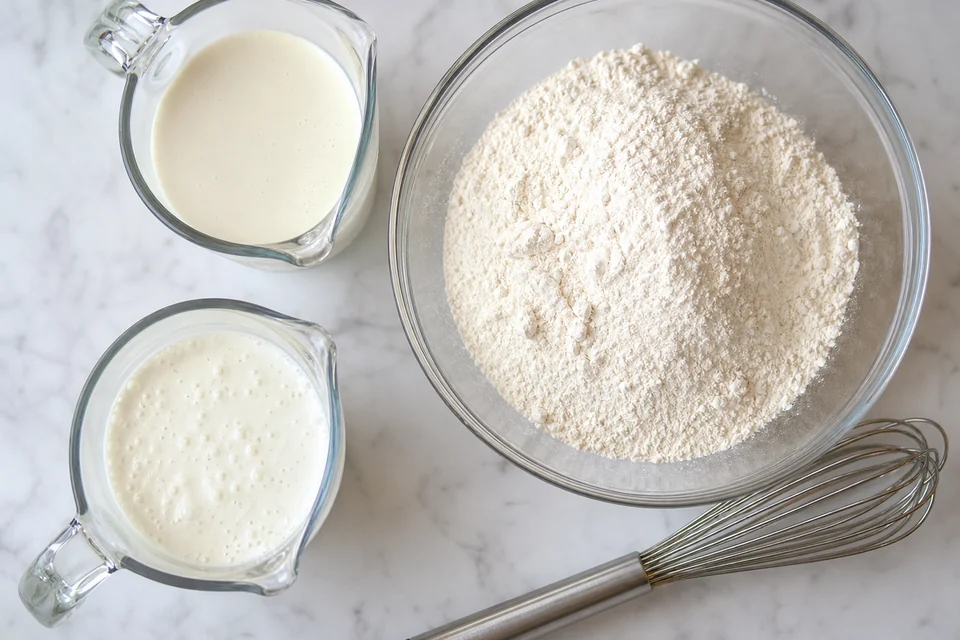
Cultured buttermilk is tangy and usually visibly thicker than drinking milk. That thickness can make two batters look different even when the same volume is used. A thicker batter may spread less on the griddle; however, spread also changes with flour absorption, rest time, mixing, and temperature. The visual difference is a cue to observe, not proof that one batch will be superior.
The label matters. Products sold under similar names can differ by market, fat level, stabilizers, and formulation. When repeating a batch, use the same product or record the change. That makes a cooking note more useful than a broad statement about all milk or all buttermilk.
Milk versus buttermilk: a practical decision table
| Question | Milk is the simpler starting point when… | Buttermilk is the simpler starting point when… |
|---|---|---|
| What does the recipe specify? | The recipe was written and balanced for milk. | The recipe was written and balanced for cultured buttermilk. |
| What flavor do you want? | You want a mild dairy background that leaves toppings prominent. | You want a distinct cultured tang in the pancake itself. |
| Which leavener is listed? | The formula already explains its baking powder or other leavener. | The formula explicitly pairs its acid and leavener choices with buttermilk. |
| How thick is the batter? | The stated milk produces the demonstrated flow and portion size. | The stated buttermilk produces the demonstrated flow and portion size. |
| Are you substituting? | You can follow a tested milk version instead of improvising. | You can follow a tested buttermilk version instead of changing one liquid alone. |
This table is deliberately recipe-specific. It does not declare a winner. If the batter is too loose, too thick, slow to set, or overly dark, first check measurements, pan heat, and the written formula before blaming the liquid.
Acidity, leavening, and why the whole formula matters
Buttermilk is acidic. In recipes that deliberately use baking soda, that acid is part of the formula’s leavening balance. Milk does not bring the same acid contribution. Swapping one for the other while leaving every other ingredient untouched can therefore change more than flavor. The result depends on how much acid and alkali the recipe contains, which is why this page does not publish a universal one-for-one promise.
Baking powder complicates broad rules further because it is formulated to provide its own acid-base system. A pancake recipe may use baking powder alone, baking soda with an acidic ingredient, or a combination. The ingredient list and tested directions are more informative than the liquid name in isolation. If you change the liquid, do not casually add extra soda in pursuit of height; excess alkali can affect flavor and browning.
Gas production is only one part of pancake height. Batter viscosity, how much the flour is mixed, how long the batter stands, the size of the portion, and how quickly the outside sets all influence the final profile. Pressing a pancake after the flip can remove height regardless of which dairy liquid was used. For that reason, a fair comparison controls technique as carefully as ingredients.
Flavor, color, crumb, and spread
Milk generally gives a mild dairy flavor. Cultured buttermilk gives a tang that can remain noticeable after cooking, especially in a lightly sweetened pancake. Toppings can mask or complement either result. A fruit topping may make the tang feel brighter, while a strongly flavored syrup can make the liquid difference harder to notice.
Surface color is not a clean measure of doneness or quality. Sugar, proteins, pan temperature, cooking fat, and time all contribute to browning. If one comparison pancake darkens faster, reduce heat or shorten the interval before the flip rather than assuming the center is cooked because the surface is brown. The pancake must be cooked through; appearance alone is not a safety endpoint.
Crumb descriptions should stay observational. You might record “smaller, even holes,” “more open center,” “soft but slightly damp,” or “firm edge.” Avoid converting one batch into a universal claim such as “buttermilk always makes the softest pancake.” A different flour, pan, leavener, or portion can reverse the result.
Spread is easiest to assess from the first pancake. Portion equal weights of batter onto the same preheated cooking surface. Note the diameter after a fixed interval. If the buttermilk batter is visibly thicker, that may explain a smaller diameter; it does not by itself prove better lift.
How to run a fair one-recipe comparison
Choose a pancake recipe that already works in your kitchen. Make half with its stated liquid as the control. For the second half, use the alternative only if the formula is suitable or you have a tested variation. Weigh ingredients where practical. Use the same flour bag, eggs, leavener, mixing bowl, rest time, pan, cooking fat, portion weight, and heat setting.
Write down the product names and fat percentages, but do not place branded packaging in the article image. Stir each batter only to the same observable stage. If one is thicker, record that instead of thinning it immediately. Cook a small first pancake from each batch, then adjust only for a documented reason. If you add liquid to one bowl, the test is no longer a direct comparison unless you record the addition.
Score what you can actually observe:
- batter flow from the scoop;
- cooked diameter and thickness;
- time until the edge looks set enough to turn;
- surface color at the same pan setting;
- center texture after a short rest;
- flavor when tasted plain and with the same topping.
Repeat the comparison before treating a result as dependable. One pancake can be distorted by a pan that was not fully heated or by a portion taken from the top of an unevenly mixed bowl.
Substitution boundaries
Milk versus buttermilk is a dairy comparison. It is not the same question as choosing oat, soy, almond, coconut, or another alternative for flavor. Those products bring different solids, sweetness, viscosity, and label considerations. Use the separate guide to milk substitutes for pancakes when that is your actual focus.
Likewise, adding lemon juice or vinegar to milk can create an acidified substitute used in some recipes, but it does not turn the product into cultured buttermilk. Treat it as a recipe-specific workaround, not an identical ingredient. Follow a method that names the acid and amount instead of improvising at the griddle.
If a recipe calls for milk and you only have buttermilk, the lowest-risk cooking choice is to select a recipe written for buttermilk. The reverse is also true. That preserves the intended liquid, leavener, sweetness, and consistency together.
Troubleshooting the current batch
If the batter barely spreads, check whether flour was overmeasured, the batter stood much longer than directed, or the chosen liquid is thicker than the recipe’s. Additions should be small and recorded. If pancakes spread too far, check missing flour, an oversized liquid measure, or a pan that is not hot enough to set the edge.
If the outside darkens before the center sets, lower the heat and make a smaller pancake. If the center is gummy, allow more cooking time at a gentler heat and confirm that the batter was not overmixed. The broader Pancake Troubleshooting hub helps separate liquid questions from heat and handling problems.
If the flavor seems flat, taste one pancake without syrup. Check salt, freshness of leavener, and the liquid’s own flavor. Buttermilk tang cannot compensate for omitted salt or stale ingredients. Milk cannot make a strongly spiced topping subtle.
Food safety, allergens, and storage
Do not taste raw pancake batter. Flour is a raw food and batter often contains raw egg; the U.S. Food and Drug Administration advises cooking foods made with flour and raw eggs rather than sampling the uncooked mixture. Keep raw batter away from ready-to-eat toppings, wash tools and work surfaces, and cook pancakes through.
Both dairy milk and cultured buttermilk contain milk. A substitute that lacks dairy ingredients is not automatically safe for a milk allergy because formulations and cross-contact statements vary. Read the current label and follow personal medical guidance. Nutrition also varies by product, serving, and recipe, so this comparison does not crown one liquid “healthier.”
Cool cooked leftovers promptly and refrigerate or freeze them under the storage guidance appropriate to your recipe and household. Do not use smell or appearance alone to override a time-temperature concern.
Frequently asked questions
Is buttermilk always better for pancakes?
No. It is the better fit when the recipe is designed around its acidity, thickness, and flavor and you like the result. Milk can be the better fit for a milk-based formula or a milder flavor.
Can I replace milk with buttermilk one for one?
Not as a universal rule. The liquid volume may look equivalent, but acidity, viscosity, leavener balance, and flavor can change. Use a tested variation.
Does buttermilk guarantee fluffy pancakes?
No. Height depends on the entire formula and technique, including leaveners, batter thickness, mixing, portion size, pan heat, and handling after the flip.
Is homemade acidified milk the same as cultured buttermilk?
No. It may serve as a recipe-specific substitute, but it is not the same cultured product. Follow a method written for that workaround.
Which one should I use with baking soda?
Use the liquid specified by the recipe. Baking soda needs an intentional acid balance; changing the liquid without reviewing the formula can change flavor, color, and rise.
Related Pancake World pages
Read why pancake recipes include eggs for another ingredient-function explanation, explore milk substitutes for pancakes for flavor-oriented alternatives, or return to Pancakes World for international pancake guides.
Sources and editorial references
U.S. Food and Drug Administration — Handling Flour Safely — https://www.fda.gov/food/buy-store-serve-safe-food/handling-flour-safely-what-you-need-know
For the wider topic, start with Guides/pancake Ingredients.
For a closely related guide, see Alternative Milks for Pancakes: How to Choose and Adjust.
A useful next comparison is Liquid Milk Substitutes for Pancakes: A Practical Comparison.
You can also continue with Eggless vs Traditional Pancakes: Flavor, Texture, and Practical Choices.
