
Quick answer
Plain, unsweetened oat, soy, almond, or rice beverage can usually serve as the liquid in a straightforward pancake recipe, but they are not identical ingredients. Brands differ in water, solids, oil, sugar, and stabilizers, so a sensible swap begins at the recipe’s stated liquid amount and ends with a rested-batter test. Coconut beverage can also work, while canned coconut milk is much richer and should not be treated as the same product.
If you need dairy-free pancakes, choose oil instead of butter and check every packaged ingredient. If you are simply out of milk, water is a workable backup in a formula that includes egg and oil. The best choice is the one that fits the eater, tastes good to you, and produces a batter you can measure and repeat.
A controlled comparison recipe
Use this small batch to compare one liquid at a time:
- 120 g all-purpose flour
- 15 g sugar
- 1 1/2 teaspoons baking powder
- 1/4 teaspoon fine salt
- 1 large egg
- 200 ml alternative milk
- 20 ml neutral oil
- 1/2 teaspoon vanilla, optional
Whisk flour, sugar, baking powder, and salt. In another bowl, whisk egg, the chosen beverage, oil, and vanilla. Fold wet into dry until no flour pocket remains. Rest for five minutes, then observe how the batter falls from a spoon. It should form a broad ribbon that spreads gradually.
Cook one small tester on a lightly oiled skillet over medium heat. Turn when bubbles open, the edge looks set, and the underside releases. Cut it open after the second side cooks. Record spread, browning, tenderness, flavor, and any tablespoon correction. Repeat the recipe with a different beverage only after cleaning the bowl and keeping flour, scoop, pan, and heat procedure constant.
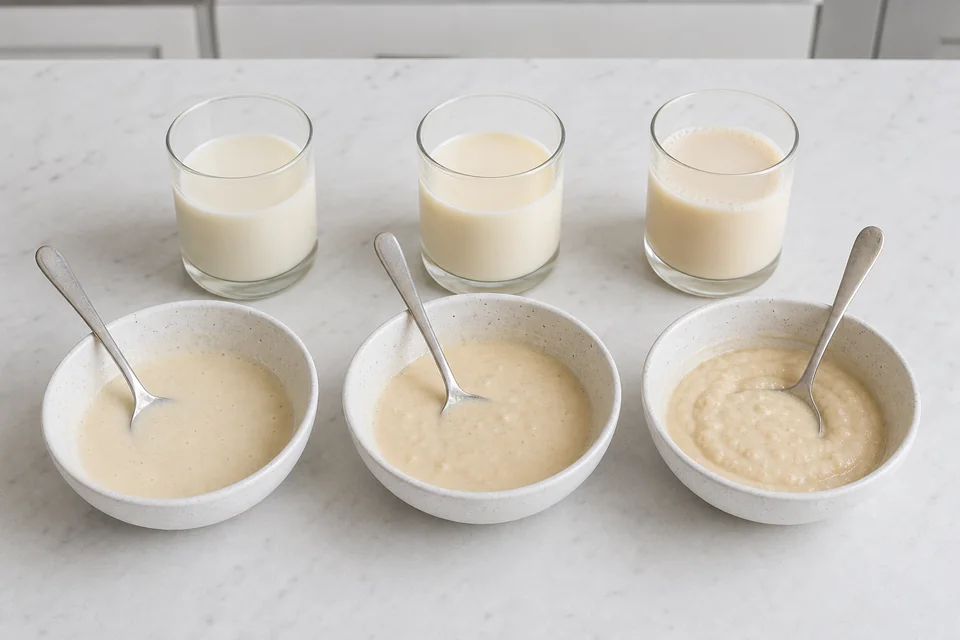
The purpose is not to declare one beverage universally superior. It is to learn how the product in your kitchen behaves. A comparison made with different flour quantities, pan settings, and pancake sizes cannot isolate the liquid.
Oat beverage
Oat beverage often has a mild cereal flavor that fits sweet pancakes naturally. Some products contain more suspended solids or gums than others, which can make the rested batter feel fuller. Begin with the full recipe amount and wait before thinning; flour and beverage solids need a moment to hydrate.
Choose unsweetened and unflavored unless the recipe is designed for added sugar or vanilla. Sweetened oat beverage can increase browning and make a lightly sweet formula taste much sweeter. If gluten avoidance matters, check the product’s gluten-free labeling rather than assuming that every oat beverage meets the same standard.
Soy beverage
Unsweetened soy beverage works well in many pancake formulas and is one of the options listed by King Arthur Baking for its tested vegan pancakes. It can provide a more substantial liquid than water, but brand behavior still varies. Shake the container as directed before measuring so settled solids are not left behind.
Soy is a major allergen in the United States. Do not present it as a neutral substitute for every eater. Read the package and choose another liquid when soy is not suitable.
Almond and other nut beverages
Almond beverage brings a light nut flavor and is often relatively thin. In a simple batter it can replace the measured milk volume, then be corrected after resting. Use an unsweetened version to keep the recipe’s sugar under control.
Almond is a tree nut, and other nut beverages carry their own allergen implications. “Plant-based” does not mean allergen-free. Check the ingredient and allergen statements, especially when a carton contains blends of nuts, pea protein, or other additions.
Rice beverage
Rice beverage tends to be light in body and can produce a thinner-looking mix. Do not add flour before the batter rests and a tester confirms excessive spread. If correction is needed, use one tablespoon flour, fold briefly, and test again.
Its mild flavor is useful when you do not want the liquid to dominate. Because products may be sweetened, compare labels before assuming two cartons will brown the same way.
Coconut beverage versus canned coconut milk
Refrigerated coconut beverage is formulated as a drink and is usually much thinner than canned coconut milk. It can be tested like the other carton beverages. Canned coconut milk contains substantially more coconut solids and fat and can make batter heavy or rich if substituted without dilution.
If coconut is the desired flavor, use a pancake recipe written for canned coconut milk or run a half-batch experiment. Do not replace 200 ml of a light beverage with 200 ml of thick canned coconut milk and expect an unchanged crumb.
Water when no alternative milk is available
Water hydrates flour but contributes no extra flavor, sugar, or fat. In the comparison formula, egg and oil supply richness and structure. The pancake may be paler, and the flavor will rely more heavily on vanilla, spice, or toppings.
Water is also useful as a correction tool. If a plant beverage makes the rested batter too thick, adding water by the tablespoon adjusts hydration without introducing more product solids.
Buttermilk is a different system
A recipe written for buttermilk may use baking soda to balance acidity, sometimes alongside baking powder. Replacing buttermilk with a neutral plant beverage changes that acid-base relationship. King Arthur Baking’s dairy-free guidance describes acidifying a non-dairy milk with lemon juice or vinegar as a buttermilk-style substitution, but that advice belongs inside a recipe that accounts for it.
For a standard baking-powder pancake, use the neutral beverage directly. For a buttermilk pancake, follow a tested dairy-free adaptation rather than keeping the original baking soda unchanged and guessing at acidity.
Diagnose the tester
It spreads too far
Confirm the pan is hot and the batter rested. If the second tester still runs into a thin puddle, add one tablespoon flour. Plant beverages can differ, but a controlled correction is better than assuming one category is always thin.
It barely spreads
Fold in one tablespoon water and retest. A beverage containing gums or higher solids may thicken the batter. Do not force a mound flat with the ladle; that can create a dense centre and irregular edge.
It browns faster than the dairy version
The product may contain added sugar, or the pan may be hotter. Read the label and reduce heat before changing the whole formula. Deep color is not automatically better, and it does not establish that a thick centre is cooked.
It tastes strongly of the beverage
Choose a more neutral product next time instead of masking it with more sugar. Vanilla, cinnamon, citrus zest, or fruit can complement a mild flavor, but they should not be used to hide rancid or unsuitable ingredients.
It is flat
The liquid may be only one factor. Check baking powder, batter thickness, mixing, and pan heat. The guide to why pancakes turn flat helps distinguish a spread problem from a leavener or handling problem.
Allergen and labeling boundaries
Dairy-free, vegan, gluten-free, nut-free, and soy-free are separate descriptions. A beverage can satisfy one and fail another. Read the full ingredient list and allergen statement on every product. Use clean equipment and appropriate cross-contact controls when the distinction is medically important.
The flour and toppings matter as much as the liquid. Swapping almond beverage into wheat pancakes does not make them gluten-free. Swapping oat beverage into an egg batter does not make it vegan. Our flour-swap guide covers the structural side of changing flour without making an individual safety promise.
Plan the next batch
Write the beverage name and exact product type in your notes: unsweetened oat beverage, canned coconut milk, and sweetened vanilla almond beverage are not interchangeable descriptions. Record the final batter correction and tester result. The next batch can then begin closer to the proven quantity.
When comparing liquids, use identical ingredient weights and portion size. Change one beverage, not the flour and topping at the same time. This turns preference into useful kitchen evidence instead of a vague memory that one batch was “better.”
Food safety
Do not taste raw batter containing flour or egg. FDA guidance advises treating flour as a raw food, and USDA guidance addresses safe handling and thorough cooking of foods containing eggs. Wash tools and work surfaces after contact with batter. Use a set edge, resilient centre, and opened tester as culinary checks, without treating surface browning as a safety guarantee.
Frequently asked questions
Which alternative milk makes the fluffiest pancakes?
There is no reliable category-only answer because the full recipe and product formulation matter. Batter thickness, leavener, mixing, portion size, and pan heat also affect height. Use the controlled half batch to compare products under the same conditions.
Can I substitute alternative milk one for one?
Start with the recipe’s stated volume in a simple baking-powder pancake. Then rest and test. A tested King Arthur vegan recipe permits several plant beverages one for one within that formula, but another recipe or carton may need a tablespoon correction.
Should I use sweetened or unsweetened?
Unsweetened, unflavored beverage gives you the clearest control over sugar and flavor. Sweetened products can work, but reduce other sugar only through a tested adjustment and expect browning to change.
Can I mix two beverages?
You can, but the result becomes harder to reproduce and diagnose. If the goal is to use small leftovers, measure the amount of each. If the goal is comparison, test them separately first.
Related pancake help
The comparison formula is an American-style pancake. If changing liquid does not resolve the observed problem, use Pancake Troubleshooting and diagnose the actual symptom.
Sources and editorial references
- King Arthur Baking, “Easy Vegan Pancakes” —
https://www.kingarthurbaking.com/recipes/easy-vegan-pancakes-recipe - King Arthur Baking, “How to bake dairy-free” —
https://www.kingarthurbaking.com/blog/2018/05/10/how-to-bake-dairy-free - Colorado State University Extension, “Ingredient Substitutions” —
https://extension.colostate.edu/resource/ingredient-substitutions/ - U.S. Food and Drug Administration, “Food Allergies: What You Need to Know” —
https://www.fda.gov/food/buy-store-serve-safe-food/food-allergies-what-you-need-know - U.S. Food and Drug Administration, “Handling Flour Safely” —
https://www.fda.gov/consumers/consumer-updates/handling-flour-safely-what-you-need-know - U.S. Department of Agriculture Food Safety and Inspection Service, “Shell Eggs from Farm to Table” —
https://www.fsis.usda.gov/food-safety/safe-food-handling-and-preparation/eggs/shell-eggs-farm-table
For more practical food and breakfast guides, visit Pancakes World.
For the wider topic, start with Guides/pancake Ingredients.
For a closely related guide, see Liquid Milk Substitutes for Pancakes: A Practical Comparison.
A useful next comparison is No-Milk Pancakes: Ingredients, Substitutions, and Method.
You can also continue with Milk Substitutes for Pancakes That Add Flavor.
For another practical angle, read Breakfast Pancake Sandwich.
