
Quick answer
Choose eggless pancakes when eggs are unavailable, intentionally excluded, unsuitable for someone eating, too prominent in a particular recipe, or simply unnecessary for the result you want. The decision can be practical, dietary, cultural, ethical, economic, or based on flavor. It does not need a health-superiority claim to be valid.
Eggs contribute several functions to many pancakes: water, fat, protein that sets with heat, emulsification, color, and some lift when beaten. Removing them therefore changes more than one thing. In a small thick pancake, flour starch and leavener may provide enough structure on their own. In an egg-rich crêpe, soufflé pancake, Dutch baby, or custardy bake, a simple spoonful of fruit purée is unlikely to reproduce the original.
The best question is not “What is the one egg substitute?” It is “What was the egg doing in this specific recipe, and which tradeoff suits this meal?” This decision guide owns that choice. For a finished formula, use the separate Lane B method page; for flavor and texture comparison, see eggless and traditional pancakes compared.
Reason 1: eggs are not available
An empty egg carton is a straightforward reason to choose an eggless recipe. A purpose-built formula can be quicker and more predictable than retrofitting an egg-heavy recipe. Flour, liquid, baking powder, a little fat, and sometimes a modest binder can produce a tender breakfast pancake.
Availability also includes cost, storage, and shopping patterns. Someone cooking for one may not want to buy a larger pack for a single batch. Another cook may have plant milk and pantry staples ready but no fresh eggs. Neither situation proves eggless pancakes are universally cheaper: commercial replacers, specialty flour, and different regional prices can reverse the comparison.
Reason 2: egg allergy or exclusion
Egg allergy can make an eggless recipe necessary, but the word eggless on a recipe is not a complete safety system. Packaged mixes, protein powders, mayonnaise-style toppings, baked garnishes, and shared tools may still contain or contact egg. Labels and kitchen practices matter.
People also exclude eggs for vegan eating, religious practice, personal ethics, or preference. An eggless pancake is not automatically vegan if it contains milk, butter, honey, whey, or a non-vegan topping. The final plate needs its own review rather than relying on the absence of one ingredient.
For serious allergy, follow qualified medical guidance and the labeling rules relevant to your location. A website recipe cannot assess a household’s cross-contact risk.
Reason 3: you prefer a different flavor
Eggs can bring richness and a recognizable aroma, especially when a recipe uses several. Some people prefer a cleaner grain, vanilla, spice, or fruit flavor. An eggless base may let cinnamon, lemon, oats, or maple lead.
The substitute also has flavor. Mashed banana is obvious and sweet; applesauce is milder but still fruity; ground flax brings seed-like notes; yogurt adds tang and dairy; chickpea liquid may be neutral in small quantities but varies. A commercial replacer can be relatively quiet, though formulas differ. Choose a substitute because its flavor belongs, not merely because it appears in a replacement chart.
Reason 4: texture priorities differ
Eggless pancakes can be soft, tender, and moist. They may be slightly less springy and may need more patience before turning. That is not automatically a defect. A eater who wants a delicate cake with crisp edges may prefer the tradeoff.
Egg-containing pancakes can brown and set efficiently, but the result also depends on flour, liquid, fat, leavener, portion, and heat. It is misleading to attribute every difference to egg. The fairest comparison uses the same pan, portion, and topping and changes only the formula intentionally.
If height is the priority, baking powder and batter thickness must be balanced with enough structure to hold gas. Simply adding more leavener to a weak eggless batter can create large bubbles that collapse or a bitter taste.
Reason 5: you want direct control over ingredients
Cooking from scratch makes the role of each ingredient visible. You can choose a neutral starch-led eggless pancake, a banana version, a flax-bound whole-grain direction, or a yogurt-based lacto-vegetarian formula. That control is one of the practical reasons described in why make pancakes from scratch.
Control is not the same as moral or nutritional purity. A boxed mix may be the right tool for time, accessibility, or consistent labeling. A scratch recipe may use more dishes and create leftover ingredients. Choose for the actual kitchen rather than an imagined ranking.
Binder options and their tradeoffs
No dedicated substitute
For small pancakes with wheat flour, a recipe may rely on starch, gluten, and baking powder. A little extra fat or starch can improve tenderness. This is the most neutral direction, but large pancakes can be fragile.
Applesauce
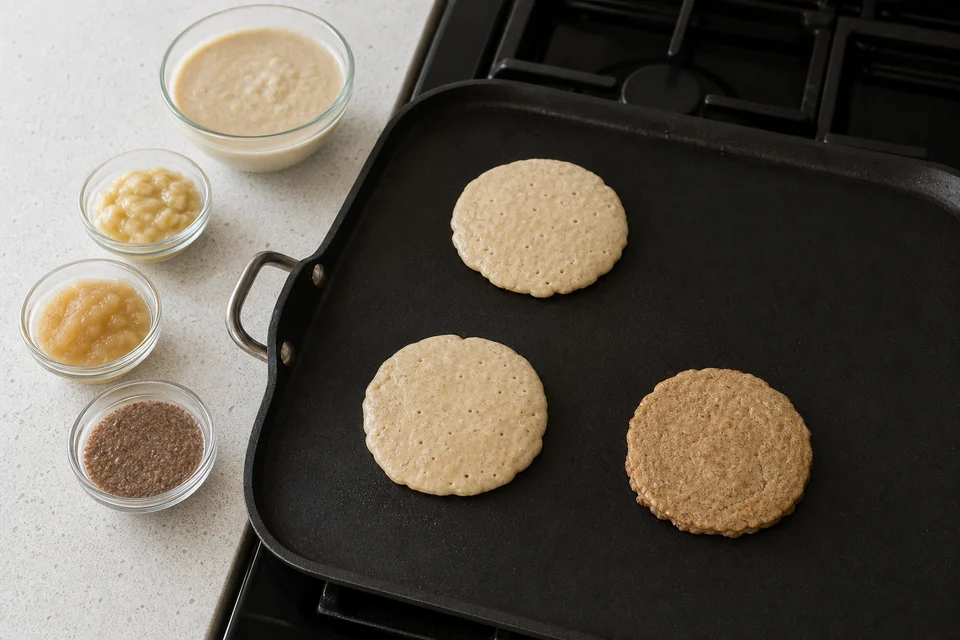
Use roughly 45–60 g in a small batch. It adds moisture, mild fruit, and some binding. Too much makes the center gummy and slows setting. Reduce other liquid rather than adding it on top without adjustment.
Mashed banana
Banana binds and sweetens while contributing a clear flavor and faster browning. It suits banana pancakes, not a neutral savory batch. Very ripe fruit contains more available sugar and can darken before the center sets.
Hydrated ground flax
Mix one tablespoon finely ground flax with about three tablespoons water and wait until thickened. It adds visible flecks and a seed flavor. It can support structure but does not create the same aeration or emulsification as a whole egg.
Yogurt
Yogurt adds moisture, protein, and acidity, but it is not dairy-free or vegan. Acidity can interact with baking soda in a recipe designed for it. Thickness varies, so hydration still needs observation.
Commercial egg replacer
Products often combine starches and gums. Follow the exact label; brands are not interchangeable by name alone. Check allergens and whether the product is intended for cakes, binding, or foaming.
A decision framework
First, identify the pancake. A standard small breakfast pancake is a friendly candidate. A soufflé-style pancake whose height depends on whipped egg whites is not. Second, identify the reason: availability, allergy, vegan eating, flavor, cost, or curiosity. Third, choose the least disruptive method. A neutral recipe needs a neutral strategy; banana belongs where banana flavor is welcome.
Fourth, decide which differences are acceptable. A softer, less springy pancake may be completely satisfactory. Fifth, test a small portion. Look at spread, edge setting, flip strength, center, and flavor before cooking the whole batch.
Diagnostics and current-batch fixes
Pancakes break during the flip
The batter may be too wet, the pancake too large, or the first side under-set. For pancakes still to cook, reduce the portion, wait for a matte edge, and support the whole round with a broad spatula. If repeated tests fail, fold in one tablespoon flour and wait two minutes.
Centers are gummy
Too much fruit purée, excess liquid, thick portions, or high heat can leave a wet center behind a dark shell. Lower heat, cook smaller rounds, and reduce the added purée in the remaining batter only if the imbalance is clear. Cut a test pancake; do not judge by surface color alone.
Batter is excessively thick
Flax, commercial gums, or whole-grain flour can keep absorbing water. Add liquid one tablespoon at a time to batter still to cook. The target is a thick ribbon that relaxes, not a pour as thin as a crêpe.
Pancakes are pale
Removing egg can reduce browning, while low heat and little sugar add to it. Confirm the center is set, then increase heat modestly for the next portion. Do not chase color until the outside burns.
Pancakes taste strongly of the substitute
Balance banana or flax with compatible spice, vanilla, citrus, cocoa, or toppings. If a neutral result was the goal, use a lower amount or a different formula next time rather than adding enough sugar to mask it.
The batch is dense
Old leavener, thick batter, excessive mixing, or a heavy purée load can all contribute. Stop stirring, thin only if needed, and keep portions modest. Reworking a mixed bowl cannot fully restore lost gas.
Prevent problems in the next batch
Start with a purpose-built eggless recipe rather than removing multiple eggs from an unrelated formula. Weigh the substitute, reduce liquid when the substitute brings water, and let gums or seeds hydrate before final adjustment. Use the same ladle and cook one small test.
Record the substitute, grams, liquid, rest, pan heat, portion, and result. If comparing options, keep every other variable fixed. Check labels before cooking for someone with allergy or a strict dietary boundary, not after the plate is served.
Nutrition and safety boundaries
Eggless does not mean lower calorie, lower fat, lower carbohydrate, higher fiber, or otherwise healthier by default. Applesauce, banana, oil, flour, syrup, and serving size all contribute. Use the exact ingredient labels and a qualified professional for individualized dietary decisions.
Raw flour remains a food-safety concern even without raw egg, so do not taste batter. Refrigerate perishable components and cooked leftovers promptly under applicable guidance. A dairy-free batter served with butter is not dairy-free; a gluten-free flour used on a shared surface may not meet a person’s cross-contact needs.
Frequently asked questions
Are eggless pancakes vegan?
Only when every ingredient and the preparation meet vegan requirements. Milk, butter, yogurt, whey, honey, and toppings still need review.
Are they automatically healthier?
No. The complete recipe, serving, and eater determine the nutritional context.
Do I always need a replacement?
No. Some purpose-built small-pancake recipes rely on flour starch, gluten, and leavener, though a binder can improve handling.
Which option tastes neutral?
A starch-led recipe or suitable commercial replacer is usually quieter than banana or flax, but products vary.
Can I remove eggs from any pancake recipe?
No. Egg-rich crêpes, oven pancakes, and soufflé styles may rely on eggs for essential structure and lift.
Why choose banana?
Choose it when moisture, sweetness, browning, and banana flavor all fit the planned pancake—not because it is universally equivalent to egg.
Related Pancake World pages
- Compare eggless and traditional pancakes.
- Return to the American pancakes hub for standard breakfast context.
- Understand another major substitution in making pancakes with water.
- Use the Pancake World troubleshooting hub for texture and heat problems.
- Review the tradeoffs behind making pancakes from scratch.
Sources and editorial references
- U.S. Food and Drug Administration, food-allergen and label guidance:
https://www.fda.gov/food/buy-store-serve-safe-food/food-allergies-what-you-need-know - U.S. Food and Drug Administration, raw flour and batter safety:
https://www.fda.gov/consumers/consumer-updates/flour-raw-food-and-other-safety-facts - U.S. Food and Drug Administration, understanding the Nutrition Facts label:
https://www.fda.gov/food/nutrition-facts-label/how-understand-and-use-nutrition-facts-label
For more practical food and breakfast guides, visit Pancakes World.
For the wider topic, start with Guides/pancake Ingredients.
For a closely related guide, see Eggless Pancakes: A Reliable Fluffy Recipe and Troubleshooting Guide.
A useful next comparison is Lemon Juice in Pancake Batter: Control Acidity and Flavor.
