
Quick answer
Crispy duck pancakes are assembled at the table from hot cooked duck, thin soft wheat wrappers, cucumber, scallions, and a savoury-sweet sauce. The “pancake” is the wrapper, not a fluffy breakfast cake. A good portion balances crisp duck skin, tender meat, fresh vegetables, and enough sauce for flavour without soaking the wrapper.
For a reliable home version, use fully cooked roast duck prepared through a trusted recipe or a commercial product used exactly as directed. Re-crisp only as its instructions allow, warm the wrappers under cover, cut vegetables into short batons, and keep every component separate until service. This page does not claim that the common takeaway dish is identical to formal Beijing roast-duck traditions or that one sauce and garnish define all Chinese service.
Know what the name means
On many English-language menus, “crispy duck pancakes” describes shredded or sliced duck rolled in thin wrappers with cucumber, scallion, and hoisin-style or plum-style sauce. The duck may be roast duck, aromatic crispy duck, or another house preparation. Those terms should not be treated as interchangeable proof of technique or origin.
Peking or Beijing roast duck is a specific culinary subject with a long documented context. A convenient home assembly using cooked duck can be inspired by the wrapper-and-garnish format without claiming to reproduce the full restaurant craft. The broader bing guide for China and Taiwan explains why one English word such as pancake can cover very different doughs and batters.
Components for eight wrappers
- 300 to 350 g hot fully cooked duck meat with crisp skin, boned and shredded or thinly sliced
- 8 thin Mandarin-style wheat wrappers, commercial or made through a tested recipe
- 1/2 cucumber, cut into short narrow batons
- 4 scallions, cut into short narrow strips
- 80 ml hoisin-style, plum-style, or recipe-specific duck sauce
- Optional coriander leaves, used sparingly
The amounts are a starting point. Wrapper diameter and duck yield determine the actual portion. Check sauce and wrapper labels for wheat, soy, sesame, sulphites, and other allergens. A sauce name does not establish one universal ingredient list.
Prepare or reheat the duck
If starting with raw duck, follow a complete tested roast-duck recipe and current poultry-safety guidance. This page does not compress raw-duck preparation into an unsafe shortcut. If using a chilled or frozen cooked product, follow its storage, thawing, oven, and doneness instructions.
To protect texture, keep skin pieces broad enough to remain crisp and meat shreds short enough to roll. Remove bones carefully and discard any hard fragments. Do not shred the duck into hair-fine strands that dry before the wrappers are ready.
If fully cooked duck needs re-crisping, arrange it in one layer and use the product or recipe method. A deep pile steams. Sauce should not go onto the duck during re-crisping because sugar can scorch and moisture softens skin.
Warm the wrappers
Commercial wrappers may require steaming, microwaving under a damp cover, or warming in a dry pan. Follow the package. The goal is a hot, flexible wrapper that separates without tearing and is not wet.
Keep the stack covered once warm. Exposure dries thin edges quickly; heavy condensation makes them sticky. Work in small batches and place parchment between wrappers only if the selected product method permits it.
If making wrappers from scratch, use a tested Mandarin-pancake formula. The hot-water dough, paired rolling technique, pan cooking, and separation step are not equivalent to mixing American pancake batter.
Cut cucumber and scallions
Cut cucumber into batons slightly shorter than the wrapper radius. Remove a watery seed core if it floods the board, then blot the pieces. Cut scallions into similarly short strips. Very long vegetables puncture the side of the roll and pull out on the first bite.
Keep vegetables cold and dry until the duck and wrappers are ready. Do not dress them with salt or vinegar in advance; that draws out water and competes with the sauce.
Assemble one balanced pancake
Lay one warm wrapper flat. Spread a thin line of sauce across the centre, leaving a border. Add a modest amount of duck, including a little skin, then two or three cucumber and scallion strips. Fold the lower edge over the filling, bring in the sides if the wrapper size allows, and roll without crushing.
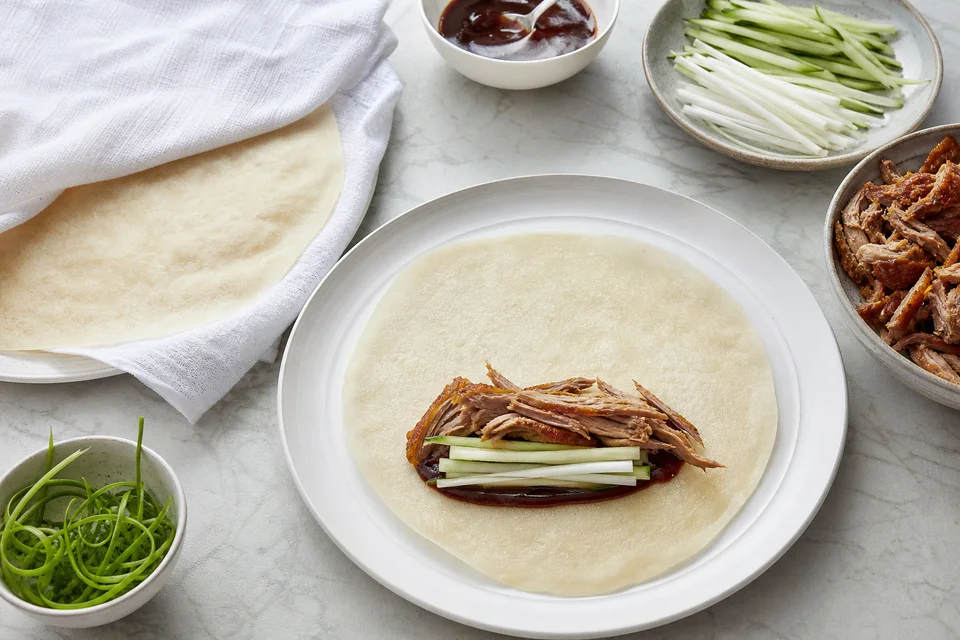
Eat it promptly. A pre-assembled tray waits in its own steam and loses the contrast that makes the dish appealing. The first roll is a calibration: if it bursts, reduce filling; if it tastes dry, add a small amount of sauce rather than soaking the wrapper.
Choose the sauce deliberately
Hoisin-style sauce is thick, salty, sweet, and often based on fermented soybean ingredients. Plum-style sauce is fruitier and product-specific. Some duck sauces are neither. Use the product you have, read its label, and thin it only when the recipe or manufacturer supports that change.
Serve sauce in a bowl with a clean spoon rather than dipping bitten rolls. If the sauce is powerful, spread it thinly. A larger amount does not create a more authentic result; it can erase the duck and make the wrapper tear.
Coordinate the meal
Prepare vegetables and serving dishes before reheating the duck. Warm wrappers while the duck rests briefly, then place all components on the table together. A useful sequence is:
- Cut and chill cucumber and scallion.
- Portion sauce.
- Reheat or finish the duck through its recipe.
- Warm wrappers near the end.
- Shred duck while hot and remove bones.
- Serve immediately for self-assembly.
For a larger meal, add steamed greens, rice, or a light soup rather than doubling the filling in every wrapper. The savory pancake toppings guide offers more ideas for moisture and texture balance, though this duck assembly remains its own format.
Why timing matters more than decoration
The duck and wrapper want opposite holding conditions. Duck skin stays crisper when exposed to dry heat and air, while wrappers stay flexible when warm and covered. Holding them together sacrifices both. Cucumber also releases water after cutting, and sauce begins migrating into the wrapper immediately.
That is why a neat component board is not merely presentation. It is the texture-control system. Put hot duck on a warm plate, keep wrappers in a covered basket or steamer as directed, and keep vegetables and sauce in separate dishes. Bring small refills from the kitchen rather than letting the full supply cool or dry on the table. Clean tongs for duck and a separate spoon for sauce also keep the service orderly.
Wrapper alternatives and limits
Mandarin-style wrappers are the intended choice. Flour tortillas are thicker and taste different; spring-roll skins may require different cooking; lettuce cups remove the wheat wrapper and create another dish. Use an alternative honestly rather than labelling it equivalent.
If gluten or another allergen is a concern, a generic “gluten-free wrapper” swap is not enough. Sauce, duck seasoning, wrapper product, shared pan, and kitchen cross-contact all require verification. A lettuce cup can be a practical adaptation but does not make the original dish certified allergen-free.
Current-batch fixes
The wrappers tear: Keep them covered, warm fewer at a time, and reduce filling. If the edges are dry, the product may have been overheated or exposed too long.
The wrappers stick together: Follow the package separation method and avoid excess steam condensation. Do not rip the centre with a knife.
The duck skin is soft: Spread duck in one layer and re-crisp only through its approved method. Sauce and covered holding will soften it again.
The meat is dry: Stop heating. Mix skin and meat in each portion and use a small amount of sauce; do not continue roasting in hope of restoring moisture.
The roll bursts: Shorten vegetable batons, reduce the duck, and leave a clean border. A wrapper is not designed to hold a dinner-size mound.
The centre is cool: Return the duck—not the raw vegetables or assembled rolls—to the appropriate heating process and verify its endpoint.
The Pancake Troubleshooting hub covers shared heat and handling symptoms.
Prevent the next batch from drifting
Count wrappers before reheating the duck and weigh the usable boned meat. Divide the duck by wrapper count so the first diners do not take oversized portions. Record wrapper brand, warming method, sauce, and re-crisping method.
Prepare one reference roll and look at the cross-section. The duck, vegetable, and sauce should all be visible. If testing a new sauce, keep wrapper and portion stable. If making wrappers from scratch, test that separate recipe before planning the full duck meal.
Food-safety and storage boundary
Raw and cooked poultry require careful separation. Use clean boards and utensils, follow current safe-temperature guidance, and do not return cooked duck to a plate that held it raw. Commercial products may already be fully cooked or may require full cooking; the label decides.
Cool leftover duck promptly and refrigerate it under current official leftovers guidance. Store wrappers, sauce, and vegetables separately. Reheat only the duck portion needed until hot throughout. Discard assembled leftovers that have sat out for an uncertain period; reheating cannot repair their handling history.
FAQ
Are crispy duck pancakes the same as Peking duck?
Not necessarily. The English menu phrase can describe several duck preparations. Formal Beijing roast duck has its own technique and context.
What are the pancakes made from?
They are thin wheat wrappers, often called Mandarin pancakes, made from a hot-water dough or purchased ready to warm. They are not fluffy batter pancakes.
Can I use leftover roast duck?
Yes when its storage history is known and it remains suitable under current leftovers guidance. Reheat it thoroughly and accept that skin texture may differ.
How much filling goes in each wrapper?
Use a modest line of duck and a few vegetable strips. The wrapper should close without stretching or tearing.
Can I assemble them before guests arrive?
It is better to prepare components and let guests assemble. Pre-filled wrappers become damp and lose their temperature and texture contrast.
Related Pancake World guides
Read bing in China and Taiwan for wrapper and pancake terminology, explore savory pancakes around the world, and use savory pancake toppings for wider plate-building ideas.
Sources and editorial references
- Encyclopaedia Britannica: Peking Duck —
https://www.britannica.com/topic/Peking-duck - USDA Food Safety and Inspection Service: Safe Minimum Internal Temperature Chart —
https://www.fsis.usda.gov/food-safety/safe-food-handling-and-preparation/food-safety-basics/safe-temperature-chart - USDA Food Safety and Inspection Service: Leftovers and Food Safety —
https://www.fsis.usda.gov/food-safety/safe-food-handling-and-preparation/food-safety-basics/leftovers-and-food-safety
For more practical food and breakfast guides, visit Pancakes World.
For the wider topic, start with World Pancakes.
For a closely related guide, see Duck with Mole Sauce and Peking-Style Pancakes.
A useful next comparison is Peking Duck Pancakes: Wrappers and Assembly.
You can also continue with Korean Seafood Pancake: Haemul Pajeon Recipe.
For another practical angle, read Quinoa Flour Pancakes: Control Bitterness and Build Structure.
