
Quick answer
Haemul pajeon is a Korean savory pancake built around green onions and seafood. A useful home version keeps the batter thin enough to bind rather than bury the ingredients, drains the seafood thoroughly, uses a visible film of oil, and cooks a manageable pancake over medium-high heat before a supported turn.
The texture target is crisp at the edge and browned underneath, with a fully set center, tender scallions, and safely cooked seafood. A soggy pajeon usually comes from excess water, a crowded or thick pancake, low pan heat, too little oil contact, or stacking after cooking.
This page owns the specific haemul pajeon recipe. The existing pajeon and bindaetteok guide carries the broader comparison between Korean jeon styles, so the two guides do not compete for the same purpose.
Ingredients for two medium pancakes
For the batter:
- 100 g plain flour;
- 30 g rice flour;
- 20 g cornstarch;
- 1/2 teaspoon fine salt;
- 1 large egg;
- 210 ml ice-cold water;
- 1 teaspoon toasted sesame oil, optional.
For the pancake:
- 180 g mixed seafood, such as small peeled shrimp and cleaned squid;
- 120 g long green onions or scallions;
- 1 mild red chili, thinly sliced, optional;
- 4–6 tablespoons neutral high-heat oil across both pancakes.
For dipping sauce:
- 2 tablespoons soy sauce;
- 1 tablespoon rice vinegar;
- 1 tablespoon water;
- 1 teaspoon toasted sesame oil;
- 1 teaspoon toasted sesame seeds;
- sliced green onion and chili to taste.
Seafood choice is flexible, not unlimited. Shrimp, squid, mussel meat, and small pieces of firm fish appear in different versions. Every product has its own preparation, allergen, and doneness considerations. If using frozen seafood, thaw it safely according to its label, drain in a sieve, and blot thoroughly. Large or wet pieces cool the pan and release steam.
Rice flour and cornstarch support a crisper, less bread-like shell, while wheat flour supplies cohesion. Ice-cold water slows early hydration and keeps the batter fluid. It is a practical home formula, not a claim that every haemul pajeon uses this exact blend.
Prepare seafood and scallions first
Cut squid into narrow rings or 2 cm pieces. Keep shrimp small; halve larger shrimp lengthwise. Check shellfish and fish for shell fragments or bones as appropriate. Blot every piece. Season very lightly with salt only if the seafood and dipping sauce are not already salty.
Trim scallions to fit the 22–24 cm pan. If the white portions are very thick, split them lengthwise so they soften with the greens. Keeping them long makes the green-onion structure visible, but shorter sections are easier to turn. Either form can be appropriate.
Mix the dipping sauce before cooking. Taste it with a clean spoon. It should be sharp and salty enough to season a bite, but diluted enough that it does not dominate the pancake. Bottled soy sauces vary, so the water is an adjustment rather than a fixed cultural rule.
Mix the batter briefly
Whisk flour, rice flour, cornstarch, and salt. In another jug whisk egg, ice water, and optional sesame oil. Pour wet into dry and stir just until no pockets of dry flour remain. Small lumps are acceptable. Long mixing develops more gluten and can make the coating chewy.
The batter should pour easily and coat a scallion without forming a thick jacket. If it sits in a mound, add cold water one tablespoon at a time. If it runs off like clear water and cannot connect ingredients, whisk in one tablespoon flour. Keep it cool while the pan heats.
Do not taste the raw batter. Flour and egg are uncooked, and seafood utensils should remain separate from finished food.
Arrange and cook the first side
Heat a broad skillet over medium-high heat. Add about 2 tablespoons oil and swirl to cover the cooking area. The oil should shimmer but not smoke. Arrange half the scallions in a single broad layer. Scatter half the seafood evenly, leaving pathways for batter to connect the pancake.
Pour half the batter over and between the ingredients. Use the spatula to guide it to the edge without building a thick center. Add chili slices if using. The pancake should sizzle promptly. If the pan is silent, the temperature or oil contact is too low.
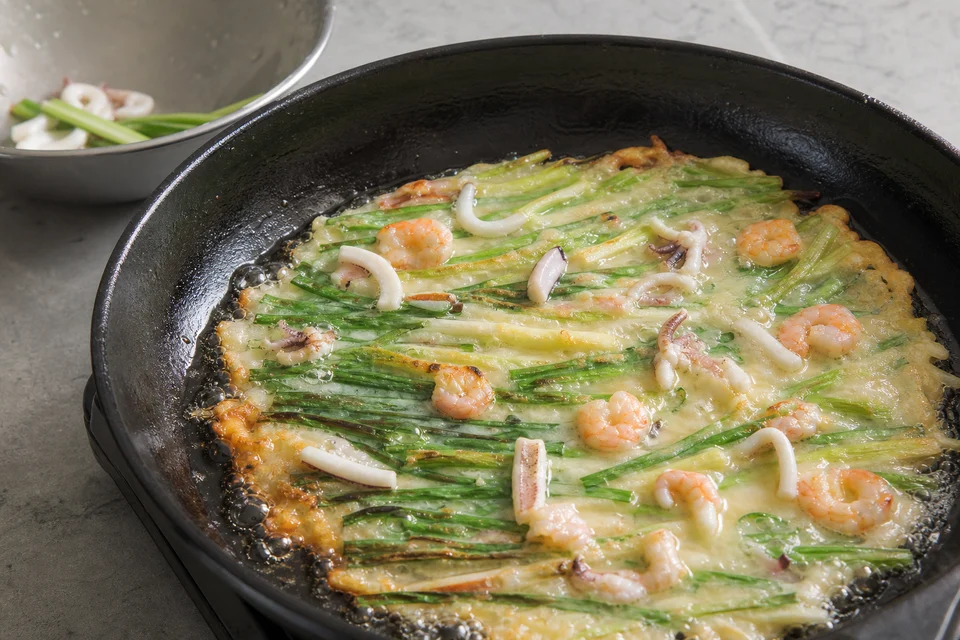
Cook until the perimeter is set and crisp, the upper batter is mostly matte, and the underside is deeply golden when lifted at one point. Rotate the pan on the burner if heat is uneven. Drizzle a little oil around dry-looking edges so it can travel underneath.
Turn without breaking the pancake
Slide a wide spatula under several points to ensure release. If you are not comfortable tossing, use the plate method: slide the pancake onto a flat heatproof plate, place the pan upside down over it, then invert carefully. Protect hands from hot oil and steam.
Add another tablespoon oil if the pan is dry, then cook the second side. Press only at obvious high spots so seafood and scallions contact the surface. Flattening the whole pancake squeezes moisture into the crumb and does not guarantee a cooked center.
Cook until the seafood reaches its validated safe endpoint and the batter is set. Cut into the center of the first pancake. No glossy raw batter should remain. Shrimp and squid appearance can support observation, but use product-appropriate seafood guidance rather than one universal visual rule.
Transfer to a rack for a minute, then cut into wedges. Do not stack the second pancake directly on top; trapped steam softens both. Serve with dipping sauce on the side.
Control crispness deliberately
Crispness begins before batter reaches the pan. Dry seafood, a preheated broad surface, a thin ingredient layer, and enough oil are more effective than cooking a thick wet pancake for a long time. The flour blend supports the surface, but it cannot overcome a pool of seafood liquid.
Keep the pancake moderate in size. A restaurant may use a broad seasoned griddle and confident toss; a home cook gains more from two 22 cm pancakes than one that overhangs the burner. Let the pan return to heat before the second batch.
Eat soon after cooking. The moist filling continues releasing steam. A rack preserves the crust better than a plate, and sauce served alongside prevents it soaking the wedges in advance.
Variations and limits
For a shrimp-focused pajeon, use small shrimp and omit squid. For a vegetable-forward version, use more scallion with thin red pepper and mushroom, but label it accurately if seafood is absent. Kimchi adds acid, salt, and moisture; squeeze and cut it, then reduce other salty seasoning.
A commercial Korean pancake mix can be convenient, but follow its label and do not add the entire salt quantity from this scratch formula automatically. Mixes may already contain starch, seasoning, or leavener.
Some recipes pour beaten egg over the arranged scallions separately; others include egg in the batter or omit it. These produce different surfaces and binding. This formula keeps one egg in the batter for manageable home turning.
Diagnostics and current-batch fixes
Pajeon is soggy
Wet seafood, crowded ingredients, thick batter, low heat, or a covered stack are likely causes. For pancakes still to cook, blot the remaining seafood, reduce filling per pancake, let the pan recover, and spread a thinner layer. Put the current pancake on a rack and return wedges briefly to a hot skillet if their centers were already safely cooked.
Underside burns before center sets
The heat is too aggressive or the pancake too thick. Move the pan off heat, lower the burner, and finish more gently. For the next pancake, divide the mixture into a smaller diameter or use less batter.
Pancake breaks at the flip
The first side may be under-set, batter too sparse, or seafood pieces too large. Let the current pancake develop a stronger base and use the plate method. For batter still to cook, cut ingredients smaller and make sure flour connects the whole layer.
Seafood releases a pool of water
Remove the pan from direct high heat to control spitting. Carefully drain only if safe, then continue cooking and verify doneness. Thaw, sieve, and blot the remaining seafood more thoroughly.
Batter is chewy
Overmixing, too much wheat flour, and long low-heat cooking can contribute. Stop stirring the current bowl and spread thinner. Next time keep the rice flour and starch proportions and mix only until combined.
Pancake sticks
The pan may be cool, insufficiently oiled, damaged, or approached too early. Add a little oil around the edge, wait for a set base, and loosen progressively. A broad suitable surface is worth more than forcing a poorly maintained pan.
Prevent problems in the next batch
Thaw seafood in advance, weigh it after draining, and blot it. Cut pieces small and split thick scallion whites. Chill the water, whisk the batter only at the last moment, and preheat the pan fully. Divide seafood, scallions, and batter into two portions before cooking.
Record pan diameter, oil, heat, and useful visual cues. Practice the plate turn with a cold empty pan if needed. Set the dipping sauce and rack out first so the finished pancake does not steam while you look for a serving dish.
Food-safety and allergen boundaries
Seafood may introduce crustacean shellfish, molluscan shellfish, or fish allergens. Batter and sauce can contain wheat, egg, soy, and sesame. A seafood-free variation cooked on the same pan may still be unsuitable for someone with allergy. Check all labels and control cross-contact deliberately.
Follow seafood-specific thawing, handling, and doneness guidance. Do not taste raw batter. Refrigerate cooked leftovers promptly within applicable limits. Reheat in a skillet or hot oven for texture, but only if the food was handled safely in the first place.
Frequently asked questions
What does haemul pajeon mean?
It refers to a Korean green-onion pancake made with seafood. Seafood mixtures and batter methods vary.
Can I use frozen seafood?
Yes. Thaw it safely according to its label, drain it thoroughly, blot it, and follow its cooking guidance.
Why is my pajeon soggy?
Wet seafood, crowding, a thick pancake, low heat, too little oil contact, and stacking are common practical causes.
Can I make one giant pancake?
You can, but two medium pancakes are easier to heat evenly and turn on a home burner.
How do I know the seafood is done?
Use validated guidance for the exact seafood plus a fully set batter. Appearance alone is not a universal endpoint.
Can I reheat pajeon?
A lightly oiled skillet or hot oven protects crust better than a microwave, within safe leftover limits.
Related Pancake World pages
- Compare broader Korean styles in the pajeon and bindaetteok guide.
- Place the dish among savory pancakes around the world.
- Browse 22 savoury pancake recipes.
- Balance sauce and sides with the savory pancake topping guide.
- Diagnose heat, sticking, and wet centers at the Pancake World troubleshooting hub.
Sources and editorial references
- Korean Cultural Center, Korean food-culture context for pajeon:
https://www.korean-culture.org/eng/webzine/201807/sub01.html - U.S. Food and Drug Administration, seafood selection and handling:
https://www.fda.gov/consumers/consumer-updates/selecting-and-serving-fresh-and-frozen-seafood-safely - U.S. Food and Drug Administration, raw flour and batter safety:
https://www.fda.gov/consumers/consumer-updates/flour-raw-food-and-other-safety-facts - USDA Food Safety and Inspection Service, leftovers and cooling:
https://www.fsis.usda.gov/food-safety/safe-food-handling-and-preparation/food-safety-basics/leftovers-and-food-safety
For more practical food and breakfast guides, visit Pancakes World.
For the wider topic, start with World Pancakes.
For a closely related guide, see 3 Bánh Xèo Recipes: Crisp Vietnamese Pancakes at Home.
A useful next comparison is Crispy Duck Pancakes: Wrappers, Fillings, and Assembly.
You can also continue with Korean Courgette Pancakes with Dipping Sauce.
Related reading
Image note: Editorial images were created and refined with AI.
