
Quick answer: what makes bánh xèo work?
Bánh xèo is a Vietnamese savory rice-batter pancake cooked thin and crisp, filled while it is still in the pan, then folded. Its familiar yellow color commonly comes from turmeric rather than egg. The finished pancake is usually eaten with fresh leaves and herbs and a dipping sauce, so crisp shell, warm filling, cool greens, and bright sauce all belong to the experience.
Three things matter more than chasing one supposedly universal “authentic” formula. The batter must be loose enough to spread in a quick thin layer. The pan must be properly hot before that batter arrives. The filling must be cooked or nearly cooked and must not release enough water to steam the shell soft. Regional, household, and restaurant versions vary in size, fat, coconut, fillings, and service. The recipes below keep that variation visible rather than claiming that one is the only correct bánh xèo.
This guide explains the historical promise of three Vietnamese bánh xèo recipes: shrimp and pork, mushroom and tofu, and small mung-bean-and-shrimp pancakes. Each uses the same practical rice-flour framework, then changes filling, size, and serving plan.
A flexible crisp batter for all three recipes
For about six 20 cm pancakes, begin with:
- 200 g rice flour;
- 25 g cornstarch or tapioca starch;
- 1 teaspoon ground turmeric;
- 1/2 teaspoon fine salt;
- 330 ml cold water, plus up to 40 ml for adjustment;
- 150 ml unsweetened coconut milk;
- 3 spring onions, thinly sliced;
- neutral high-heat cooking oil.
Whisk the dry ingredients together, then add the water and coconut milk. Stop when no dry pockets remain; rice batter does not need prolonged beating. Rest it for 30 minutes, stir in the spring onions, and check the flow. A ladleful should run readily around a tilted pan. It should not sit like American pancake batter, but it also should not look like clear water with sediment beneath it.
Rice flour settles. Stir from the bottom before every pancake. If the first test pancake forms a thick layer before it can travel, add water one tablespoon at a time. If it tears like a wet lace doily and never gains a continuous surface, stop adding liquid and let the next portion cook slightly longer. A measured first pancake tells you more than changing the whole bowl in advance.
Coconut milk brings flavor and richness, but it is not a licence to make the batter heavy. Products differ in concentration. If yours is very thick, part of the adjustment water may be needed. For a coconut-free version, use water and expect a leaner flavor; do not silently substitute a sweetened drink.
Equipment and preparation before the pan heats
A well-seasoned carbon-steel pan, cast-iron skillet, or reliable nonstick skillet can work. A broad 20–24 cm cooking surface is easier than a high-sided saucepan. You also need a lid, a thin spatula, a ladle, and a rack or individual plates. Stacking hot bánh xèo traps steam and sacrifices the crust.
Wash and dry herbs and lettuce before cooking. Mix the sauce before the first pancake. Slice fillings thinly, cook raw meat or seafood according to the recipe, and drain vegetables well. Once batter hits the pan, there is little time to search for sprouts or chop herbs.
The pan is ready when a tiny drop of batter begins to sizzle promptly without blackening. Add enough oil to make a visible film. Bánh xèo is not dry-griddled: good contact with hot oil helps produce its lacy, crisp edge. Excess oil can make the plate greasy, so replenish a modest amount between pancakes instead of filling the pan.
Recipe 1: shrimp, pork, and bean-sprout bánh xèo
For six pancakes, prepare 180 g thinly sliced pork shoulder, 180 g peeled shrimp, one small sliced onion, and about 250 g rinsed bean sprouts. Keep raw pork and shrimp separate from herbs and serving leaves. Cook the pork in a lightly oiled skillet until no raw areas remain. Add onion, then shrimp, and cook until the seafood reaches the safe endpoint appropriate to its size. Transfer the filling to a clean bowl.
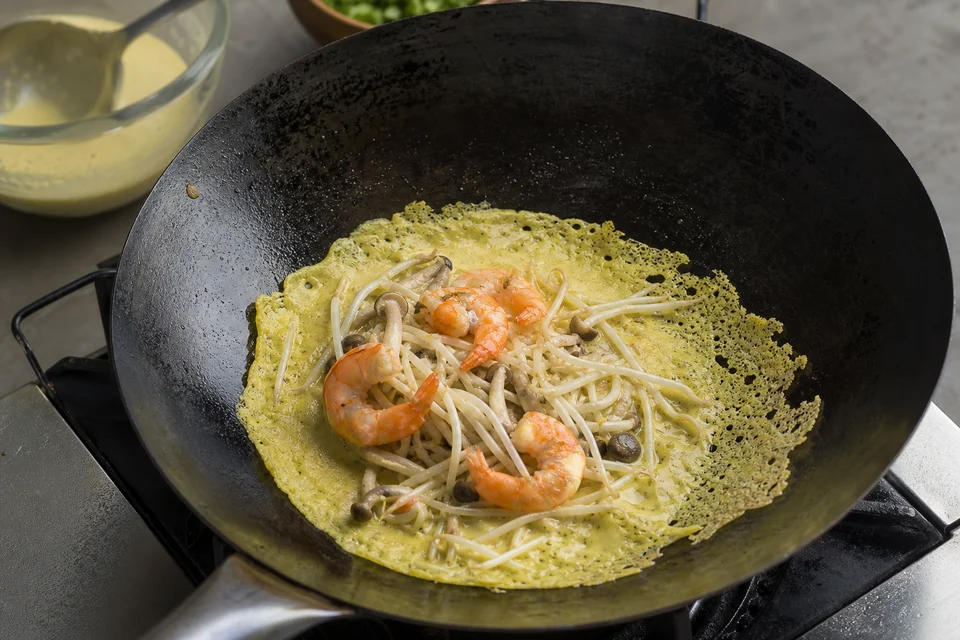
Reheat and oil the pan. Scatter a small portion of pork, shrimp, and onion across one side. Ladle roughly 80 ml batter around the pan while tilting immediately. The batter should hiss and form a thin round. Add a small handful of sprouts to the filling side, cover for about one minute to soften them, then uncover.
Continue cooking until the underside is deeply golden, the edge lifts, and the top looks dry rather than gummy. Drizzle a few drops of oil around a reluctant edge. Fold the unfilled half over the filling and slide the pancake onto a rack or plate. Do not press it flat. Serve at once or hold briefly in a low oven on a rack, never in a covered stack.
Recipe 2: mushroom and tofu bánh xèo
This version replaces animal filling rather than pretending that every sauce and shared pan is automatically vegetarian. Use 250 g firm tofu, pressed and cut into thin batons; 250 g sliced oyster, shiitake, or brown mushrooms; one small sliced onion; and 200 g bean sprouts. Season lightly with salt and pepper so the filling does not flood the pancake with liquid.
Brown the tofu in a small amount of oil and set it aside. Cook the mushrooms in batches until their released moisture has evaporated and their edges begin to color. Add onion near the end. A pale, wet mushroom mixture will steam the shell, so this reduction step is structural as well as flavorful.
Pour and spread the batter as in Recipe 1. Place tofu and mushroom on one half, add sprouts, cover briefly, then uncover and crisp completely before folding. Serve with a plant-based dipping sauce whose complete ingredient list you have checked. A fish-sauce-based nước chấm is not vegetarian merely because the pancake filling is tofu.
For a softer vegetable addition, use very thin carrot or mung-bean sprouts. Avoid a mound of cabbage, courgette, or frozen vegetables unless they have been cooked and drained. Their water is the common path from crisp pancake to steamed wrapper.
Recipe 3: small mung-bean-and-shrimp bánh xèo
Smaller pancakes are easier to manage and create more crisp edge. Soak 80 g split hulled mung beans until tender enough for the recipe plan, drain thoroughly, and steam or cook them until tender but not soupy. Prepare 180 g peeled small shrimp, 150 g sprouts, sliced spring onion, and the base batter.
Cook the shrimp separately and keep it warm. Use a 16–18 cm skillet or pour smaller portions into a broad pan one at a time. Add a spoonful of mung beans and two or three shrimp to one side, then pour about 55 ml batter and tilt quickly. Add a few sprouts, cover only long enough to soften them, and finish uncovered until the base is crisp.
The mung beans should appear as a filling, not disappear into a thick blended batter. If they roll out during folding, use less. These smaller pancakes suit a table where each person wraps one crisp piece at a time with lettuce and herbs.
This variation is a practical home interpretation, not a claim that one size or filling represents every Vietnamese region. Keep the dish name and method clear; “mini taco” may describe the hand motion to an unfamiliar diner, but it should not replace the food’s own name.
How to serve, wrap, and dip bánh xèo
Put lettuce, mustard greens if available, mint, coriander, and other chosen herbs on the table. Tear off a crisp piece of bánh xèo, place it in a leaf with herbs, fold the leaf around it, and dip. Large pancakes are normally easier to eat in pieces than as one folded parcel.
A balanced dipping sauce may combine fish sauce, water, lime, sugar, garlic, and chili in recipe-specific proportions. Fish sauce strength varies, so a fixed spoon count is not universal. Taste for salt, acidity, sweetness, and heat. For the tofu version, choose a clearly plant-based sauce and do not call it fish sauce.
Keep sauce beside the pancake rather than pouring it over the whole plate. Sauce added early migrates into the crust. Serve herbs cool and dry; wet leaves dilute the dip and soften the food.
Crispness diagnostics and current-batch fixes
| What you see | Likely cause | Fix the pancakes still to cook |
|---|---|---|
| thick, flexible shell | batter too thick or too much batter | add water one tablespoon at a time and use a smaller ladle |
| pale, oily surface | pan was cool before pouring | preheat longer and wait for a prompt sizzle |
| dark outside, wet top | heat too high for the thickness | lower heat slightly and spread the next pancake thinner |
| shell tears during folding | turned or folded before the center set | cook uncovered longer and loosen the whole edge first |
| crisp edge but soft center | filling too wet or piled too high | drain filling and reduce the amount |
| first pancake sticks | pan seasoning, insufficient oil, or premature release | add a thin oil film and wait for browning before lifting |
| later batter becomes uneven | rice flour settled | stir from the bottom before every ladle |
For a soft pancake already on the plate, place it open-side down in a clean lightly oiled skillet over moderate heat. Recrisp briefly without adding more filling. It will not become identical to a fresh one, but direct dry heat can improve the base. Do not microwave when crispness is the goal.
Prevent the same problem in the next batch
Record the batter liquid, ladle volume, pan size, and heat setting that produced your best pancake. “Medium-high” differs between appliances; the observable target is immediate sizzling without scorching before the top sets. Change one variable at a time.
Cook watery vegetables ahead, drain sprouts, and keep prepared fillings in small portions. Stir the batter before every pour. Re-oil lightly and allow the pan to recover its heat between pancakes. Use a rack if you must hold them. A covered plate, deep pile, or generous sauce is a deliberate choice for softness, not a crispness strategy.
If you want to compare other vegetable-rich griddle foods, the Korean jeon guide explains why a scallion pajeon behaves differently. The savory pancakes around the world overview also keeps rice batters, pulse batters, doughs, and filled flatbreads distinct.
Food-safety and allergy boundaries
Do not taste raw batter. Rice flour and starch are still raw dry ingredients, and the filling may include raw pork or seafood. Use separate utensils and boards for raw animal foods and ready-to-eat herbs. Cook pork and seafood fully, follow current official guidance for the specific ingredient, and move cooked filling to a clean container.
Rice flour does not make the whole meal automatically gluten-free. Commercial flour mixes, sauces, seasoning, shared utensils, and cooking surfaces can introduce wheat. Fish sauce contains fish; soy-based alternatives may contain soy and wheat. Shrimp is a crustacean allergen. Coconut and tofu also matter for some diners. Verify actual labels and kitchen practice rather than inferring from the dish name.
Cooked fillings and leftover pancakes should not remain at room temperature indefinitely. Cool and refrigerate promptly under current food-safety guidance. Reheat only leftovers that were handled safely. Texture quality is best when the filling is prepared ahead but each pancake is cooked just before eating.
Frequently asked questions
Does bánh xèo contain egg?
Many bánh xèo batters use turmeric for the yellow color and contain no egg, but formulas vary. Check the actual recipe or restaurant ingredients rather than relying on color.
Why is my bánh xèo not crispy?
The usual practical causes are a cool pan, batter that is too thick, too much batter, wet filling, or steam trapped by stacking. Test a thinner pour on a properly preheated oiled pan.
Can I make bánh xèo batter ahead?
You can mix it ahead and refrigerate it in a covered container, but stir thoroughly because rice flour settles. Treat the storage time according to the complete ingredient list and current food-safety guidance.
Can I omit coconut milk?
Yes, a water-based batter is possible, although flavor and browning may change. Replace it deliberately and adjust flow by observation rather than adding the same volume automatically.
What herbs go with bánh xèo?
Lettuce and mint are common starting points, with additional herbs and leaves varying by availability and serving tradition. Use fresh, dry leaves that complement rather than bury the crisp pancake.
Can I reheat bánh xèo?
A lightly oiled skillet or hot oven on a rack preserves texture better than a microwave. Reheat only properly stored leftovers and expect some loss of crispness.
Is bánh xèo the same as a crêpe?
“Vietnamese savory crêpe” helps describe its thin folded shape in English, but the rice batter, frying method, fillings, herbs, and dipping service give bánh xèo its own identity.
Related Pancake World pages
Explore the wider 21 savory pancakes around the world, choose another dinner idea from 22 savoury pancake recipes, or match fillings with the savory pancake toppings guide. For spreading, sticking, dark edges, or wet centers, use the Pancake World troubleshooting hub.
Sources and editorial references
- Vietnam National Authority of Tourism, Bánh xèo recipe and serving context —
https://vietnam.travel/things-to-do/banh-xeo-recipe - U.S. Food and Drug Administration, Flour is a raw food and other safety facts —
https://www.fda.gov/consumers/consumer-updates/flour-raw-food-and-other-safety-facts - U.S. Food and Drug Administration, Selecting and serving fresh and frozen seafood safely —
https://www.fda.gov/consumers/consumer-updates/selecting-and-serving-fresh-and-frozen-seafood-safely - USDA Food Safety and Inspection Service, Leftovers and food safety —
https://www.fsis.usda.gov/food-safety/safe-food-handling-and-preparation/food-safety-basics/leftovers-and-food-safety
For more practical food and breakfast guides, visit Pancakes World.
For the wider topic, start with World Pancakes.
For a closely related guide, see Korean Courgette Pancakes with Dipping Sauce.
A useful next comparison is Korean Seafood Pancake: Haemul Pajeon Recipe.
You can also continue with 15 Vegan Masala Dosa Variations.
For another practical angle, read Injera in Ethiopia: Fermentation, Texture, and the Shared Plate.
