
Quick answer
Arepas and cachapas are distinct corn-based foods strongly associated with Colombia and Venezuela. An arepa is a shaped round cake made from a corn dough, commonly using precooked cornmeal in modern home cooking. It can be griddled, baked, or fried, and served plain, topped, or split and filled. A cachapa is made from a wetter batter based on fresh sweet corn; it cooks as a tender yellow pancake and is often folded around soft white cheese.
Neither dish belongs to one rigid national formula. Arepas have extensive regional variation in Colombia and Venezuela, including differences in thickness, colour, corn processing, fillings, and meal role. Cachapas are especially identified with Venezuela, while fresh-corn cakes also exist in Colombian cooking under regional names and practices. The comparison is more useful when it explains ingredients and technique than when it tries to award ownership.
The number 17–18 comes from an older numbered collection; it is not an official ranking or a verified list count. Pancake World retains the original page but treats both foods as complete subjects.
The clearest distinction: dough versus fresh-corn batter
Modern arepa dough is often made by hydrating flour specifically labelled as precooked cornmeal for arepas. Water and salt form a soft, mouldable dough that can be patted into a disk. It should hold an edge without flowing. This flour is not interchangeable with ordinary cornmeal, cornstarch, polenta, or Mexican masa harina; processing and hydration differ.
Cachapa batter begins with corn kernels, traditionally fresh sweet corn, ground or blended into a coarse, moist mixture. Depending on the recipe, it may include milk, sugar, salt, fat, or a small binder. It pours or is spooned onto the cooking surface, then spreads into a pancake. The kernels give it a sweet corn aroma, yellow colour, and irregular tender texture.
That single contrast answers many kitchen questions. If the mixture must be shaped by hand, it belongs to an arepa-style workflow. If it spreads from a ladle and visibly contains fresh corn, it belongs to a cachapa-style workflow.
Side-by-side comparison
| Feature | Arepa | Cachapa |
|---|---|---|
| Main modern home base | Precooked arepa cornmeal and water | Ground or blended fresh sweet corn |
| Raw form | Soft mouldable dough | Thick spoonable batter |
| Typical shape | Round patty with defined edge | Wider pancake with softer edge |
| Colour | White or yellow, depending on cornmeal | Yellow from fresh corn |
| Texture | Crust outside, cooked corn crumb inside | Tender, moist, visibly corn-rich |
| Cooking | Griddle, pan, oven, or frying, depending on style | Griddle or pan, turned like a pancake |
| Serving | Plain, topped, or split and filled | Often folded with cheese |
| Geographic context | Deeply embedded in both Colombian and Venezuelan cuisines | Particularly associated with Venezuela; related fresh-corn cakes exist elsewhere |
This table is a diagnostic, not a national rulebook. A thin Colombian arepa and a thick Venezuelan filled arepa can differ more from each other than two generic summaries suggest.
Arepas in Colombia and Venezuela
Arepas function as daily bread, breakfast, snack, accompaniment, or a filled meal depending on place and cook. In Colombia, many arepas are served alongside other food or topped with butter and cheese, but stuffed forms also exist. Regional preparations may use different corn, cheese, thickness, or cooking. In Venezuela, the familiar split-and-filled arepa is prominent, with fillings that can turn the corn cake into a complete meal. These are tendencies, not borders.
Avoid the shortcut that Colombian arepas are always “plain” and Venezuelan arepas are always “stuffed.” It hides regional variety in both countries. Likewise, do not assume that a branded packet of flour defines tradition. Precooked flour transformed convenience, but corn preparation long predates the modern package.
To make a basic home arepa, follow the water ratio on the flour package, because products absorb differently. Add flour to salted water as directed, mix without dry pockets, and rest only as the recipe instructs. Portion, roll, and pat into even disks. Repair edge cracks with damp fingers. Cook on a lightly greased griddle over moderate heat until a crust forms on both sides and the interior is cooked according to the recipe. Thick arepas may finish in an oven.
Do not give one universal cooking time. Thickness, moisture, griddle temperature, and finishing method change it. A dark crust does not prove the centre is ready.
Cachapas and the role of fresh corn
A cachapa celebrates fresh corn rather than turning meal into a shapeable dough. Blend kernels coarsely so the batter holds together while some corn texture remains. Salt balances sweetness; added sugar depends on the corn and the cook. Some recipes use a little milk or flour, while others rely more directly on the corn.
Heat a lightly greased flat pan over medium heat. Spoon the batter into a round and spread it gently. Cook until the upper surface loses its wet shine and the underside releases, then turn carefully. The second side usually needs less time. Add cheese and fold while warm.
The cheese often discussed with Venezuelan cachapas is a soft white fresh cheese with a salty contrast. Availability varies. Choose a cheese based on a recipe and local food-safety guidance rather than claiming any white melting cheese is identical.
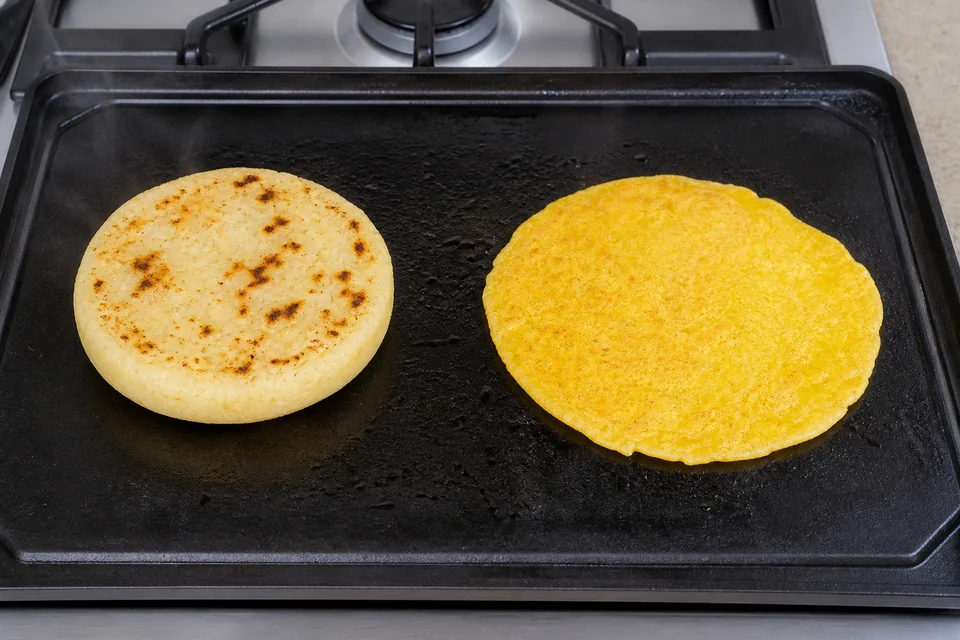
The generated process photograph is a visual comparison. It does not document one traditional cooktop or prove a country-specific recipe.
Which should you make?
Choose arepas when you have correctly labelled precooked arepa flour, want a sturdy corn cake, or plan to fill it after cooking. Choose cachapas when fresh sweet corn is the flavour you want and you are comfortable turning a soft pancake. Arepas are easier to portion uniformly because the dough holds its shape. Cachapas make seasonal corn the central texture.
If you want a neutral base for beans, meats, eggs, avocado, or cheese, an arepa is often the better vehicle. If you want sweet corn and cheese to remain the main event, make cachapas. Neither needs to imitate a wheat breakfast pancake.
Common ingredient mistakes
Using ordinary cornmeal for arepas: It may remain gritty and fail to bind because it was processed differently. Buy flour labelled for arepas or follow a recipe designed for your exact product.
Using masa harina: Mexican nixtamalized masa has its own flavour and handling. It is excellent for its intended foods but is not a drop-in arepa flour replacement.
Using canned creamed corn as the whole cachapa formula: Added starches, sugar, and liquid vary by product. Use a tested recipe written for canned corn if fresh or frozen kernels are unavailable.
Overblending cachapa batter: A perfectly smooth purée loses the kernel texture that distinguishes the pancake. Pulse and inspect rather than running the blender continuously.
Adding very wet fillings before the arepa crust sets: Moisture can weaken the cake. Cook first, rest briefly, then split and fill according to the recipe.
Current-batch diagnostics
| Observation | Arepa response | Cachapa response |
|---|---|---|
| Mixture cracks | Add water sparingly and rest per flour directions | Not applicable; batter should not be moulded |
| Mixture flows | Add correct arepa flour gradually | Normal within limits; chill briefly or add corn if excessively thin |
| Exterior burns first | Lower heat and reduce thickness | Lower heat and make a smaller pancake |
| Sticks during turn | Wait for crust to release; use light fat | Let the wet top set more before turning |
| Centre seems raw | Finish using recipe’s method; do not rely on colour | Reduce size and cook more gently |
| Result is bland | Check salt and serving components next batch | Check corn sweetness, salt, and cheese balance |
Use one correction at a time. The aim is to identify whether hydration, portion size, or heat caused the observable issue.
Fillings and serving without stereotypes
An arepa can carry cheese, beans, shredded meat, chicken, avocado, eggs, vegetables, or combinations. Name a specific filling instead of labelling every stuffed arepa “Venezuelan.” The way the filling is prepared matters as much as the ingredient list: loose watery fillings soften the interior quickly.
Cachapas are often served folded with cheese, sometimes with meat or other accompaniments. A plain cachapa can also be served as the corn component of a meal. Keep additions proportionate so the sweet-corn pancake remains identifiable.
When ordering, ask what flour or corn is used, whether cheese is inside or on top, and whether the item contains meat, dairy, gluten-containing binders, or shared-surface cross-contact. Corn as the primary ingredient does not automatically certify a dish as gluten-free.
Storage and reheating
Both foods are best hot from the griddle. Refrigerate leftovers promptly in covered shallow containers, within the USDA two-hour limit or one hour above 90°F (32°C). Use general refrigerated leftovers within three to four days when held at 40°F (4°C) or below.
Cool arepas without fillings when possible, then refrigerate or freeze with separators. Reheat on a skillet or in an oven to restore the exterior before filling. Store cachapas and cheese separately when practical; reheat the pancake gently, add cheese, and fold. A microwave is quick but can soften crusts and make thick corn cakes heat unevenly.
Cultural limits that improve the article
Do not settle the Colombia–Venezuela question with a winner. Indigenous corn traditions precede modern national borders, while contemporary dishes developed through many regional histories. Sources and cooks may frame identity differently. The responsible approach is to name the preparation, place, and source precisely.
Do not use flags, costume, or rustic styling as authenticity evidence. The project-generated hero image shows plausible finished foods, not a documentary claim about a family, restaurant, or nation. Authenticity is not visible from browning alone.
Frequently asked questions
Are arepas Colombian or Venezuelan?
They are deeply important in both cuisines, with extensive regional variation. A useful guide explains those forms rather than awarding exclusive ownership.
Is a cachapa an arepa?
No. A cachapa uses a wetter fresh-corn batter, while an arepa is shaped from corn dough.
Can I use masa harina for arepas?
Not as a direct substitution. Use precooked flour labelled for arepas or a recipe written for your exact corn product.
Why does my arepa dough crack?
It may need slightly more water or hydration time. Follow the package ratio, then adjust with damp hands rather than pouring in a large amount.
Can I make cachapas with frozen corn?
Yes in recipes designed for it. Thaw and drain if instructed, then assess batter moisture because frozen corn can release liquid.
Are arepas gluten-free?
Corn ingredients may be gluten-free, but binders, fillings, packages, and shared cooking surfaces matter. Verify the complete preparation.
What cheese goes in a cachapa?
A soft white cheese is a common documented pairing. Use the cheese named by your recipe or a clearly labelled local substitute without claiming equivalence.
Why are the numbers 17–18 in the title?
They preserve a historical list address. They are not official ranks for Colombia, Venezuela, arepas, or cachapas.
Related Pancake World pages
Compare these corn-based foods with the wheat-based American pancakes guide while preserving their distinct ingredients, techniques, and cultural contexts.
Sources and editorial references
- Familia Kitchen: How to Make Venezuelan Arepas —
https://familiakitchen.com/how-to-make-arepas/ - Encyclopaedia Britannica: Arepa —
https://www.britannica.com/topic/arepa - USDA Food Safety and Inspection Service: Leftovers and Food Safety —
https://www.fsis.usda.gov/food-safety/safe-food-handling-and-preparation/food-safety-basics/leftovers-and-food-safety
For more practical food and breakfast guides, visit Pancakes World.
For the wider topic, start with World Pancakes.
For a closely related guide, see Blini in Eastern Europe: Styles, Batter Choices, Fillings, and Serving.
A useful next comparison is 21 Savory Pancakes Around the World: A Practical Food-Culture Guide.
You can also continue with Two Korean Jeon Styles: Pajeon and Bindaetteok Explained.
For another practical angle, read Borlengo in Italy: A Thin Emilian Griddle Bread.
