
Quick answer: what is dorayaki?
Dorayaki is a Japanese sweet made by sandwiching a filling—most recognizably sweet red bean paste—between two small, round, browned pancake-like cakes. The two outer rounds are soft rather than crisp, with smooth, evenly colored faces and a joined edge that makes the finished sweet easy to hold. It is a confection and snack, not simply a breakfast stack with syrup.
That concise definition is more dependable than a single invention story. Historical accounts around the name and shape compete, and the available Japanese library reference explicitly presents more than one explanation. This guide therefore describes the food readers can identify today, then treats origin claims as qualified accounts rather than settled fact.
Form, filling, and serving context
The basic visual structure is consistent: two similar round cakes enclose a filling. A classic filling is anko, a sweet paste made from adzuki beans. The paste may look smooth or retain some bean texture, depending on style and producer. The outer cakes are generally evenly browned on their exposed faces and lighter at the inner edge.
Dorayaki is often eaten by hand as a single sweet. Tea is a natural serving companion because it balances the sweetness and makes the snack feel complete without turning it into a plated dessert. Packaging, size, sweetness, and filling amount vary, so a photograph cannot prove that one specimen is the universal standard.
The filling should be visible enough in a cross-section to identify the sandwich construction. An extravagant overfilled edge may be a contemporary presentation, but excess filling is not required for the item to be dorayaki. Likewise, a perfectly smooth surface is common but is not an authenticity certificate.
Dorayaki compared with other pancake-like foods
Calling dorayaki a “Japanese pancake sandwich” helps English-speaking readers picture the form, but the phrase has limits. Dorayaki belongs to Japanese confectionery context, and its sweet bean filling is central to the classic identity. It is not a Western breakfast pancake stack with anko added as a topping.
It is also distinct from Japanese souffle pancakes. Souffle-style pancakes are tall, airy, cooked and served as a plated dish, and particularly sensitive to foam and heat. Dorayaki rounds are thinner and intended to hold a filling. Readers troubleshooting lost height should use the separate guide to Japanese souffle pancake deflation, not transfer that technique to dorayaki.
Taiyaki is another sweet that may contain red bean paste, but it is cooked in a shaped mold and has a different exterior form. Imagawayaki or obanyaki also enclose fillings in cooked batter, yet their shape and cooking equipment differ. Shared filling does not make the sweets interchangeable.
The same care applies across world pancake traditions. A filled masa cake such as a pupusa from El Salvador has a different dough, filling logic, cooking context, and cultural identity. “Filled pancake” is a broad comparison, not a claim that the foods share an origin.
A practical identification table
| Feature | Typical dorayaki cue | What the cue does not prove |
|---|---|---|
| Shape | two small round cakes joined as a sandwich | one mandatory diameter or thickness |
| Surface | smooth, even golden-brown outer faces | quality or authenticity from color alone |
| Filling | sweet red bean paste is the classic reference point | that every dorayaki must use one paste texture |
| Texture | soft cakes that can be bitten with the filling | a universal moisture level or shelf life |
| Service | handheld sweet, often paired with tea | one fixed time of day or occasion |
Use several cues together. A single round pancake with bean paste on top is not the classic sandwich form. A fish-shaped filled cake points toward taiyaki. A tall plated foam pancake points toward souffle style.
The name and competing origin accounts
The Japanese word “dora” can refer to a gong, and the round shape has encouraged explanations linking the sweet’s name to that object. The National Diet Library Collaborative Reference Database records competing accounts rather than one conclusively proven narrative. Some stories connect the name to a gong used in a legend; other explanations focus on the cake’s gong-like shape and later development.
The responsible conclusion is not that history is unknowable, but that the evidence supports uncertainty. A cultural guide can say that multiple accounts circulate and that the gong association is prominent. It should not declare one colorful story the verified moment when all dorayaki was invented.
Nor should a source about dorayaki be stretched into a history of all Japanese pancakes. Different dishes have different lineages, techniques, and naming histories. Evidence has to follow the food it actually discusses.
What not to infer from a historical source
A reference entry can document questions, cited materials, and competing explanations. It does not license images from those materials for reuse. The hero and process images prepared for this page are new project-generated editorial food images, not archival photographs and not evidence of a historical kitchen.
The source also does not establish one mandatory modern recipe, ingredient brand, nutrition profile, or serving size. A date attached to one account may describe a written reference, a named shop, or a form of the sweet rather than the first time any similar cake was made. Those distinctions should remain visible.
Finally, familiar popular-culture associations do not substitute for culinary evidence. A fictional character’s fondness for dorayaki may explain global recognition, but it does not define the food or establish its origin.
How dorayaki is assembled
At a high level, a cook makes pairs of evenly sized round cakes, cools them enough that the filling will hold, places anko in the center of one round, and caps it with the other. The edges are gently brought together so the filling stays centered and the sandwich can be handled.
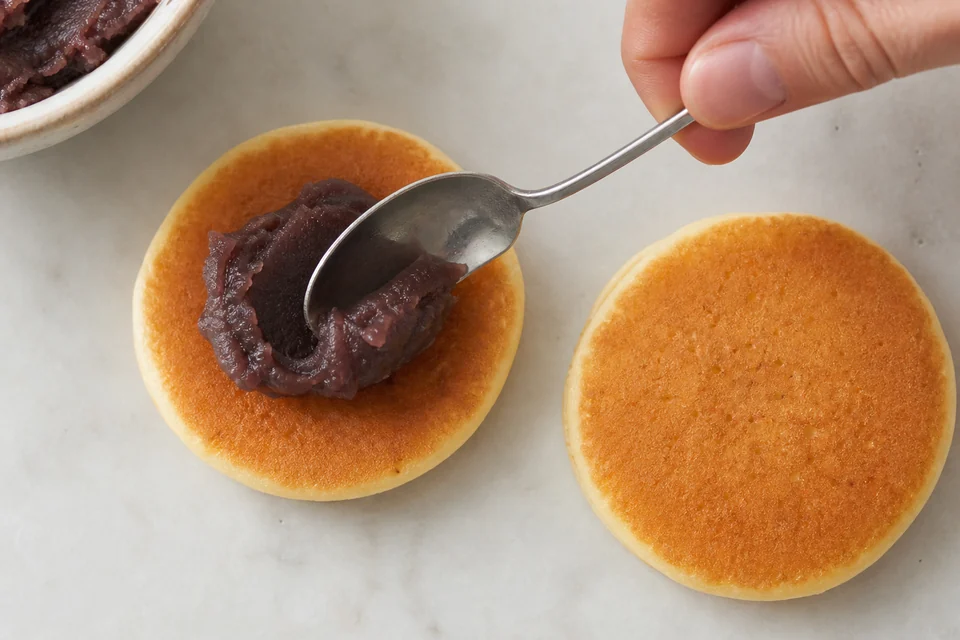
The project image shows that assembly logic; it is not a complete recipe. Precise flour type, egg and sugar ratios, resting time, pan temperature, cake diameter, and filling weight belong to a tested formula. Publishing a cultural overview as though it were a validated recipe would give the reader false precision.
Several observable principles remain useful. Make paired rounds of similar diameter so the edges align. Keep the heat moderate enough to color the surface evenly without leaving the center raw. Cool the rounds before storage so trapped steam does not create uncontrolled condensation. Place filling centrally and add only enough that the sandwich closes without a large spill.
Choosing dorayaki at a shop
Start with the filling label. “Anko” tells you that sweet bean paste is central, but ask whether it is smooth or textured if that matters to you. Contemporary versions may use custard, chestnut, cream, matcha-flavored fillings, chocolate, fruit, or combinations. Those can be accurately called modern varieties without being presented as the historic standard.
Check the package for allergens and storage directions. The cakes commonly involve wheat and egg, and some products may include milk, soy, sesame, or other ingredients. A red bean filling does not make the complete sweet vegan or gluten-free. Cross-contact cannot be judged from a photograph.
Notice freshness through the producer’s own date and storage guidance rather than inventing a universal shelf life. Filled sweets vary in water activity, packaging, preservatives, and filling. Refrigerating every product may not preserve the intended texture, while leaving a perishable cream filling at room temperature can be unsafe. Follow the actual label.
Serving and tasting thoughtfully
Serve dorayaki whole or cut cleanly to show the layers. If several fillings are being compared, cut each into portions and label them outside the food image or in accompanying page text. A plain tea lets the cake and filling remain the focus. A heavily sweet drink can make differences harder to notice.
Taste the outer cake first, then the filling, then the complete bite. Look for balance: the cake should support the filling rather than disappear, and the filling should not make the sandwich impossible to handle. These are tasting observations, not a universal scoring system.
For a dessert plate, fruit or a small spoonful of unsweetened cream can be editorial serving ideas, but they should not be described as traditional without evidence. The simplest culturally cautious presentation is the finished sweet with tea.
Making a home version: boundaries and checkpoints
Choose a tested dorayaki recipe from a reliable Japanese culinary source or a carefully tested publication. Do not begin with a generic American pancake mix and assume the result will match. The target exterior, sweetness, flexibility, and paired form are specific enough to deserve a dedicated formula.
Before cooking the whole batch, make one test round. Check whether it spreads to the intended diameter, colors evenly, releases cleanly, and cooks through without becoming dry. Adjust heat before adjusting ingredients. If one side is patchy, examine pan cleanliness and grease distribution. If edges dry before the center sets, reduce size or heat.
Pair cakes as they cool. Matching by diameter produces a neater sandwich. Keep them covered according to the recipe so they remain flexible, but avoid sealing actively steaming rounds. Fill only after the cakes reach the recipe’s intended stage.
Common mistakes and limits
Treating every round Japanese cake as dorayaki. Shape alone is insufficient; the paired cakes and filling matter.
Using dark color as a doneness test. Sugar and heat can brown a surface before the center is ready. Follow the recipe and assess the cooked interior.
Overfilling for the photograph. A dramatic cross-section can distort the practical eating experience. Use enough filling for a clear layer and stable closure.
Declaring one origin legend as fact. Retain the competing-account wording supported by the library reference.
Copying storage advice across fillings. Bean paste, custard, dairy cream, and packaged commercial products may need different handling. Follow the source recipe or label.
Frequently asked questions
What is inside traditional dorayaki?
Sweet red bean paste is the classic filling. The paste can be smooth or more textured, and modern versions use many other fillings.
Is dorayaki the same as a souffle pancake?
No. Dorayaki uses two thinner round cakes to enclose filling. Souffle pancakes are tall plated pancakes built around foam and are served differently.
Why is it called dorayaki?
The name is often linked to a dora, or gong, but competing historical accounts exist. The gong-like round shape is a common explanation; one exclusive invention story is not proven here.
Is dorayaki always filled with red bean paste?
Red bean paste defines the classic reference point, but contemporary products may use custard, cream, chocolate, chestnut, matcha, fruit, or other fillings.
Is dorayaki gluten-free or vegan?
Do not assume so. The cakes commonly contain wheat and egg, and formulations vary. Read the current ingredient and allergen information.
How should dorayaki be stored?
Follow the producer’s label or the tested recipe. Filling, packaging, and formulation determine storage; there is no safe universal rule for every version.
Related Pancake World pages
For a distinct Japanese technique problem, read why Japanese souffle pancakes deflate. For another filled cake with its own cultural context, see pupusas from El Salvador. Continue exploring international food traditions on Pancakes World.
Sources and editorial references
National Diet Library Collaborative Reference Database — https://crd.ndl.go.jp/reference/entry/index.php?id=1000215401&page=ref_view
For the wider topic, start with Japanese Pancakes.
For a closely related guide, see Different Kinds of Japanese Pancakes: A Practical Guide to Distinct Styles.
A useful next comparison is Monjayaki: The Tokyo Griddle Dish You Need to Try.
You can also continue with How to Enjoy Sweet Japanese Pancakes.
Related reading
- History of Japanese Pancakes: Who Invented the Pancake?
- Martabak and Murtabak: Sweet, Savory, and Regional Forms Explained
Image note: Editorial images were created and refined with AI.