
Quick answer: what is monjayaki?
Monjayaki is a savory Tokyo griddle dish made from a thin, seasoned flour-and-dashi batter with finely chopped cabbage and optional additions. Instead of setting into a firm cake that can be lifted onto a plate, it cooks into a soft, cohesive layer with crisp browned patches around the edge. Diners commonly take small portions directly from the hot griddle with a little metal spatula.
That loose, almost molten texture is intentional. A first-time visitor expecting a neat American pancake or a sliceable okonomiyaki may think the center looks unfinished. The better comparison is a shared griddle dish: vegetables and additions provide texture, the liquid batter binds them, and the hot surface creates the browned underside that makes each small bite satisfying.
Why monjayaki belongs to Tokyo
Official Tokyo tourism material presents monjayaki as one of the city’s local foods and links it particularly with Tsukishima. Tsukishima’s Monja Street is known for specialist restaurants where tables are fitted with hot iron griddles. The number of venues changes, so the enduring point is the concentration of monjayaki restaurants, not a fixed restaurant count.
GO TOKYO also publishes a historical account connecting the dish to an early nineteenth-century children’s snack. In that account, children used small spatulas to trace characters in batter on a griddle, giving rise to the name mojiyaki, or “grilled characters,” which later became monjayaki. Origin stories can simplify a dish’s development, so this is best treated as an attributed Tokyo tourism account rather than an uncontested single moment of invention.
Today’s restaurant versions can include seafood, pork, spicy cod roe, mochi, cheese, corn, or other combinations. Those choices show how adaptable the format is. They do not create one mandatory recipe, and a simple cabbage-rich monja remains a useful way to understand the technique.
Monjayaki versus okonomiyaki
Both dishes can begin with flour-based batter, cabbage, and savory additions, and both are associated with cooking on an iron griddle. The resemblance stops short of interchangeability.
Okonomiyaki batter is usually thick enough to hold its ingredients in a cake-like round. Depending on the regional style, ingredients may be mixed or layered. The cooked result can be turned, sauced, cut, and served in portions.
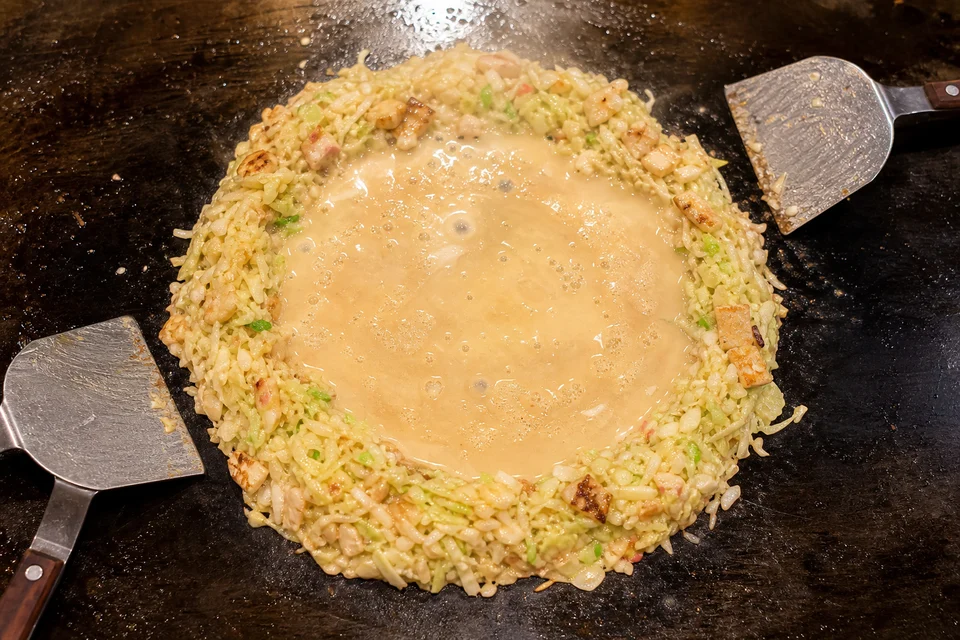
Monjayaki contains substantially more stock relative to flour, according to the Japan National Tourism Organization’s guide. The chopped solid ingredients cook first. They are arranged into a ring, often called a dote, and the liquid batter is poured into the center. As the liquid thickens, it is mixed with the surrounding ingredients and spread across the griddle. The result stays much softer and is eaten in small scraped-up bites.
For a broader comparison that also includes soufflé pancakes, dorayaki, and other unrelated forms, read different kinds of Japanese pancakes. Monjayaki is not simply “failed okonomiyaki,” and it should not be judged by whether it can be flipped as one piece.
| Feature | Monjayaki | Mixed-style okonomiyaki |
|---|---|---|
| Batter | Very loose and stock-forward | Thicker and cake-forming |
| Initial cooking | Solids commonly cook first | Mixed batter may be placed together |
| Shape | Soft layer spread on the griddle | Cohesive round |
| Turning | Not normally flipped as one cake | Commonly flipped |
| Eating | Small bites scraped from the griddle | Cut into portions |
These are practical tendencies, not rules for every restaurant or regional variation.
What the texture should be like
The center should be soft, glossy, and cohesive rather than dry and bready. The underside and edges develop browned, crisp areas where the mixture stays in contact with the griddle. Finely chopped cabbage softens while retaining some texture; tempura crumbs or other additions can bring extra contrast.
“Runny” describes the raw batter but does not mean the finished dish is cold liquid. Heat transforms the flour-thickened stock into a spoonable or scrapeable layer. If you are cooking at a restaurant table, follow the staff’s instructions about heat, sequence, and when to eat. The griddle and spatulas remain hot throughout the meal.
The most enjoyable bites often combine a small crisp patch with some soft center. Press a small spatula against the griddle, drag a bite toward you, and let it cool briefly before eating. Scraping a large serving all at once removes the contrast and makes the dish harder to manage.
A careful home-style monjayaki method
This vegetarian corn-and-cheese version is a technique demonstration, not a claim of one definitive Tokyo formula. It serves two as a shared snack or light meal.
Ingredients
- 300 ml prepared dashi or mild vegetable stock, cooled
- 30 g plain flour
- 1 tablespoon Worcestershire-style sauce or a Japanese-style savory sauce
- 250 g green cabbage, very finely chopped
- 2 spring onions, thinly sliced
- 60 g sweetcorn, drained
- 40 g grated melting cheese, optional
- 2 tablespoons tenkasu, optional
- 1 teaspoon neutral oil
- aonori or finely sliced nori for finishing, optional
Read packaged-sauce and stock labels for allergens and dietary suitability. If you use seafood or meat, cook it according to a reliable ingredient-specific method; this guide does not provide a universal timing for every protein.
Mix the batter
Whisk a small splash of stock into the flour until smooth, then whisk in the remaining stock and sauce. This order limits flour lumps. Put the cabbage, spring onion, corn, and optional tenkasu in a separate bowl. Keep the cheese ready for the later stage.
The batter should look much thinner than pancake batter. Do not add extra flour to make it familiar. A thicker mixture will move the result toward a cake instead of the soft monja texture described here.
Cook the solids and form the ring
Heat a large flat griddle or broad skillet over medium heat and add a thin film of oil. Lift the solid ingredients from their bowl, leaving any collected liquid behind, and place them on the hot surface. Stir and chop them with two spatulas until the cabbage begins to soften and the mixture sizzles evenly.
Gather the solids into a broad ring with a clear well in the center. The wall does not need to be architectural, but it should hold the first pour long enough for the batter to start thickening.
Add the batter and finish
Pour part of the thin batter into the center. Wait until it becomes slightly thicker, then fold some of the ring inward. Add the rest gradually, mixing and spreading as it thickens. Scatter over the cheese if using, and spread everything into a thin layer.
Let the underside make steady contact with the surface. Avoid constant stirring; crisp patches need time against the griddle. When the mixture is cohesive and bubbling gently, finish with aonori and begin taking small bites. If using an ordinary skillet rather than a table griddle, turn off the heat once the dish is ready and protect the table from the hot pan.
Current-batch troubleshooting
The batter escaped through the ring
The chopped mixture may not have formed a complete wall, or too much liquid was poured at once. Push the solids back together, let the escaped batter thicken, and incorporate it. On the next pour, add less and wait longer before mixing.
The result became a firm pancake
Too much flour, too little stock, or prolonged cooking can produce a sliceable cake. Do not try to restore a cooked batch by pouring cold stock over it. Eat the tasty result you have, then record the ratio and make the next batch looser.
Nothing is browning
The surface may be overcrowded or not hot enough. Create a thinner layer and give it uninterrupted contact. If steam dominates but sizzling is weak, raise the heat a small step. Avoid a sudden maximum setting, which can scorch sauce and cheese before the cabbage settles.
The underside tastes burnt
Reduce the heat and scrape away blackened residue before spreading the next portion. Dark, crisp patches are desirable; acrid black patches are not. Sweet sauces and cheese can color quickly, so add them with control.
The cabbage is still harsh and raw
It may have been cut too coarsely or rushed through the first stage. Continue cooking the chopped solids before adding all the batter. For the next batch, cut thin shreds across into short pieces so they soften and mix easily.
For general heat, sticking, and doneness logic, the Pancake Troubleshooting hub offers transferable griddle cues, even though monjayaki has its own intended texture.
Ordering monjayaki for the first time
At a specialist restaurant, ask whether staff cook the dish or diners are expected to cook it themselves. Some venues guide the process; others may prepare it. Watch the first one before attempting a second flavor. Table rules, griddle temperature, and ingredient order can differ.
Choose a combination whose ingredients you already understand. A simple cabbage, corn, or seafood version makes the base texture easier to notice than a heavily loaded order. If you have allergies, ask the restaurant directly about batter, dashi, sauces, toppings, shared spatulas, and the griddle. Visual inspection cannot establish allergen safety.
Do not reach across the hot plate or set phones, napkins, bags, or sleeves near it. Use the small spatula provided, take modest bites, and allow each bite to cool. The communal pace is part of the experience; there is no need to remove the entire dish at once.
Variations without losing the idea
Mentaiko and cheese create a rich, salty version; mochi brings chew; seafood adds sweetness and savoriness; kimchi adds acidity and heat. These are options, not a checklist. Keep the additions finely cut enough to cook and combine with the soft base.
If you prefer a firmer green-onion pancake that can be flipped and portioned, negiyaki is a more relevant next guide. If you want a sweet Japanese pancake sandwich, dorayaki is a completely different dish. The shared English word “pancake” should not erase those distinctions.
Frequently asked questions
Is monjayaki raw in the middle?
Its finished texture is deliberately soft, but the flour-thickened batter is cooked on a hot griddle until cohesive and bubbling. Follow restaurant guidance and do not use appearance alone to make ingredient-specific food-safety judgments.
Is monjayaki the same as okonomiyaki?
No. They share some ingredients and griddle context, but monjayaki uses a looser stock-rich batter, is spread rather than flipped as one cake, and is eaten in small scraped bites.
Does monjayaki always contain seafood?
No. Restaurants offer many combinations. Check the dashi, sauce, additions, and shared cooking surface if seafood avoidance or allergy safety matters.
Why is the ingredient ring necessary?
The ring temporarily contains the thin batter so it can thicken before being mixed with the solids. It is a practical control method, not decoration.
Can I cook monjayaki in a skillet?
Yes, if the skillet is broad enough to cook the solids, hold a ring, and spread a thin layer. The experience differs from a large table griddle, but the same sequence can work.
Where is monjayaki especially associated with?
Official tourism sources associate it with Tokyo and especially Tsukishima, where many specialist restaurants are concentrated.
Related Pancake World guides
- Compare different kinds of Japanese pancakes.
- Learn about the firmer green-onion style negiyaki.
- Explore the unrelated sweet pancake sandwich dorayaki.
- Use the Pancake Troubleshooting hub for general griddle control.
Sources and editorial references
- GO TOKYO, Tokyo Local Food —
https://www.gotokyo.org/en/see-and-do/drinking-and-dining/tokyo-local-food/index.html - Japan National Tourism Organization, Okonomiyaki Guide —
https://www.japan.travel/en/guide/okonomiyaki-guide/
For more practical food and breakfast guides, visit Pancakes World.
For the wider topic, start with Japanese Pancakes.
A useful next comparison is Hiroshimayaki: Hiroshima-Style Okonomiyaki.
You can also continue with Pancakes in Japan: Hotcakes, Soufflé Pancakes, Dorayaki, and Okonomiyaki.
Related reading
- Indian Savory Semolina and Yogurt Pancakes
- Scotch Pancakes: How to Recognize the Small Dropped Style
Image note: Editorial images were created and refined with AI.
