
Quick answer
Hiroshima-style okonomiyaki is a layered savory griddle dish. A thin batter base supports a generous mound of cabbage and other chosen ingredients; noodles and egg are cooked as separate layers and then joined into one finished round. That construction is the practical difference to remember. It is not simply a thick cabbage batter with noodles stirred through it.
The name hiroshimayaki is commonly understood by English-language readers, but “Hiroshima-style okonomiyaki” is the clearer wording for this guide. The Ministry of Agriculture, Forestry and Fisheries of Japan documents the dish as part of Hiroshima’s regional food culture and describes its layered character and postwar development. Individual shops and households still vary in noodle choice, seasoning, added ingredients, and assembly detail, so one home formula should not be presented as the only authentic version.
This page owns the full layered method: how to organize the griddle, soften a tall cabbage mound, move the fragile base, integrate noodles and egg, diagnose a loose stack, and prevent the same problem next time. For a comparison rather than a complete method, use the separate guide to okonomiyaki styles in Japan.
What makes the Hiroshima style distinct
The easiest comparison is construction. Osaka-associated okonomiyaki commonly combines shredded cabbage with batter before cooking. Hiroshima-style preparation keeps recognizable components in layers. A thin crepe-like base is cooked first, cabbage is piled above it, and the stack is turned so the vegetables can soften against the hot surface. Cooked noodles and a thin egg round are added in later stages.
That does not make one style better. It changes the cook’s work. A mixed batter behaves like one cohesive cake; a layered build requires space, two broad spatulas, deliberate transfers, and patience while the cabbage loses volume. Noodles are a structural and textural layer, not a garnish. The egg helps form the final base after the assembled stack is placed on it.
Do not collapse Hiroshima-style okonomiyaki into every food called a Japanese pancake. Hotcakes, dorayaki, soufflé-style pancakes, monjayaki, negiyaki, and regional okonomiyaki are separate foods. The overview of pancakes in Japan explains those boundaries, while the monjayaki guide covers a much looser griddle dish.
A manageable home formula
For two substantial rounds, prepare a thin batter from 90 g all-purpose flour and about 180 ml cool water, whisked until smooth enough to spread. Have roughly 500 g finely shredded cabbage, two cooked portions of yakisoba-style or other suitable wheat noodles, two eggs, neutral cooking oil, sliced scallion, and the sauce and garnish you intend to use. Optional additions must be fully compatible with your dietary needs and cooked safely.
This is a bounded home starting point, not a claim that every Hiroshima cook uses these ratios. Flour absorbs differently, cabbage heads hold different amounts of water, and noodle packages vary. The batter should spread into a thin round without running like water. The cabbage should be cut finely enough to soften and settle rather than forming rigid chunks.
Read all ingredient labels. Prepared sauces and noodles can contain allergens or animal-derived ingredients. If you use meat or seafood, follow the product-specific handling and safe-doneness directions; this article does not treat exterior browning as proof that an added ingredient is safely cooked. Raw flour also requires cooking, so neither the batter nor a visibly pasty base is ready to eat.
Set up the griddle before mixing
A large flat griddle is easiest because the cabbage stack, noodles, egg, and a clear landing area must coexist. Two skillets can work if each has a broad, low-sided cooking surface and you plan the transfers. Use two wide metal or heat-safe spatulas that can support most of the round. A narrow turner encourages bending and spills.
Preheat to a steady medium working temperature rather than chasing one universal burner number. Pan material, element size, and thermostatic cycling differ. Wipe on a thin film of oil. Pools of fat can make the base slide while dry patches encourage sticking. Cook a teaspoon of batter as a surface check: it should set without scorching immediately.
Arrange cabbage, noodles, eggs, sauce, garnish, spatulas, and a clean serving plate within reach. Once the base is covered by cabbage, the method moves through staged transfers; searching for equipment then is how a manageable stack turns into a crowded one.
Layer and cook the okonomiyaki
1. Spread a thin base
Pour half the batter and use the back of a ladle to make a thin round. Keep a small spoonful of batter in reserve. Let the surface lose its raw gloss and the underside gain enough structure to slide a spatula beneath it. The goal is a flexible base, not a crisp cracker.
2. Build the cabbage upward
Pile half the cabbage centrally, leaving a narrow visible rim. Add scallion and any recipe-appropriate thin additions. Drizzle the reserved batter over the mound; it is a light connector, not enough to saturate the vegetables. The pile will look unusually tall. That is expected because cabbage settles substantially as it heats.
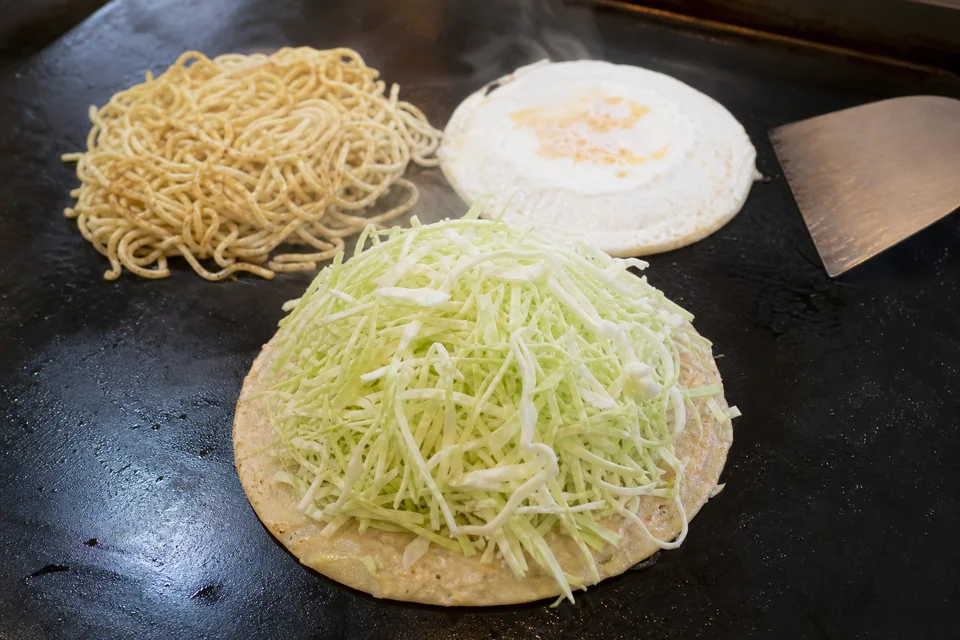
3. Turn with two spatulas
Slide one spatula under each side, bring them close enough to support the center, and turn the entire build in one controlled motion. Stray cabbage is not a reason to panic. Tuck loose pieces under the stack with a spatula rather than pressing the top flat.
Let the cabbage cook against the griddle until it softens, releases steam, and the mound visibly settles. Moderate the heat if the edges darken before the center begins to relax. Pressing hard may make the stack look tidy but drives out moisture unevenly and can tear the thin top layer.
4. Season and shape the noodles
Warm one portion of cooked noodles on the clear side of the griddle. Separate compacted strands, season lightly according to the noodle and sauce products you selected, and shape them into a round no wider than the cabbage stack. Avoid a wet pool of sauce; excess liquid makes the transfer slippery and masks whether the noodles are heated.
Lift the softened cabbage-and-base stack onto the noodle round. Center it before letting go. If noodles escape around one edge, use the spatulas to nudge them underneath rather than repeatedly lifting the whole build.
5. Add the egg layer
Crack an egg onto a lightly oiled clear area and break the yolk with a spatula. Spread it into a thin round approximately the size of the stack. Before it becomes dry, transfer the noodle-and-cabbage build onto the egg. Allow the egg to set through, then support the round with both spatulas and turn it so the original batter base is underneath again.
6. Finish without hiding the structure
Brush or spoon sauce across the hot top in a restrained layer and add the garnishes that fit your version. A neat grid is optional; the useful outcome is a cohesive round with softened cabbage, separate noodles, a cooked egg layer, and no raw batter. Rest it only briefly before cutting so the layers remain hot.
Doneness cues that matter
Color alone is incomplete evidence. Look for several cues together: the cabbage mound has lost height; rigid raw strands have softened; the thin batter base is no longer pasty; noodles are hot and loosened rather than cold in the middle; and the egg is set. A broad spatula should lift the stack without the center flowing apart.
Steam tells you moisture is leaving the vegetables, but it is not a timer. A very dense cabbage pile may need gentler, longer contact than a finely cut one. If an added ingredient has its own safe cooking requirement, verify that requirement independently. Sauce, mayonnaise, and garnish belong only after the structural cooking is complete.
Current-batch problems and fixes
The base tears before the first turn: Stop enlarging the tear. Slide both spatulas under intact areas and make the turn once. Afterward, tuck the torn edge beneath the cabbage. The finished round may be irregular but still usable if all components cook through.
Cabbage spills across the griddle: Keep cooking the central stack and push loose strands back underneath as they soften. Do not add more raw batter over the mess; it will create pasty pockets that are harder to cook safely.
The outside browns while the cabbage stays rigid: Move to a cooler zone or reduce the heat. Give the mound time to steam and settle. A splash of water is not a universal fix because it can loosen the base and change the griddle conditions.
The noodles slide out: Scrape away any pool of sauce, reshape the noodles to the stack’s footprint, and recenter with two spatulas. If the layer remains loose, serve the complete cooked components as an untidy portion rather than repeatedly flipping and tearing them.
The egg sticks: Let it set enough to release and use a thin-edged spatula. Pulling a wet egg layer prematurely can leave part of it on the griddle. Confirm that the egg is fully cooked before serving.
The stack will not hold together: Check whether the cabbage has softened and the components share the same diameter. Keep the round supported from both sides. For a fully cooked but broken result, plate it as a deconstructed portion; cosmetic rescue should not mean compressing it into a dense puck.
For broader heat, sticking, and center problems, continue at the Pancake Troubleshooting hub.
Prevent the next batch from falling apart
Cut the cabbage more consistently, weigh or portion it before heating the griddle, and cook only one round at a time until the sequence feels natural. Set out two matching spatulas and reserve a landing area for every transfer. Shape the noodle and egg rounds to the same diameter as the cabbage build.
Record observations rather than just “good” or “bad”: whether the first base released, how quickly the cabbage settled, when browning began, whether the noodle layer was dry enough to grip, and which transfer caused movement. Change one variable next time. If the cabbage remained rigid, adjust cut size or heat exposure; if the base tore, focus on set and support; if noodles slipped, reduce surface liquid. Changing all three makes the lesson impossible to identify.
Serving, leftovers, and limits
Serve the okonomiyaki hot, cutting through the layers with a sharp knife or griddle spatula. Let diners add extra sauce at the table instead of soaking the base. A simple crunchy salad or lightly seasoned vegetables make a useful contrast without turning the plate into another construction project.
Cool leftovers promptly and refrigerate them in a shallow covered container under the food-safety guidance appropriate to the ingredients used. Reheat until the center is properly hot. Expect the cabbage and noodles to soften; reheating restores warmth, not the exact fresh-griddle texture. Discard food left outside safe time and temperature controls rather than relying on smell.
This guide is a practical home interpretation. It does not reproduce a named shop, claim a single definitive Hiroshima formula, or turn regional history into a marketing story. For a broader comparison of Japanese griddle foods, see different kinds of Japanese pancakes.
FAQ
Is hiroshimayaki the same as Hiroshima-style okonomiyaki?
The terms are often used for the same regional style in English-language food writing. “Hiroshima-style okonomiyaki” is clearer here because it names both the place and the wider dish family without suggesting that every local version is identical.
What is the main difference from Osaka-style okonomiyaki?
Hiroshima-style construction keeps the thin base, cabbage, noodles, and egg as staged layers. Osaka-associated home methods more often mix cabbage into batter before cooking. The comparison guide to okonomiyaki in Japan explains variations without turning either description into a universal rule.
Do Hiroshima-style okonomiyaki always contain noodles?
Noodles are a familiar and defining feature of the contemporary style described by the cited regional sources, but noodle type and other details vary. Follow the complete formula you choose and do not assume one restaurant’s assembly represents every version.
Can I make it in a skillet?
Yes, if the skillet provides enough flat space and you use a second pan or a clear work area for noodles and egg. Low sides and two broad spatulas make transfers easier. Reduce the portion before overcrowding the cookware.
Why is my cabbage still crunchy?
The shreds may be too coarse, the mound may be very dense, or the surface may be browning faster than the center softens. Moderate the heat, let the mound settle, and cut the next batch more evenly rather than crushing the current one.
Related Pancake World guides
Compare regional constructions in okonomiyaki in Japan, then place the dish within the wider guide to pancakes in Japan. The different kinds of Japanese pancakes page separates sweet and savory traditions, while monjayaki owns its distinct loose-griddle method.
Sources and editorial references
- Ministry of Agriculture, Forestry and Fisheries Japan: Hiroshima Okonomiyaki —
https://www.maff.go.jp/e/policies/market/k_ryouri/search_menu/2805/index.html - Japan National Tourism Organization: Okonomiyaki Guide —
https://www.japan.travel/en/guide/okonomiyaki-guide/ - U.S. Food and Drug Administration: Handling Flour Safely —
https://www.fda.gov/consumers/consumer-updates/handling-flour-safely-what-you-need-know - USDA Food Safety and Inspection Service: Leftovers and Food Safety —
https://www.fsis.usda.gov/food-safety/safe-food-handling-and-preparation/food-safety-basics/leftovers-and-food-safety
For more practical food and breakfast guides, visit Pancakes World.
For the wider topic, start with Japanese Pancakes.
For a closely related guide, see Easy Okonomiyaki: Japanese Savory Pancakes at Home.
A useful next comparison is Discover the Flavors of Okonomiyaki.
