
Quick answer
Roti canai is a Malaysian layered flatbread associated especially with Mamak food culture and commonly eaten hot from the griddle with dhal or curry. Tourism Malaysia describes a crisp, flaky exterior and a soft, chewy interior. The country’s Department of National Heritage lists roti canai among intangible heritage foods, while its research on Malaysian food heritage emphasizes local adaptation rather than a frozen copy of an Indian predecessor.
Four useful tasting directions are plain roti canai with dhal or curry, egg-filled roti telur, sweet banana roti, and crisp conical roti tissue. They show how one stretched-dough family can move from everyday savory breakfast to filled meal or sweet snack. They are not the only four forms in Malaysia and should not be promoted as a definitive national ranking.
What makes roti canai distinct
Roti canai is made from dough, not a pourable pancake batter. The cook rests the dough, stretches it into a very thin sheet, folds or coils it to build layers, and cooks it on a hot flat surface with fat. The finished bread may be clapped or compressed to separate layers before service, depending on the style and cook.
That sequence distinguishes it from roti jala, which Tourism Malaysia describes as a lacy net made by drizzling batter, and from murtabak, which encloses a substantial seasoned filling. It also differs from a wheat crêpe: a crêpe spreads liquid batter directly across the pan, while roti canai develops structure through dough handling and lamination.
Do not use “pancake,” “flatbread,” “paratha,” and “roti” as exact synonyms. English category labels can orient a traveler, but the local dish name, setting, dough, technique, and service matter.
Four Malaysian tasting directions
1. Plain roti canai with dhal or curry
Plain roti canai gives the clearest view of the bread itself. Look for browned patches, crisp thin layers, a tender chewy center, and enough separation that a torn piece can pick up sauce. Tourism Malaysia identifies dhal and curry as common accompaniments.
Taste one piece without sauce first. Then dip lightly into dhal, followed by the curry served by the kitchen. This order shows how the bread changes with moisture and spice. A sauce should complement the roti; soaking the entire plate immediately makes it harder to judge the layers.
“Curry” is not one standardized bowl. Fish, chicken, meat, vegetable, and lentil preparations differ, as do spice, heat, thickness, and allergens. Ask what is served rather than assuming the color supplies the ingredient list.
2. Roti telur
Roti telur places egg within the folded dough and cooks the filling as part of the bread. The result is more substantial and less purely layered than a plain roti. Onion or other additions may appear by establishment, so order by the named menu item and ask what is included.
The filling must cook through the establishment’s method. At home, use a dedicated roti telur recipe rather than cracking an arbitrary amount of egg into a thin sheet. Too much filling makes sealing and turning difficult; too little heat can leave the center unset while the outside darkens.
Eat a corner first to assess the layered edge, then a center bite containing egg. Dhal or curry can still be served, but begin with a small dip so the filling remains distinct.
3. Roti pisang
Banana roti represents a sweet filled direction documented in Malaysia’s heritage literature. Thin banana pieces are enclosed within the dough and cooked as the roti browns. Condensed milk, sugar, chocolate, or other finishes may be offered, but the exact presentation varies.
Ripe banana contributes sweetness and moisture. A heavy pour of condensed milk can dominate both fruit and dough, so taste first. This is a sweet roti canai variation, not evidence that every roti canai is dessert.
At home, keep banana pieces thin and the filling modest so the packet can close and turn. Follow a tested recipe for the filling and heat. Raw dough and an undercooked center should not be served simply because the banana is soft.
4. Roti tissue
Tourism Malaysia describes roti tissue as a Mamak variation that is lighter, thinner, and crispier, commonly finished with condensed milk or sugar and sometimes presented as a tall cone. Its visual height comes from shaping the thin crisp bread after cooking, not from a thick fluffy crumb.
Break a piece from the edge and listen for crispness. Add sweet topping sparingly so the thin structure does not soften at once. Roti tissue is fragile and best shared promptly.
Do not call a tall cone a larger plain roti canai. The stretching, thinness, cooking, sweetness, and service goal are different even though the dish belongs to the roti canai family.
A bounded home method
Use a Malaysian roti canai recipe with measured ingredients and an explicit rest, stretch, fold, and griddle sequence. A general workflow looks like this:
- Mix wheat flour, water, salt, and the recipe’s specified fat or other ingredients until no dry flour remains.
- Knead to the recipe’s smooth, elastic endpoint.
- Divide into equal balls, coat as directed, cover, and rest for the full specified period.
- On a suitable surface, press and stretch one ball into a very thin sheet without tearing large holes.
- Apply the recipe’s fat, fold or coil to create layers, and rest again if directed.
- Flatten the folded portion to the intended diameter without destroying every layer.
- Cook on the specified griddle or pan, turning until both sides and the interior reach the recipe’s endpoint.
- Clap or compress only if the chosen method directs it, then serve immediately.
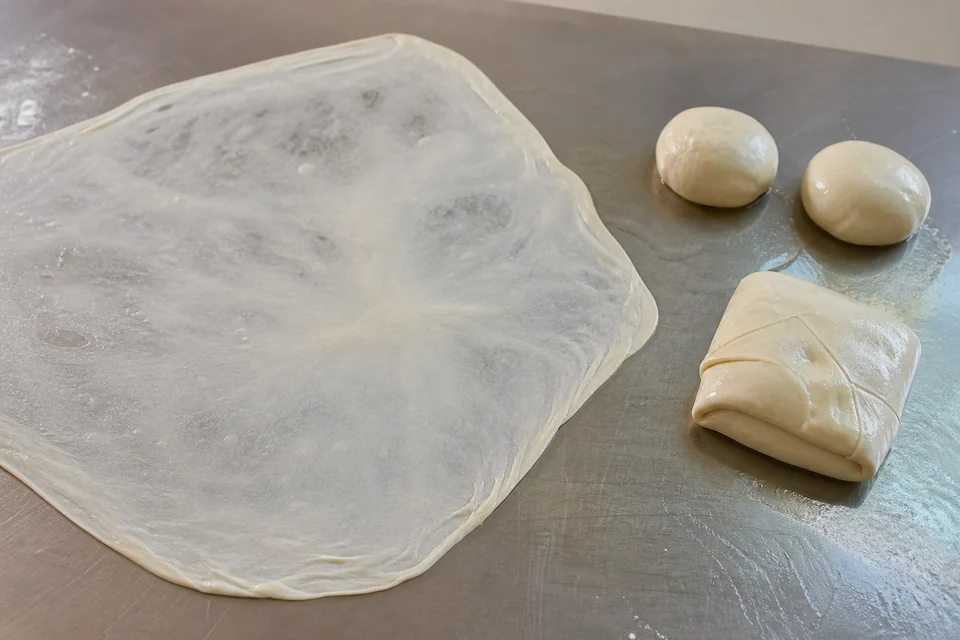
This is a process map, not a universal formula. Flour strength, hydration, fat, rest, room conditions, stretching technique, portion size, griddle, and cook all affect the result. Do not invent ingredient amounts from a photograph.
Why the rests matter in practice
Freshly mixed dough can resist stretching and spring back. A recipe’s rest gives the dough time within that formula’s process before it is thinned. Skipping or shortening it can make the cook use excessive force, causing thick areas and tears.
Rest does not fix every dough problem, and this page does not claim one universal duration. Follow the chosen formula. Keep portions covered as directed so the surface does not dry into a skin. If one ball stretches well and another does not, compare weight, coating, covered storage, and rest rather than adding random water during shaping.
Stretch without turning it into a stunt
Professional roti makers can create dramatic airborne motions, but a home cook does not need to copy a performance. Press outward, lift and stretch sections carefully, or use a recipe’s safe countertop method. The goal is an evenly thin sheet with manageable edges, not maximum width at any cost.
Work on a stable surface with clear space. Keep hot pans and loose utensils away from the stretching area. If the sheet tears, fold the small tear inside and continue; if it repeatedly shreds, stop and review dough development and rest for the next portion.
Cook and serve the current batch
Place the shaped roti on the prepared surface without bunching the layers. Follow the recipe’s heat and fat instructions. Turn when the first side has enough structure; moving constantly can prevent even contact. If dark spots appear before the center is ready, use the recipe’s lower-heat response rather than serving the interior raw.
Serve plain roti immediately with dhal or curry in separate bowls. Keep roti telur intact long enough for the filling to finish. Serve banana roti and tissue-style roti soon after cooking because steam and sweet sauces soften crisp layers.
If a finished roti is chewy but cooked, tear it into pieces and enjoy it with sauce rather than trying to fry it indefinitely. If it is visibly raw inside, return to the recipe’s safe cooking process; exterior color alone does not settle doneness.
Ordering at a Mamak restaurant
Begin with plain roti canai to understand the establishment’s base. Add one filled or sweet variation after that. Ask which dhal or curry is included and whether additional sauces cost extra. If you need dietary information, ask about wheat, egg, dairy or ghee, meat, fish, lentils, soy, nuts, and shared griddle or utensil contact.
Mamak refers to a Malaysian Indian-Muslim food and social context; it is not merely a marketing word for any curry restaurant. Tourism and heritage sources describe roti canai within Malaysia’s shared breakfast culture and multi-ethnic food landscape. Approach the meal as a living local practice, not a checklist of exotic flavors.
Common mistakes
Calling roti canai a pourable pancake: It is stretched and layered dough.
Claiming one untouched origin: Malaysian heritage research emphasizes adaptation and local identity. Use careful historical language.
Treating four variations as exhaustive: Menus include many fillings, shapes, and local names.
Skipping rest and forcing the dough: Follow the complete recipe’s rest and handling system.
Overfilling: Egg, banana, onion, cheese, or other additions change sealing and cooking.
Flooding crisp roti with sauce before tasting: Dip one piece first and preserve part of the texture.
Ignoring raw flour: The U.S. FDA notes that flour is a raw food. Do not taste raw dough, and cook the selected recipe fully.
Improve the next batch
Record flour brand, dough weight, rest conditions, stretchability, fold, griddle setting, and finished texture. On the next attempt, change only one factor. If layers merge, review stretching and folding. If the dough springs back, review recipe development and rest. If the outside darkens early, review portion thickness and heat.
Do not use more fat, more water, a longer rest, and a hotter griddle all at once. A controlled comparison produces useful learning even when the first roti is not restaurant-thin.
Limitations
This guide does not certify one vendor, recipe, or presentation as the national standard. Malaysia’s roti canai culture includes regional, community, restaurant, and household variation. “Authentic” should describe evidenced context and method, not a visual score awarded from afar.
The four directions preserve the legacy page’s numbered promise while remaining transparent: plain, egg, banana, and tissue-style roti are a tasting framework, not the only legitimate forms.
FAQ
Is roti canai a pancake or flatbread?
It is best described as a layered griddled flatbread made from stretched dough. “Pancake” may appear in broad international categories, but it should not imply pourable batter.
What is roti canai served with?
Tourism Malaysia commonly describes dhal or curry. Exact sauces vary, so ask which lentil, fish, chicken, meat, or vegetable preparation is included.
What is the difference between roti canai and roti tissue?
Plain roti canai aims for flaky crisp layers with a soft chewy interior. Roti tissue is stretched and cooked thinner and crispier, often finished sweet and shaped dramatically.
Is roti telur the same as murtabak?
No. Roti telur is an egg-filled roti variation, while murtabak is a distinct substantial filled bread commonly involving seasoned meat, egg, and onion. Menu practices vary, so use the stated name.
Can I make roti canai without throwing the dough?
Yes. Use a home recipe that teaches safe countertop stretching. The essential goal is a thin even sheet that can be layered, not an airborne performance.
Related Pancake World guides
Compare other layered and filled traditions through blini, martabak, and serabi. Explore the wider international collection from Pancakes World, and use the Pancake Troubleshooting hub for general heat and center symptoms.
Sources and editorial references
- Tourism Malaysia: Malaysian Food Top Picks —
https://www.malaysia.travel/explore/malaysian-food-52-top-picks-you-shouldn-t-miss - Tourism Malaysia: Malaysian Breakfast —
https://www.malaysia.travel/explore/20-awesome-and-true-malaysian-breakfast - Department of National Heritage Malaysia: Intangible Heritage Objects —
https://www.heritage.gov.my/en/kraf.html?catid=17&id=202%3Aobjek-warisan-tidak-ketara&view=article - Department of National Heritage Malaysia: Preservation of Traditional Malay Food Heritage —
https://www.heritage.gov.my/ms/koleksi-penerbitan.html?download=8%3Abab-dalam-buku-siri-1-pelestarian-warisan-makanan-tradisional-melayu - U.S. Food and Drug Administration: Handling Flour Safely —
https://www.fda.gov/consumers/consumer-updates/handling-flour-safely-what-you-need-know
For the wider topic, start with World Pancakes.
For a closely related guide, see Peking Duck Pancakes: Wrappers and Assembly.
A useful next comparison is Huevos Rancheros-Inspired Breakfast Bake.
You can also continue with Duck with Mole Sauce and Peking-Style Pancakes.
For another practical angle, read Recipe Comments and Reader Feedback at Pancakes World.
