
Quick answer: martabak does not describe one universal pancake
Martabak, murtabak, mutabbaq, and mataba are related names used for different folded, stuffed, or griddle-cooked foods across parts of Southeast Asia, South Asia, and the Arabian Peninsula. Two forms create the most confusion. Savory murtabak is generally a thin dough or wrapper folded around a seasoned egg-and-meat or other filling and fried on a griddle. Indonesian martabak manis is a thick, sweet, porous pancake filled after cooking with combinations such as peanuts, chocolate sprinkles, cheese, sugar, butter, or condensed milk.
Those two foods are not sweet and savory versions of one identical batter. Their structures, cooking actions, and serving roles differ. Thailand, Indonesia, Singapore, and India also do not share one standardized recipe. The number ten comes from an older collection and does not by itself define the food.
A fast comparison
| Form | Base | Filling or finish | Final shape | Common context |
|---|---|---|---|---|
| Indonesian martabak manis | Thick aerated batter | Sweet fillings added to the cooked pancake | Folded thick round cut into pieces | Sweet snack or shared treat |
| Indonesian martabak telur | Thin stretched dough | Egg with seasoned meat, scallion, or other savory ingredients | Crisp fried parcel cut into squares | Savory street food or meal |
| Singapore-style murtabak | Thin dough | Often egg and seasoned meat, with variations | Large filled parcel, griddled and portioned | Restaurant or hawker meal |
| Thai mataba / roti mataba | Thin roti-like dough | Savory filling, often egg and seasoned meat; local variations | Folded parcel, pan-fried | Snack or meal with condiments |
| South Asian related forms | Layered or thin dough depending on place | Meat, egg, onion, spices, or local fillings | Folded and griddled | Regional snack or meal |
This table is a navigation aid. A vendor’s name, filling, dough, and technique should define the item in front of you.
Indonesian martabak manis
Martabak manis is a thick sweet pancake with a spongy, honeycombed interior. The cook pours batter into a deep round pan, lets bubbles form, may sprinkle sugar as the surface sets, and cooks the pancake without flipping it like a breakfast stack. Once done, the cake is removed, spread or scattered with fillings, folded, and cut into wedges or smaller pieces.
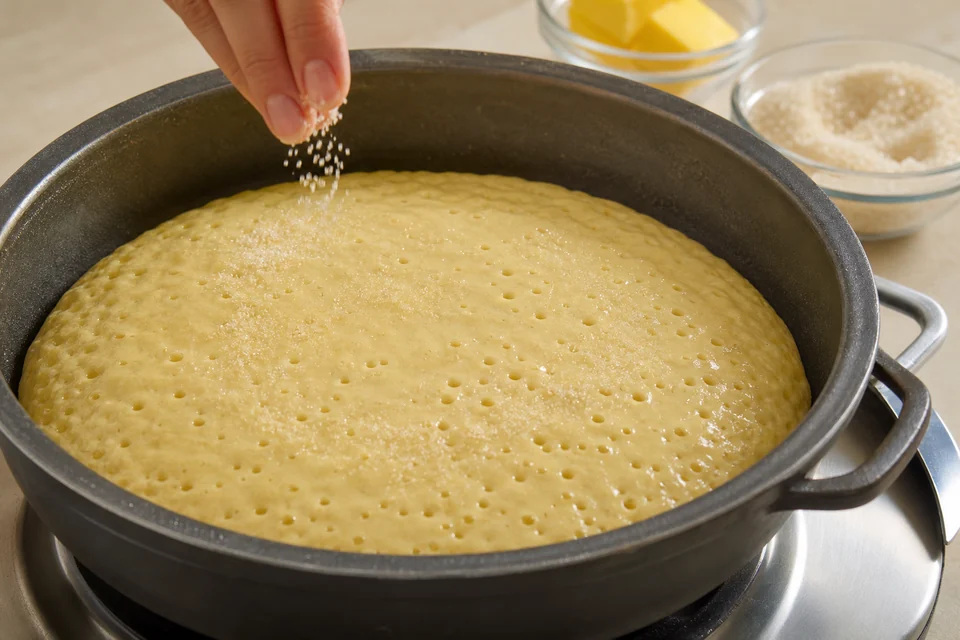
Commonly encountered fillings include chocolate sprinkles, crushed peanuts, cheese, sugar, butter or margarine, and condensed milk. Contemporary shops may add cookies, chocolate spreads, matcha, fruit, or colorful batters. Those are current variations, not evidence that every filling belongs to one historical canon.
The porous crumb matters because it receives melted fat and filling. However, more filling is not automatically better. A heavily loaded wedge can become greasy, overwhelmingly sweet, or difficult to hold. Choose by flavor and portion rather than treating an overflowing cross-section as proof of quality.
How sweet martabak cooks
The batter must balance flow, leavening, and the pan’s concentrated heat. A deep, heavy pan supports a thick round, while an ordinary shallow skillet may not reproduce the same edge and crumb. A tested recipe may use yeast, baking soda, baking powder, eggs, or a combination, with a defined rest.
Surface bubbles need time to rise and set. If heat is too high, the base burns while the upper batter stays wet. If it is too low for too long, the cake may dry before structure develops. A lid may help finish the top, but follow the recipe because trapped steam and leavener behavior vary.
Do not copy a topping video as a batter formula. Use measured ingredients and a method that explains pan size, batter depth, heat, bubble cues, and doneness. The process image is project-generated illustration, not documentary proof of a named Indonesian vendor.
Indonesian martabak telur
Martabak telur is savory and structurally closer to a stuffed fried flatbread. A very thin, extensible dough surrounds a filling based on egg and often seasoned meat, scallions, onions, or spices. The parcel cooks on a generously oiled griddle until the wrapper is crisp and the filling is set, then it is cut for serving.
The dough may be stretched dramatically, but a home recipe should explain resting and handling rather than encouraging a beginner to imitate speed. Holes can allow liquid egg to escape. A filling that is too wet or overpacked also makes sealing and turning difficult.
Food safety matters because browning wrapper does not prove that meat and egg in the center are cooked. Use a tested filling method, keep raw ingredients separate from ready-to-eat condiments, and confirm the center is fully set.
Singapore murtabak
In Singapore, murtabak is commonly encountered as a large savory filled parcel in Indian Muslim food contexts. Egg, onion, and seasoned meat may be enclosed in stretched dough, griddled, cut, and served with curry or another accompaniment. Mutton, chicken, beef, sardine, and contemporary variations may appear depending on the stall.
That menu range should not be turned into a single official formula. Ask what a named version contains, especially when meat, fish, dairy, gluten, or egg matters. A large murtabak is often suitable for sharing; portion size and accompanying curry can make the meal more substantial than the word “pancake” suggests.
The Indian Muslim context in Singapore reflects movement and exchange, but this article does not reduce that history to one inventor or direct one-way guide. Culinary names travel and adapt. Evidence for a precise chronology requires dedicated historical sources beyond a menu comparison.
Thai mataba or roti mataba
Thai spellings may include mataba or martabak, often in relation to a roti-like parcel filled with egg, onion, seasoned meat, or another savory mixture. Condiments can bring sweet, tangy, or spicy contrast. Recipes and restaurant labels differ by community and region.
The practical identification is familiar: thin dough, enclosed savory filling, folded form, and griddle frying. It should not be confused with a thick Indonesian sweet martabak merely because English spellings resemble one another.
For ordering, ask about meat, egg, onion, curry seasoning, sauce, and shared cooking surfaces. For home cooking, choose a recipe grounded in the local form you intend rather than combining a Thai name with an Indonesian sweet batter.
India and the wider family of stuffed breads
The word mutabbaq has an Arabic root associated with folding, and related filled, folded breads appear across a broad geography. In parts of South Asia, murtabak or mutabbaq may be known through regional, coastal, or community food traditions. India also has many unrelated stuffed flatbreads, so visual similarity does not make every paratha or egg-filled bread a martabak.
This is an important editorial limit. A credible guide can acknowledge connections and migration without claiming that one current country invented every form. It should also resist a legacy title that lists countries as if they share equal ownership of the same dish.
If you encounter the name in India, use the local menu, language, and cook’s description. Identify dough, filling, and method. That preserves specificity better than forcing the item into a pan-Asian list.
Choosing sweet or savory martabak
Choose martabak manis when you want a rich shared sweet. Decide on one main filling direction—peanut and chocolate, cheese, or another clearly named combination—rather than assuming the longest topping list is best. Ask about nuts, dairy, gluten, egg, and packaged spread ingredients.
Choose savory martabak or murtabak when you want a crisp parcel and meal-like filling. Pick the protein or vegetable version, ask which curry or condiment accompanies it, and consider sharing a large portion. If you avoid a particular meat for allergy, religious, or personal reasons, ask about cooking surfaces and utensils as well as the filling itself.
| You prefer… | Better starting form | Key question |
|---|---|---|
| Thick, soft, and sweet | Martabak manis | Which fillings and nuts are included? |
| Crisp wrapper and savory egg filling | Martabak telur or murtabak | Is the center fully cooked and what meat is used? |
| A large shared meal | Singapore-style murtabak | What size and curry come with it? |
| Roti-like folded snack | Thai mataba | What filling and condiments define this version? |
Home preparation boundaries
Sweet and savory forms need separate recipes. For martabak manis, the core challenges are batter activity, pan shape, controlled heat, bubble formation, and a set center. For savory murtabak, they are elastic dough, filling moisture, sealing, turning, and cooking the egg and meat safely.
Do not use an ordinary sweet pancake mix for a stuffed savory parcel. Do not pour murtabak egg filling into a thick sweet martabak pan. Similar names do not make the methods interchangeable.
Prepare fillings before the final cooking stage. Keep nuts and other allergens clearly separated. For savory versions, cool pre-cooked meat as directed before mixing, and do not reuse raw-meat utensils on the finished parcel.
Serving and portioning
Martabak manis is rich, so cut clean small pieces and serve while the crumb is warm and the filling soft. A serrated or sharp knife can reduce compression. If the filling contains melted chocolate or condensed milk, protect clothing and surfaces; the folded interior can flow when hot.
Savory martabak is usually cut into squares or wedges and served with a sauce, curry, pickles, or another local accompaniment. Let it rest just enough to handle, not so long that trapped steam softens the entire wrapper. Warn diners that the center can remain hotter than the crust.
Avoid plating all forms with the same garnish for a generic “Asian pancake” look. Service should follow the actual recipe and context.
Storage and reheating
Sweet martabak is best fresh. Its porous crumb absorbs fat and condensed toppings, so refrigeration can firm the filling and make the cake dense. If storing, cool promptly, pack covered, refrigerate according to the recipe, and reheat gently. Fresh fruit or cream-based fillings may shorten storage and change texture.
Savory parcels contain egg and often meat, so prompt cooling and refrigeration matter. Reheat until the filling is hot, using a method that also restores some exterior crispness. An oven or dry skillet may help after safe heating, but the exact method depends on thickness. Do not rely on a crisp wrapper to prove the center is hot.
Freeze only when the tested recipe supports it. Wet sauces and fresh garnishes are usually better stored separately.
Common mistakes and cultural limits
The largest mistake is showing martabak manis while describing savory murtabak, or the reverse. Another is presenting Indonesia, Thailand, Singapore, and India as four stops on one simple invention timeline. A third is claiming an exhaustive number of varieties when names and fillings overlap.
Cooking errors include using excessive heat for a thick sweet batter, filling savory dough until it cannot close, and serving browned parcels with raw egg or meat inside. Label allergens plainly. Chocolate sprinkles may contain dairy or soy; cheese and condensed milk are dairy; peanuts and tree nuts need specific disclosure.
Frequently asked questions
Is martabak sweet or savory?
It can refer to both, especially in Indonesia. Martabak manis is a thick sweet pancake; martabak telur is a savory egg-filled parcel.
Is murtabak the same as martabak?
The names are related and spellings vary, but a menu’s local usage matters. Do not assume the same batter or filling from spelling alone.
Is martabak manis the same as apam balik?
They are related thick filled pancake forms in the region, but names, batter, pan, thickness, fillings, and local identity differ. Treat them as connected, not identical.
Does savory murtabak always contain meat?
No. Meat-and-egg versions are common, but fillings vary and vegetable or other versions exist. Ask the seller.
Why does martabak manis have holes?
Leavening, batter rest, and pan heat create gas bubbles and a porous crumb. A tested recipe coordinates these variables.
Can I make sweet martabak in a regular skillet?
Some home recipes adapt to a heavy skillet, but a shallow pan may produce a different edge and thickness. Use a recipe designed for your pan size.
How do I know savory martabak is cooked?
The wrapper should be crisp and the central egg-and-meat filling fully cooked. Use a tested method and inspect the thickest section rather than relying on exterior color.
Which country’s version should I try first?
Choose the form first: Indonesian martabak manis for sweet, Indonesian or Singapore murtabak for a substantial savory parcel, or Thai mataba for a local roti-like interpretation where available.
Related Pancake World pages
Compare Indonesian serabi styles and more world pancake traditions.
Sources and editorial references
- Academy of Nutrition and Dietetics, Asian-Style Beef Burritos Recipe / murtabak note —
https://www.eatright.org/recipes/entrees/asian-style-beef-burritos-recipe - Serious Eats, Sweet or Savory, Martabak Is the King of Indonesian Street Food —
https://www.seriouseats.com/sweet-or-savory-martabak-is-the-king-of-indonesian-street-food
For more practical food and breakfast guides, visit Pancakes World.
For the wider topic, start with World Pancakes.
A useful next comparison is German Eierkuchen: Thin, Flexible Pancakes for Sweet or Savory Fillings.
You can also continue with Dosa, Uttapam, and Thalipeeth: Three Indian Batter Traditions.
For another practical angle, read Arepas and Cachapas: Colombia and Venezuela Compared.
